info@biomedres.us
+1 (502) 904-2126
One Westbrook Corporate Center, Suite 300, Westchester, IL 60154, USA
Site Map
 ISSN: 2574 -1241
ISSN: 2574 -1241
ISSN: 2574 -1241
Received: June 12, 2025; Published: June 19, 2025
*Corresponding author: Ligia María Rosado Alcocer, Professor, Autonomous University of Yucatán, Mexico
DOI: 10.26717/BJSTR.2025.62.009735
Aim: To determine the optimal timing for adding vasopressin as a secondary vasopressor in adult patients with
refractory septic shock treated with norepinephrine.
Methods: A systematic review with a quantitative approach using the “evidence-based nursing” methodology,
with a PIO-structured question, Boolean operators “AND” and “OR” were used, and words in documentary language
in DeCS and MeSH. The search included the following databases: PubMed, SciELO, and EBSCO. Inclusion
criteria: Articles from systematic reviews with meta-analyses and systematic reviews, no more than 10 years old,
open-access research, excluding duplicates and those that present a risk of bias.
Results: 35 articles were recovered, of which the following were eliminated: 5.71% (2) due to duplication,
11.47% (4) due to the period of time outside the established one, 5.71% (2) for not having access to the primary
document, 100% (9) for not being related to the subject of study, the Scottish Intercollegiate Guidelines Network
scale was used to evaluate the quality of the evidence in this study, subsequently 25.71% (9) were excluded for
not complying with the quality assessment or presenting biases, in the end 25.71% (9) articles were obtained
included in the systematic review after applying all the criteria.
Conclusion: The combination of vasopressors improves hemodynamic stability and reduces adverse effects,
particularly when norepinephrine doses reach 0.25 and 0.5 mcg/kg/min. In these cases, vasopressin reduces
the dose of catecholamines needed to achieve adequate mean arterial pressure and improve organ perfusion.
Keywords: Vasopressor Therapy; Vasopressin; Septic Shock; Refractory Septic Shock; Intensive Care Unit; Recommended Dose; Norepinephrine; Mean Arterial Pressure
Abbreviations: SIRS: Systemic Inflammatory Response Syndrome; ICU: Intensive Care Unit; MAP: Mean Arterial Pressure; DeCS: Health Sciences Descriptors; MeSH: Medical Subject Headings; PRISMA: Preferred Reporting Items for Systematic Reviews and Meta-Analyses; SIGN: Scottish Intercollegiate Guidelines Network; FLC: Critical Reading Sheets
Sepsis is a complex clinical condition caused by a systemic inflammatory response to infection, leading to tissue damage and organ dysfunction, with a high risk of mortality. The diagnosis of sepsis requires the presence of SIRS (Systemic Inflammatory Response Syndrome) along with evidence or suspicion of infection. Clinically, sepsis is identified when the patient presents signs such as fever (>38.3°C or <36°C), tachycardia (>90 bpm), increased respiratory rate (>20 rpm or pCO2 <32 mmHg), and abnormalities in the white blood cell count (leukocytosis >12,000 or leukopenia <4,000 cells/μL, or >10% of immature forms) [1]. In this context, nurses must be able to quickly identify the signs and symptoms of sepsis, such as fever, tachycardia, hypotension, tachypnea, and altered mental status. These early signs allow for timely treatment to be started, avoiding complications that can put the patient’s life at risk [2], nurses have the responsibility to follow strict treatment protocols based on guidelines such as the Surviving Sepsis Campaign and the Clinical Practice Guideline for Septic Shock in Adults. These guidelines indicate that, after the administration of fluids and vasopressors, if blood pressure does not stabilize and signs of hypoperfusion persist, the addition of vasopressin should be considered [3], A decrease in lactate levels and an improvement in peripheral perfusion by monitoring skin temperature, pulse oximetry and capillary refill are usually positive indicators that the treatment is working [4]. In clinical practice, the initial dose of norepinephrine is set between 0.05 and 0.1 mcg/kg/min, adjusted according to the patient’s hemodynamic response.
This dose can be gradually increased to a maximum of approximately 1-2 mcg/kg/min, depending on the need to maintain a MAP of at least 65 mmHg. Continuous intravenous infusion is the preferred method to ensure precise dose control and an adequate response to treatment [5], Vasopressin is used at a dose of 0.04 U/min, this dose does not significantly affect blood pressure in normal individuals, but in patients with sepsis it can increase it up to 50 mmHg. [6], Vasopressin is crucial in refractory septic shock by acting on V1 receptors of the vascular endothelium, promoting vasoconstriction through the activation of phospholipase C and the release of calcium [7]. The use of low doses of vasopressin is presented as a promising alternative to conventional therapy based on high doses of catecholamines according to González O, et al. [8], the use of vasopressin as a vasopressor agent is widely debated, highlighting its potent effect in reducing the need for catecholamines (Norepinephrine), according to Bruhn C [9], it is noted that the optimal time to add a second vasopressor is still uncertain. Although it is suggested that a norepinephrine dose of 0.25-0.5 mcg/kg/min could be the threshold to consider the addition of vasopressin.
This research is quantitative and based on a systematic review using the Evidence-Based Nursing (EBN) method. The research question was developed following the PIO (Problem, Intervention, Outcome) model (Table 1). Once the clinical research question was formulated, a detailed protocol was established to plan the process of searching for scientific evidence, and a table with words in everyday language was created. These components were converted into an indexed language for document searching, using both the Health Sciences Descriptors (DeCS) [10] and the Medical Subject Headings (MeSH) [11] in Spanish, English, and Portuguese. (Tables 2 & 3).
Table 1: PIO question and its components.

Note: Own elaboration Spain V, Ortega S. 2024.
Table 2: Terms for DeCS (Descriptors in Health Sciences).
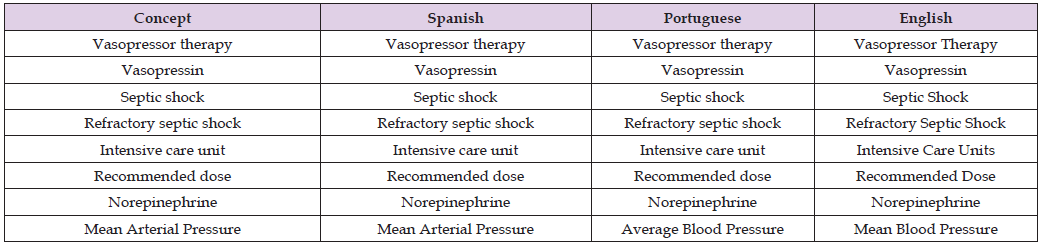
Note: Own elaboration Spain V, Ortega S. 2024.
Table 3: Terms for MeSH (Medical Subject Headings).
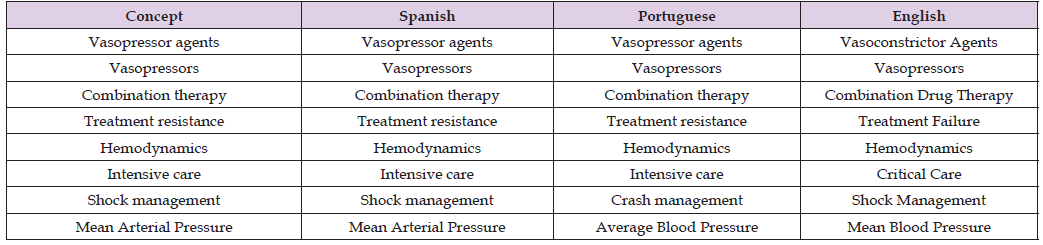
Note: Own elaboration Spain V, Ortega S. 2024.
Search Protocol
An advanced search was carried out using Boolean operators and specific limiters. These strategies allowed us to reduce the number of evidence aligned with our objective. Limiters such as publication period (articles published between 2014 and 2024), type of study (quantitative studies), and language (English, Spanish, and Portuguese) were applied. For information retrieval, the strategy established that the reviewers filtered according to previously established criteria, which were mainly open access documents. These were stored in a search log. The initial selection was made by reading the title and summary of the evidence located and from there, those related to the research question were selected and discarded, thus allowing us to have better control. The information sources reviewed included PubMed (29 articles), SciELO (4 articles), and EBSCO (2 articles). Search strings designed to maximize the sensitivity and precision of the results were used, such as: (refractory septic shock AND vasopressin AND noradrenaline), (noradrenaline AND septic shock AND vasopressin), (refractory septic shock AND vasopressin), and (noradrenaline AND septic shock). These strategies allowed us to retrieve a significant volume of relevant scientific articles, facilitating access to quality information pertinent to the study. According to the previously defined inclusion criteria, a total of 35 articles were selected for detailed analysis (Table 4). These articles were filtered based on their relevance, methodological quality, and relationship to the research topic. These articles were retrieved using key terms related to vasopressin management in patients with refractory septic shock, applying advanced search strategies that ensure comprehensive coverage of the available literature [12-45].
Table 4: Eligible articles and search string used.

Through an exhaustive review of the literature, a set of studies has been identified that address the topic from diverse perspectives and methodological approaches. For the synthesis, the PRISMA flow diagram was used, this is a tool that helps to visualize the study selection process, from identification to final inclusion, the acronyms of the PRISMA flow are defined by (Preferred, Reporting, Items, for Systematic Reviews and Meta-Analyses). Based on this tool, we proceeded to select our articles of interest following the steps of Identification, Sampling, Eligibility and Inclusion. With a total number of 35 articles. During the sampling, 17 studies were excluded for different reasons: 2 due to duplication, 2 for not having access to the full text, 4 articles because the year of publication was more than 10 years old, and 9 for not being related to the topic of study (Figure 1).
Figure 1

In total, 18 were eligible, to subsequently go through a critical assessment process (through FLC version 3.0) [46,47] of which 9 were discarded for not complying with the quality evaluation or presenting biases. This process ensures that the evidence used is accurate, upto- date, and of high quality, meeting the scientific and methodological standards required for informed clinical decision-making. The Scottish Intercollegiate Guidelines Network (SIGN) scale was used to assess the quality of evidence in this study because it offers a structured and rigorous approach to classifying different types of research, such as clinical trials and observational studies (Table 5).
Table 5: Selected articles, degree of recommendation, level of evidence.
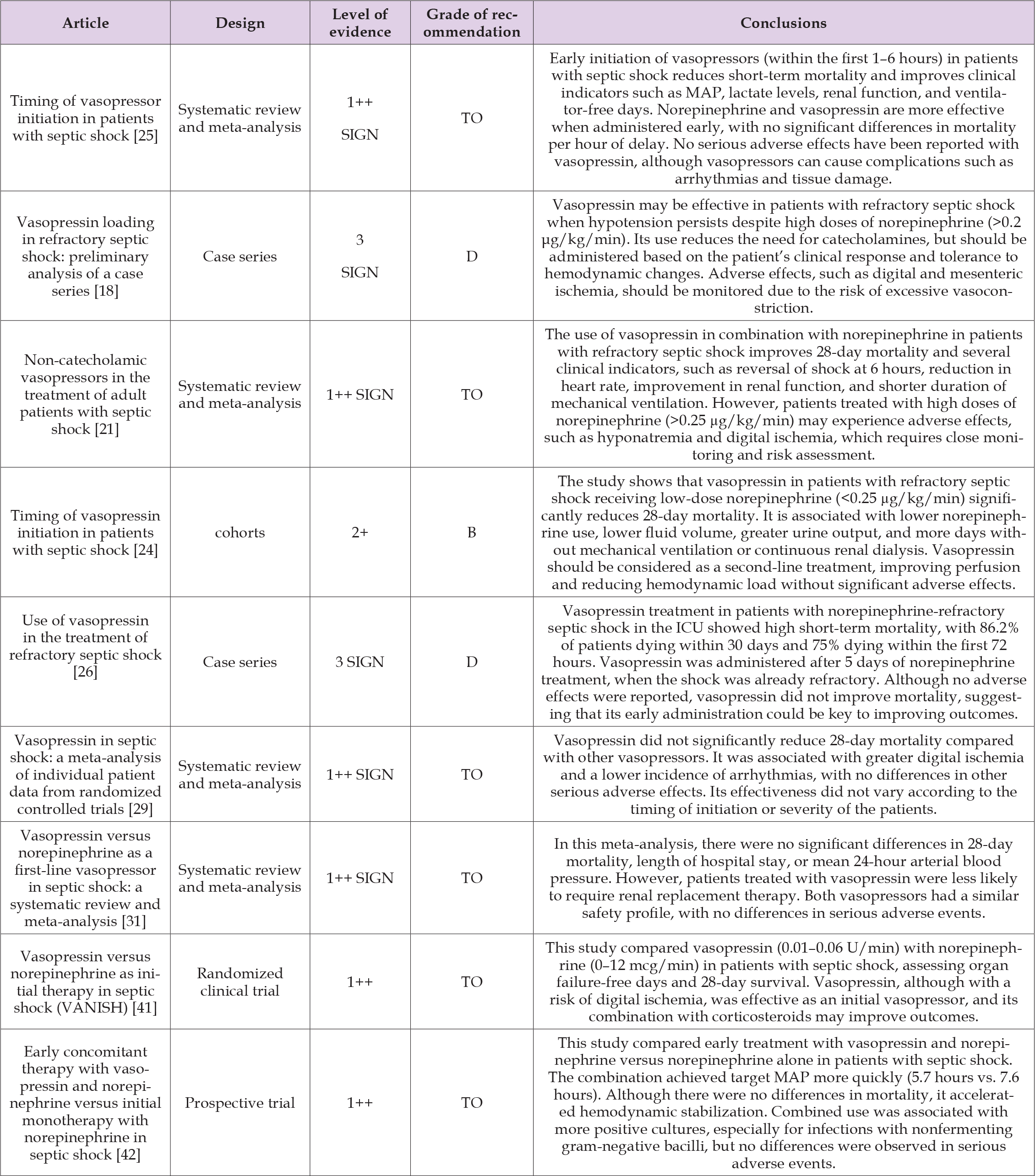
The studies included in this review show that adding vasopressin when norepinephrine doses reach 0.25–0.5 mcg/kg/min may be associated with an improvement in MAP and a reduction in the need for norepinephrine. Some clinical trials, such as the VANISH study, have suggested that early use of vasopressin in combination with norepinephrine reduces the incidence of renal failure and decreases the catecholamine load in patients with less severe septic shock. However, in cases of severe refractory septic shock, the benefit of vasopressin appears to be more limited, possibly due to the characteristic vascular hyporesponsiveness. (Gordon AC, et al. [13]). It is also important to highlight that the Surviving Sepsis Campaign [14] guidelines recommend the use of norepinephrine as a first-line vasopressor to achieve a target MAP of 65 mmHg, supporting the addition of vasopressin at a dose of 0.03 IU/min when norepinephrine doses reach levels of 0.25- 0.5 mcg/kg/min.
This seeks to stabilize hemodynamics and reduce adverse effects associated with high doses of norepinephrine, such as arrhythmias, although without a clear impact on long-term mortality [15]. The addition of vasopressin to norepinephrine therapy in patients with refractory septic shock may improve some clinical outcomes; the optimal timing of this vasopressor should be based on a thorough clinical assessment and ongoing patient monitoring to maximize the benefits and minimize the risks associated with its use. Regarding mortality, results are inconsistent. Some observational studies and systematic reviews report a marginal reduction in 28-day mortality when lowdose vasopressin is used in conjunction with norepinephrine compared with norepinephrine alone. However, other studies found no significant differences in mortality, suggesting that the benefits of vasopressin may depend on additional factors, such as the timing of administration and the patient’s initial clinical condition. (Sedhai YR, et al. [16]). The reviewed studies also emphasize the importance of individualizing treatment. Patients with different levels of septic shock severity may respond differently to the addition of vasopressin. Thus, the decision to initiate vasopressin should be based not only on the norepinephrine dose, but also on clinical parameters such as MAP, lactate levels, and renal function.
A systematic review of the optimal timing of vasopressin addition in adult patients with refractory septic shock treated with norepinephrine infusion in the ICU indicates that the combination of both vasopressors can improve hemodynamic stability and reduce some adverse effects, particularly when norepinephrine doses reach 0.25– 0.5 mcg/kg/min. In these cases, vasopressin acts as a secondary vasopressor, allowing a reduction in the catecholamine dose required to achieve adequate mean arterial pressure (MAP) and improve organ perfusion. However, evidence regarding whether this approach translates into a significant reduction in mortality remains conflicting, with some studies reporting improvements in 28-day survival, while others find no significant differences compared with norepinephrine alone. Regarding the severity of septic shock, studies suggest that vasopressin may be more effective in less severe cases, where there is still some vascular reactivity. In contrast, in severe refractory septic shock, where vascular resistance is severely compromised, the response to vasopressin tends to be less pronounced, underscoring the importance of personalizing treatment according to the patient’s hemodynamic response.
To the Faculty of Nursing at the Autonomous University of Yucatán, for the academic training and opportunities provided throughout this process, and special recognition to my advisors for their guidance, patience, and valuable contributions that enriched each stage of this research.
The authors declare that they have no conflicts of interest in relation to this work.

International Association of Landscape Archaeology, Czech Glass Society, Czech Republic

Department of Chemistry, Semenov Institute of Chemical Physics, USSR Academy of Sciences, Moscow, Russia

Neurology, LA BioMed Research Institute, USA

Associate Professor at Department of Breast and Thyorid Surgey, Chongqing General Hospital, China

Professor of Nuclear Medicine, Faculty of Medicine and Surgery, University of Milan, Milan, Italy





 Abstract
 PDF
PDF



























