info@biomedres.us
+1 (502) 904-2126
One Westbrook Corporate Center, Suite 300, Westchester, IL 60154, USA
Site Map
 ISSN: 2574 -1241
ISSN: 2574 -1241
ISSN: 2574 -1241
Received: June 06, 2025; Published: June 16, 2025
*Corresponding author: Shukun Wang, Acute Infectious Disease Prevention and Control Institute, Yunnan Provincial Center for Disease Control and Prevention (Yunnan Academy of Preventive Medicine), Kunming, China
DOI: 10.26717/BJSTR.2025.62.009728
The COVID-19 pandemic has profoundly impacted global health and socio-economic systems. By analyzing four major global epidemics, this study delineated viral transmission pathways and variant evolution trends. It developed an epidemic stage model using histograms of new cases—categorized into initial, rising, plateau, and decline phases—and cumulative case curves with inflection-point stages. A bidirectional predictive model, evaluating epidemic severity and intervention efficacy under scenarios with or without inflection points, was validated using data from India’s general population, U.S. healthcare workers, and localized outbreaks in China. The study proposed a phased framework: early detection, surveillance and early warning response, and prioritized prevention/ control periods. Additionally, it clarified the dynamic relationship between variant dominance niches and transmission efficiency, establishing a technical framework to enhance pandemic preparedness. These findings aim to optimize resource allocation and refine global strategies for mitigating future public health crises.
Keywords: COVID-19 Pandemic; Epidemic Wave; Measurement by Stage; Technology Pattern
The coronavirus disease 2019 (COVID-19) pandemic has been a public health event of international concern for more than three years, possessing high infectivity, rapid spread, wide-ranging infection, multiple epidemic waves, and Increased virus variation. The pandemic has changed the understanding and experience of scientists worldwide in terms of disease-free infection, virus carriage, virus mutation, immune escape, trend prediction, and staged prevention and control. COVID-19 has seriously jeopardized human health and socioeconomic development. The pandemic remains a severe challenge worldwide that disrupts people’s lives and requires a coordinated international response. Since December 2019, the emergence of variants of the virus that causes COVID-19, severe acute respiratory coronavirus 2 (SARS-CoV-2), in many regions such as Europe and the Americas has led to four predominant epidemic waves of confirmed cases and deaths (waves of virus variants infection, from now on, “wave”) and their baseline fluctuations, and presented pandemic features with scale, regular, catastrophic, and staged epidemic waves owing to these variants [1-3]. Since the World Health Organization (WHO) declared a global pandemic on March 11, 2020, China eliminated the current epidemic before April 2020, when there was no vaccine, and has effectively controlled imported infections [4-7].
To better understand and address the multifaceted impacts of COVID-19, this review systematically retrieved and analyzed key publications from databases, such as PubMed, Web of Science, Embase, and the Cochrane Library, focusing on studies published between 2020 and 2024. Additionally, global and national COVID-19 case data released by the WHO from 2020 to 2023 were critically examined. Drawing from these sources, we developed a methodological framework for segmenting and quantifying COVID-19 pandemic waves and identifying critical turning points. This framework has been integrated into the infectious disease surveillance and early warning system. The technical model established through this analysis offers a comprehensive approach to assessing epidemic wave processes, monitoring virus transmission routes, understanding the virus variant selection, and the transmission characteristics of the SARS-CoV-2 Omicron (B.1.1.529) variant globally and in the United States (US). The model revealed two successive waves of epidemics in India and the US, contrasted with a single-cluster outbreak in China. Herein, we describe the technical model’s outline, the inflection point’s role, the spread of dominant niche variants, and the technical direction of epidemic development, prevention, and control.
Global and US COVID-19 Epidemic Waves
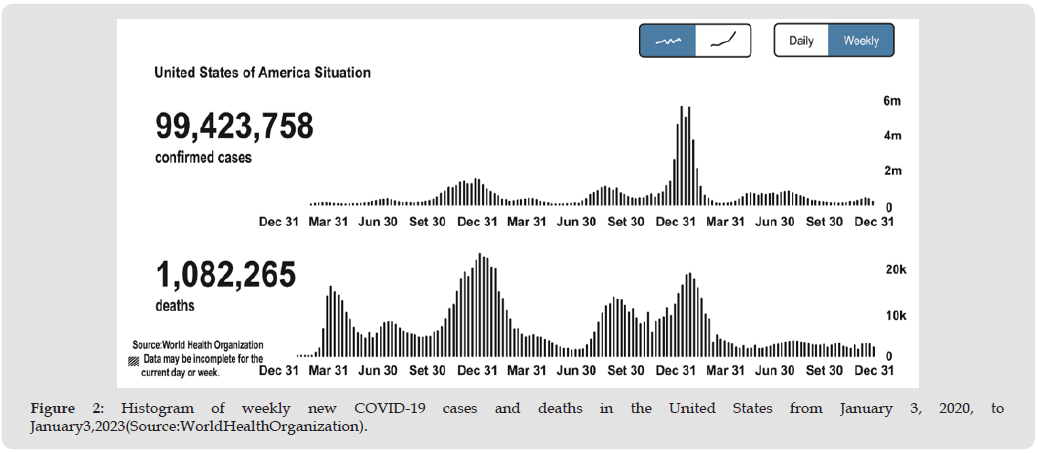
According to COVID-19 real-time statistics of the WHO, as of January 3, 2023, the cumulative number of confirmed cases and deaths worldwide was close to 656 million and 6.67 million, respectively; in the US, these figures are comparable to 0.994 million and 1.08 million, respectively. Since December 30, 2019, the US and countries worldwide have experienced four major waves of new confirmed or fatal COVID-19 cases, each lasting 3 to 6 months, owing to the original SARS-CoV-2 strain, followed by the Alpha (B.1.1.7), Beta (B.1.351), Gamma (P.1), Delta (B.1.617.2), and Omicron (B.1.1.529) variants of SARS-CoV-2. Subtypes of the Omicron variant caused the fourth wave from May to October 2022. The transmission of each variant and its wave duration are related. The natural evolutionary selection of virus variants is the root cause of the emergence and replacement of the four waves. Each dominant variant can significantly affect the corresponding region in less than six months. Since December 2021, the epidemic wave owing to the Omicron variant showed the characteristics of the highest peak, the most extended peak period, and the recurrence of subsequent peaks. Since March 2022, changes in the number of deaths have not shown characteristics similar to the previous four waves, and the number of deaths per day or week, mortality, and case fatality rate reached the lowest level since the start of the pandemic. The number of deaths in the peak period of the Omicron waves seems to be higher globally and, in the US, than that during the Delta wave period, based on differences in the number of cases, case fatality rate, primary infection number, and characteristics of high infectiveness and an extended transmission period of Omicron and Delta variants. The number of deaths caused by Omicron in the corresponding period would be affected by the cumulative number of deaths caused by the Delta variant rather than the exact number of deaths caused by the Delta variant (Figures 1 & 2) [1-5,8-10].
Figure 1
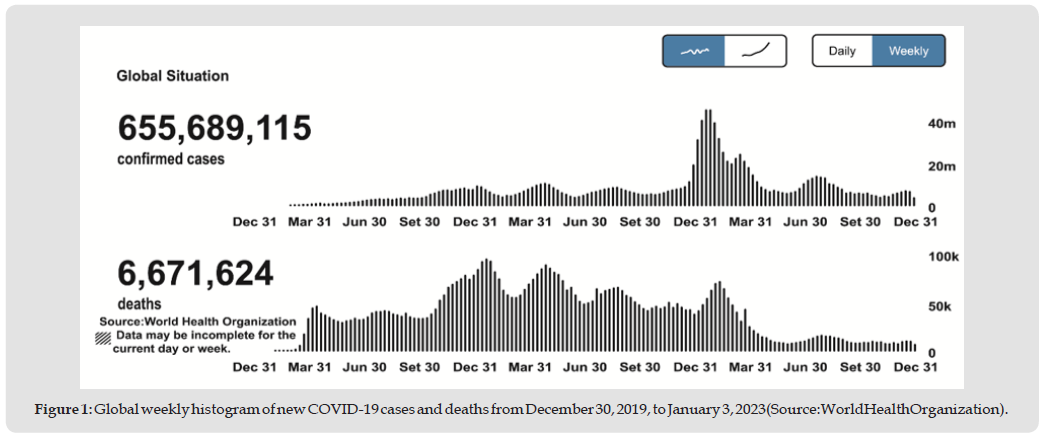
Figure 2
Routes of Transmission of COVID-19
SARS-CoV-2 can be transmitted directly or indirectly through respiratory droplets (with a diameter of greater than 5 micrometers or the most effective transmission distance of less than 1 meter), droplet- contaminated hands, droplet-contaminated surfaces, cold chain foods, and aerosols (with a diameter of less than 5 micrometers or the most effective outdoor transmission distance of greater than 1 meter) generated by people infected with COVID-19, which are then inhaled via the respiratory tract or introduced to the body via contact with the virus. The index patient and early cases may become infected via the animal-human or animal–cold chain–human routes. The infectivity of human-human and human-object-human-associated droplets, aerosols, and surface-infected objects depends on the corresponding degree of close contact. The conditions for human-toobject- to-human transmission depend on the presence of infectious viral contamination on objects, the viability of the virus, and its ability to infect humans. Information regarding outdoor airborne transmission remains unavailable beyond 10 meters between individuals. Using big data can optimize the process of identifying close contacts and spatial-temporal intersections. An intersection transmission is a low-probability event but not a zero-probability event, and it must be based on its epidemiological correlation and exclude other possible transmission chains and routes. The most economical public health and social measures (PHSM) are wearing masks correctly, maintaining social distancing, engaging in proper hand hygiene, and cleaning and disinfecting surfaces [11-14].
Selection of SARS-CoV-2 Variants
The global identification of over 13 variants of SARS-CoV-2 demonstrates a comprehensive pattern characterized by diverse genetic mutations, dominant stages, alternative outcomes, persistent variations, heightened transmissibility, and diminished pathogenicity. The Omicron variant has given rise to subvariantsBA.1,BA.1.1,BA.2,BA.2.4,- BA.2.5,BA.2.6,BA.2.7,BA.2.8,BA.2.10,BA.2.12,BA.2.12.1,BA.2.75,- BA.2.75.2,XBB.1,BA.3,BA.4,BA.5,BA.4.6,BA.5.2,BF.7(BA.5.2.1.7),and XBB.1.5 as well as numerous other subtypes that exemplify a distinct ecological niche characterized by enhanced infectivity potentiality, occultation capability, immune evasion capacity, low pathogenicity level, diversity and variability in genetic makeup, adaptability to different environments and relative stability. The Delta variant, previously the dominant variant, has been eliminated. The emergence of future variants/subtypes is more likely to result from gene recombination involving the Omicron variant rather than arising from other variants, which is in line with the natural law of viral evolutionary selection in virology, epidemiology, infectious diseases, immunology, and ecology [1-3,8-10,13-20]. A viral variant niche refers to variation in the population infection rate of each variant in time and space and its functional relationship with related variants. The emergence of future variants/subtypes is more likely to result from gene recombination involving the Omicron variant rather than originating from other variants [1-3].
Figure 3
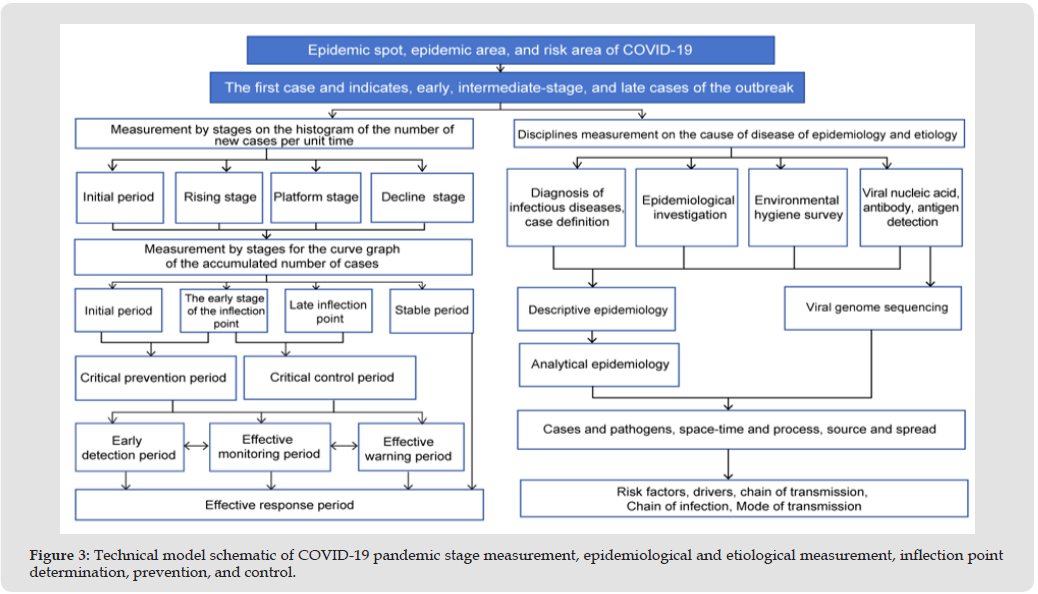
Figure 4
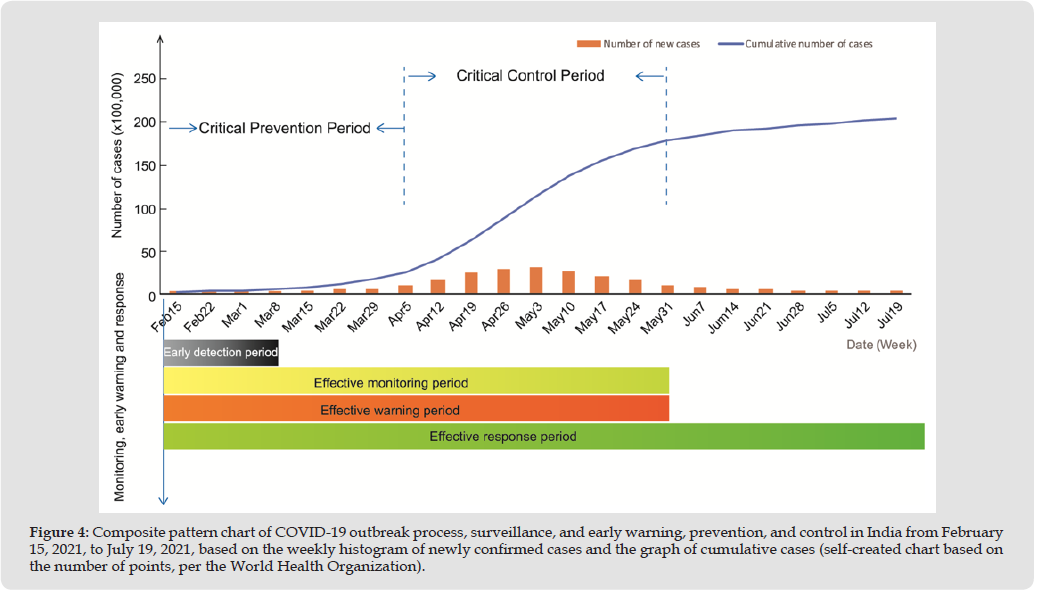
Figure 5
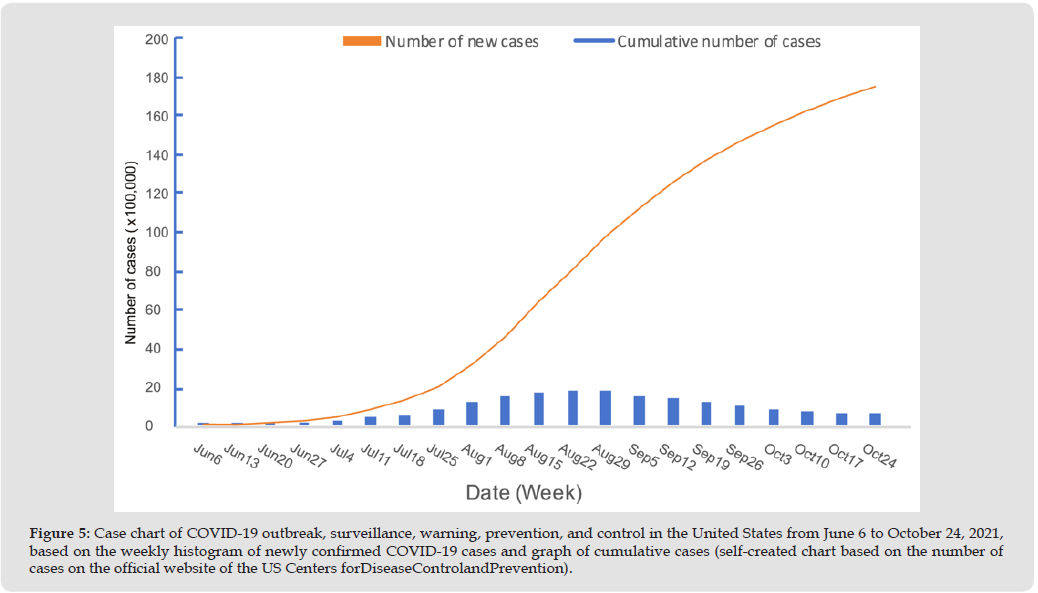
Figure 6

Epidemic Wave Among the Entire Population of India
Based on WHO statistical data on COVID-19 and the translation coordinate theory, we analyzed the large-scale epidemic wave caused by the Delta variant in India from February 15 to July 19, 2021. The weekly number of newly confirmed cases was 86.7, 105, 114, 148, 240, 372, 514, 873, 1429, 2172, 2597, 2739, 2388, 1846, 1365, 915, 631, 442, 351, 312, 292, 269, 266 thousand cases, respectively. The histogram of newly confirmed cases per week with a typical normal distribution and the curve chart of the cumulative number of patients with the usual concave-convex trend were plotted (Figures 3 & 4). The endpoints of the corresponding histograms’ starting, rising, plateau, and declining periods were the weeks of March 8, April 26, May 10, and July 19, respectively. The weeks of April 5 and May 31 were close to the peaks of the concave trend in the ascending and descending periods, respectively. The endpoints of the corresponding curve chart’s starting period, early period, late period, and plateau period were the weeks of March 8, May 3, May 31, and July 19, respectively. The weeks of April 5 and May 31 were close to the beginning and end points of the rapid rising period, respectively. The starting points of early detection, effective monitoring, adequate warning, and effective response were all coordinated origin 0. The earlier, middle, and late monitoring and warning endpoints were the weeks of March 8, May 3, and May 31, respectively. The left stage of April 5 was the critical prevention period, and the necessary control period was between April 5 and May 31. The horizontal coordinate week of May 3 corresponds to the histogram peak ordinate value of 2.739 million cases; the flat coordinate week of May 3 corresponds to the concave-convex trend cutoff point of the curve chart, which compares to the ordinate value of 11.391 million cases; all are the inflection points of time–case number change. The coordinates of the inflection points were the week of May 3 with 2.739 million cases and the week of May 3 with 11.391 million cases, respectively [1,2,7].
Epidemic Wave Among Healthcare Personnel in the US
Based on COVID-19 statistical data from the US Centers for Disease Control and Prevention and the translation coordinate theory, we analyzed a large-scale epidemic wave caused by the Delta variant in the US healthcare sector from June 6 to October 24, 2021. The weekly number of newly confirmed cases was 1216, 1282, 1494, 1975, 3102, 4488, 5858, 8412, 12540, 15460, 17623, 18078, 18092, 15908, 14360, 12621, 10648, 9093, 8331, 7240, and 7103 cases. A typical average distribution feature histogram and concave-convex trend feature curve chart were drawn (Figures 3-5). The endpoints of the corresponding histograms’ starting, rising, plateau, and declining periods were the weeks of June 27, August 29, September 5, and October 24, respectively. The endpoints of the corresponding curve chart’s starting period, early period, late period, and plateau period were the weeks of June 27, August 29, October 3, and October 24, respectively. The leftward stage of July 18 was the critical prevention period, and the necessary control period was between July 18 and October 3. In the week of August 29, the ordinate value of the horizontal coordinate corresponded to the peak of the histogram of 18,092 cases, and the ordinate value of the concave-convex trend cutoff point of the curve chart of 109,620 cases; all were the inflection points of the number of time–cases. The inflection point coordinates were the week of August 29 with 18,092 cases and the week of August 29 with 109,620 cases, respectively [18].
Cluster of Cases in Ruili City, China
Ruili has a population of nearly 300,000. Its neighboring country, Myanmar, has been severely affected by COVID-19. Many villages lie on the land border between Myanmar and China, and cross-border exchanges are frequent. Authorities proactively reported 106 confirmed COVID-19 cases within familial units, adjacent communities, designated quarantine facilities, and communities in Ruili from July 4 to August 13, 2021. The daily number of newly established cases was 3, 5, 15, 0, 8, 10, 12, 7, 1, 1, 2, 0, 1, 0, 4, 7, 0, 1, 0, 0, 1, 0, 0, 2, 0, 0, 0, 3, 0, 2, 3, 3, 1, 0, 7, 0, 0, 2, 3, 1, and 1 cases. The genome sequences of these cases were derived from 15 independent transmission chains in two branches of the Delta variant, suggesting that multiple regions and channels of imported cases caused the epidemic. Owing to strict implementation of border risk source control, closed-loop management, surveillance and early warning, case treatment, nucleic acid screening, epidemiological tracing, isolation management, containment, vaccination, PHSM, prevention, disinfection, physical prevention facilities, electronic technical prevention, personnel measures, each epidemic, and every transmission chain was rapidly and thoroughly controlled. The histogram of the number of daily or weekly newly confirmed cases does not show the characteristics of normal distribution, and the corresponding curve chart does not show the attributes of a concave and convex trend. The corresponding histogram or curve chart does not show the completed four stages in the typical epidemic wave or outbreak process: monitoring and warning stages, the critical prevention period, the critical control period, and the change nodes of the number of cases over time.
Outline of Technical Model
This paper proactively examines the significant waves of the COVID-19 epidemic and identifies the inflection points of confirmed cases, transmission patterns, and the emergence of SARS-CoV-2 variants. It specifically focuses on two epidemic waves that have impacted the entire population of India and the healthcare community in the United States, as well as a clustered outbreak in Ruili, China. Additionally, it highlights the implementation of surveillance and early warning systems for infectious diseases over the past three years. We established a precise technical model that jointly adopts a histogram of newly confirmed cases and a curve chart of cumulative instances to measure the outbreak process, surveillance and early warning, and prevention and control according to stages and for epidemiological and etiological measurement. The model has characteristics regarding the etiology, regularity, stages, prevention, control, practicality, and effectiveness applicable to cluster, outbreak, epidemic, and pandemic levels. Early detection, monitoring, investigation, warning, measurement, prevention, control, and assessment of each potential epidemic or wave is a technical procedure, and timely and continuous surveillance, investigation, phased measurement, and wave identification are specialized keys. Standardized and effective implementation of the diagnosis and treatment of infected patients, isolation management of personnel at risk, grading and zoning, regional control, critical prevention, critical control, population detection, vaccination, PHSM, and extensive data monitoring are the focus of prevention and control. The technical model’s application objectives are to avoid an epidemic, lower the peak, and shorten the peak period (Figures 1-6) [1,2,7,13-20].
Role of the Inflection Point
The inflection point generally occurs when the number of newly confirmed cases or deaths increases in major waves, globally and in the US, and each wave has an inflection point (Figures 1 & 2). The inflection point has a two-way predictive function in severe epidemic situations (increasing trend in the number of cases) and a positive trend (decreasing trend in the number of cases). Large-scale epidemic waves usually have an inflection point, such as the two stages before and after the inflection points of the two epidemic waves in India and the US (Figures 4 & 5). The inflection point did not appear; it also has the bidirectional predictive effect of epidemic development (the beginning and rising period of the histogram or the initial and early period of the curve) or the epidemic is under control, such as in the two epidemic waves development periods in India and the US (before the inflection point) and the cluster of outbreaks in Ruili, China; that is to say, an epidemic usually has no inflection point under the steady state (Figures 4-6) [1,4-7,18]. The inflection point is a crucial index for determining the sharp increase in the number of cases, continuation of the peak, sustained development of the epidemic, formation of the epidemic scale, strengthening of the herd immunity barrier, and increasing difficulty and costs of China’s dynamic zero-COVID policy. The inflection point is also a key node for integrating issues of health and safety, standard production, and expected productive life, as well as the uniformity, scientific basis, sustainability, and effectiveness of social and economic development.
Propagation of Dominant Niche Variants
Although the number of new cases has decreased significantly after the inflection point in major epidemic waves of confirmed COVID-19 cases and deaths at all levels worldwide over the past three years, the second, third, and fourth waves occurred after the end of the first, second, and third peaks, respectively; that is, the evolutionary selection of the dominant niche variants determined the wave replacements. Although the Omicron variant has caused infections since February 2022, it shows no signs of a higher hospitalization rate, more severe rate of disease, case fatality rate, or mortality rate than other variants. In addition, prevalence intensity, mild disease, asymptomatic infection, severe illness, and death among older adults, young children, and the general population are predictable. However, this variant presents problems of latent transmission, immune escape, diversity, adaptability, and stability of epidemic waves, as well as the inevitability of periodic and baseline fluctuations and other long-term issues (Figures 1 & 2). The latest wave of the Omicron variant cases globally and in the US during March 2022; the Omicron variant outbreak in Shanghai, China, in April 2022; the third anniversary of the COVID-19 pandemic in December 2022; and the third anniversary of the level 1 response to COVID-19 in China in January 2023 seem to be four spatiotemporal nodes to consider the return of COVID-19 to Class B infectious disease prevention and control [1,2,13-20].
Epidemic Development and Prevention and Control Technologies
The Omicron variant subtypes have shown distinctive characteristics of the dominant novel coronavirus variant niche globally and in different countries and regions. These characteristics include the highest wave peak of confirmed cases, the most extended wave period, the most prolonged baseline fluctuation period, the most significant number of infected patients, the highest epidemic intensity, the most comprehensive transmission range, and the most significant difficulty in prevention and control. The baseline fluctuation trend of the epidemic lasted for 12, 24, and 36 months. The US has experienced multiple dominant variant epidemic waves, immune escape, and antibody- dependent tolerance enhancement. China has experienced dynamic clearing of multiple prevalent variants before the emergence of the Delta variant. China has achieved success in three aspects: efficient clearance of multiple dominant variants prior to the emergence of the Delta variant, robust natural immunity against the single Omicron variant during peak epidemic waves, and minimal immune evasion observed with different subtypes of the Omicron variant. As long as epidemic waves of the Omicron variant continue in the population of any country or region, the two states of vaccine immunity and natural infection will be superimposed, and the endemic phase of Omicron will be attained.
Thus, there is a high probability that specific herd immunity will be achieved over time or that a state of endemic herd immunity will develop, and the population will not be highly susceptible to future virus variant strains. Generally, there have been no similar peaks or waves in the past, and the baseline fluctuation state of low-level epidemic intensity has been more present [1,2]. The Omicron variant in China also presents a challenging and complex multi-point distribution, frequent occurrence in multiple places, multi-chain transmission, multi-domain peaks, and more incredible difficulty and costs of monitoring, early warning, measurement, and control. In the first season of 2023, COVID-19 entered an epidemic wave, and synchronously, concurrently, the immunity barrier owing to vaccination will weaken, the natural immunity barrier will become stronger, population immunity will develop, and baseline fluctuation will continue. We will actively strengthen the prevention and control measures for a Class B infectious disease. The focus of prevention and control is the diagnosis, treatment, monitoring, and prevention of three deterministic populations (management of cases, protection of older people, protection of children), PHSM, and outbreak management among people at risk in time and space. The focus should be actively placed on antigen detection, ensuring strict adherence to home isolation measures, prioritizing the prevention of severe disease, and promoting standardized treatment for symptomatic patients. The primary responsibility of relevant professionals and technicians in national disease control and prevention institutions is to scientifically and accurately clarify characteristics, trends, and rules regarding the infectious and deadly nature of COVID-19 and its causative agent, SARS-CoV-2.
The main task of the national expert group is to generate scientific, integrated, unified, honest, and practical phased prevention and control advice; to participate in the formulation of prevention and control policies and strategies; review the phased prevention and control plans and diagnosis and treatment standards; and strive to prevent any misunderstanding [1,2,4-7], “which experts/practitioners have tested. This technical model involves the epidemic prediction (monitoring, investigation, measurement, early warning), early warning (detection, reporting, treatment, prevention), and response (strategy, measures, costs, benefit) as three goals to achieve technical support, that is, to minimize the occurrence of an epidemic, reduce peak harm and minimize costs to achieve the maximum effect using scientific and precise prevention and control technology. By the latest national prevention and control program standards, timely revision and implementation of sporadic, cluster, outbreak, and large-scale epidemic emergency plans; standardized and complete population monitoring and management; epidemic analysis and judgment; outbreak investigation and treatment; timely control of risks; and identification of potential or actual peaks are crucial. The aim is to effectively coordinate topics involving epidemic waves and baseline fluctuation, imported and domestic rebound infection, regular prevention and emergency response, phased measurement, epidemiological and etiological measurement, graded zoning and zoning control, short-term and longterm epidemic control, local and overall epidemic control, vaccines, drugs, immune barriers, Class A and B management, and the social economy and political economy. Early detection, monitoring, warning, phased measurement, epidemiological and etiological measurement, and inflection point determination are critical approaches that carry significant responsibilities [4-7,9,10,13-20]
National Major Science and Technology Project (2012ZX10004212); Key Research and Development Program of Yunnan Province, No. 202103AC100006; Key Science and Technology Special Program of Yunnan Province (202102AA100019).
All authors declare no conflict of interest.

International Association of Landscape Archaeology, Czech Glass Society, Czech Republic

Department of Chemistry, Semenov Institute of Chemical Physics, USSR Academy of Sciences, Moscow, Russia

Neurology, LA BioMed Research Institute, USA

Associate Professor at Department of Breast and Thyorid Surgey, Chongqing General Hospital, China

Professor of Nuclear Medicine, Faculty of Medicine and Surgery, University of Milan, Milan, Italy





 Abstract
 PDF
PDF



























