info@biomedres.us
+1 (502) 904-2126
One Westbrook Corporate Center, Suite 300, Westchester, IL 60154, USA
Site Map
 ISSN: 2574 -1241
ISSN: 2574 -1241
ISSN: 2574 -1241
Received: May 23, 2025; Published: May 30, 2025
*Corresponding author: Tomáš Hájek, International Association of Landscape Archaeology and the Economic and Social Council of the Most Region, Czech Republic
DOI: 10.26717/BJSTR.2025.62.009698
On the Structure of Relationships between Wind Energy and Monument Care
While wind energy may be subject to protection in monument care on one hand, wind energy and monument care are two spheres on a scale of various conflicts on the other hand [1]. This study strives to capture the two underlying elements of the relationships between wind energy and monument care. It is written from the perspective of Central Europe or the entire European geographic area, where the traditional cultural landscape prevails with few exceptions. The study has two levels from the chronological perspective. The first developmental stage in wind energy ends with direct interconnection of renewable resource development with the effort to influence the ongoing climate change. During this first stage, wind energy development is legitimised by the spirit of experimenting technical progress and the core ideas of environmentalism; this arises from the protectionist view of nature and natural resources as scarce resources, from the distrust of clamorous consumerist of the modern society, and from the idea of economical harmony with nature as the way forward. The concept of sustainability arising from the Club of Rome is an umbrella term encompassing all these. The second, current stage of wind energy development is far more radical. On one hand, the moral ethos of the traditional environmentalism, i.e. in particular criticism of consumerism and the idea of moderate harmony with nature as a societal ideal, disappears from the ideological principles of wind energy and other renewable resources.
On the other hand, this stage is statist and dirigiste, marking out zero-carbon objectives for the current industrial societies in association with the ideas concerning the cause of climate change. Determining this turning point on the timeline may be subject to discussion. However, considering wind energy in Europe and the key role played by the German, French and British monument care in the context of European monument care, year 2005, when the English Heritage issued the manual entitled Wind Energy and the Historic Environment, appears to be the most accurate estimate of this turning point. Introductory sections of the manual state: “Although climate change is natural and constant process, there is a strong scientific and political consensus, internationally and within the UK, that the current increase in average temperatures results mainly from increasing atmospheric concentrations of carbon dioxide and other greenhouse gases and that these concentrations are the result, in part at least, of human influences [2].” It is interesting to note that from the methodological perspective, this manual comes with rather uncommon structuring of the impact of wind energy on historic environment in two ways: in addition to the commonly noted direct impact on the visual values of the landscape, the manual also describes direct physical consequences from the perspective of archaeological heritage. The manual states that a wind powerplant with the output of 1-2 MW requires 100 m³ of reinforced concrete in a 3.5m deep block with the diameter of 16 m. This emphasis on the direct impact means that wind powerplant cannot be perceived as a somewhat temporary structure. The fact that the issue of wind energy connection to power transmission is mentioned from the perspective of its influence on the historic environment is also important. It is important to highlight that the document also pays attention to the issue of offshore wind powerplants, mentioning the topic of wreckages and archaeological heritage on the land flooded due to the rise of the sea level over the last 10,000 years. A brief note on offshore wind powerplants – while their development was delayed compared to onshore powerplants, they are currently clearly on the rise. Offshore wind powerplants within sight of the seashore referred to as near-shore power plants are required to blend in the visual values of the shore landscape [3]. However, year 2005 viewed against the backdrop of the subsequent development only appears to be a sign of things to come as a new chapter unfolded. The study entitled Windenergie und Denkmalschutz published in 2019 described a situation quite changed from the time when the English Heritage published the document structuring the topic of relationship between wind energy and monument care without an alarmist character. The German study states: “The usage of wind energy is in increasing conflict with monument care due to the size of wind powerplants [4].” Nonetheless, even this study is mere taste of the subsequent development, as the situation has progressed dramatically and monument care has abandoned its key principles to allow for unlimited development of wind energy owing to the recent legislative activities of the German federal government.
Germany has to make 2% of its total area available for wind energy until 2032, the current share being around 0.8%. As approximately 10% of plans for the construction of new wind powerplants are currently rejected due to monument protection, in particular protection of visual values of monuments and their surroundings, amendments to monument protection laws are gradually drafted in individual federal states. As a result, it will be possible to construct new wind powerplants closer to monuments without asking monument care authorities for their opinion and without these authorities having any ways for asserting their position effectively [5].
Wind Energy as the Collision of Individual Environmental Interests
Many studies focus on the attitude of the population to wind energy, concluding a prevailing positive stance. By contrast, the specific aspect of cultural heritage protection from the general perspective of the impact of wind energy development on the environment has been little studied at the general scientific level [6]. At the same time, it is clearly noticeable that concerns of environmental character are also voiced in certain significant conflicts between the development of wind energy and monument care. Therefore, it is important to begin the study by summing up certain environmental, or specifically environmental health risks of wind energy development. From the commercial perspective, it is seen as an advanced technology using renewable resources. Wind energy is the most economical type of energy from renewable sources, as the time required for the construction of a wind powerplant is no more than one year and wind powerplant does not consume any energy for its operation [7]. Then again, there are increasing amounts of material and energy needed for the production of massive and sophisticated wind powerplants and their installation in specific locations, in particular at sea with the associated corrosive conditions.
The following topics are discussed and addressed from the environmental and medical point of view:
a) The issue of noise: Wind energy produces noise at three levels:
• Temporary noise is produced during the construction stage;
• Aerodynamically produced noise as the rotor blades move through the air is permanent;
• Engineering components of wind powerplants produce noise;
• Infrasound is also produced, measured and addressed. Population exposure to noise may be limited in various ways: through technical specification of a wind powerplant, by optimising the distance between a wind powerplant and residential areas, through inspections of the manufacturing facility and the place of operation of wind a powerplant. The issue of noise tends to be overestimated and can be seen as an environmental and medical problem, which is gradually resolved satisfactorily owing to the technological development in wind energy, among others.
b) The issue of shadow flicker: This sharp change from light to shade occurs when the sun is low on the horizon and shines through the rotor blades. This may lead to mental discomfort, which is naturally individual. Long-term exposure may undoubtedly result in persisting problems in predisposed people, but this problem also applies to permanent exposure to noise, even when the acoustic pressure values are low, as even these values have a documented impact on the organism. While this mainly applies to predisposed people, the problem is not limited to these persons, as the disruptive impact of noise of low acoustic pressure deserves attention in particular at nighttime. Shadow flicker is a phenomenon typically considered when approving new wind powerplants. According to some recommendations, maintaining the distance between a rotor and residential areas ten times greater than the rotor diameter is sufficient for reducing shadow flicker. It is important to apply a generally cautious and proven approach when selecting the location of a wind powerplant, including adaptation of the powerplant’s technical parameters to minimisation of this phenomenon, which may become significant at certain times of year and specific parts of day; small windows in residential buildings are a factor intensifying the disruptiveness of shadow flicker. In the operation of a wind powerplant, shadow flicker is addressed by reducing the operation of a wind powerplant at certain times [8].
c) The conflict between commitments of individual European Union member states in nature protection and development of renewable resources can be mentioned as an example of the conflict between individual environmental interests in the development of wind energy. For example, the relationship between the European NATURA 2000 network and development of wind energy may also be subject to conflict, albeit one that can be resolved [9].
On the Topic of Wind Energy as Special Type of Industrial Heritage: As the history of wind energy has been described in detail, this study will only touch on this topic. The first wind powerplant was built in the USA in 1880s. The history of wind energy in Europe began in 1891, when the wind powerplant in Askov, Denmark started its test operation. Boom of wind energy came with the energy crisis in the second half of the 1970s and has been maintained to this day. The first generation of wind powerplants is disappearing fast owing to the rapid pace of technological innovation, despite their unique technology and aesthetics. Only partial “vintage” structures are preserved by manufacturers along with some documentation and photographs. The initial stage of wind energy development is also captured in museums with emphasis on the founding figures in wind energy. From the perspective of general methodology, the issue of maintaining and presenting initial generations of wind powerplants should be addressed through the range of proven approaches applied in monument care and museology. The topic of monument conservation and presentation of first generations of wind powerplants needs to be perceived in two underlying specific contexts:
a) Wind powerplants are undoubtedly part of industrial heritage, which has been developed theoretically and practically over decades. Wind energy structures initially designed as technical structures without the aim to make any permanent aesthetic impact can be subject to conservation and presentation principles applied to industrial heritage. However, the character of a wind powerplant as industrial heritage differs from the traditional categories of industrial heritage, such as single or multiple purpose smelting furnaces. Wind powerplants are designed from the start as temporary structures with easy disassembly, although current wind powerplants tend to have the character of a standard engineering and construction project. The issue of conservation and presentation of the first generations of wind powerplants is becoming increasingly pressing with rather dramatic development of wind energy in the European Union linked to climate change. Determining the value of a specific structure from the perspective of monument care is always subject to multifaceted expert assessment of its aesthetic and historical value. The aesthetic value is derived from the uniqueness of the relevant item as an artwork and its historical value arises from its rarity and representativeness. Rapid development of wind energy ultimately works against the principles of intentionally created aesthetic values, as well as historical values of a monument; rarity and representativeness will apply sporadically in the context of dynamic changes. In addition, cultural heritage also needs to hold a certain age-related value (der Alterswert). This is the reason why monument care cannot grant the status of cultural heritage to newly constructed structures using their potential monument value as justification. Monument care has to respect the authority of history. Including wind energy in industrial heritage therefore is a new, as yet understudied phenomenon.
b) The topic of wind energy as monument value within industrial heritage may also be influenced significantly by the availability of wind energy. Wind maps for individual territories show that wind energy may be profitable and meet the criteria of renewability in selected locations only, such as on the windward sides of mountains. Therefore, maintaining a conserved wind powerplant in its original location may be increasingly difficult or even impossible. Therefore, when considering wind energy as monument value in the context of industrial heritage, rescue removal of a wind powerplant as a cultural technical monument to newly established outdoor collections in suitable parts of landscape or to existing or newly established museums of technical industrial heritage should be ultimately preferred.
Development of wind energy in the Czech Republic began ten years later compared to member states of the European Communities, later transformed into the European Union. After the slow start, acceleration of the development in the first decade of the 21st century was promising, only to be followed by stagnation in the second decade, in contrast to the rapid dynamics in the development of wind energy in other European countries, such as Germany, Spain, France, Great Britain and Denmark. The above deliberation on the monument value of wind energy therefore applies mostly to these countries, rather than the Czech Republic. Stocktake of wind energy and a strategy for handling this industrial heritage is a current global topic.
Environmental principles of mostly planetary character clash with monument care principles with mostly national or even regional character in the topic of construction of new wind powerplants in the traditional cultural landscape. The study therefore cannot but compare somewhat incomparable factors, i.e. environmentalism and various monument cares. Nonetheless, certain general statements can be derived from this, albeit with appropriate caution. Environmental protection and cultural heritage protection each have their own history, and an analysis of their shared themes and differences would require extensive study. Nonetheless, the modern environmentalism and monument care build on the same foundations, i.e. the effort to oppose the aggressive and unscrupulous demands of the current industrialism. If wind energy as one of the most important promoters of the modern idea of environmentalism and monument care are in conflict, this conflict cannot be decisive [10]. Quite understandably, the potential conflict in the relationships between renewable energy sources and monument care tasks is not an unresolvable problem for official documents in international monument care, including non-governmental organisations. Renewable resources primarily serve industrial development purposes, while monument care strives to maintain the original cultural substances. This means that a certain degree of conflict is unavoidable, but cannot exceed a specific level owing to the shared foundations of environmental protection and cultural heritage care.
Conflicts therefore have to occur from the following perspectives:
a) Whether the installation of renewable resources results in interference with the authentic material historical substance, for example with the original roofing of a monument in the case of installation of photovoltaic panels. Specialised literature states that incorporation of renewable solar energy in architecture and the historic environment has been studied far more than incorporation of wind energy, geothermal energy or bioenergy.
b) Whether the introduction of renewable resources damages the visual values of the historic environment as an integral part of the monument as a whole. This is specifically the case of wind energy.
c) Solar powerplants and wind farms are problematic with regard to the area they require for their operation. In this case, the problem does not lie in the intervention in the material character of the monument or the visual value of the historic environment, which remains practically unchanged. Disruption of the historical land use, including historical division of land, is a problem here and the issue of archaeological heritage also needs to be considered.
Erscheinungsbild: The term “Erscheinungsbild”, typical for the German monument care and indirectly also for monument cares in Central Europe, needs to be mentioned with regard to resolution of the conflict between wind energy and monument care. Firstly, it should be noted that interpretation of this term is not and cannot be unambiguous, as it is centred around aesthetic judgements depending on many factors; it is subjective stance on one hand, and rather changeable societal cultural patterns. Erscheinungsbild refers to a visual residential and landscape value, expressing how built-in landscape and free landscape appear on the outside when viewed as an artwork of a kind. The interpretation problem arising from the term Erscheinungsbild is the question whether it should be interpreted purely from the topographic and geometric point of view, or whether to also take into account other aspects described in the study by Jürgen Hasse entitled Atmosphären und Stimmungen im Denkmalschutz – Zur Überwindung des Visualismus im Denkmalschutz. Historic buildings are artifacts of a kind and their existence outside the historic environment is purely abstract. A historic building is a subjective reality created from its surroundings that are bound to the building itself.
It is important to stress out for subsequent deliberation in this study that despite being tangible, a historic building is mainly an aesthetic notion embedded in its authentic historic determination. Therefore, if the process of aesthetic determination is disrupted, the historic building ceases to exist, even when it is still present in its material substance of an artifact. According to Hasse, understanding of a historic building is not limited to cognitive perception of the structure and its surroundings. The term Erscheinungsbild is a typical example of the cognitive visualist perception of a historic building and its surroundings. Hasse points out: “Die Erlebnisqualität eines Baudenkmals erchließt sich wesentlich über Atmosphäre und Stimmungen, die von dessen inneren wie äußerer Umgebung augestrahlt werden…Die unbestimmten Begriffe der Umgebung wie des Ercheinungbildes heben auf die Würdigung des phänomenalen Ercheinens eines Baudenkmals ab [11].” (The study author decided to use the original German version of the text owing to its philosophical and terminological complexity to avoid distortion). To sum up, the term Erscheinungsbild always includes something beyond the purely cognitive perception, which is reflected externally in standard monument care with regard to wind powerplants in the emphasis on a structural and visual analysis of the historic structure and its historic environment. Nonetheless, Erscheinungsbild successfully fulfils its role as part of methodological basis of monument care.
Landscape Character: Wind powerplants are a threat to the visual value of historic environments – even at a great distance. This means that the legal institute of a protection zone, including Erscheinungsbild that also protects the visual value of a historic building and its historic environment, is insufficient in this sense. To protect the visual value of a historic environment in connection with the demands of wind energy, it is necessary to focus on the protection of the visual value of entire landscape segments. The topic of this study has to culminate in the issue of maintaining values of the traditional cultural landscape. Several comments should firstly be included. The path to understanding a cultural landscape as a monument value is complicated. The modern monument care combines several principles: the mostly British antiquarian principle, the protective and historical principle, i.e. the German Heimatschutz principle, and the French principle of creation of the state idea on the ruins left by the Great French Revolution. However, all of these traditional approaches to cultural heritage view a historic building as a solitaire or an ensemble. The zonal approach to monument protection was asserted later in the truly modern monument care reaching beyond the melancholic Cult of Monuments of the 19th century.
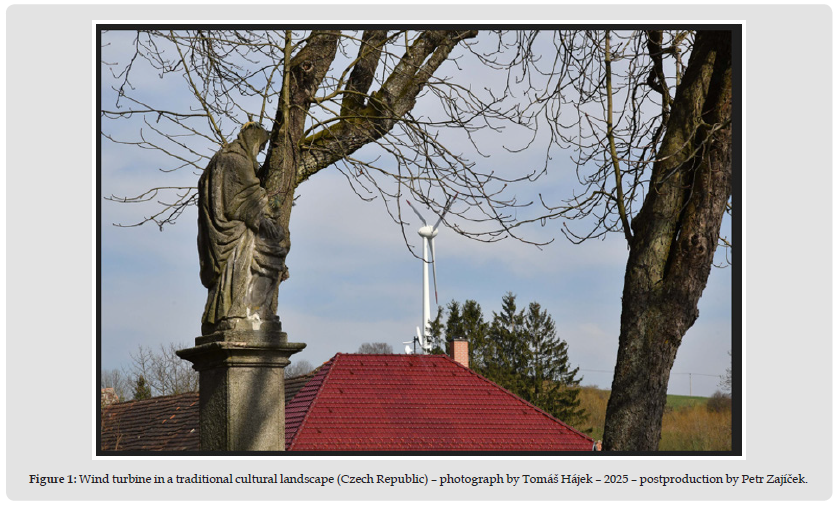
Urban conservation areas and zones, rural conservation areas and zones and landscape conservation zones were a major contribution of monument care in the historic Czech lands to the zonal protection even on a global scale. Monument protection of the traditional cultural landscape as a whole is the peak of the zonal approach to monument care, in addition with reference to Heimatschutz, i.e. protection of the homeland, and perception of the environment surrounding monuments as a historic environment, which is influenced by the current environmentalism. All this historical and factual context is combined in the methodological and administrative term “landscape character”, which is used to protect integrated natural, aesthetic and historic values of a landscape. In the Czech Republic, the institute of landscape character is part of the environmental legislation and a major connecting piece in the environmental legislation and the monument legislation. Landscape character is the instrument allowing for assessment of the indirect impact of a newly planned wind powerplant on the visual value of a historic environment [12]. It is obvious from the context detailed above that the assessment according to landscape character can never be accepted without any objections. While there are certain objective criteria, landscape needs to be assessed through its perception, which involves a subjective aesthetic judgement, despite all formalisation available (Figure 1).
Figure 1
European Landscape Convention and the Development of Wind Power: The European Landscape Convention was signed in Florence in 2000. It is the most significant convention on landscape, politically promoted by the Congress of Local and Regional Authorities in Europe. Landscape in this convention is perceived at a multiregional and multistate level. The convention combining nature conservation with the protection of cultural heritage can be referred to when seeking unbiased and balanced discussion on the placement of wind powerplants in a landscape. The key features of the convention are as follows:
a) It is a future-oriented convention;
b) Landscape values should be protected, but also renewed
and created;
c) Landscape is determined by human perception;
d) Human perception is an evaluation criterion;
e) Aesthetic values of a landscape are emphasised.
It should be noted in this context that the institute of landscape character does not deviate greatly from the language of the European Landscape Convention.
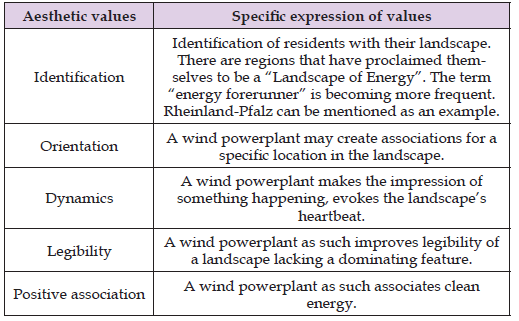
The inconspicuous European Landscape Convention is in fact an important instrument [13]. It opens ways of understanding wind powerplants as a new element in the traditional cultural landscape and codifying its positive value for the landscape. Positive values of wind powerplants include socio-economic values, values from the perspective of the idea of beauty and art, and aesthetic values from the everyday perspective. Socio-economic values can be defined as follows: “net economic impact, including local and community socio- economic benefits such as employment, associated business and supply chain opportunities.” Wind energy is an extensive industry and the attitude of wind energy to ideas of beauty is unavoidably ambivalent. The mass development of wind energy is by definition in conflict with fulfilment of aesthetic ideas, yet at the same time wind powerplants in certain cases may be approached as an attempt to create a unique artwork of an architectural and visual-arts character. A wind powerplant is an artistic topic as a tree in a landscape, a minor monument or ruins of a castle. It is matter, just as stone for a sculptor, an instrument for expressing a general feeling whose presence in the landscape invites solutions. It has design that can be worked with freely. Aesthetic values of a wind powerplant as such from the everyday perspective are summarised in the following table [14]: (Table 1).
Table 1: Aesthetic values of a wind powerplant as such from the everyday perspective.
UNESCO taking a Major Methodological Step forward in Clarifying and Balancing the Relationship between Wind Energy and Monument Care: In 2021, the UNESCO World Heritage Centre published a major document on the discussed topic entitled World Heritage and Wind Energy Planning. During this time, climate change and human contribution to this change was a key motif justifying practically the highest possible priority for the development of renewable energy sources. This study unquestionably deserves to be reviewed in greater detail. Firstly, the following quote points to mutual reflection between environmental protection and protection of cultural heritage, which has already been mentioned in this study: “The energy transition and heritage conservation are two global challenges with the same goal of sustainable development and the same responsibility to future generations.” The content of the subsequent quote is highly conflicting and escalated further discussions, for example in Germany, on the topic of construction of wind powerplants near major historic buildings on the World Heritage List. The castle of Wartburg can be mentioned as one example for many. UNESCO states: “Wind development involves historically unprecedented changes to landscapes.”
Definition of Outstanding Universal Value should be examined further. The term outstanding means that the monument is the most representative example of a certain type of cultural heritage. The term universal refers to the value of the relevant cultural monument being recognisable by all humankind. The OUV concept shifted or expanded over time. The added requirements concern authenticity, integrity and permanent care provided in a management plan. Authenticity can be characterised as genuineness of attributes of the relevant monument and integrity refers to the monument’s compactness. However, the major shift in the interpretation of the OUV lies in the following statement: “This development highlights an underlying paradigm shift from one conception of heritage to another. The first, which is still in use, emphasizes preservation of physical structures and materials from the past; this is the conventional view of heritage.” This conception is followed in the key document Venice Charter from 1964. However: “The second conception protects a property or natural space based on values attributed by different social groups [referred to as stakeholders]; this is a value based approach. Thus, under this approach, the experts are not the only parties that identify and designate heritage to be conserved due to its OUV.” This value-based approach leads to acceptance of evolution of the values of historic buildings on the World Heritage List.
A certain level of conflict in the case of opposing interest of stakeholders is therefore seen as natural, instead of being by default considered the fault of those who propose something different. To reiterate, UNESCO in its document on wind energy operates with the term stakeholder and thus clearly shows that it works with the value-based approach, meaning that the fact of developing wind energy is accepted as unavoidable, arriving as a legitimate value that needs to find compromise with traditional approaches to cultural heritage protection. UNESCO opened space for real compromise between wind energy and monument care. As visualisation is a key method for balancing interests with regard to indirect impact of wind energy on the OUV of individual monuments on the World Heritage List, and numerous visualisation approaches have been developed, it is important to quote UNESCO’s opinion that the optimal visualisation practice is yet to be found. It is stated: “Unanimously all participants and external stakeholders, practitioners and experts from across the different interest groups agreed on the need to develop a framework for good technical practice for visualizations.” At the same time, development of visualisation techniques is clearly evident within the Landscape Impact Area (LIA) methodology, which was used in the case of the Church and Hill at Vézelay as one of the major monument values of the Routes of Santiago de Compostela, which was included in the World Heritage List in 1979.
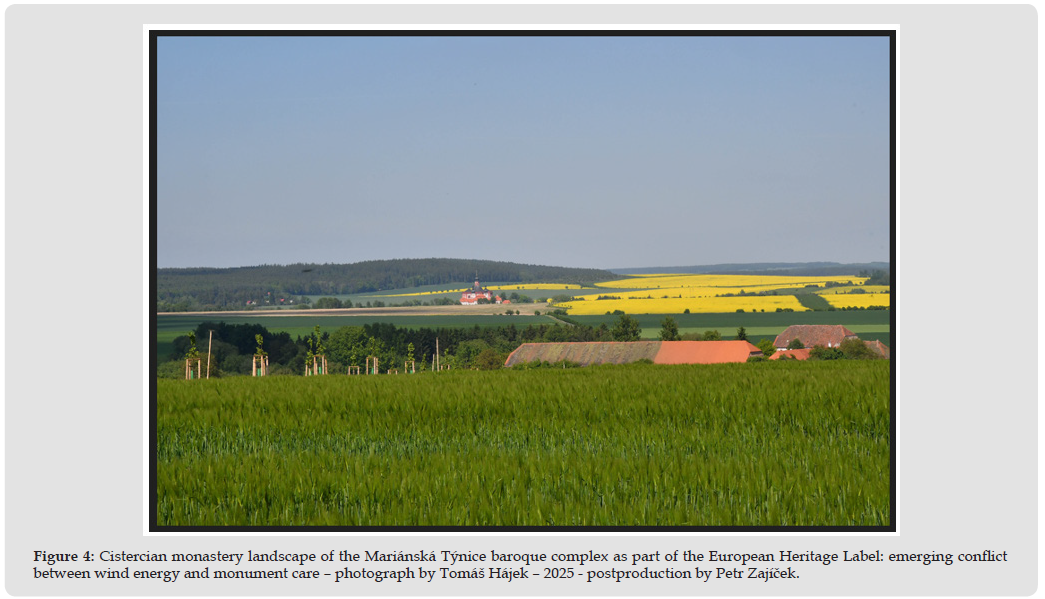
This is an example of a major conflict between development of renewable energy sources and wind energy in particular, and cultural heritage protection. Wind powerplants are situated on hilltops along the entire route in Spain, which poses a clear problem as regards the visual value of the traditional cultural landscape [15]. This study considers a key factor of the visualisation approach used in the case of Vézelay to be the fact that the area under examination je 30 kilometres from the historic building and anything at a greater distance is considered irrelevant [16]. It is important to note that wind powerplants are visible within 30 km (in mountainous areas) to 80 km (in lowlands). The distance up to 10 km from a historic building is typically considered with regard to the impact of a wind powerplant on the historic environment and a distance of 5-7 km from a historic building is considered sufficient [17]. Expert literature studies the issue of visibility in a visual analysis also with regard to the differentiation scale: a scheme including a scale of visibility for distances of up to 30 kilometres in the following manner was created in the 1980s: 0-3 km is considered a short distance, 3-10 km is a middle distance, and 10-30 km is considered a long distance. The maximum detail can be distinguished at a short distance, buildings can still be differentiated from the environment at a middle distance, and only schematic scenery can be distinguished at a long distance [18] (Figures 2-4).
Figure 2
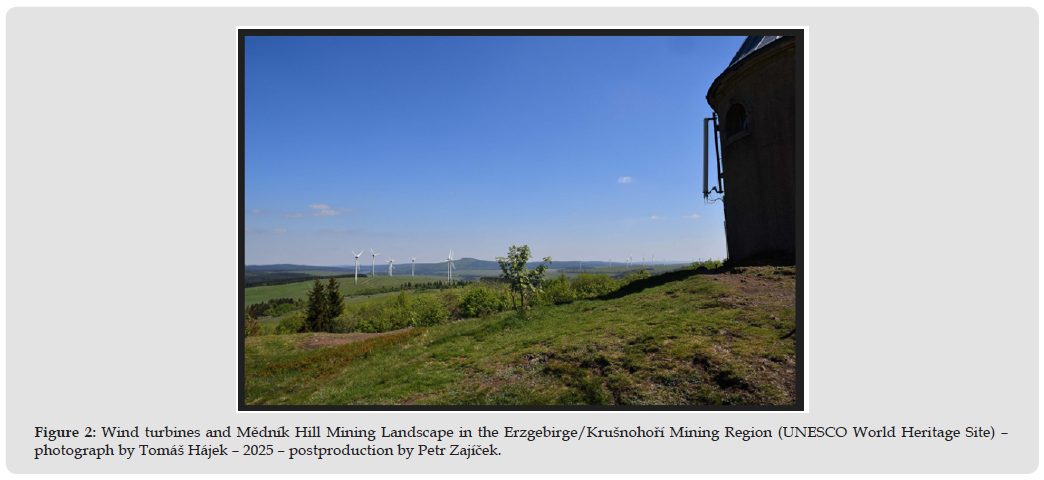
Figure 3
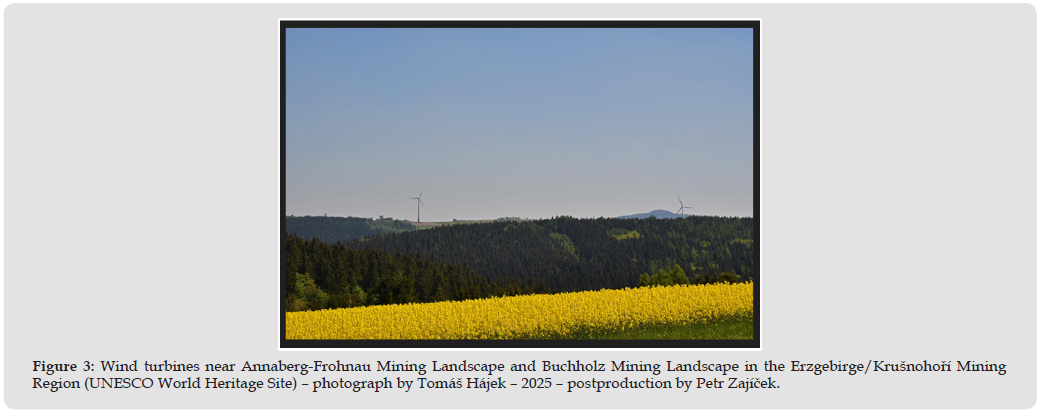
Figure 4
High-Tech Wind Energy Landscape: This study supports the approach according to which a single wind powerplant is seen as a newly constructed dominating feature in a traditional cultural landscape, while groups of wind powerplants are considered change the character of a traditional cultural landscape entirely, creating a high-tech landscape. Approaching a traditional cultural landscape with high number of wind powerplants grouped into wind farms as a high-tech landscape is new aestheticism. The futuristic dimension of dynamically working wind powerplants and the lack of emissions is a key factor. This distinction can be found in specialised literature and is associated with the Czech landscape architect Ivan Vorel. This study adds the following to this topic: A high-tech wind energy landscape is a landscape that maximises the options for interpreting the European Landscape Convention and the UNESCO World Heritage and Wind Energy Planning document. The traditional cultural landscape is fully occupied with the development of wind energy, yet this development does not disregard other values in the landscape, including monument values.
A high-tech wind energy landscape in this sense represents an ideal, but the other side of the same coin should also be considered: from the perspective of phenomenology, a high-tech wind energy landscape is not strictly a high-tech landscape in the inner sense, as there are landscapes with elements at a much higher technical level. A high-tech wind energy landscape is high-tech mostly on the outside, yet operates gradually and discretely as a processor. Examination of the reverse side of the ideal shows that a high-tech wind energy landscape is essentially fusion of the mankind and the Earth, as wind originates in the Earth’s ecosystem. A high-tech wind energy landscape is authentic expression of current industrial abilities, yet at the same time has its archaic aspects. When looking at a high-tech wind energy landscape, an observer cannot but wonder why the mankind did not discover wind energy earlier. Compared to controlled nuclear fission or the massive effort of world’s scientists to create functional nuclear fusion for power generation, wind energy is relatively simple. A high-tech wind energy landscape therefore has to contain the ambivalence of the truth and illusion. Truth and illusion in what sense? The truth in the sense that wind energy may be highly effective as a major supporting power. The illusiveness stems from the fact that the massive planetary unit is highly unstable, in particular during dramatic times that may result from climate change and subsequent migration waves, not to mention wars.
To use a metaphor: A high-tech wind energy landscape says: the universal future of the mankind can be seen through me, yet I bind the mankind to the Earth and the Sun, to the archaic man of the past. The aesthetics of a high-tech wind energy landscape is immense, evoking bright white bandages covering an old wound, the fact that the same archaic man hides under the facade of modern technology. As a high-tech wind energy landscape binds us to the Earth and the Sun, it prompts us to reflect on the idea of renewability in more detail. The planet Earth as an ecosystem is entirely non-renewable and the same applies to the Solar System. Renewability can only be described when examining a very short interval; renewability is relative and depends on the scale. If it is true that the mankind is destined for the universe (and there is nowhere else to go), and the dynamics of a high-tech wind energy points to this direction, large scales must be considered. However, renewability of wind energy on these large scales is only temporary, and renewability is metaphor for the external comparison of the conventional power generation using fossil fuels and wind energy, which is also bound to the Earth and the Sun, yet differently. To sum up: while a high-tech wind energy landscape is a positive value, its connection to the archaicity of the traditional man bound to the Earth and the Sunn cannot be ignored. This archaicity covertly existing in a high-tech wind energy landscape points to the hidden non-renewability of renewable resources.
Phantom Landscape: The amendment of monument care laws in Germany at the level of individual federal states in the sense of carving into the protected historic environment of a monument is a step towards creating a phantom landscape. Firstly, the opinion voiced previously in this study should be reiterated: A monument is an aesthetic idea projected from the surroundings of the historic building. When the surroundings of the historic building are eliminated, there is nothing to project, even though the historic building continues to exist. However, it will not exist much longer, as it is bound to deteriorate under general disinterest or even be demolished. This is because the historic building without its historic environment becomes a phantom. The frontal collision of the development of wind energy and monument care may eventually escalate in a situation, where monument care will need to be abandoned instead of being discredited by protecting historic buildings without their historic environment. If monument care is forced to discontinue its efforts, this will unavoidably lead to discussion on the irrationality of the current development of wind energy, since it is unable to recognise renewability from non-renewability. Finally, the following question will be posed: is the energy produced by the force of wind in the style assumed by its development, for example by the German Wind-am-Land-Gesetz, renewable? Is it possible that it consumes something else, something that may burden the overall balance to the point that wind energy becomes non-renewable? This is certainly the case.
If monument care is forced to preventively cease its activities as a result of dramatic development of wind energy, it would mean that the cultural identity is no longer protected by anyone or anything. This would mean that wind energy, despite its demands on material and other resources, has consumed sources of cultural identity, the cultural assets entirely. Wind powerplants would then fail to be real wind powerplants in the context of energy from renewable sources. Instead, they would be phantoms of wind powerplants. The landscape created by Wind-am-Land-Gesetz is a phantom landscape. In this landscape, phantoms of new wind powerplants face the phantoms of historic buildings. A high-tech wind energy landscape is a positive value with an ambivalent basis pointing to the universe, and a phantom landscape represents violence in fumbling. A phantom landscape points to the development of energy that appears to be renewable on the outside, yet draws on non-renewable sources as it drives the identity out of the traditional cultural landscape, transforming it into a cultural desert. It is contrary to the European Landscape Convention and UNESCO’s stance on the issue of wind energy and monument care, as UNESCO does not recommend softening monument care laws to allow for unrestricted boom of wind energy.
Vision of Wind Energy Seascape: This study is written from the perspective of protection of the traditional cultural landscape, specifically the European cultural landscape. The concept of a high-tech wind energy landscape as opposed to a phantom landscape applies to the traditional cultural landscape, including wind powerplants on seashore and near-shore wind energy. The relationship between seascape and the development of wind energy is a new, emerging chapter. One can only assume that a wind energy seascape has the potential for creating a highly sophisticated high-tech wind energy landscape of an entirely new kind. Such landscape would appear as a cosmic landscape placed on the planet Earth, as if a transfer station on the way to the cosmos still here on the planet Earth. A wind energy seascape from the aesthetic point of view is the highest level of a hightech wind energy landscape, less burdened by the ambivalence typical for a high-tech wind energy landscape in the traditional cultural landscape. A wind energy seascape cannot be occupied only by the archaic mankind bound to its archaicity. It needs a mankind ready to change itself and embrace cosmic scales. However, the topic of wind energy seascape only seems to be an emerging chapter to be filled with new content as the relevant areas grow. While gazing towards cosmic scales, even a wind energy seascape is bound to the Earth and the Sun.
On the Causes of Great Social Controversy between Wind Energy and Monument Care
Wind energy is not accepted with confidence. It triggers mistrust, even irrational mistrust and is subject to great social controversy [19- 26]. What is the cause of this irrational mistrust? After all, wind energy carries a great potential for compromise with other public and private interests [27]. This study has identified two possible reasons from its perspective:
a) Non-existence of a universal anthropological and aesthetic platform for resolving the conflict between wind energy and monument care, mainly in the traditional cultural landscape. This study proposes the following triad as an anthropological and aesthetic platform for resolving the conflict between wind energy and monument care: a high-tech wind energy landscape, a phantom landscape and the vision of wind energy seascape. Individual questionable cases of new wind powerplant placement in a landscape could be resolved by dialectic assessment of the triad elements.
b) Wind energy seems to be suspected of not being entirely transparent, in particular in recent times. This study proposes explanation of this irrational mistrust by demonstrating that this mistrust in fact is rational. Completed analyses show that consensus between wind energy and monument care can be found, as long as a fair and open game is played. Once signs of a hidden agenda occur, a phantom landscape is being created, provoking groups of people who feel that something is threatened and should be protected without knowing specifically what to protect. Almost fanatic irrationality in the clash of wind energy with monument care shows that the main issue may lie elsewhere. This may be the meta-justification of the absolute priority of renewable resources. Monument care than acts not only as an authority protecting monuments, but also as a corrective force for the void meaning behind speaking truth, which results in phantomization of cultural monuments, as well as wind energy, as it becomes the victim of this process.
The author would like to thank the Study and Scientific Library of the Plzeň Region for their help with researching the topic. The author would like to thank for support in examining the topic of this study to:
Břetislav Koč
Kristina Langarová
No conflict of interest.


 Abstract
 PDF
PDF






























