info@biomedres.us
+1 (502) 904-2126
One Westbrook Corporate Center, Suite 300, Westchester, IL 60154, USA
Site Map
 ISSN: 2574 -1241
ISSN: 2574 -1241
ISSN: 2574 -1241
Received: May 16, 2025; Published: May 23, 2025
*Corresponding author: Mohammad Reza Hassibian, Department of Medical Informatics, Faculty of Medicine, Mashhad University of Medical Sciences, Mashhad, Iran
DOI: 10.26717/BJSTR.2025.62.009679
Objectives: Sending messages to both patients and physicians can play an important role in preventing irrational
drug prescriptions. The purpose of this study was to evaluate the effect of SMS-based messaging on general
practitioners and patients to reduce dexamethasone prescriptions.
Methods: In this RCT, 38 physicians of 63 general practitioners who prescribed Dexamethasone were selected in
spring of 2016. Physicians who prescribed dexamethasone were assigned to the intervention and control group.
Sending messages was done in two phases. First phase was sending SMS to the patients who were supposed to
be visited by the physicians in the intervention group. Second phase, messages were sent simultaneously to both
patients and physicians of the intervention group. The study was evaluated in seven periods of time.
Results: The results showed that, the ratio of prescriptions containing dexamethasone, Control and intervention
group physicians At the end of the process of sending SMS to patients Also, sending simultaneous SMS to physicians
and patients there was no significant difference between the two groups (P>0.0 5).
Discussion: In our study society, sending text messages to patients and both physician and patient simultaneously
could not change the behavior of both physicians and patients to reduce the prescriptions containing
dexamethasone.
Conclusion: There may be other factors which we have not considered in our study such as age, sex, education,
and economic and cultural situation affecting the behavior of both physicians and patients which remains to be
considered in future studies.
Keywords: Dexamethasone Prescriptions; Feedback Effect; Text Messaging; RCT; Iran
Logical prescribing of medicine by physicians is a basic principle of policymaking in developing countries. According to the statistics, in 2011 the average growth rate of drug use in Iran was about 11.5%, 7% in developing countries, and 9% worldwide [1,2]. Excessive drug prescriptions by physicians as well as the patients’ request for medication are two of the most common reasons for the growth of drug usage [3,4]. In the future, prescriptions of injectable drugs are more likely to increase than other drugs [5]. One such drug is dexamethasone injection, which is a corticosteroid that has potent anti-inflammatory properties and is used to treat a wide range of diseases. On the downside, using dexamethasone not only has side effects for the digestive system, eyes, bones, cardiovascular system, and the nervous system, but also increases the cost of treatment for the patient and places a heavy burden on the healthcare system of the country [6-8]. According to studies conducted in Iran, the prescription of corticosteroids is questionable [4,5,9]. A study of 100 million drug prescriptions performed in Iran (1998) showed that 12.7% of prescriptions were for corticosteroids, an increase of 23% in 2007 [10]. In another study performed in Iran between 2007 and 2011 showed the rate of prescriptions of these drugs increased by 50%, of which 30% belonged to dexamethasone. According to a study done by (Soleimani, et al. [11]), dexamethasone ranked first among ten prescribed drugs in 2007-2012. The study also showed that the patient’s request for dexamethasone doubled since 2007 compared to 2010.
Also, the cost of dexamethasone injections increased by 3.6% since 2007 compared to 2010 [11,12]. With this in mind, there is a significant need to remind the side effects of the dexamethasone through mobile messaging and email tools. Sending informed messages is one solution that is widely used nowadays to increase awareness. The messages could be designed to serve as feedback for a specific behavior. For example, sending messages to physicians who prescribe numerous amounts of drugs is a kind of feedback message. Feedback is a theory-based concept that reinforces or modifies behaviors that leads to positive behaviors and modifies negative behaviors [13,14]. Several studies have examined the effectiveness of feedback-based messages in the field of medicine and most of those studies have shown improvement in the quality of clinical care. [15-18]. However, another research indicates the lack of effectiveness of this method [19]. Considering the controversial results of these studies as well as the lack of similar studies, we have conducted this randomized clinical trial to evaluate the effectiveness of using SMSs on patients and general practitioners simultaneously to reduce the rate of prescriptions of dexamethasone.
Study Design
In this study, the effect of text-based messaging was evaluated based on a Randomized Controlled Trial (RCT) with a 1: 1 assignment rate. The study lasted about ten months and was conducted at one of the medical clinics in Mashhad.
Participants
The drug prescriptions of general practitioners who were practicing in healthcare clinics were extracted from the database of the Food and Drug Prescriptions of the Mashhad University of Medical Sciences (all prescriptions were from the three months of spring 2016). The criteria for entering the study were working as a general practitioner in a healthcare clinic and having prescribed dexamethasone (based on the median percentage of dexamethasone prescriptions). By calculating the median of each category, the categories were again stratified into two parts: a) above the median percentage, and b) lower than the median percentage, by using Excel 2010 software by dividing each section randomly into two groups, the intervention and control. Finally, 19 physicians were assigned to the intervention group and 19 physicians were assigned to the control group (Figure 1). The patients admitted to the intervention group of physicians were asked to give their mobile phone number to the admission officer. Patients received three text messages at a time interval of one minute, describing the side effects of dexamethasone and asking them not to request their attending physician to prescribe this drug for them.
Study Timeline
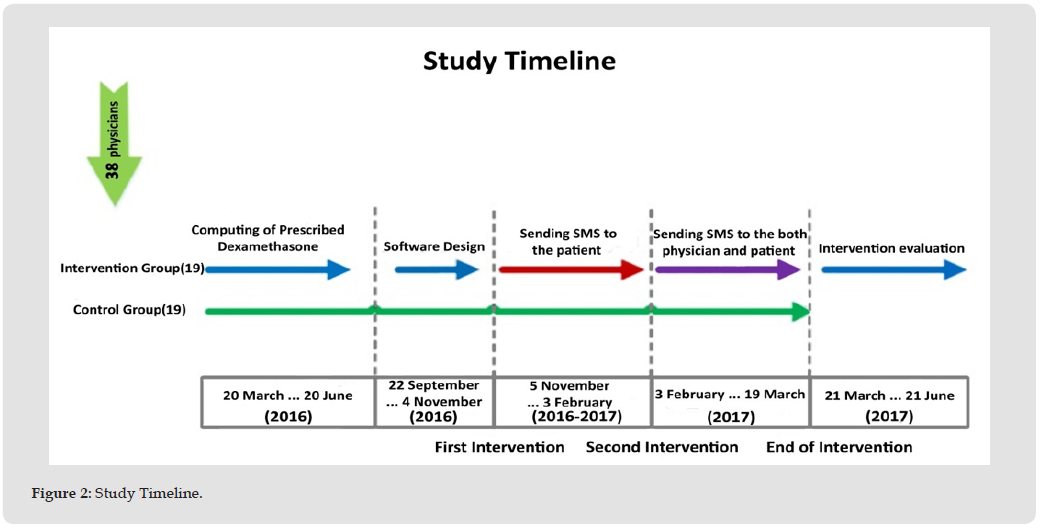
Study timeline for this trial is displayed in Figure 2.
Figure 1
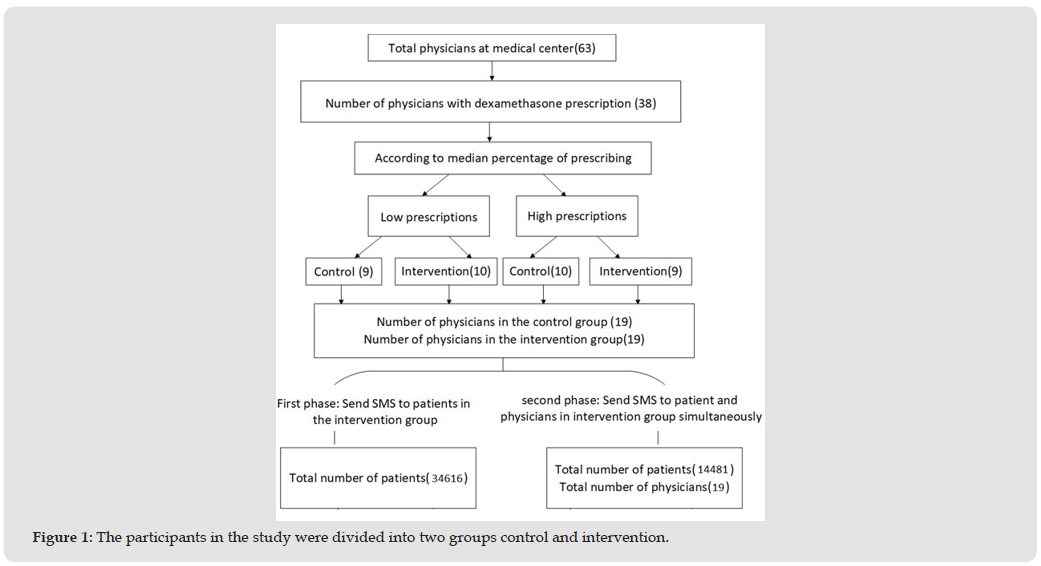
Figure 2
Intervention Design
Sending SMSs was done in two phases:
• Phase 1: SMSs were sent to patients in the intervening group from November 5 to February 3, 2016, at a time interval of one minute. The purpose was three-fold:
1) to dissuade patients from insisting that their physician prescribe dexamethasone for them,
2) to trust their physician, and
3) to inform patients about the disadvantages of using dexamethasone. These SMSs were sent through the computer system deployed in the clinic. No messages were sent to patients referring to physicians in the control group. This process lasted for ninety days.
• Phase 2: Next, text messages were sent to physicians and patients in the intervening group. After completing the first phase, text messages were sent to physicians and patients simultaneously. Physicians of the intervention groups received text messages regarding the status of their dexamethasone prescriptions. These messages included percentages of prescriptions including dexamethasone that they gave within one and half months, from 5 November to 20 December 2016. These messages were sent five times in an equal period and this process lasted for forty-five days. A total of 121,229 messages were sent to 49,097 patients and 80% of the patients reported receiving the messages.
Outcome Measure and Statistical Analysis
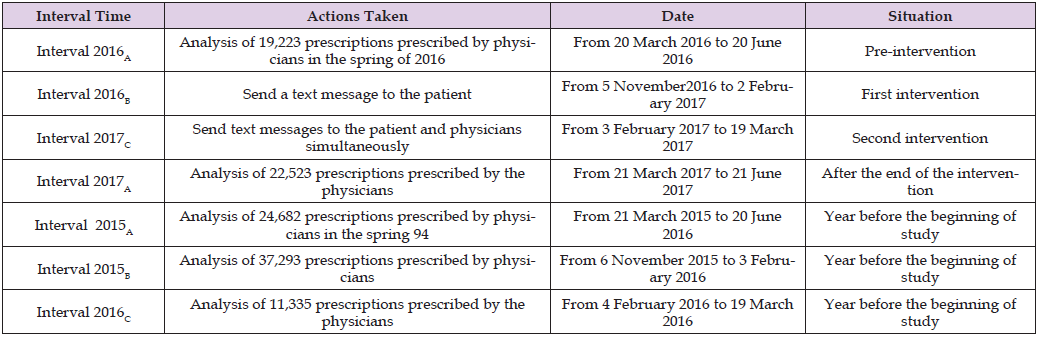
The main outcome of this study was obtaining the ratio of prescriptions including dexamethasone to the total number of prescriptions prescribed by each physician. For this purpose, the prescriptions of each physician were collected after the intervention. Also, the amount of dexamethasone prescribed by physicians in the control and intervention groups was extracted. Statistical significance of the two-tailed analyzes in this study with 95% confidence interval and an alpha level less than 0.05 was performed. Descriptive statistics (percentage, average, etc.) and inferential statistics (normalization test in four time intervals in the control and intervention groups were analyzed separately by the Kolmogorov-Smirnov test and paired samples t-test for comparison of the groups) (Figure 2). Paired samples t-test analysis was used to compare the percentage effect of prescribing dexamethasone used in different periods. Since prescribing dexamethasone may be dependent on seasonal changes, we observed an irregular trend in data in 2016. Hence, we also collected data for the year 2015, and we saw that this seasonal and irregular trend is also present in the data of this year. Therefore, the comparison of data before and after intervention in 2016 was not correct (Table 1). That is why we extracted the data of the year 2015, and whenever we performed the intervention in 2016, we compared the corresponding time interval to the year 2015. Therefore, the paired samples t-test was used to evaluate the impact of text messaging on patients and simultaneous messaging to patients and physicians in the intervention and control groups to increase the matching of the comparisons. All statistical analyzes were performed using the software SPSS version 21 (Figure 3).
Figure 3
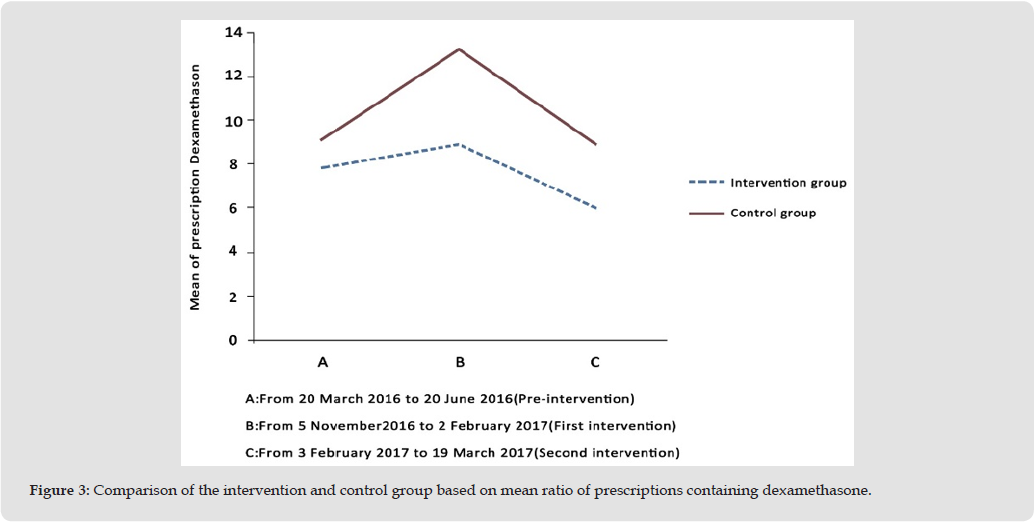
Table 1: Time intervals and actions taken.
Ethical Issue
This study was registered at the IRCT ID: IRCT2017020532395N and approved by the Ethics Committee of the Research Committee of Mashhad University of Medical Sciences (MHR: IR.mums. fm.REC.1395.195, dated: 4/13/2016). Participants’ information were used as anonymous.
The current study was able to determine the ratio of dexamethasone prescriptions written by physicians to total dexamethasone prescriptions, which was calculated using the following formula: Evaluation index for each physician I=pi

In order to evaluate the effectiveness of the interventions, the ratio of prescriptions containing dexamethasone to the total number of prescriptions in the seven periods of time was calculated.
Comparison of the Number of Prescriptions Containing Dexamethasone to the Total Number of Prescriptions in the 2015B and 2016B Time Periods
In the intervention and control groups in the 2016B interval, the ratio of prescriptions containing dexamethasone to the total number of prescriptions was 7.96±6.48 respectively, and in the control group it was 7.91±9.91. According to the independent samples t-test, there was no significant difference during this time (p-value=0.23). It should be noted that during the same period in the year before the study started, the ratio of prescriptions containing dexamethasone to the total number of prescriptions in both the intervention and control groups were 10.83± 8.25 and 17.09 ± 10.17 respectively. Again, according to the independent samples t-test, there was no significant differences in both the intervention and control groups (p-value= 0.22) as shown in Table 2. The paired samples t-test was used to compare the control groups with each other, as well as to compare the intervention groups at the intervals 2015B and 2016B. The results indicate that there is no significant difference between the mean ratio of prescriptions containing dexamethasone to total prescriptions in the control groups (p-value=0.327) and intervention (p-value=0.478) as shown in Table 2. In other words, sending a text message to patients did not affect the ratio of prescriptions containing dexamethasone to the total prescriptions.
Table 2: Comparison of the number of prescriptions containing dexamethasone to the total number of prescriptions in the 2015B and 2016B interval.

Comparison of Dexamethasone Manifestation to Total Prescriptions in the 2016C Interval and 2017C Intervals In the 2017C time interval, the ratio of prescriptions containing dexamethasone to the total number of prescriptions in the intervention groups (physician and patient) and the control group was 6.37±6.8 and 9.30±8.01 receptively, which indicates no significant difference in this period (independent samples t-test, p-value=0.28). It should be noted that during the same period of the same year before the study, there was no significant differences in the ratio of prescriptions containing dexamethasone to total prescriptions in the period 2016C (independent samples t-test). The computed ratio was 14.39±12.9 and 18.6±22.67 in the intervention (both physician and patient) and control groups respectively (p-value=0.53) as shown in Table 3. The paired samples t-test was used to compare the control groups with each other, as well as to compare the intervention groups within the 2016C and 2017C time intervals. The results indicate that there is no significant difference between the mean ratio of prescriptions containing dexamethasone to total number of prescriptions in the control groups (p-value=0.098), while there is a significant difference in the intervention group (p-value=0.03) as shown in Table 3. Therefore, sending a text message to the physician and the patient simultaneously did not have an effect on the ratio of prescriptions containing dexamethasone to the total number of prescriptions. However, the physician’s performance relative to himself improved in comparison with the previous year before the intervention.
Table 3: Comparison of Dexamethasone manifestation to total prescriptions in the 2016C interval and 2017C intervals.

Comparison of the Number of Prescriptions Containing Dexamethasone to the Total Number of Prescriptions in the 2016A and 2017A Intervals
In the 2017A time period, the ratio of prescriptions containing dexamethasone to total prescriptions in the pre and post intervention interval in both the intervention and control groups was 5.90±5.54 and 6.79±7.79, respectively. There was no significant difference in that time interval according to the independent samples t-test (p-value= 0.27). It should be noted that during the same period of the year before the study, the ratio of prescriptions containing dexamethasone to the total number of prescriptions both in the intervention and control groups in the 2016A time interval was 6.23±7.83 and 7.95±9.10 respectively. According to the independent samples t-test there was no significant difference at the desired time (p-value=0.58) (Table 4). The paired samples t-test was used to compare the control groups with each other, as well as the comparison of intervention groups with each other in 2016A and 2017A. The results indicate that there is no significant difference between the mean ratio of prescriptions of dexamethasone to total prescriptions in the control group (p-value= 0.18), while there is a significant difference in the intervention group (p-value=0.017). In other words, the physician’s performance compared to himself has improved over the course of the last year before the intervention took place (Table 4). Graphs related to the effect of intervention in both phases are shown in Figure 3. The prescriptions including dexamethasone in control group was more than intervention group in time interval B in comparison with other times. Mashhad is a tourist city and the clinic was located in the tourist area of the city. These caused increasing of the number of dexamethasone prescriptions in both groups. However, because the intervention group improved their performance toward themselves, this increase was seen in the control group.
Table 4: Comparison of the number of prescriptions containing dexamethasone to the total number of prescriptions in the 2016A and 2017A intervals.

In this randomized clinical trial (RCT), decreasing the usage of dexamethasone through sending text messages to patients alone and to patients and general practitioners simultaneously was investigated. Findings of the study indicate that sending texts to physicians and patients simultaneously and sending text messages only to patients to reduce the prescriptions of dexamethasone is not effective. In this study, the efficacy of sending informative messages only to the patient did not affect the amount of dexamethasone prescribed. We think that this result can be related to demographic characteristics that affect SMSs as an effective intervention. Also, 20% of patients did not receive the SMSs (due to server downtime), which could also be a reason for the ineffectiveness of the intervention. Due to the fact that in Iran many messages are sent via SMS to mobile subscribers, it can be argued that many of the patients studied did not observe their content with the assumption that the messages were advertisements. Other reasons why we could not see the effect of the intervention were confounding variables that were not the subject of this study such as age, sex, literacy rate, and socioeconomic status of individuals. One of the issues that has always been raised by physicians is the insistence of patients on prescribing drugs based on self-diagnosis or their personal experience. According to our research, a similar study has not been conducted in Iran in this regard; hence, we are not able to compare the outcome of our study with others.
Based on the literature review, the current study is the first randomized clinical trial that has been designed and implemented using short messages for simultaneous feedback to physicians and patients and the results were not positive, as previously stated. It seems that one of the probable reasons for obtaining not significant results is the use of non-threatening SMS content. Due to the lack of similar studies, only studies that were done on physicians were used for comparison. In a study conducted by (Saraf-Nejad, et al. [17]) on the effectiveness of sending SMSs regarding the prescribing of dexamethasone, the study’s SMS content contained a threat concept and was sent via the Social Security Insurance Organization. The effectiveness of both text and letter messaging was reported in the decreasing of dexamethasone prescriptions [17]. However, in a similar study by Vaegter et al. in 2010, no positive effect was found for reducing drug prescriptions using letters send by the postal service [20,21]. In a similar study by (Elouafkaoui, et al. [16]), using text messaging and linear gradient graphs showed an improvement in the prescribing of antibiotics after multiple interventions [16]. In a study by (Thampi, et al. [22]), the use of postal letters in reducing the usage of antibiotic prescriptions in physicians did not result in a decrease of prescriptions [22]. In a three-month study conducted by (Armstrong, et al. [23]), the effectiveness of fax-based messaging on the reduction of antibiotic prescriptions on both the intervention and control groups was not observed [23]. The reason may be because of using an old technology (i.e., fax machine) that is not available to the general population.
It should be noted that the timeframe to send messages and the way messages are sent are very important. Messages should be sent continuously over time so that its effects can be seen. In the study of (Saraf-Nejad, et al. [17]), the text messaging period was determined to be ten months and positive results were reported [17]. So, the positive and negative results of text messaging may be related to the time factor. There are many other factors such as age, gender, and socioeconomic status that may affect the results of text messaging (age and gender were not effective in Sarafi-Nejad et al.’s study, but the number of sent messages was effective as a consequence of the intervention)
Study limitations were not receiving text messages by patients due to network downtimes and the lack of cooperation from some patients in giving their mobile number.
In our study society, sending text messages to patients and both physician and patient simultaneously could not change the behavior of both physicians and patients to reduce the prescriptions containing dexamethasone. In another words, there may be other factors which we have not considered in our study such as age, sex, education, and economic and cultural situation affecting the behavior of both physicians and patients which remains to be considered in future studies.
The authors would like to acknowledge Mashhad University of Medical Sciences for financial support and also thank physicians and staff of outpatient clinics and all patients for their collaboration in this study.
Mashhad University of Medical Sciences.
There are no conflicts of interest.

International Association of Landscape Archaeology, Czech Glass Society, Czech Republic

Department of Chemistry, Semenov Institute of Chemical Physics, USSR Academy of Sciences, Moscow, Russia

Neurology, LA BioMed Research Institute, USA

Associate Professor at Department of Breast and Thyorid Surgey, Chongqing General Hospital, China

Professor of Nuclear Medicine, Faculty of Medicine and Surgery, University of Milan, Milan, Italy





 Abstract
 PDF
PDF



























