info@biomedres.us
+1 (502) 904-2126
One Westbrook Corporate Center, Suite 300, Westchester, IL 60154, USA
Site Map
 ISSN: 2574 -1241
ISSN: 2574 -1241
ISSN: 2574 -1241
Received: April 29, 2025; Published: May 14, 2025
*Corresponding author: Fahad Alrowais, Dermatologist, Prince Sultan Military Hospital, Riyadh, Saudi Arabia
DOI: 10.26717/BJSTR.2025.61.009664
Background: Acne is a common chronic inflammatory skin condition that affects millions of individuals worldwide.
The objective of this study is to systematically review and synthesize qualitative papers exploring views
and experiences of acne and its treatments among people with acne.
Methods: The design of the study is based on a systematic review and synthesis of qualitative papers. Papers
are identified through (6) data sources which are searched in the English language from 1985 to 2020. Inclusion
criteria were studies reporting qualitative data and analysis, studies carried out among patients with acne. Three
researchers independently screened the titles and abstracts of papers. A total of (22) papers were included.
Papers explored acne patients’ experiences, impacts of acne, and perceptions of acne treatments.
Results: The findings showed that patients often viewed acne as short-term and that this had implications for
acne management, particularly long-term treatment adherence. Patients often felt that the substantial impact of
acne was not recognized by others, or that their condition was trivialized by Healthcare Professionals (HCPs).
The sense of a lack of control over acne and control over treatment was linked to both psychological impact and
treatment adherence. Concerns and uncertainty over acne treatments were influenced by variable advice and
information from others.
Conclusion: the patients need support with understanding the long-term management of acne, building control
over acne and its treatments, and acknowledging the impact and appropriate information to reduce the barriers
to effective treatment use.
Keywords: Acne; Patients; Treatments; Systematic Review; Thematic Synthesis
People of all ages are susceptible to acne, a chronic inflammatory skin disorder that has a major influence on people’s self-esteem, mental health, and general happiness [1]. Inflammation, sebum production, bacterial colonisation, and follicular hyperkeratinization are the variables that interact to cause acne [2]. The production of excess sebum by sebaceous glands is an important factor in the development of acne and the creation of comedones. Even further blockage of the hair follicles, caused by follicular hyperkeratinization, results in the development of microcomedones. Inflammation causes nodules, cysts, pustules, and papules to develop when the Propionibacterium acnes colonises these blocked follicles. The aetiology of acne vulgaris is complex and includes environmental variables, hormonal impacts, and genetic predisposition [3]. Lesions such as comedones, papules, pustules, nodules, and cysts are the hallmarks of acne [4]. Acne may be mild, moderate, or severe, and it can leave scars and post-inflammatory hyperpigmentation in its wake. A person’s sense of self-worth, body image, and relationships with others may be greatly affected by the outward look of acne lesions. In instance, acne vulgaris may cause emotional discomfort, social exclusion, and a worse quality of life, especially in adolescents [5]. To provide comprehensive treatment and meet the specific requirements of those afflicted by acne, it is essential to understand the psychological consequences of the condition [6].
Patients’ opinions on acne treatments have been under investigation [7]. When it comes to acne treatments, people have different perceptions than doctors and nurses. Some people may have great success with certain therapies that improve their acne and general health. For others, the ineffectiveness of acne treatments or unpleasant side effects could be enough to drive them to give up [8]. Additionally, some people may become irritated if they don’t see instantaneous benefits after using acne treatments. One way to keep realistic expectations in check is to know that clearing up acne usually takes time and regular effort. In addition, adverse effects are a possibility with certain acne treatments, particularly those that include systemic medicine [9]. Some people may stop taking the medication altogether if these side effects become too much for them to bear, while others may have varying levels of tolerance for them. Patients need to know the possible advantages and disadvantages of therapies so they may make educated choices [10]. A number of studies have shown that acne negatively affects people’s psychological and social health [11,12]. Individuals seek out acne treatments with the hopes of enhancing their physical appearance, self-esteem, and general sense of contentment. Some patients may have a favorable impression of their therapy’s efficacy, while others may point out problems such treatment response variability, adverse effects, and treatment length [13].
Acne patients often have high hopes for the results of their treatments, hoping for visible and dramatic changes as soon as possible [14]. When patients have unrealistic expectations about their therapy, they may be disappointed when the outcomes fall short of their expectations. In order to establish mutual understanding between patients and healthcare providers, it is crucial to communicate effectively and manage patients’ expectations. For some people, it might be difficult to stick to treatments for acne vulgaris. Complications of therapy, adverse effects, patients’ perceptions of their effectiveness, and their level of motivation all have a role in patients’ levels of adherence [15]. Some people may choose topical treatments, while others may choose systemic medications or procedural procedures as their preferred therapy methods [16]. Thus, the purpose of this theme synthesis and systematic review is to synthesize patients’ views on acne treatments to provide evidence for a better therapy for this group. We can learn a lot about how patients feel about the effects of acne treatments from the results of the systematic review and thematic synthesis. To provide holistic therapy, it is essential to identify and address the social, emotional, and physical effects of acne vulgaris. Healthcare practitioners, academics, and lawmakers may use this review’s results to better treat acne and create patient-centered methods.
Data Sources and Search Strategy
PubMed, Web of Science, Embase, Cochrane Library, Research Square, and ScienceDirect were searched in the English language from 1985 to 2020. In addition, a manual search for the articles that meet the criteria was also conducted. The search mesh terms included (“acne vulgaris” OR “acne” OR “vulgaris” OR “acne treatments” OR “acne vulgaris treatments” OR “vulgaris treatments””) AND (“patients” OR “people” OR “individuals”) AND (“healthcare professionals” OR “health professionals”). The records were managed and screened, and duplicates were excluded using Zotero 6.0.4. Using the Preferred Reporting Items for Systematic Reviews and Meta-Analyses as a guide, we conducted this systematic review and thematic analysis. Conversations with coauthors led to the development of the search method.
To make sure that all relevant phrases linked to acne and qualitative research were covered in the search, the authors included a librarian and utilized the Information Specialists’ Sub-Group search filter resource. This helped with the arduous task of searching for qualitative literature. Qualitative research, according to the authors, consists of articles that include both qualitative data and qualitative techniques of data collecting and analysis. Studies that included individuals with acne were eligible for inclusion in the papers. Qualitative methods of data collection and analysis were also acceptable. The studies could have included more than one skin condition involving acne, or they could have presented qualitative data independently or as part of a mixed-methods study.
Selection Process
Exclusion criteria for the studies were as follows:
a) Studies that do not pertain to the topic of the systematic review; b) Studies that do not provide enough data to draw any conclusions about the efficacy of acne treatments;
c) Studies that have already been published or have participants who have participated in similar studies;
d) studies that cannot confirm the treatment of acne; and e) studies that have used animals as subjects.
The titles and abstracts of the articles were reviewed by three separate scholars. The full-text screening of eligible publications was carried out by a single researcher, who then addressed any doubts with the co-authors.
Data Extraction
Each article’s abstract includes the following information: author( s), publication year, study focus, participants, methods, and results.
Synthesis of Findings
There were three steps to a theme synthesis. The first step was for one of the researchers to code the relevant content (quotes or author descriptors) line by line. Afterward, descriptive themes across studies were developed by organizing the free codes. To make the coding of the data more methodical, a coding manual was created. The highlighted topics were carefully considered and any differences were addressed until a consensus was obtained. Step three included “going beyond” the data to establish analytical themes that, when combined with the original research, provide new insights. Through group brainstorming, we were able to identify overarching themes related to analysis, and then we built a model to illustrate how these themes relate to treatment initiation (the choice to begin treatment) and adherence.
Risk of Bias and Quality Assessment
The qualitative articles’ strengths and flaws were indicated using a modified version of the Critical Appraisal Skills Programme instrument. The researchers included all the documents, no matter how bad they were. Everyone in the research team had their own look at each paper. They discussed and ultimately settled their disagreements over the quality assessment.
Systematic Literature Search
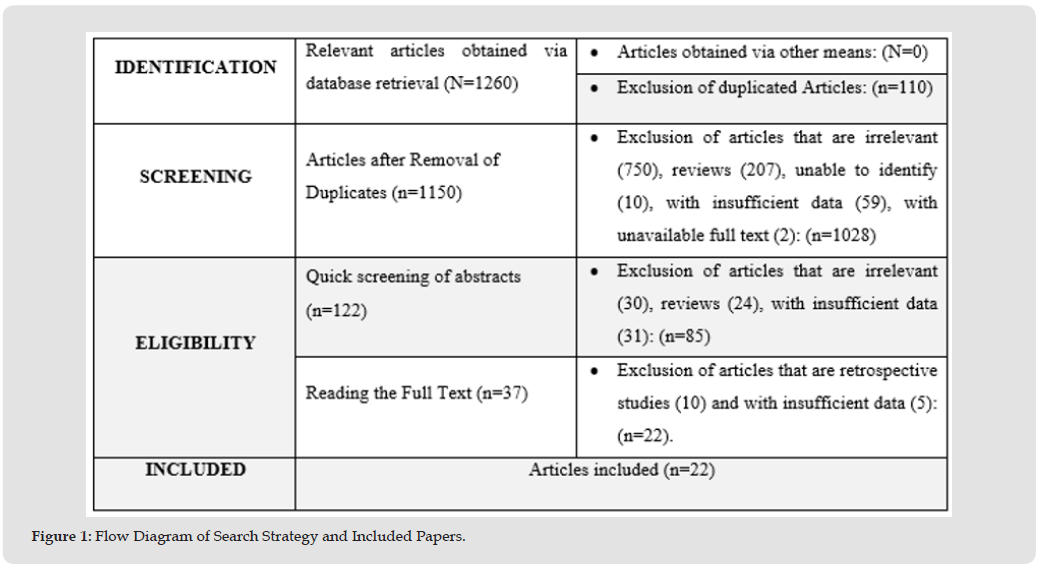
The literature retrieval flowchart is shown in Figure 1. As of 2020, a grand total of 1,260 items that may be of interest were retrieved from various electronic databases. Among these, 306 were found in PubMed, 107 in Embase, 77 in the Cochrane Library, 100 in Web of Science, 13 in ScienceDirect, And 657 in Research Square. A total of 110 records were deemed duplicate after the first screening. The inclusion and exclusion criteria were followed after reviewing the abstracts and titles of 1,028 articles. Then, another 100 records were removed because there wasn’t enough data, the full text wasn’t available, or there was no verified diagnosis after carefully reviewing the abstract and entire text of each publication. In the end, 22 papers met the inclusion criteria and were included in this review.
Figure 1
Study Characteristics
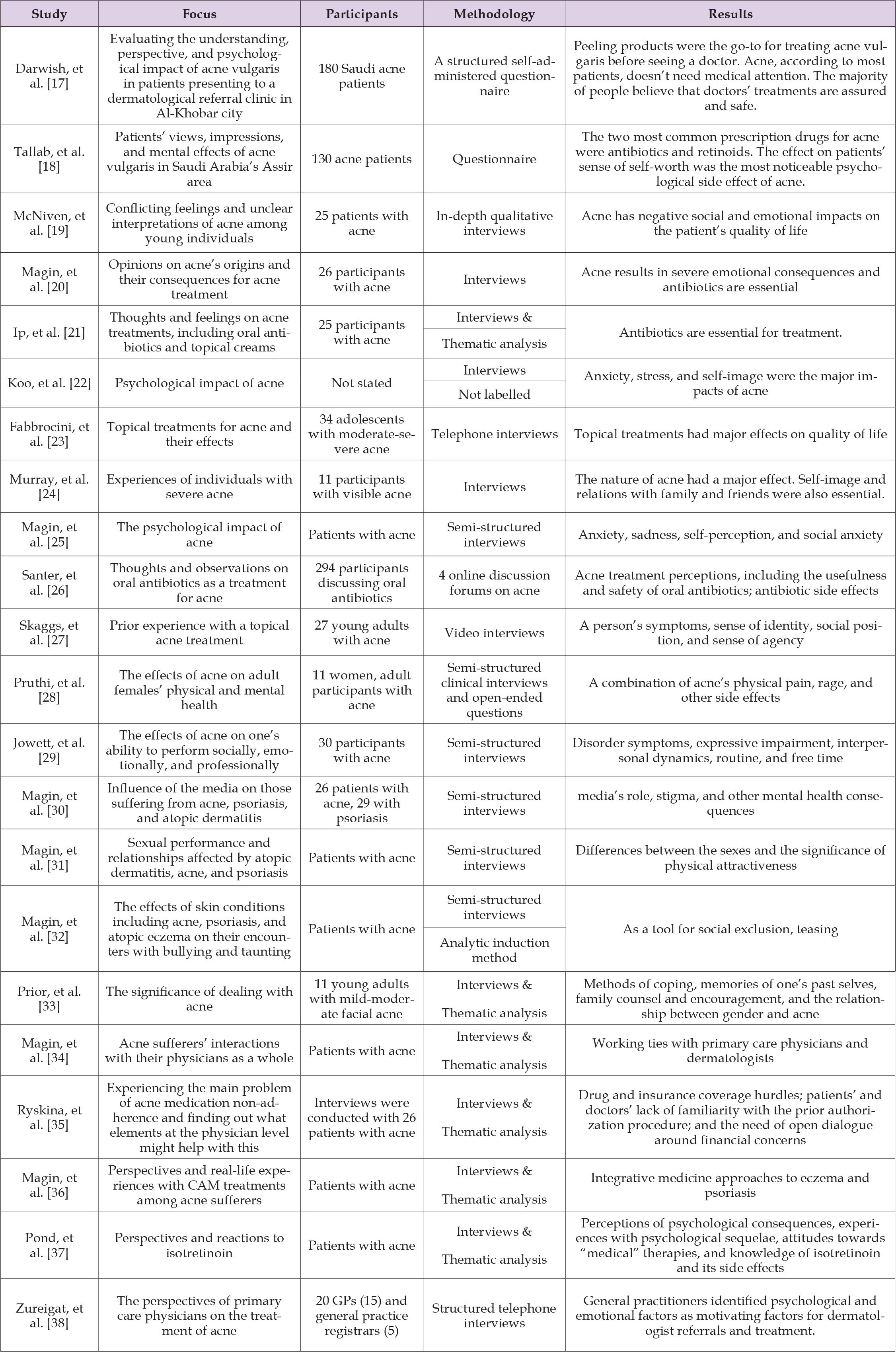
Included studies covered a wide range of subjects, including living with acne, its psychosocial impact, CAM, sexual life and acne, doctor- patient relationships, acne treatment perceptions, acne causation, ambivalence and ambiguity among young people, and the attitudes of health professionals towards acne management. Data was gathered using a variety of means, such as questionnaires, in-person interviews, online written interviews, video or telephone interviews, and online discussion forums. Research was conducted in many nations, as shown in Table 1.
Table 1: Papers Included in the Synthesis.
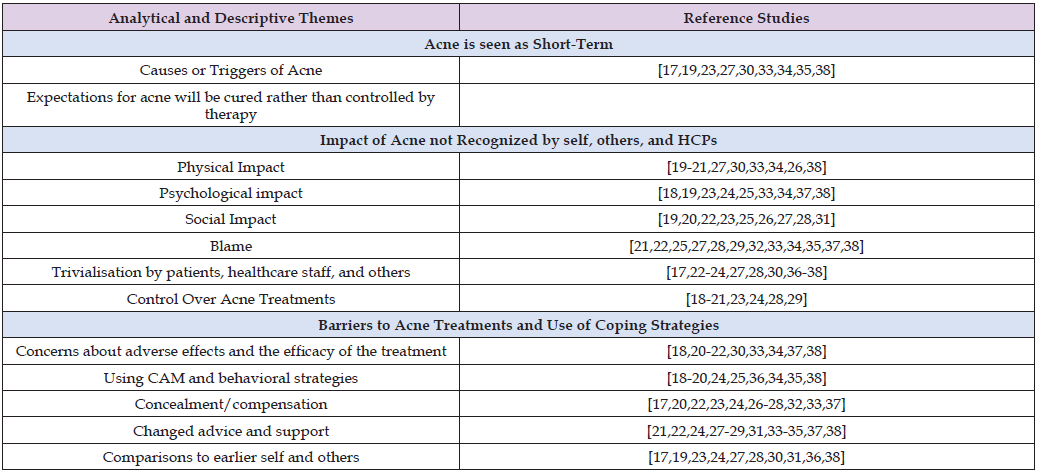
Three main analytical themes emerged from the line-by-line coding’s descriptive themes:
(1) Acne is seen as short-term,
(2) The impact of acne not recognized by self, others, and HCPs, and
(3) Barriers to acne treatments and use of coping strategies. Table 2 shows how the descriptive and analytical themes affect people’s propensity to start and finish acne treatments. Table 2 also provides a summary of the research that addressed each analytical subject.
Table 2: Analytical and Descriptive Themes with Study Reference.
It seems like many acne sufferers didn’t think their disease would last forever and didn’t see the need for therapy. People in the study often didn’t give their acne much thought at first because they thought it would “go away” until puberty or some other factor took control. People did not see their acne as needing long-term care, according to studies, since they believed therapy would eliminate the issue rather than just manage it.
Causes or Triggers of Acne
Acne was often thought to as a “normal” aspect of puberty, according to research. But it appeared like most people’s acne went on for a longer period of time, and some even had it as adults, which caused a lot of stress and uncertainty [17,18]. As a means of “curing” their acne, people sought for other explanations, such as changes to their diet and personal hygiene practices. Dishonest work practices, air pollution, perspiration, cosmetics, and insufficient bathing were all linked to hygiene issues and acne [19,20]. Some items that could contribute to acne include chocolate, soda, fast food, coffee, yeast, and alcohol [21]. According to [21], participants in the study were less likely to cite stress and genetics.
Expectations for Acne will be Cured Rather Than Controlled by Therapy
A common source of disappointment for those seeking medical therapy for acne was the expectation that it would “cure” the condition. Treatment was either ineffective or just somewhat successful, according to participants, who characterized it as “keeping their acne at bay” [22]. In the lack of ‘immediate’ outcomes, this seems to have consequences for acne management, with dissatisfaction leading to early treatment discontinuation or alternate treatment choices.
Acne had a major influence on people in all studies, and when healthcare providers, loved ones, and friends failed to acknowledge this, it was very frustrating. It was usual for people to have physical, psychological, and social effects, which made it hard for them to make and keep friends. Based on the data, it seems that some people blame others or themselves for their acne, which may be related to the misunderstandings and myths surrounding the causes of acne. There seemed to be consequences for acne treatment, including consultation practices, stemming from the widespread perception of trivialization by healthcare providers and coworkers in the data.
Physical Impact
Several researches [23-25] focused on the physical effects, which included things like redness, pain, burning, poor sleep quality, scarring, and general physical appearance.
Psychological Impact
Participants reported a range of negative emotions and thoughts related to acne, including shame, anger, poor self-esteem, suicidal ideation, personality changes, and social isolation as a result of the media’s portrayal of “perfect skin [26,27].
Social Impact
Various studies have shown the societal effects of acne. Relationships suffered when people resorted to avoidance strategies because they were insecure about themselves, worried about what other people would think of them, and felt self-conscious about their looks [28]. It was found that bullying and teasing had a greater psychological effect [29]. Participants reported being preoccupied, skipping school, having interpersonal issues (including with insensitive coworkers and the general public), and feeling self-conscious in relation to their career and schooling [30].
Blame
Several studies demonstrated the feelings of self-blame and blame inflicted by others [31,32]. Family members were sometimes perceived to blame participants if they had not ‘grown out of it’ as expected. When participants perceived their acne to be caused by diet or hygiene, this sometimes led to self-blame as these were within their control.
Trivialisation by the Self, Healthcare staff, and Others According to various studies, patients with acne often feel unheard by healthcare providers, which can lead to a lack of attention during consultations, unquestioning prescriptions, or a long wait for a dermatologist referral [33,34]. Participants also felt that their coworkers downplayed the seriousness of their acne, either because they were unaware of the requirement of scheduling visits with healthcare providers or because they were absent from work due to the condition [34]. Participants in other studies expressed reluctance to assume the “sick role” because of the stigmatization of acne and the misconception that it is a cosmetic problem rather than a medical one; this led to an aspect of “self-trivialization” [35]. Therefore, to avoid seeing the HCP, individuals may seek out non-traditional methods of treating their acne.
Control Over Acne Treatments
Both the actual and perceived levels of control over acne and its treatment were examined in several studies [35,36]. The term “their perceived control over treatment” (HCP) describes how individuals feel about the therapy they’ve selected, as opposed to the idea that control is with someone else. Regardless of whether or not a topical solution helped acne, one research indicated that participants felt more in control of their acne, which improved their satisfaction with acne symptoms and reduced its effect. Having some say in acne therapy or acne itself seems to lessen the emotional toll and boost compliance.
Concern and confusion about the efficacy of acne treatments was a major barrier to their usage across trials, and this was made worse by the fact that participants got varying advice and assistance from others. Researchers emphasized coping mechanisms that people used, such as establishing comparisons—which some people found helpful in the short term—and concealment/compensation (explained below). Many study participants preferred using CAM and behavioural techniques to treat their acne. This might be seen as an obstacle to pursuing successful acne therapy, or it could be seen as a way to cope by trying to manage the disease.
Concerns about Adverse Effects and the Efficacy of the Treatment
Side effects (bleaching, irritation), medication strength, time to action, proper application, storage, understanding of different topicals, and, as previously stated, uncertainty about their efficacy were among the concerns surrounding topical treatments for acne [37]. Although the research did not investigate how people felt about the treatment’s efficacy, it did find that using topicals effectively helped with acne management and lessened its psychological impact [38]. Although patients voiced worries about the drug’s adverse effects, two studies [26,37] showed that oral isotretinoin was seen as a successful treatment. Oral antibiotics were seen as successful, ineffective, or moderately effective by participants, with the latter group indicating that they were only momentarily effective.
Using CAM and Behavioural Strategies
When it comes to treating acne, several research have looked into CAM and behavioural approaches. Oils, citrus washes, aloe vera, medication, and vitamins were all components of CAM therapies. According to [17,18] participants preferred CAM over medical therapies because of the ‘natural’ components and the reduced likelihood of harmful effects. The other factors were the feeling of accessibility and internal control [19]. Dietary changes, more frequent face washing, and less frequent exposure to the sun and water were all examples of behavioral solutions. Participants would overwash or pick at their acne in an attempt to clear it up because they believed that cleanliness was the cause or worsening of their acne [20]. Modifying one’s diet included doing things like drinking more water and cutting out items that were considered bad for one’s health [21].
Changed Advice and Support
Some patients found that it helped to have friends or family make light of their condition or treatment (isotretinoin) by making jokes about it or encouraging them to consult healthcare providers [22]. A study [23] found that participants benefited from hearing from friends who also suffered from acne because it allowed them to empathize with their situation. Also, [29] found that although some female participants found the advice unsolicited, male participants generally found that recommendations for products to try were helpful. According to [26], advice given in online forums was seen as inconsistent and often included recommendations for treatments or guidance on how to contact and use health services.
Concealment/Compensation
As a means of dealing with acne, some people choose to disguise it by altering their hairdo or clothes [27,28]. While some participants found that using cosmetics helped them manage emotionally, others found that it made their spots stand out more, wore off too soon, or even caused acne [29]. Some people tried to hide their acne by engaging in unhealthy habits, such as cutting down on food or taking up martial arts [30].
Comparisons to Earlier Self and Others
According to several studies [31-33], participants’ emotions were affected by strategies that involved comparing themselves to others or their previous selves. This could lead to either a better or worse perception of their acne which intensifies the psychological impact. To justify the detrimental effects of acne or express gratitude that their situation was not worse, participants compared it to other health issues (34).
This systematic review and synthesis of qualitative research highlighted three analytical themes that influence treatment initiation and adherence. Treatment start and adherence are impacted by three analytical themes that were identified in this systematic review and synthesis of qualitative literature. Implications for self-management, including difficulties in adhering to long-term treatments, emerged from the common perception that acne was a temporary ailment. Acne had a major effect on the people in these studies, and they often felt downtrodden when other people made light of their problem. A need to feel in charge of one’s acne and one’s therapy was emphasized as examples of the significance of perceived control. Possessing command over one of them seems to lessen the psychological toll and boost compliance. Individuals had worries about treatments that were amplified by conflicting recommendations. A study on the effects of eczema, psoriasis, and epidermolysis bullosa confirmed that those suffering from chronic skin illnesses often encounter unfavorable interactions with others [35,36]. People were hesitant to take medications, according to a review of qualitative research on medication adherence [37], in part due to worries about the usage of the medication, such as potential side effects and its perceived efficacy. Additionally, they emphasize the need for individuals to be active participants in their own healthcare [38].
This study’s results corroborate those of the previous one, and they go even beyond by implying that participants’ perceptions of their own agency helped mitigate the psychological effect and boost adherence. Patients with vitiligo, psoriasis, or eczema report that their healthcare provider (HCP) treats their disease as insignificant, according to research on these and other skin disorders [36,37]. We have also shown that self-trivialization influences people’s consultation behaviors via synthesizing the research. Similar obstacles around treatment adherence were identified in a quantitative systematic evaluation of acne treatment adherence [37,38], with negative effects and a delayed start of action leading to poor adherence. Perception of the reasons of acne, especially the belief that it is a short-term disease, desire to employ CAM and behavioural techniques, and the advice obtained all have a role in treatment adherence, according to the present qualitative synthesis.
This study has shown that acne treatments are perceived differently by patients. Further study should investigate patients’ perspectives and experiences with acne sufferers so that certain issues (such as perceived trivialization, treatment choice, the psychological effect of acne, and acne as a short-term ailment) may be properly addressed from both perspectives. The results stress the significance of controlling acne or therapy and of conveying the significance of long-term acne management. There has to be more study on how to help individuals with acne, particularly in terms of the emotional toll it may take. Last but not least, in order to successfully manage acne, individuals want trustworthy information on treatments, such as how to use them correctly, how long it takes for them to start working, and how to deal with adverse effects. This is the first synthesis and systematic review of qualitative articles on acne that we are aware of. A wide range of perspectives on acne and its treatments are covered in detail. Because three separate researchers reviewed the titles and abstracts of the publications, we can say with certainty that all relevant studies were included. Since many of the featured articles were written by the same author, the lack of fresh research may be seen as a possible shortcoming. While these articles did make use of the same sample, they did so with a variety of study objectives and an emphasis on distinct types of experiences.
The authors would like to thank the research team and all those involved in the research.
None.
The research is funded by the research team.
• Conception and Design: Fahad Alrowais
• Analysis and Interpretation of the Data: Ahmed A. Alrumih
• Drafting of The Article: Raed Al Mutiri

International Association of Landscape Archaeology, Czech Glass Society, Czech Republic

Department of Chemistry, Semenov Institute of Chemical Physics, USSR Academy of Sciences, Moscow, Russia

Neurology, LA BioMed Research Institute, USA

Associate Professor at Department of Breast and Thyorid Surgey, Chongqing General Hospital, China

Professor of Nuclear Medicine, Faculty of Medicine and Surgery, University of Milan, Milan, Italy





 Abstract
 PDF
PDF



























