info@biomedres.us
+1 (502) 904-2126
One Westbrook Corporate Center, Suite 300, Westchester, IL 60154, USA
Site Map
 ISSN: 2574 -1241
ISSN: 2574 -1241
ISSN: 2574 -1241
Received: April 17, 2025; Published: May 07, 2025
*Corresponding author: SHAHELA ALAM, Dhaka Commerce College, Mirpur, Dhaka, Bangladesh
DOI: 10.26717/BJSTR.2025.61.009649
In the present investigation, a total of 250 W. attu were examined during January 2016 to December 2017 for the investigations on parasite infestation and pathological effects on the hosts. The prevalence of infestation of ecto-parasite was 23.6% in W. attu (59 specimens) and mean intensity of parasite was 3.11 ± 1.47 per infested fish. The prevalence of infestation of endo-parasites was 34.4% in W. attu (86 specimens) and mean intensity of parasites was 1.66 ± 0.24 per infested fish. Regarding the organal distribution, most of the parasites were found to favour the intestine of the fishes, except Isoparorchis hypselobagri wash arboured the swim bladder. Juvenile Isoparorchis hypselobagri caused massive tissue damages resulting in erosions and formation of tunnels in the musculature, accumulation of moisture, connective tissue dislocation, massive melanization and mixed inflammatory responses in W. attu. The infected liver showed incipient vacuolation, accumulation of melanin macrophage centers and hemopoietic tissue degeneration. Massive pigmentation was also noted in swim bladder of W. attu due to the infection of juvenile Isoparorchis hypselobagri.
Keywords: Parasitic Infestation; Isoparorchis hypselobagri; Wallago attu; Histopathology
Fishes are the main source of protein in the riverine country like Bangladesh. They supply an appreciable part of human nutrition and also play an important role in the economy of Bangladesh. Besides, all dietary essentials, amino acids are present in fish flesh and about 85- 95% of fish protein is digestible (Nilson [1]). Thus, fish protein is the best animal protein and very much essential for human body development. It was estimated that about 80% of the animal protein comes from fisheries sector and rest 20% from other resources like poultry and livestock. But recently the amount decreased to 60% because parasitic infestation interferes with the protein contents of fish body and decreases the amount of production. Promas, et al. [2], gave a report on the life cycle of G. spinigerum. They did an experiment by feeding Cyclops containing 7-30 days old infection to C. batrachus, encysted larvae were recovered in the musculature of the stomach, intestinal, mesentries and in the body musculature. Based on the finding, the authors concluded that C. batrachus is a second intermediate host for G. spinigerum. The parasites play a crucial role in maintaining the ecosystem balance with relation to all living creatures. Every living creature considered by parasitism either as a host or as a parasite (Combes [3]). Besides, the parasite is a very important constituent of global biodiversity (Poulin, et al. [4]).
The parasitic copepods have a very significant biodiversity and parasitize practically all groups of marine animals. So they play a vital role in biodiversity, balance and functioning of marine ecosystems. On the coasts of Tunisia, the studies on ecto-parasites are quite numerous. Researches on copepods biodiversity in Tunisia were done by Essafi, et al. [5-12], The irritating activities and damage of tissues lining the walls of the esophagus, stomach, intestine etc. cause microscopic lesions in their host’s tissues which become the site for the secondary infection by bacteria (Cheng, et al. [13,14]) worked on the incidence of I. hypselobagri among the catfishes of Bhavanisager reservoir. They recovered the worm from the air bladder of W. attu, in the viscera and body musculature of Callichrous bimaculatus and ovary of Mystus aor. They mentioned that I. hypselobagri utilizes W. attu as it’s final host and the intensity of the trematode increase with the host’s age. Chowdhury, et al. [15] studied the infestation of Isoparorchis hypselobagri in the swim bladder of Mystus vittatus, M. cavasius and M. tengra. Ventakeshappa, et al. [16] recorded a new host of W. attu of fish louse Ergasilus malnadensis in India. Gupta, et al. [17] found 17 new monogeneans Mizellus inglisi n. sp., from gill filaments of W. attu. Rajrswari, et al. [18] identified a new species Bychowskyella singhi from the gills of W. attu at Hydrabad, India.
In Bangladesh very few attempts have been made on the histo-pathological effects of parasites. Among the few, Ahmed, et al. [19-22] worked on Clarias batrachus, gold fish and flat fish. Jahan [23] thoroughly studied on the histology and histo-chemistry of I. hypselobagri. Very few studies have been done on parasitization, host parasite relationship and histopathology of I. hypselobagri. Siddique, et al. [24] reported incidents of these trematode from W. attu. Chakravarty, et al. [25] had done some histo-pathological observations of caryophylliasis in the cat fish Clarias batrachus and the status of caryophyllidea with a report of some caryophyllid infections in the Clarias batrachus, in north-east India and a record of an anomalous form. Nahida [26] observed the helminth parasites and histopathology of infested organs in N. nundus. Hunter, et al. [27] theorized that the black pigment of the inter fascicular connective tissue of the host was mediated by an enzyme reaction, which caused mechanical obstruction due to the occurrence of parasite in clusters. Roberts, et al. [28] pointed out that the internal organ of infected fish show only mild histo-pathological changes which may be the result of background pathology. Helminths in fishes are also recognized as causing serious effect on their hosts (Dogiel [29-32]. first described changes in the stomach of a fish host brought on by a trematode Genarchopsis sp.
Woodland [33] mentioned the condition of the intestine due to the presence of a cestode Gangesia sp. Changes brought on by nematodes have been noted by Yeh [34]. Very few studies have been done on parasitization, host-parasite relationship and histopathology of I. hypselobagri. Ahmed, et al. [18] studied the comparative histopathology as related to modes of attachment and scolex morphology, gross anatomy, host response and effects of the three caryophyllid cestode, Djombangia penetrans, Lytocestus indicus and L. parvulus. Khanum [35] observed severe pathogenic lesions done by juvenile I. hypselobagri on the skin surface, body musculature, liver, intestine, kidney and other visceral organs in two species of Ompok. Khanum, et al. [36] studied on the histopathological effects of a trematode Isoparorchis hypselobagri (Billet) in Wallago attu (Bloch and Schneider). In this experiment both the encysted and free forms found in these organs caused damaged to muscle tissue and perforations in the liver. The juvenile form of I. hypselobagri disrupted the structural integrity of the body musculature and visceral organ of the host. Naser, et al. [37] studied the histo-anatomical and histo-numerical analysis of the digestive system of Channa punctatus. The digestive tract was short in length and the digestive system includes large mouth with sharp teeth, highly distensible oesophagus, a large stomach, a number of pyloric caecae and a short intestinal tract. The mucosal layer of the oesophagus is highly folded, the stomach was distinct with strong and branched villi and the intestine was short with long villi.
Yesmin, et al. [38] worked on Histo-pathological affects due to helminth infestation in Clarias batrachus (Linnaeus) and Clarias gariepinus (Burchell). Two catfish, Clarias batrachus (1000) and C. gariepinus (500) were examined throughout two years time period. Total sixteen parasites species were recovered from these two fishes. In the present observation, the liver, stomach and intestine were found to be infected by numerous nematode, cestode and trematode parasites. Serious pathogenicity was observed due to the infection of the cestodes in C. batrachus. Among the recovered sixteen parasites, the maximum damage were caused by Djombangia penetrans followed by Lytocestus parvulus, L. indicus, Capingentoides batrachii caused complete penetration through the stomach and the scolex was deeply buried up to the serosa layers caused shallow ulcers and lesions. While in C. gariepinus, no remarkable histopathological damages observed caused by the inhabiting parasites. Histozoic helminths, particularly migrating forms causes greater damage. Due to severe infection of these species, intestine becomes porous through the epithelial layer andultimately become sieve-like. The muscularis mucosa were fully disrupted and damaged by the parasites like, Djombangiapenetrans, Capingenoidesbatrachii, Pseudocaryophylaeus indicus, Procamallanus benglalensis and Spiracamallanus olsenia. All these species generally capable of local damage primarily by direct cellular destruction and hemorrhage.
Islam, et al. [39] worked on histopathological studies of early and latest ages of Epizootic Ulcerative Syndrome infected fishes from three natural ponds at Demra, Dhaka. Five different types of freshwater wild fishes such as Anabas testudineus, Channa punctatus, Colisa fasciatus, Mustus vittatus and Puntius ticto were collected. In this study, a prevalence of 64% (322/500) was recorded. Channa punctatus was found to be the most infected fish among the examined fishes. Petechia haemorrhages and moderate necrosis with melano macrophages and multinucleated giant cells without fungal hyphae were pronounced in the early stages in the muscles. Moderate to severe necrosis friable tissues processing trailing fungal hyphae associated with fungal, protozoan and bacterial infection may have caused denuding or total erosion of the affected tissues. Extensive ulcers and high mortality were prominent in the latest ages of infection. Cystic granulomas associated with multinucleated giant cells often engulfing fungal hyphae were the most characteristic features at the latest ages in EUS affected fish.
A total of 250 Wallago attu were autopsied and examined. After collection, the fishes were kept in an ice box with ice and carried to the Parasitology laboratory, Department of Zoology under University of Dhaka for the present observation. In the laboratory they were examined within 2-3 hours. On the arrival at the laboratory, the fishes were given serial numbers and then the total length and weight were measured. The affected parts and organs of the fish, e.g. skin, liver, muscles, kidney, swim bladder and alimentary canal were separated and treated according to the methods instructed by Wallington, et al. [40] for histological studies. After detection, the affected tissues were carefully fixed by a gradual addition of 10% Buffered neutral formalin solution.
Technique for Histological Study
The methods of Gray [41,42] were followed for the preparation of the permanent histological slides. For preparation of histological slides, the tissue materials were kept in 10% Buffered neutral formalin solution for 24-48 hr for fixation, dehydrated in ascending grades of ethanol (50%, 70%, 90% and 100%), impregnated and embedded in paraffin and sectioned at 5µ. Sections were mounted on slides, deparafined by low grading and stained with haematoxylin and counter stained with eosin, dehydrated and finally mounted in Canada balsam.
Parasite causes damage to their host and they occupy a definite position or site in suitable environment on their hosts. Fishes are one of the most common hosts of helminth parasites. The parasites of digestive tract feed either on the digested contents of the host’s intestine or the host’s own tissues (Markov [43]. The influence of the parasite may result in extensive change in individual organs or tissues or it can exert a general effect on host. “Like all animals, fishes have their full complement of disease and parasites and of abnormalities, both malignant and benign and there is no question that most fishes die from such disorders, natural enemies other than men” (Lagler [44]. Wallago attu (Bl.) was studied for histopathological damage caused by parasitic monogenea Mizelleus indicus (Jain, et al. [45,46]. During the extensive study spread over three year, control and infected gills well examined through scanning electron microscopy (SEM) as well as light microscopic tools. The damage caused on the gills as observed on several occassions have been self explanatory for the decline in fish health under heavy infection (Arya, et al. [47] In the present observation, multiple organs were examined to find out the mode of parasites present in the body of W. attu. Some histological and pathological changes were observed on the skin, body musculature, swim bladder and visceral organs of the host fishes.
Structural integrity of the skin, body musculature and visceral organs were more disrupted by the juvenile trematode Isoparorchis hypselobagri and Contracaecum sp. larvae than other helminth parasites which were found in the stomach and intestine. Isoparorchis hypselobagri and Contracaecum sp. larvae were found to be the most pathogenic and damaging one (Figures 1B & 1C). As no reports on the study of the pathological effects of these parasites in these host fishes are available, the nature and degree of pathogenicity were chosen for this particular study. Stomach and intestine were infected by trematode, cestode, nematode and acanthocephalan parasites. In the histo-pathological examination, at the site of attachment of cyst to the intestinal wall of the host, mechanical displacement and compression of tissue layer, especially muscularis were noticed. The muscularis mucosa were fully disrupted and damaged by the parasites. Infections in body cavity are supposed to cause visceral adhesions that impair the functions of intestinal tract by interfering with the parasites. However, the mechanical obstruction was caused due to the occurrence of the parasites in clusters. The pathology manifested in the form of compression of the muscular folds was due to multiple infections. Helminth parasites generally affect the internal organs of the host fish, particularly the gut. They perforate the intestine heavily and inhibit host’s growth.
Figure 1
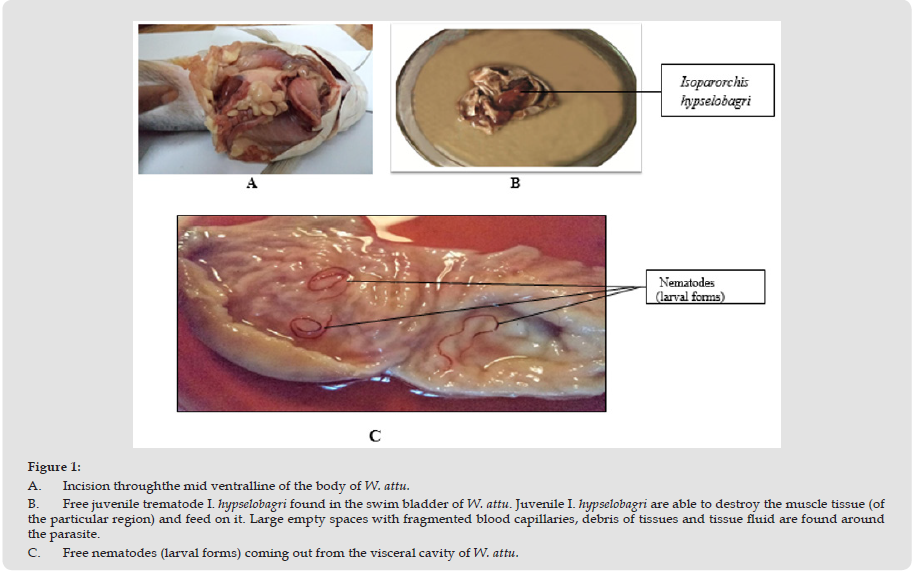
The normal growth of fishes is interrupted and inhibited if they are heavily infested with endoparasites viz., trematode, nematode, cestode and acanthocephalan. The irritating activities and damage of tissues lining the walls of the oesophagus, stomach, intestine etc. cause microscopic lesions in their host’s tissues which become the site for the secondary infection by bacteria (Cheng [12]). Each true fish parasite therefore uses the fish for its home and food and the total damage is related to the numbers of parasites present (Soulsby, et al. [48,49]. Helminths are very common in freshwater fishes. Very few lesions have been attributed to intestinal forms. Histozoic helminthes particularly migrating forms, cause greater damage in fishes. In severe cases, hyperemia, hemorrhage, cellular infiltration, lesion, nacrosis, fibrosis etc. have been observed. After encystment and fibrotic encapsulation, many larval helminthes produce no further obvious damage except pressure on adjacent host tissue. Migrating larva of trematode (cercariae), cestode (plurocercoides) and nematode produce the most serious reactions: leukocytes, fibrosis, hemorrhage and necrosis. Continual migrations, such as larvae of Contracaecum sp. produce peritonitis which results in fibrosis and extensive adhesions. Many fishes were observed with marks of perforation, lacerations and scars on their surface and abdomen. It is assumed that many metacercarial forms might be lost through these laceration processes. Any kind of internal changes or due to the cause of host’s death, metacercarial forms need to leave the host immediately.
At that time they bored their way into the external environment for their survival through laceration processes. Sometimes, it was also observed during the study period that, the trematode reaches the buccal cavity or gill and sometimes came out through the anus or genital opening of lower abdomen. Cestodes were found to have different habits and distribution pattern to the various organs of the hosts. Some of them were attached by mean of scolex and a very few number was found to exposed freely in the gut. Most of the Caryophyllaeid cestodes shows its abundance in the first and second loop of anterior part of the intestine, immediately behind the stomach which also agreed with Mackiewcz [50]. He also predicted that the normal distribution patterns of many species may be altered in the case of heavy infections. In the stomach and intestine, the scolex of the mature form of Polyoncobothrium polypteri was embedded within the muscularis and the rest of the body hanging freely in the lumen. In some of the congested regions, there were swollen mesh works of red blood cells, fibroblast with broken blood cells. Basophilic cytoplasm and cell boundaries were poorly defined. The giant cells arranged themselves around the debris. No significant changes being observed in the early stage of the infestation. During the later stage of the parasitic infestation, border of mucosa were irregular or disrupted, columnar cells were degenerated and goblet cells were enlarged. The stomach was a sigmoid, highly distensible sac with numerous folds in its lining. The normal stomach wall consisted of five layers such as sub serosa, muscularis, sub-mucosa and mucosa.
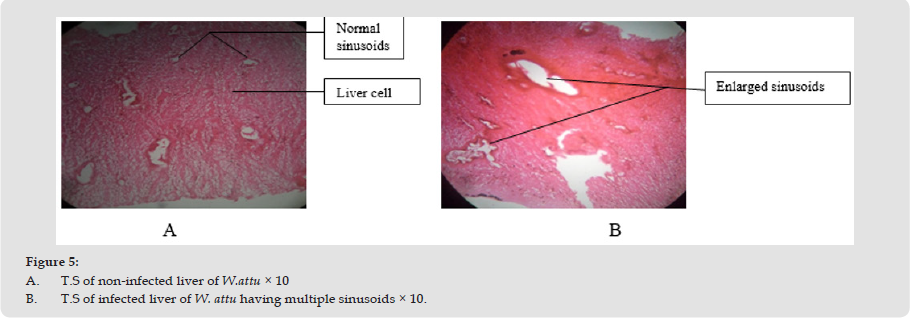
The mucosa is thrown into numerous waves like villi projecting into the lumen. The muscularis mucosa is well developed and lies below the sub-mucosa. It consists of an outer longitudinal layer and inner circular layer. The muscularis consists of a thick and prominent layer of circular muscle fibres. The intestine was a straight, sigmoid or coiled tube. The normal intestine consists of four layers such as serosa, muscularis, sub-mucosa and mucosa. The muscularis consists of two layers: an outer thin layer of longitudinal muscle fibers and inner thick layer of circular muscle fibers. The mucosa is folded into numerous simple foods or finger like villi. These villi are numerous in the proximal part and are fused with one another distally. The histology of liver shows sinusoids which are irregularly distributed between the polygonal hepatocytes are fewer in number and are lined by endothelial cells with very prominent nuclei. Normal liver was large and there was a compound tubular gland consisting of a large number of hepatic acini. The globular of the pathogenic parasite posses pseudobothrial depressions and an apical sucker which penetrate the epithelium, sub mucosa and muscularis of the intestine in such a way that the head is projecting from the outside of the intestine surrounded by a capsule and causes a serious damage. This was also observed by Bovein [51]. This is however generally found only in case of heavy presence of infection of parasites which effectively blocked the tube of the gut during heavy infection. This is also supported by the findings of Mackiewcz [52].
A number of observable histopathological changes occurred in the intestinal tissue of infected fishes. The gut helminthes damaged the walls at the sites of their attachment. This disruption was mainly due to the action of sucker of the parasites. As a result, the intestinal wall was heavily destroyed. Deposited melanin was also observed inside intestinal tissue. The gut wall was perforated where the host tissue reacted vigorously. Large vacuoles were also formed. Fluid filled empty space along with debris and lymphocytes were present. The intestinal mucosa and villi tissue was disrupted, the blood vessels were ruptured and intestinal tissue showed incipient necrosis (Figure 2A). It was revealed from the sections of a portion of the intestine that there was a severe damage in the mucous membrane with the broken villi. The parasites were observed to move forward leaving a considerable portion of the intestine only with serosal layer Polyoncobothrium polypteri, the truncated cone-shaped scolex of the species was found to attach firmly to the wall of the intestine, causes lesions and inflammation; generally capable of local damage (Figure 2B). In the early stage, there are no significant histo-pathological changes observed in the serosa, muscularis, mucosa and sub-mucosa layer of the stomach. In the later stage, some columnar cells of mucosa layer and mucous cells were degenerated. In some severe cases, the gastric glands were ruptured (Figure 3A). Lesions occur within the muscularis of the stomach and external serosa is involved in any generalized peritonitis due to tape worms.
Figure 2
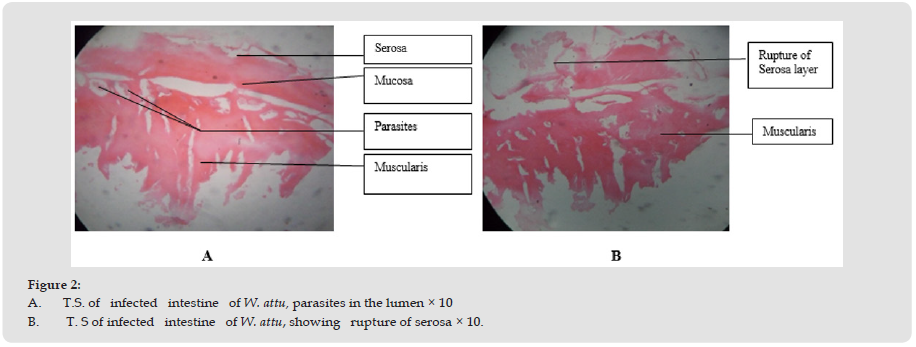
Figure 3
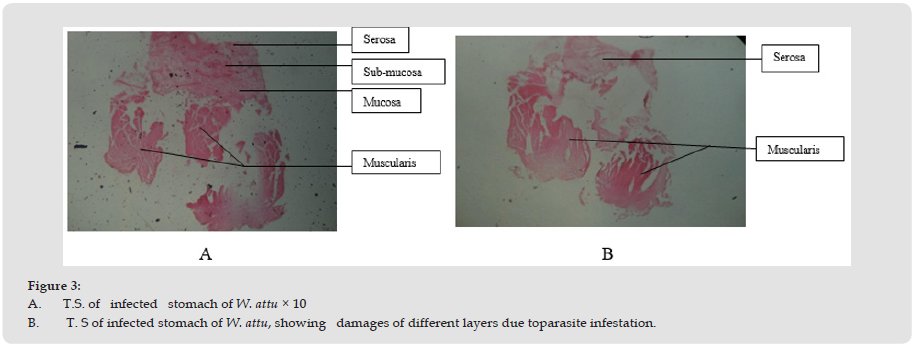
The stomach wall of the host was infected by nematode parasites. Histo-pathological examination confirmed that the stomach wall was severely damage due to the penetration of these larvae into the muscular layers. The serosa was destroyed and many sections of larvae were observed among the muscularis mucosa and the connective tissue. Below the encapsulated parasite, the muscularis layer was found to be damaged (Figure 3B). Cosmoxynemoides aguirrei and Contracaecum L3 larva found attached in the epithelial layer of the stomach with their chitinous buccal capsules and causes local damage. The encystment of larval nematodes on the outer wall of digestive tract of W. attu caused local damages and mechanical destructions which also supported by Hine and Kennedy [53]. Destruction and distention of muscularis affected due to the encystations of the nematodes associated with their presence, was a proliferation of the epithelial cells. Blood cells infiltration was being observed. In W. attu, trematode (both encysted and free), I. hypselobagri were frequently found in swim bladder and more rarely in body cavity (stomach, oesophagus, mouth, urinary system, billiary system, ovaries, circulatory system). The parasite, I. hypselobagri was found distributed in and around the general viscera. Some cysts of it were also observed in the liver. The main effect of the parasite was done on the skin surface, body musculature and visceral organs. I. hypselobagri (immature) were found attached to the body muscles causing extensive tissue damages including inflammation, necrosis and empty spaces with fragmented blood capillaries, tissue debris, lymphocytes and fluids.
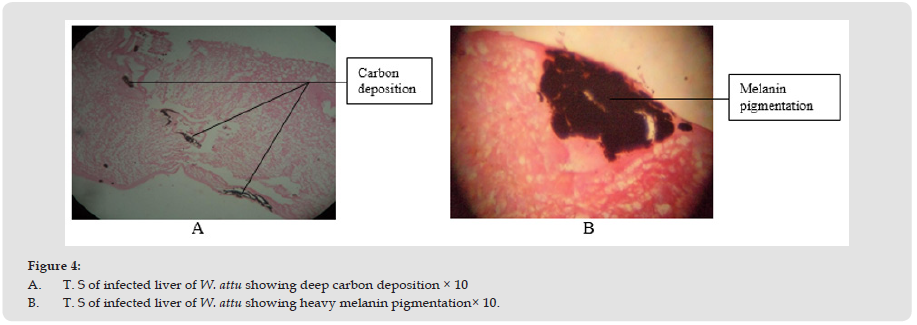
Due to the structural construction and the ability of the immature I. hypselobagri, they are normally capable of dissolving and penetrating the skin and muscle layers when they are living in the regular habitat and corresponding microenvironment. But a long with the onset of decomposition of viscera or any unusual change of host body’s microenvironment, the trematode become stimulated or compelled to utilize the dissolving and penetrating capacity for their survival. It can be noted as a homeostatic adjustment or adaptation of the juvenile trematode I. hypselobagri. The juvenile parasites dissolve the skin with the help of the penetration glands, located in the oral sucker situated at the anterior region of the body and in the acetabulum. Heavy melanin deposition was observed along with accumulated melanin macrophage centers in the infected liver. Due to the presence of I. hypselobagri as well as cyst, small vacuoles were formed in the liver. The melanin-macrophage centers should possibly be considered as a component of the reticulo-endothelial system and hence, part of the defensive system of the fish against any infection. Presence of massive melanization again confirms this. Sometimes hepatic blood vessels were ruptured. The affected liver showed mild hepatic or hemopoietic degenerative changes with hemorrhages (Figure 4).
Figure 4
During the migration of immature I. hypselobagri from visceral cavity to the swim bladder, massive disruption and dislocation of the visceral organs occurred. Irregular black pigmentation was scattered throughout the swim bladder, due to the infection by juvenile I. hypselobagri. In severe cases, the alveolar sacs and capillary plexuses were disrupted causing necrosis. Due to the severe infections of Pallisentis umbellatus, causes damage of muscularis layer forming mass of cluster (Figure 5). These species obviously causes mechanical obstruction and denudation of the epithelial layer within the gut occupying a major portion of the intestinal cavity of the lumen and thus allow in an arrow space for the chime to pass through. Moreover, larval forms also cause the barrier of the chime to pass and ultimately a total blockage of the results. The chime on passing through such a narrow space of the lumen causes gradual disruption of the gut and finally disappearance of the tissue system. Vijay [54] investigated the occurrence and pathological changes induced by Gangesia sp. in the intestine of freshwater fishes, Wallago attu. The parasites have caused severe changes in the host. The infestation of helminth parasites to the fish brings vital changes in the host body. These changes not only reflect on the physiological status of the organism but many important physiological functions are interrupted. The energy yielding process of the body is generally effected thus the physicochemical constituents of various regions of the host effected.
Figure 5
Worms penetrate through intestinal layers causing damage to mucosa, submucosa, and come to lie near the muscularis mucosa. Vajidkhan [55] investigated the occurrence and pathological changes induced by Gangesia sp. in the intestine of freshwater fish, Wallago attu. The histopathology of the fish tissues shows different pathological conditions. There was broken intestinal villi and disappeared leaving flattened surface, ulcerative lesions surrounded by inflammatory cells, infiltration of cellular organization into fibers and necrosis.Diseases affect the normal health conditions and cause reduction in growth, abnormal metabolic activities and even resulting in great economic loss. Health of any population depends on the control of disease and maintenance of a healthy relationship between living creatures and their environment (Snieszko [56]). Diseases are the most serious limiting factors in aquaculture because of increased density of fish in restricted water where the fish pathogens can easily transmit from one fish to another. Much economic loss is however preventable with proper fish health management (Kabata [57]. In the present investigation, it was observed that intestine was favored by many parasites. According to Bullock [58] and Dogiel [28], the intestine of fish is usually more infected than any other organ. It may be related to the fact that due to easy availability of nutrients in the intestine, parasites favor this niche. Bashirullah [59] investigated the distribution and occurrence of Isoparorchis hypselobagri in different hosts and localities from Bangladesh water.
Out of 25 hosts, he recorded seven new hosts from Dhaka, Bangladesh. He collected Isoparorchis hypselobagri from swim bladder of Wallago attu, Mystus aor, M. cavassius and from lateral muscles of Channa striatus, C. marulius, C. punctatus and Nandus nandus. He found juvenile of Isoparorchis in the lateral muscles of fishes within heavily pigmented cysts. He believed that the parasite actively penetrate the gut wall and migrate into the swim bladder of siluroid fish. He also discussed the life history of the trematode parasite. Histo-pathological studies showed that skin, muscle layer, stomach, intestine, swim bladder, liver were damaged by the infection of helminthes parasites. Helminths in fishes are also recognized as causing serious effect on their hosts Migaki, et al. [30]. Vajidkhan (2018) showed the occurrence and pathological changes induced by Circumoncobothrium sp. in the intestine of freshwater fish, Mastacembelus armatus. The histopathology of the fish tissues shows different pathological conditions. There was destruction of all intestinal layers and loss of its architectural morphology, destruction of lamina propria, sub-mucosa and vacuolation of muscle layer, cystic growth, which produces ulcerative lesion, atrophy and necrosis. Multiple changes occurred in the liver for parasite infestation. One of them is vacuole formation, causes spongy appearance where fluid accumulated thus the surrounding cells faces more pressure and the normal liver function hampered and also the hosts immunity decreased. These reasons promote the possibility of primary and secondary infection. Netane, et al. [60] showed the pathological effects and occurrence of nematode Estrongyylides excisus parasitizing freshwater fish.
The histopathological effects of E. excisus on freshwater fish Wallago attu i.e Hyperaemia, edema, microhaemorrhages and inflammatory reaction necrosis were observed around the encysted parasites in the liver tissue. Mackiewicz, et al. [51] found cellular damage, mechanical obstruction, production of lesions and necrosis etc. caused by the helminthes in different organs in fish. Some remarkable works have been done on histopathology of catfishes by Bhattacharjees, et al. [34,35,61,62]; etc. Due to the infestation of I. hypselobagri in the swim bladder, massive melanization was observed. In the body musculature, intestine and kidney fluid filled empty spaces along with debris’ sand lymphocytes were present. Similar observation also reported by Roberts, et al. [63,64]. In the present work, it was observed that the worms burrowing deep into the muscularis, nodule was formed. Inflammation and compression of tissue layers were noticed at the site of attachment of cysts to the intestinal wall of the host [65,66]. In some cases, a thin mucoid interface layer was seen between the host tissue and the cyst of the worm. Loose muscle fibers were also evident. Necrotic tissue surrounded the cyst of the worm and blood cells infiltration was observed. So, the present observation indicates several host tissue reaction resulting into degeneration and encapsulation of larvae, ultimately resulting into the formation of fibrous nodules. This also causes destruction of muscular layers of the intestine wall of the fish. The structural integrity of the visceral organs and body musculature of W. attu were massively disrupted by enteric parasites. In the present study, juvenile Isoparorchis hypselobagri was the most pathogenic and damaging of the whole.
The extent of damaged one by I. hypselobagri was highly variable but was related to intensity of infection and of the size of the host and parasites. With the help of penetrating glands, located in the oral sucker, the juvenile trematode dissolved the skin and muscles for making the tunnel or space in the host tissues, resulting accumulation of melanin macrophages and more moisture, necrosis, connective tissue proliferation and mixed inflammatory responses. Heavy melanin deposition was observed along with accumulated melanin macrophage centers in the infected liver. Sometimes hepatic blood vessels were ruptured with mild hepatic or hemopoietic degenerative changes with hemorrhages. The intestinal wall was heavily destroyed. Fluid filled empty space along with debris and lymphocytes were present. The intestinal mucosa and villi tissue showed incipient necrosis. During the migration of immature I. hypselobagri from cavity to the swim bladder, massive disruption and dislocation of the visceral organs occurred. Irregular black pigmentation was scattered throughout the swim bladder, in severe cases, the alveolar sacs and capillary plexuses were disrupted causing necrosis.

International Association of Landscape Archaeology, Czech Glass Society, Czech Republic

Department of Chemistry, Semenov Institute of Chemical Physics, USSR Academy of Sciences, Moscow, Russia

Neurology, LA BioMed Research Institute, USA

Associate Professor at Department of Breast and Thyorid Surgey, Chongqing General Hospital, China

Professor of Nuclear Medicine, Faculty of Medicine and Surgery, University of Milan, Milan, Italy





 Abstract
 PDF
PDF



























