info@biomedres.us
+1 (502) 904-2126
One Westbrook Corporate Center, Suite 300, Westchester, IL 60154, USA
Site Map
 ISSN: 2574 -1241
ISSN: 2574 -1241
ISSN: 2574 -1241
Received: April 30, 2025; Published: May 08, 2025
*Corresponding author: Mok Tik Lun, Li Wai Chun Building, The Chinese University of Hong Kong, Hong Kong
DOI: 10.26717/BJSTR.2025.61.009646
This case report documents the clinical effects of Traditional Chinese Medicine (TCM) acupuncture in a 75-yearold male patient with refractory wet age-related macular degeneration (wet AMD) in the right eye (OD), who showed poor response to conventional anti-vascular endothelial growth factor (anti-VEGF) therapy. The patient received acupuncture treatment from May 29, 2024, to mid-January 2025, with four optical coherence tomography (OCT) scans performed during this period. Results showed a reduction in central retinal thickness (CRT) from 350 μm to 285 μm, along with significant subjective improvements in symptoms such as dim vision, distortion, and visual field defects. This case provides new clinical evidence supporting acupuncture as a potential adjunctive therapy for anti-VEGF-resistant wet AMD.
Age-related macular degeneration (AMD) is a progressive retinal disorder characterized by central vision loss, with hallmark symptoms including blurred vision, central scotomas, metamorphopsia (visual distortion), and dyschromatopsia (impaired color perception). Clinically, AMD manifests in two forms: dry (atrophic) and wet (neovascular/ exudative) subtypes. Globally, AMD affects over 190 million individuals, with approximately 10% suffering permanent vision loss. Demographic aging and lifestyle changes project this number to exceed 280 million by 2040. In Hong Kong, the Hospital Authority reported 3,000 new wet AMD cases annually since 2010, with current estimates suggesting over 500,000 residents live with AMD - 10% being wet type and 90% dry type.
Intravitreal anti-vascular endothelial growth factor (anti-VEGF) injections represent the gold-standard treatment for wet AMD worldwide. This therapy inhibits pathological angiogenesis by neutralizing VEGF, thereby reducing neovascularization, vascular leakage, and hemorrhage. Clinical studies demonstrate that over 90% of treated patients achieve vision stabilization, with nearly one-third showing visual improvement. However, the treatment requires frequent reinjection (often monthly) due to recurrent neovascular activity, continuing until visual acuity, macular thickness, and leakage stabilize. Recent breakthroughs include a novel gene therapy approach published in The Lancet by Oxford University researchers. While long-term outcomes remain under investigation, preliminary results show promising therapeutic potential. Nevertheless, approximately 10-15% of wet AMD patients exhibit suboptimal responses to anti-VEGF therapy, creating an urgent need for alternative treatments. Traditional Chinese Medicine (TCM) conceptualizes AMD as arising from “Liver-Kidney essence deficiency,” “Qi-Blood insufficiency,” and “phlegm-stasis accumulation.” Emerging evidence suggests acupuncture may modulate ocular microcirculation, neurovascular homeostasis, and inflammatory pathways. This case report examines acupuncture’s therapeutic effects in a 75-year-old male with anti-VEGF-resistant wet AMD, contributing to the growing body of evidence for integrative treatment approaches.
Acupunture Treatment Protocol
A 75-year-old male patient presented to the Chinese Medicine Specialty Clinic cum Clinical Teaching and Research Centre of The Chinese University of Hong Kong on May 29, 2024, complaining of dim vision, visual distortion, and central scotoma in his right eye (OD). The patient had been receiving long-term intravitreal anti-VEGF injections for wet age-related macular degeneration (AMD) but showed suboptimal therapeutic response. Regular optical coherence tomography (OCT) monitoring at Hong Kong Eye Hospital revealed central retinal thickness of 350 μm, indicating macular edema, along with active choroidal neovascularization showing persistent vascular leakage. Traditional Chinese Medicine diagnosis identified Liver-Kidney Yin deficiency as the primary syndrome with secondary Phlegm-turbidity disturbing the clear orifices. The patient presented with a pale tongue showing yellow, thick, and aging coating, and a deep, wiry, intermittent pulse. Systemic examination showed normal appetite, sleep patterns, and bowel/bladder function.
From May 2024 to January 2025, the patient received weekly to biweekly acupuncture treatments. Local acupoints included Touwei (ST8) [1], Sishencong (EX-HN1), Shangxing (DU23), Yuyao (EX-HN4), Yintang (EX-HN3), Yingxiang (LI20), and Dicang (ST4). Distal points incorporated Waiguan (TE5), Lieque (LU7), Neiguan (PC6), and Hegu (LI4). Lower limb points consisted of Yanglingquan (GB34), Yinlingquan (SP9), Taixi (KI3), Zhaohai (KI6), Shenmai (BL62), Sanyinjiao (SP6), and Fenglong (ST40). Treatment employed disposable sterile acupuncture needles (0.25 × 40 mm) following standard disinfection procedures. Practitioners used an even reinforcing-reducing technique upon achieving Deqi sensation, with needles retained for 30 minutes per session. No adverse events were reported throughout the treatment course. The comprehensive approach combined local ocular points with systemic regulation through distal and lower limb acupoints to address both the root deficiency and secondary pathological factors.
OCT Monitoring Results Before and After Acupuncture Treatment
The following table summarizes the central average thickness( μm) measurements from OCT 20.0° (6.2mm) scans with ART 9 across the four follow-up reports (Table 1):
Table 1:
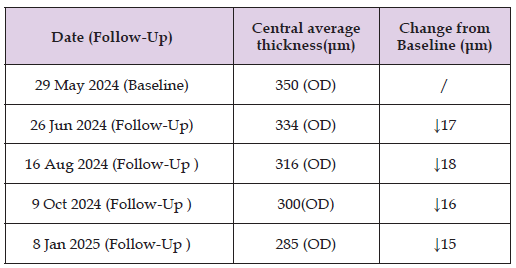
This case study provides valuable clinical insights into the potential role of acupuncture as an alternative treatment for patients with wet age-related macular degeneration who show poor response to conventional anti-VEGF therapy. The patient’s clinical course is particularly noteworthy as it demonstrates measurable anatomical and functional improvements achieved solely through acupuncture intervention, without concurrent anti-VEGF injections or other pharmaceutical treatments. While the patient did briefly receive some Qi-tonifying Chinese herbal formulas upon request, this was limited to a short period and unlikely to account for the sustained improvements observed throughout the treatment course. The subjective reports of enhanced visual brightness, reduced distortion, and improved clarity, combined with the objective evidence of progressive reduction in central retinal thickness on OCT imaging, suggest that acupuncture may influence the disease process through mechanisms that complement or differ from VEGF inhibition.
The therapeutic approach in this case was rooted in traditional Chinese medical theory, specifically emphasizing the role of the Bladder Meridian and Yin/Yang meridians in ocular physiology and pathology. While these conceptual frameworks may not readily align with contemporary biomedical models of retinal disease, the clinical outcomes observed in this treatment-resistant case present a compelling argument for their therapeutic relevance. The selection of specific acupoints was based on classical indications for eye disorders and their known effects on local circulation and neurological function, which may translate to improved retinal perfusion and modulation of vascular permeability. This empirical evidence challenges the conventional therapeutic paradigm and suggests that traditional medical systems may offer valuable alternatives when standard treatments fail.
The demonstrated clinical improvements gain additional significance when considering that a substantial minority of wet AMD patients (approximately 10-15%) show inadequate response to anti- VEGF therapy [2], with some experiencing paradoxical worsening of macular edema. For these challenging cases, our findings suggest that acupuncture may represent a viable therapeutic alternative that warrants serious consideration. The mechanisms underlying these effects remain to be fully elucidated but may involve modulation of ocular microcirculation, anti-inflammatory actions, neuroprotective effects, or influence on alternative angiogenic pathways. These observations highlight the importance of maintaining an open yet rigorous approach to evaluating therapeutic interventions from different medical traditions, particularly when dealing with conditions that prove refractory to conventional treatments. While further research is needed to validate and expand upon these findings, this case provides preliminary evidence that acupuncture may have a meaningful role in the management of anti-VEGF-resistant wet AMD [3].
This case study demonstrates that acupuncture may serve as a promising therapeutic alternative for patients with anti-VEGF-resistant wet AMD. The observed improvements in both subjective visual symptoms and objective OCT measurements, achieved without concurrent conventional treatment, suggest that traditional Chinese medicine approaches can offer meaningful clinical benefits when standard therapies fail. While the exact mechanisms remain to be fully elucidated, these findings underscore the importance of exploring complementary treatment paradigms in refractory retinal diseases. This case provides a foundation for future research to further investigate the role of acupuncture in managing challenging cases of wet AMD, potentially expanding treatment options for patients with limited responses to current standard therapies. The integration of such traditional approaches with modern ophthalmological practice may ultimately lead to more comprehensive care strategies for complex retinal conditions.

International Association of Landscape Archaeology, Czech Glass Society, Czech Republic

Department of Chemistry, Semenov Institute of Chemical Physics, USSR Academy of Sciences, Moscow, Russia

Department of Educational Sciences, Research Centre Qualities of Teachers, School of Education – HAN, Nijmegen, Netherlands

Associate Professor at Department of Breast and Thyorid Surgey, Chongqing General Hospital, China

Neurology, LA BioMed Research Institute, USA





 Abstract
 PDF
PDF



























