info@biomedres.us
+1 (502) 904-2126
One Westbrook Corporate Center, Suite 300, Westchester, IL 60154, USA
Site Map
 ISSN: 2574 -1241
ISSN: 2574 -1241
ISSN: 2574 -1241
Received: April 23, 2025; Published: May 05, 2025
*Corresponding author: Atsushi Imai, Department of Obstetrics and Gynecology, Matsunami General Hospital, 185-1 Dendai, Kasamatsu, Gifu 501-6062, Japan
DOI: 10.26717/BJSTR.2025.61.009641
Dienogest, a novel progestin, is considered an effective pharmacological intervention for ovarian endometrioma due to its favorable side effect profile. We present a rare case of malignant transformation of an ovarian endometrioma into carcinoma following long-term (exceeding 10 years) hormonal management with dienogest. The patient, a 54-year-old Japanese woman, had initially been advised to undergo surgical management at age 42 due to suspected deep infiltrating endometriosis. Preferring a conservative approach, she sought symptomatic relief through hormonal therapy at our institution. Magnetic resonance imaging (MRI) and transvaginal ultrasonography revealed a left ovarian cystic lesion suggestive of endometrioma. Dienogest therapy commenced at age 43 and was accompanied by semiannual ultrasonographic monitoring, which demonstrated stable lesion size. At age 53, contrast-enhanced MRI indicated focal mural enhancement, raising suspicion of malignant transformation. Surgical resection was performed, and histopathological analysis confirmed stage 2B endometrioid carcinoma of the left ovary with uterine involvement. The patient underwent six cycles of adjuvant chemotherapy with paclitaxel and carboplatin. As delayed diagnosis significantly compromises prognosis, regular imaging surveillance using ultrasonography and/or MRI is recommended for patients with endometrioma under prolonged dienogest therapy.
Endometriosis is a chronic, estrogen-dependent inflammatory disorder characterized by the ectopic presence of endometrial-like glands and stroma [1-4]. It affects approximately 5–15% of women of reproductive age. Although benign, endometriosis demonstrates several malignancy-like traits, such as estrogen-driven proliferation, recurrence, and potential for dissemination. Persistent estrogenic stimulation may predispose to malignant transformation, with ovarian endometrioma exhibiting an estimated 1-2 % risk of progression to malignancy [5]. Dienogest exerts progestogenic effects and inhibits endometriotic proliferation, angiogenesis, and inflammation [6- 8]. Reports of malignant transformation in ovarian endometrioma during dienogest therapy remain exceedingly rare [9,10]. These reports delineate a unique case of ovarian endometrioma undergoing malignant transformation after extended dienogest administration.
A 54-year-old multiparous woman with no systemic comorbidities initially presented with menorrhagia. At age 42, surgical management was recommended at another facility for presumed deep infiltrating endometriosis. Declining surgical intervention, she presented to our clinic seeking symptom control via hormonal therapy. Imaging revealed a 37 mm left ovarian cyst consistent with endometrioma. Dienogest therapy was initiated at age 43, and biannual ultrasonographic assessments showed no significant changes in lesion size. After approximately a decade of therapy, MRI at age 53 identified an increase in cyst diameter to 43 mm and the emergence of a 13 mm mural nodule (Figure 1).
Figure 1
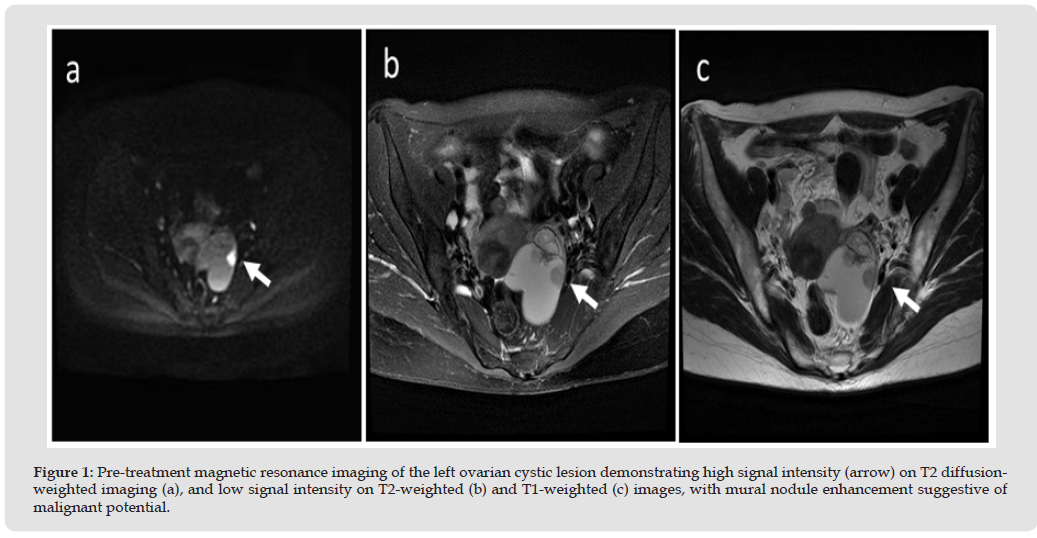
This lesion exhibited high signal intensity on T2-weighted diffusion imaging and low signal on conventional T1- and T2-weighted sequences (Fig.1). Contrast enhancement was focal within the mural component. The patient underwent extensive cytoreductive surgery, including total abdominal hysterectomy, bilateral salpingo-oophorectomy, and omentectomy. No residual macroscopic disease remained postoperatively. Histopathology confirmed stage 2B endometrioid carcinoma of the left ovary with contiguous uterine infiltration. Adjuvant chemotherapy with six cycles of paclitaxel and carboplatin was administered.
The lifetime risk of ovarian cancer among women is approximately 1.3–1.4% [11], with endometrioma-associated malignancy accounting for about 1.8% of cases [5,11]. Clear cell and endometrioid carcinomas are the predominant histological subtypes associated with endometriosis, supported by genetic correlation analyses [11- 14]. Dienogest is recognized for its dual role in exerting progestogenic effects and suppressing pathophysiological mechanisms of endometriosis, including cellular proliferation, angiogenesis, inflammation, and induction of apoptosis [8,15,16]. These mechanisms may also confer protective effects against neoplastic transformation. According to the Pharmaceuticals and Medical Devices Agency of Japan, only three cases of ovarian cancer have been reported over a decade of dienogest usage, highlighting its favorable safety profile. Nonetheless, previously reported cases of malignant transformation often involved a short interval between treatment initiation and cancer diagnosis, raising suspicion of pre-existing occult malignancy [8,17-19]. For initial assessment, transvaginal ultrasonography remains the diagnostic modality of choice. MRI, particularly with contrast enhancement, provides high diagnostic accuracy and is instrumental in differentiating endometriomas from other adnexal pathologies and ruling out malignancy. In summary, although malignant transformation of ovarian endometrioma during dienogest therapy is exceedingly rare, the potential risk necessitates vigilant long-term surveillance through periodic imaging.
The authors declare no conflict of interest.
This study was written after reviewing the Life Science Ethics Checkpoints, Personal Information about People and Data Ethics. We would like to express our deepest gratitude to the many physicians and other concerned individuals who provided guidance and advice for this study, as well as to the local medical institutions that have supported our family on a daily basis. The author has also been in possession of some diseases for a long time and continues to receive treatment. In particular, I would like to express my gratitude to the many doctors, pharmacists, and other medical professionals who have been involved in psychiatric treatment over a long period of time. I would also like to thank the LLMs developers for their efforts and all their wisdom.


 Abstract
 PDF
PDF