info@biomedres.us
+1 (502) 904-2126
One Westbrook Corporate Center, Suite 300, Westchester, IL 60154, USA
Site Map
 ISSN: 2574 -1241
ISSN: 2574 -1241
ISSN: 2574 -1241
Received: April 07, 2025; Published: April 23, 2025
*Corresponding author: Saeed Shoja Shafti, Emeritus Professor of Psychiatry, New York, USA
DOI: 10.26717/BJSTR.2025.61.009606
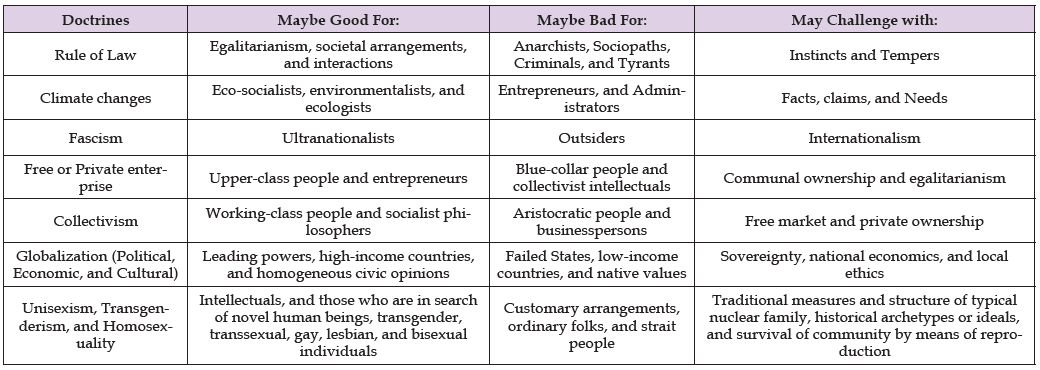
The modern era is full of ideologies and doctrines that generally have roots in academic disputes, theoretical thoughts, or ethical concerns (Table 1). Nevertheless, formulations, which may be full of recommendations and calculations, or doctrines, which may be packed with justifications or condemnations, or prophecies, which may be filled with wishes or fears, may not be calibrated without pragmatic measures, experiences, or outlooks. Methodically, even practice may not always be sufficient for standardization because restricted experience in a limited setting may not be enough for normalization of big ideas, plans, or generalizations of obtainable extrapolations, though it may not be worthless either. For example, while historical events may be processed ideologically, like historical materialism from a Marxian perspective, or commonsensically, like customary historians, analyzing history without considering its context, namely associated sociocultural dynamics and political economy in a specific period of time (cross-sectional processes in addition to longitudinal courses), may not be constructive enough for the discovery of its concealed implications or its genuine roots. Accordingly, it demands a multidimensional exploration, which may or may not include a specific ideology or perspective as well. Otherwise, it would result in one-sided conclusions. On the other hand, followers of a specific ideology may wonder why other people are not thinking similarly to them, why they have so many antagonists, why their favorite philosophy has not captured, so far, enough national and international advocates, or why their attractive beliefs have been invented so gradually or revealed so lately.
Table 1: A Rough Draft of Some Current Tenets.
Thus, is their brainpower or judgment superior to that of other people? Similarly, such an attitude may be prevalent among many of the cult’s devotees’ as well [1]. Probably, they do not consider that their conviction is the outcome of a specific series of events, relationships, educations, and experiences that may have innumerable variances amongst people in every community and even household. Therefore, people behave and think differently, which designates their own character and habits. Consequently, any discrepancy in the said parameters may cause dissimilar mindsets, and, consequently, different frames of mind may generate different judgments. This is the basis of cultural differences among societies, which have roots in historical, geopolitical, and international affairs, too. On the other hand, the dynamism of culture is not independent of social structure, economics, or politics. So, while there are a lot of similar social problems around the world, there are unique public complications as well, which are specific to certain civilizations. As a result, expressing comments or doctrines regarding people who have not been visited or comprehended perceptibly by the associated doctrinaire may fail to provide anticipated outcomes or right inferences [2]. Allegorically, logic is not independent of locality. Similarly, a politician or decision- maker who has never understood his own society may act like a teacher who has never recognized his own pupils or a musician who has never acknowledged the preferences of his own audiences. Anyhow, there have been a lot of ideas, advice, rules, or predictions that either have never been applicable, administratively, or favorable, publicly; maybe because there has been discrepancy, obscurity, or untimeliness between them and dynamic forces that should prepare the public minds for acceptance of such pioneering ideas.
The realization of such an optimal match, as well, is not always easy. Thoughtless undervaluation of public opinions, sarcasm of beloved values, underestimation of the power of the deep state, ignoring natural science, evolution, or sociobiology, and denial of the associated dialectic between various constituents or dynamics may lead to more detriments than benefits (Table 1). Thus, recurring failure of some societal or political activists may be in concealed sociocultural physiognomies of their targets. For instance, a historian, who may have ignored the demographic, financial, or historical characteristics of a nation in a specific era, may try to evaluate past happenings by means of present-day facts or judge bygone predilections or attempts through present-day yearnings or preferences. Such an analyst, historian, or sociologist may easily accuse the real victims of some historic tragedies as the main defendants of those mishaps and project, unconsciously, their subjective inner conflicts on external guiltless targets. Though history is, emblematically, a one-sided pathway between the past, present, and future, it is not like a monochrome identity and involves a mixture of people and ideas, which may end in different events. Nobody can condemn past failures without considering the dialectic of dynamics that have caused a social deterioration, regression, or incident. Similarly, no success is analyzable without a multidimensional approach. Though intellects may have faith in unlimited broadmindedness regarding personal opinion or conduct, even up to a stateless anarchistic level, the masses, as the constituents of every society, may not handle such a stance so straightforwardly or intellectually.
On the other hand, while normalization of an abnormal pattern may not be, legally, impossible, management of its potential complications, like social disparity, should not be ignorantly overlooked. Therefore, though such an open outlook may consider itself a critical tool for reassessment of prevalent totems and taboos and sociological intervention of existing cultural stereotypes, it should be aware of the potential costs of any pointless interference. On the other hand, though some intellectuals, elites, or doctrinaires may have faith in the eventual convincing of publics by similar propaganda and schemes, they should not forget that they should first convince the majority of their own people and settle any conceivable social disparity respecting such provoking attitudes [3]. Frequent rise and fall of sociopolitical processes may show that neither cultural values nor sociopolitical paradigms have enough strength for overall formulations or one-sided anticipations. Likewise, limitless modernism may not be applicable without considering the mindset of the silent majority. In general, any sociologist who cannot polish his or her theoretical considerations with pragmatic experiences and real facts may never attain objectively what he or she had supposed subjectively. The end result of such a failure may include half-done formulations, mistaken theorizations, and, maybe, turning fortune into famine. bThough knowledge may provide necessary context for cerebral elites to ponder better and to analyze in detail, the library and literature may not replace streets and lanes if theorization is supposed to be in support of the masses and tries to solve the existing problems [4-22]. Likewise, the dichotomy between elites’ theorizations and masses’ favorites may provide a gap in public opinion, which may not be filled easily by decree or dissertation.


 Abstract
 PDF
PDF






























