info@biomedres.us
+1 (502) 904-2126
One Westbrook Corporate Center, Suite 300, Westchester, IL 60154, USA
Site Map
 ISSN: 2574 -1241
ISSN: 2574 -1241
ISSN: 2574 -1241
Received: March 28, 2025; Published: April 16, 2025
*Corresponding author: Sarmishtha Chanda, Department of Physiology, Sister Nibedita Govt. General Degree College. Judges Court Road, Alipore, Kolkata 700027, West Bengal, India
DOI: 10.26717/BJSTR.2025.61.009601
Uranium is naturally occurring heaviest metal present on earth in a mixture of three different isotope forms as 234U, 235U, and 238U. It is found in very small amounts in nature in the rocks, soil, surface and underground water. It is commonly present in lignite, monazite and phosphate rocks (typically in the order of 0.005 to 0.02%). In groundwater, uranium is present as a result of leaching from natural deposits, releases from mill tailings, emission from the nuclear industry, contribution from fly ash and nitrate & phosphate fertilizer application (Uranium Report, et al. [1]). Naturally occurring uranium is associated with granitic and meta-sedimentary rocks, as well as younger sedimentary deposits. It naturally occurs in groundwater as a result of the dissolution of uranium bearing minerals from rock leaching and from uranium mines. Over-pumping of the aquifers’ groundwater causes decline of water levels which induces oxidation to enhance uranium enrichment in the shallow groundwater. Geochemical and uranium isotope data suggests that, factors causes high uranium concentrations in groundwater, are uranium content in aquifer rocks, oxidation state, and groundwater chemistry that promotes the formation of soluble uranyl carbonate complexes. Anthropogenic activities like, mill tailings, emissions from the nuclear industry, and the combustion of coal and other fuels, applications of phosphate fertilisers also causes considerable emission of uranium to the environment (Uranium Report, et al. [1]). Uranium has a very high half-life about 76,000 years. Due to its long half-life it induces several potential dangerous health hazards on human as well as living species continuously exposed to it (Dewar, et al. [2]). Uranium is an α-particle emitter, and produces radon along with other radioactive decay products.
The α-particles are bulky (2 protons and 2 neutrons) and cannot penetrate the dermal layer. However, when ingested or inhaled it causes internal exposure to radiation and gives rise to hazardous health effects. In most of the cases of uranium induced health hazards, the health effects is due to radon exposure particularly, and not due to uranium itself (Dewar, et al. [2]). Uranium has been found in many states of India due to geogenic or anthropogenic causes. Uranium concentrations in shallow ground water in India, shows a wide range from 0.0 to 2876 μg/L, indicating that uranium concentrations in groundwater greatly vary by several orders of magnitude (Uranium Report, et al. [1]). WHO has set a permissible limit for drinking water uranium which is < 30ppb/l, whereas, in most of the states of India we have much more uranium concentration in our ground water used as drinking water. According to a report published on 2020 by UCIL, in Punjab more than 24.2% wells have >30 ppb/l uranium concentration in drinking water, in Haryana it is about 19.6 % wells are contaminated above the permissible limit ( > 30 ppb/l), in Telangana more than 10.1 % wells are contaminated water ( > 30 ppb/l), in Delhi more than 11.7% wells are above the permissible limit ( > 30 ppb/l), in Rajasthan >7.2 % wells are above > 30 ppb/l, in Andhra Pradesh >4.9 % wells are above > 30 ppb/l and Uttar Pradesh >4.4% wells are above > 30 ppb/l. We have recently studied Jharkhand where about >1.5 % drinking water sources are contaminated with uranium and in West Bengal it is least, about 0.1% drinking water sources are contaminated (Uranium Report [1]).
In Jharkhand, the India’s most old uranium mine is still operating, stating from 1968. It is situated at Jadugora. According to the UCIL, India, more than 60 ppb /L uranium has been detected in the shallow tubewell water sources in Jadugora (permissible limits as per Atomic Energy Regulatory Board (DAE)) Jharkhand. The highest values obtained was 69.9 ppb at Koderma in Koderma District (Uranium Report [1]). We have found uranium in six water sources at Jadugora beyond the permissible limit and the values lies between 184.67- 77.04 ppb/l. The Districts which are partly affected in Jharkhand by high Uranium in ground water are - Godda, Koderma, Latehar, Palamau. We have surveyed over 30 families at Jadugora to classify the health effects (if any) coming from uranium exposure due to contaminated environment, drinking water and food sources. Total 163 uranium exposed subjects were studied in this survey. 48 male subjects (24-48 years), 45 female subjects (21-37 years) and 70 children (3-15 years) had been chosen for this survey. Informed consent had been taken from each and every participants before taking their drinking water and food samples and clinical examinations. They had been asked for their health issues, examined by registered clinician and their drinking water and food samples were collected and were analysed for uranium and other trace metal concentrations using inductively coupled plasma mass spectrometry (ICP-MS, DRC-II quadrupole) in Regional Chemical Laboratories of CGWB at Lucknow. Spirometry had been done on every subjects to study the lung function test and effect of uranium exposure on lung volumes. The chemical properties of uranium in drinking water are of greater health concern than its radioactivity (Balaram, et al. [3,4]).
The issue is not only the drinking water, but also the surface water of nearby uranium mines of Jadugora, which is contaminated by uranium. Chand nadi (a small stream) flowing through the uranium mine of Jadugora is highly polluted by uranium (mean concentration of uranium is 126.77 ppb/l ± 44.07, 6 samples studied) and it is also used as the main water source for irrigation in local fields. People residing in that area mainly working in the mine and also involved in farming. The woman of the family who were not working in the mines are also experiencing myriad clinical problems. The clinical symptoms are summarized below in Table 1. The children who were neither involved in mining nor in farming are also facing several health problems including developmental defects (Figure 1). The local people, who are Santali tribe, believe throughout generations, that all the developmental defects in children and clinical outcomes in people of Jadugora is due to the curse of local deity Ronkini Devi, whose shrine is located at the hill top of ‘Dudh Pahar’, (Hill region), near uranium mine. The families studied, reported several issues of developmental defects in their offspring, including, spontaneous abortion and intrauterine growth retardation (IUGR). Some of the expecting mother also experienced first trimester abortion and some had to undergo medical termination of pregnancies due to birth defects in foetal body, when performed ultrasonography after their 12th week of pregnancy. The women who were not working in mine had got uranium exposure through the drinking water, local vegetables and fish, and also from radioisotopes released in the environment from nearby uranium mine. Table 1 classify different clinical manifestations coming from chronic uranium exposure.
Figure 1
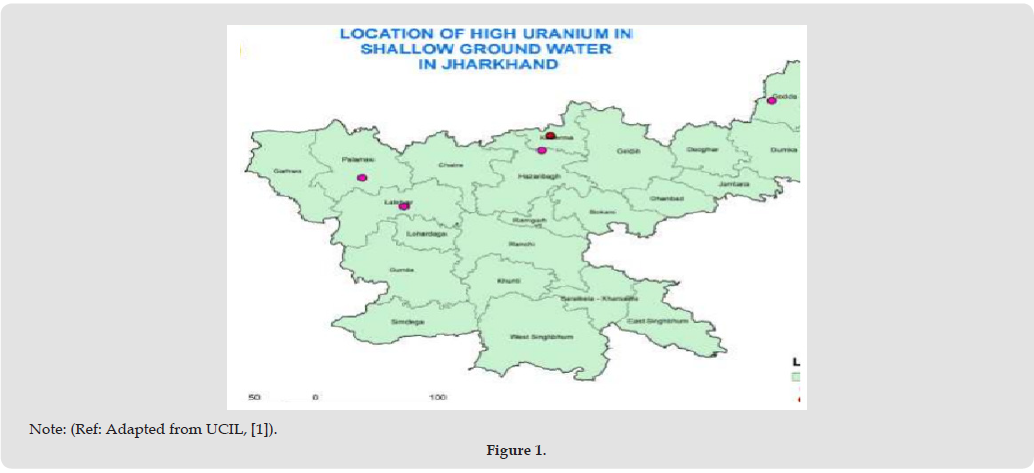
Table 1: Clinical Findings associated with Uranium in drinking water reported from survey conducted on 35 families.
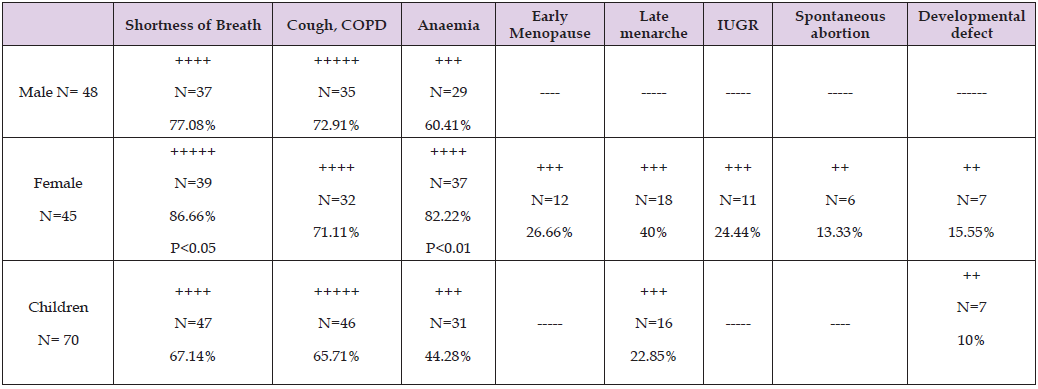
Anaemia, cough and shortness of breath are the common features of uranium exposure. There is no difference in the frequency of occurrence of cough between male and female counterpart of the exposed population. The anaemia and shortness of breath are predominating in female counterpart of the population and the differences are significant. In children the frequency of occurrence of anaemia is low and it is also significantly low than female and male participants of the study participants.It is seen from the above table that female participants of the survey had several gynaecological issues including early menopause and late menarche. Female reportedly had spontaneous abortion issues and IUGR with developmental defects like cleft lips, cleft palate, hydrocephalus and down-syndrome. Women in the area of mining near Tummalapalle, Kottala, and MC Palle villages at Kadapa district of Andhra Pradesh complain of spontaneous abortions, bleeding and a number of hysterectomies (Menon, et al. [5]). We have also seen similar issues in females of Jadugora. In Andhra Pradesh, babies with low-birth-weight, developmental issues like foetal deformity, tumours and heart issues have been identified. As a result, abortions were conducted as late as the fourth or even fifth month of pregnancy (Menon, et al. [5]). A cohort study on a population in India exposed to higher levels of natural background radiation has shown increased incidences of down syndrome and autosomal dominant congenital anomalies (Dewar, et al. [2]). Once ingested uranium can cross placental barrier and affect the neonatal and foetal developmental processes. However, mutagenic or teratogenic effects of uranium had not been studied widely. How prenatal exposure of uranium causes birth defects is a global concern.
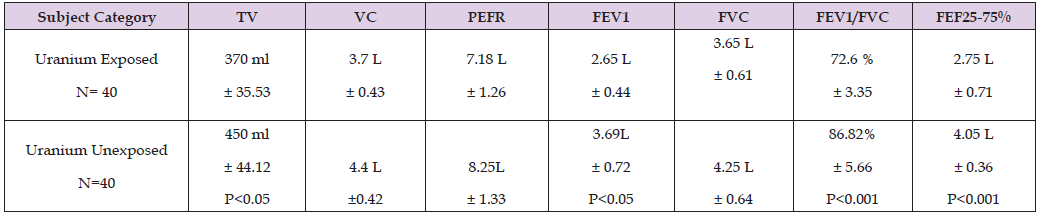
Therefore, dealing with trans-generational effects is a big challenge in case of continuous radiation exposure. Uranium, having its long half-life can affects the metabolic pathways in the body which may disrupts several physiological and developmental milestones in human in a trans-generational fashion (Balaram, et al. [3,6]). Therefore, geogenic or anthropogenic exposure of uranium is a trans-generational threat to human population. We have conducted lung volume tests with spirometer on every male subjects and female subjects studied and compared them with normal individuals (age and sex matched) residing far apart from the mining area (normal individuals are chosen from 25 sq km apart of mining area). The lung volume and their comparison with uranium unexposed normal individuals have been classified and tabulated in Table 2. The lung volumes and lung capacities showed significant decrease in uranium exposed participants which actually an indicative of compromised lung as a function of uranium exposure. The pulmonary function parameters of the uranium exposed persons, working at Jadugora uranium mine, are drastically poor and the reduction in lung capacities and lung volume in exposed personal are statistically significant. We have not studied the incidents of lung cancer in exposed participants. The problem is, currently, there is no plan to monitor the uranium deposition from working mines of Jharkhand, neither from Jharkhand Government, nor from any public or private concern. Uranium binds to soil and can be taken up by the crops and vegetables and causes bio magnification. This bio-magnification further promotes bioaccumulation in human.
Table 2: Lung capacities and Lung volume in Uranium exposed and unexposed participants.
Contamination from uranium mines will persist for generations. Dust from mines or from nuclear power plant that blown in the atmosphere contains considerable amount of radioisotopes. These radioisotopes are dissimilating in the environment causing bio accumulation in water bodies and soil. It causes thorium 230 decay to produce radon gas. Uranium, with a half-life of 76000 years, produces radon for millennia. In the atmosphere, radon decays into the radioactive solids polonium which give rise to serious health hazards like cancer. We are not sure about the frequency of occurrence of cancer in affected people who are working in the mines or residing nearby areas. Immediate action should be taken to assess the occurrence of lung or other cancers and developmental defects in children to save the generation from radioisotope exposure as well as chemical exposure from uranium.

International Association of Landscape Archaeology, Czech Glass Society, Czech Republic

Department of Chemistry, Semenov Institute of Chemical Physics, USSR Academy of Sciences, Moscow, Russia

Neurology, LA BioMed Research Institute, USA

Associate Professor at Department of Breast and Thyorid Surgey, Chongqing General Hospital, China

Professor of Nuclear Medicine, Faculty of Medicine and Surgery, University of Milan, Milan, Italy





 Abstract
 PDF
PDF



























