info@biomedres.us
+1 (502) 904-2126
One Westbrook Corporate Center, Suite 300, Westchester, IL 60154, USA
Site Map
 ISSN: 2574 -1241
ISSN: 2574 -1241
ISSN: 2574 -1241
Received: March 26, 2025; Published: March 31, 2025
*Corresponding author: Manfred Doepp, HolisticCenter, 13 Haupt St., Abtwil 9030, Switzerland
DOI: 10.26717/BJSTR.2025.61.009562
Since ancient times, the question of the ether has preoccupied mankind. Many philosophers and physicists have studied it intensively and developed ideas and theories. Today, despite the rapid development of (post)modern physics, we do not have a much clearer understanding of it. The world of quanta is gradually opening up, although it requires a depth of thought that is only accessible to consciously developed people. A progression of ether concepts is presented, with the result that the ether is of a non-material nature and permeates the entire universe from dimension 5. It allows us an unlimited transmission of information and energy that we could and should use.
The word “ether” is still commonly used, e.g. when it comes to the emission of radio waves. However, there is hardly any understanding of what it is. This is no wonder, as there is no accepted definition, only certain ideas. Today’s physicists are consistently of the opinion that the ether has been abolished since the acceptance of the theory of relativity. However, there are still unanswered questions, such as whether the current world view of physics and especially astrophysics could be inadequate. Discoveries are regularly made that open up further questions instead of providing answers. It therefore makes sense to pursue the question of the ether.
The concept of ether was already described in ancient times by Plato in Timaeus with the name of the Greek deity Aither (ancient Greek Αἰθήρ, English ‘brightness’) as the “purest kind of air” [1]. Aristotle added the ether as the fifth element (quintessence) to the four elements (fire, water, air, earth), which permeates all elements as the “fifth being” and “flows through the cosmos as a mediating medium” [2]. The Aristotelian theory of elements regarded the ether as a massless, unchanging, eternal substance and as a medium for the uniform movements of the heavenly bodies [3,4]. The question may be asked: was he thus ahead of our time?
In the late 17th century, the ether was understood as a hypothetical substance that was postulated as a medium for the propagation of light. This concept was later transferred from optics to electrodynamics and gravitation, mainly to avoid assumptions based on action at distance. In general, the ether was regarded as the carrier of all physical processes in the universe [5]. A dictionary from 1904 writes: “The ether is a weightless, unresisting, imponderable, finest substance that permeates all bodies and fills space.” The question is whether a substance described in this way can actually be a substance. Christiaan Huygens formulated the first complete wave theory of light in 1678- 1690; his light ether penetrated solid matter as well as the empty space of the universe. By developing a systematic description of wave phenomena, he was able to provide an elegant explanation of reflection and refraction. This was seen as an important argument for the wave theory and thus for the ether as a transfer medium for waves and rays [6]. Thomas Young was able to help the wave theory achieve a breakthrough around 1800. Young was the first to prove that the wave theory of light could explain some phenomena that could not be reconciled with Newton’s corpuscle theory. For example, he explained Newton’s rings using the principle of interference and was the first to carry out the double-slit experiment, the results of which clearly supported the wave nature of light and thus the existence of the ether. Young was also unable to reconcile the effect of polarization with the wave model. In 1817, he also solved this problem by assuming that light waves behave like transverse waves - this was unusual, as light waves had been thought of as longitudinal waves in analogy to sound [7].
A good 100 years ago, Albert Einstein spoke in a lecture about the fact that it was no longer possible to assign ponderable properties to this medium of remote effects. It could have neither states of motion nor mechanical states: “Physics has abolished a ponderable = weighable/measurable ether”. If you read this lecture by Einstein to the end, he simultaneously introduces a kind of imponderable = imponderable/unmeasurable ether. There are clear statements that the cosmos with its light and remote effects cannot be conceived without an imponderable ether. Einstein thus establishes a new theory of ether, which requires a new understanding of space-time and is no longer associated with purely material qualities/dimensions, but with higher qualities [8,9]. What qualities could he have meant? There are many physicists from the 19th century who dealt with the ether, among others:
Michelson-Morley Experiment
The experiment disproved the ether at rest, and an ether entrainment contradicted the aberration of light. The experiment contained a false basic assumption, namely to see the ether as a particle/corpuscle medium [10,11]. We now know the wave-particle duality.
James C. Maxwell
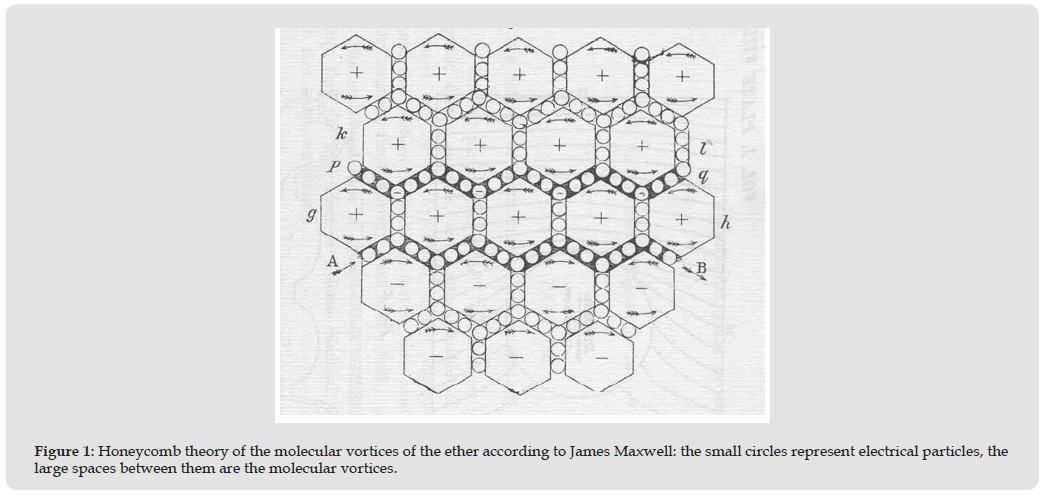
Maxwell’s equations could never be brought into complete agreement with the mechanical ether models. But mechanical ether models are obsolete. The equations were so incomplete that Oliver Heaviside corrected them [12,13]. Maxwell said: “Whatever difficulties we may have in forming a consistent idea of the constitution of the ether, there can be no doubt that the interplanetary and interstellar spaces are not empty, but are occupied by a material substance or body, which is certainly the largest, and probably the most uniform body of which we have any knowledge” (Figure 1).
Figure 1
Lord Kelvin
He (1867) developed a vortex theory in which the atoms of matter are vortices. A variant was Kelvin’s vortex-sponge theory, in which both rotating and non-rotating parts interact in certain sections of the ether [14]. Heinrich Hertz directly proved the finite propagation speed of electromagnetic forces predicted by Maxwell. He summed up the contemporary view of the ether: “Take electricity out of the world, and light disappears; take the light-bearing ether out of the world, and the electric and magnetic forces can no longer transcend space” [15,16].
Albert Einstein
The current standard model for describing gravity without action at a distance is the general theory of relativity (ART) completed by Einstein in 1915. In a letter to Einstein (1916), Lorentz now suspected that the ether had basically been reintroduced in this theory. In his reply, Einstein wrote that one could certainly speak of a “new ether”, but that the concept of motion should not be applied to it. In 1920, he wrote in the paper “Ether and Relativity Theory” that the special theory of relativity did not necessarily exclude the ether, as physical qualities had to be attributed to space in order to explain effects such as rotation and acceleration. And in the general theory of relativity, space could not be conceived without gravitational potential, which is why one could speak of a “gravitational ether” in the sense of an “ether of general relativity” [17]. He finally summarized his new definition of the “ether” once again: [18,19] “But even if these possibilities mature into real theories, we will not be able to do without the ether, i.e. the continuum endowed with physical properties in theoretical physics; for the general theory of relativity, to whose fundamental points of view physicists will probably always adhere, excludes an unmediated action at distance; but every theory of near action presupposes continuous fields, thus also the existence of a non-material ‘ether’. Physics displaced the ether at that time, but since then it has stood unconvinced by the phenomena of dark mass and dark energy, which are said to make up the majority of the universe. Opinions outside the scientific mainstream are held by the Nobel Prize winners Robert B. Laughlin and Frank Wilczek, according to whom it is also possible to speak of an ether in modern physics - especially with regard to the quantum vacuum [20,21]. Relativistic electrodynamics has now been merged with quantum mechanics; the resulting relativistic quantum electrodynamics does not require a carrier medium for the waves.
J.W. Von Goethe
The ether permeates Goethe’s work in the natural sciences. As is well known, he also worked with prisms and the color spectrum. He asked himself whether Newton’s discovery could not also be reversed? If you look at a white dot on a black surface, you see the familiar light spectrum. If you look with a prism at a black dot against a white background, you can discover a different spectrum. The eclipse spectrum is mirrored in relation to the light spectrum and shows a new color in the middle: purple [22]. So a big puzzle is that we have two complementary spectra. One is green in the middle, the other purple, which is missing from the other. According to Goethe, purple is the gateway to the ether of life, where the two ends of the light spectrum unite.
Rudolf Steiner
The sun forms a polar cross from these four sources: Heat, Light, Chemism and Life. The sun has four etheric realms of power [23].
Nikola Tesla
He developed the “Dynamic Theory of Gravity”: Matter itself contains no energy, all its energy comes from the ether. Ether energy can be called up as “free energy”. It is available indefinitely [24]. The quantum dimensions (according to John Baxter) [25]. John Baxter apparently has access to the cosmic information field. Among other things, he describes the five dimensions:
• Dimension 1: Elementary particles, quarks, leptons, monopoles. The laws of quantum mechanics apply. • Dimension 2: Quantum entanglement, quantum communication. • Dimension 3: Quantum interactions, tunneling, the dance of electrons. • Dimension 4: Quantum reality in time, space-time as a reaction to matter and energy. Fluidity of time, time dilation, timelines. • Dimension 5: Quantum fabric of the cosmos, quantum divergence, quantum enlightenment, multiverse in the form of parallel universes. Every decision, every action creates a different reality [26-29].
A material view of the ether is misleading. The ether is ubiquitous and eternal in dimension 5 and may be described as plasma. A spiritual law states: lower dimensions cannot recognize and penetrate higher dimensions, but higher dimensions do penetrate lower dimensions. The ether therefore permeates dimensions 1-4, whereas from a material perspective (dimensions 1-3), including time (dimension 4), the ether is not recognizable. However, it is accessible to clairvoyants (via the pineal gland, theta frequency in the brain, emotional hemisphere). It provides people with intuition, creativity, inspiration, it activates DNA as true epigenetics, it provides healing and an expanded consciousness. It permeates the entire universe like a holographic network (comparable to a quantum computer without boundaries). It is subdivided into honeycomb-shaped segments, the content of which is concentrated on assigned entities (suns, planets, galaxies, humanity, spiritual beings...). The ether contains the cosmic-universal information field that the Creator created as a repository of all information (the earthly version: Akashic Records). The entire cosmic knowledge since the original creation of the multiverses is localized in it. The ether is non-material/immaterial. It also contains quantum reality and vacuum energy. Without the ether, there would be no transportation, no transmission of waves. Without the ether, the universe could not exist. It is divine in nature. In the 1920s, all the great physicists of the time said that there could be no physics without God. Consider.
Max Planck (29)
In the last decades of his life, he turned his attention to the philosophical borderline questions of his physical world view. In lectures and essays, he argued that religion was based on a belief in God and encompassed the ethical realm, but that natural science, as a scientific- empirical cognition, strove towards God. Planck affirmed the believed reality of God. Hence, dimensions 1-4 are those of illusion, transience and relativity. Dimension 5, and therefore the ether, is the world of truth, imperishability and absoluteness. If we develop the necessary awareness and do not limit ourselves to dimensions 1-4, this unlimited power is at our disposal.


 Abstract
 PDF
PDF






























