info@biomedres.us
+1 (502) 904-2126
One Westbrook Corporate Center, Suite 300, Westchester, IL 60154, USA
Site Map
 ISSN: 2574 -1241
ISSN: 2574 -1241
ISSN: 2574 -1241
Received: March 12, 2025; Published: March 20, 2025
*Corresponding author: Jiandong Chen, Department of Critical Care Medicine, Affiliated Hospital of Shaoxing university, Yuecheng District, Shaoxing, Zhejiang 312000, China
DOI: 10.26717/BJSTR.2025.61.009542
This study used network pharmacology and bioinformatics to identify the active ingredients of Yinhua Antidote
Soup (YHJDT) and predict its mechanisms of action in treating sepsis, providing a theoretical basis for the use of
Chinese medicine in sepsis treatment.
Methods: Databases such as TCMSP were utilized to screen the active ingredients of YHJDT, while sepsis-related
genes were obtained from Gene Cards. The disease targets and active ingredients were combined to create a
protein-protein interaction (PPI) network. Key targets were analyzed through Gene Ontology (GO) and KEGG
pathway enrichment, and molecular docking of key target molecules was performed using Auto Dock software.
Results: A total of 69 active ingredients of YHJDT were identified, corresponding to 555 different gene targets.
GeneCards retrieved 1,266 sepsis-related genes, and 191 overlapping genes were identified after interacting
with YHJDT targets. GO and KEGG enrichment analyses revealed that these genes were mainly involved in biological
processes such as proteolysis, positive regulation of gene expression, cellular response to lipopolysaccharides,
and negative regulation of apoptosis. Molecular functions primarily included serine-type endopeptidase
activity, enzyme binding, and identical protein binding. Key KEGG pathways involved lipid and atherosclerosis,
cancer pathways, the AGE-RAGE signaling pathway in diabetic complications, fluid shear stress and atherosclerosis,
and human cytomegalovirus infection. Molecular docking showed all docking scores were ≤-4 kcal/
mol, with the ALB-β-carotene interaction being the most favorable at -8.6689. Minimal inhibitory concentration
(MIC) assays revealed berberine exhibited strong bacteriostatic effects, and both quercetin and berberine inhibited
LPS-induced expression of inflammatory factors TNF-α and IL-1β.
Keywords: YHJDT; Network Pharmacology; Bioinformatics; Molecular Mechanisms; Sepsis
Sepsis is a life-threatening condition caused by acute infections, characterized by a dysregulated host inflammatory response and multiorgan dysfunction. It remains a leading cause of preventable deaths among critically ill patients. Globally, more than 18 million cases of sepsis occur annually, with mortality rates ranging from 30% to 70% [1]. A key factor in the pathogenesis of sepsis is the release of lipopolysaccharides (LPS) from Gram-negative bacteria. LPS triggers systemic inflammation by entering the bloodstream during bacterial invasion, eventually leading to multiple organ dysfunction syndrome (MODS) [2,3]. Despite advances in therapeutic strategies, the mortality rate of sepsis remains high, particularly in underdeveloped regions [4]. In recent years, traditional Chinese medicine (TCM) has gained attention for its potential in improving clinical outcomes for sepsis patients. Some researchers suggest that the acute injury in sepsis can be explained through the “warm disease” theory, proposing the concept of the “mutual combination of external and internal poisonous evils” as a guiding principle [5]. They emphasize “supporting detoxification and clearing channels” as the primary therapeutic approach. Yinhua Antidote Soup (YHJDT), a traditional formula, exemplifies this treatment strategy. It contains ingredients such as honeysuckle, forsythia, Prunella vulgaris (Xiakucao), Coptis chinensis (Huanglian), and Moutan bark (Danpi), which collectively function to clear heat, detoxify, drain fire, and cool the blood. The interaction and synergism between the various compounds in these herbs play a crucial role in determining the formula’s therapeutic efficacy.
For instance, studies have shown that honeysuckle extract reduces serum IgE and histamine levels in mice with allergic rhinitis, while inhibiting IL-4 and IL-17 production, thereby alleviating inflammation and autoimmunity [6]. Forsythia is known for its ability to clear heat and toxins, reduce swelling, and dissipate wind and heat [7]. Its active compound, forsythin, exhibits potent anti-inflammatory effects. Forsythiaside B, another key compound, has been shown to ameliorate coagulopathy in a rat model of sepsis by inhibiting the formation of PAD4-dependent neutrophil extracellular traps (NETs) [8,9]. YHJDT has been used in traditional medicine for inflammation- related diseases. In models of LPS-induced inflammation, YHJDT reduced inflammation by modulating the NF-κB and MAPK signaling pathways, potentially due to the decreased expression of cyclooxygenase- 2 (COX-2) and inducible nitric oxide synthase (iNOS) [10,11]. In conclusion, the active ingredients of YHJDT exhibit significant anti- inflammatory properties. Given that sepsis is a systemic inflammatory response induced by Gram-negative bacteria, the objective of this study is to explore whether YHJDT can alleviate the inflammatory response in sepsis.
Cyberpharmacology integrates multiple scientific disciplines, including multidirectional pharmacology, bioinformatics, and computer science, to analyze biological systems through bioinformatics and network analysis methods. This holistic approach helps elucidate the mechanisms of drug action and facilitates the design of multi-target drug molecules [12]. For instance, some scholars employed network pharmacology to predict the relevant targets of Coniferin A for the treatment of esophageal squamous cell carcinoma and validated its effects on cell phenotypes through molecular biology experiments [13]. Similarly, other researchers utilized network pharmacology to uncover the effects of XCD on LPS-induced acute lung injury, subsequently confirming these findings through RNA sequencing [14]. These studies highlight the pivotal role of cyberpharmacology in elucidating the pharmacological mechanisms of herbal drug interventions. Given the diversity of active ingredients in Yinhua Antidote Soup (YHJDT) and the unclear molecular mechanisms underlying its effects, this study aims to apply the “molecule-target-pathway-disease” theory from network pharmacology to investigate the biological mechanisms of YHJDT in the treatment of sepsis. The findings are expected to provide valuable insights and guide future experimental research.
Screening of Active Ingredients
The active ingredients of Yinhua Antidote Soup (YHJDT) were obtained from the Traditional Chinese Medicine Systems Pharmacology (TCMSP) database (https://old.tcmsp-e.com/tcmsp.php), with screening criteria set at oral bioavailability (OB) ≥ 30% and drug-likeness (DL) ≥ 0.18. The corresponding targets for the selected active ingredients were also retrieved from the TCMSP database. Additionally, targets registered in the HERB database were integrated to ensure a comprehensive dataset for further analysis.
Disease Target and Drug Target Screening
Sepsis-related genes were obtained from the GeneCards database (https://www.genecards.org/), with only protein-coding genes being retained. Genes with a relevance score higher than 2 were selected to identify sepsis-related target proteins. Microarray gene expression profiles associated with sepsis were sourced from the NCBI GEO database (https://www.ncbi.nlm.nih.gov/geo/), specifically referencing two expression matrices, GSE13670 and GSE54514. The raw data files were processed using the limma package in R, and the data underwent quantile normalization. Probe identifiers were converted to gene symbols, and if multiple probes mapped to the same gene symbol, the average expression value was applied. Principal Component Analysis (PCA) was performed on the normalized dataset to assess the separation between active samples and controls. The two sets of sepsis-related genes were then intersected with the active ingredient target set. Overlapping genes were identified to predict the target proteins of YHJDT in the treatment of sepsis. The results were visualized using the ggvenn package in R.
Building Network Diagrams
The Cytoscape software (version 3.10.2) was utilized to construct and visualize the network. Protein-protein interaction networks (PPIs) were generated using the STRING database (https://cn.stringdb. org/) with default parameters to identify interactions between overlapping target proteins. These PPI data were then imported into Cytoscape for visualization. The CentiScaPe 2.2 module in Cytoscape was applied to analyze the PPIs, using key metrics such as “Betweenness,” “Closeness,” and “Degree” to identify the core targets within the interaction network.
Enrichment Analysis
KEGG pathway enrichment and Gene Ontology (GO) enrichment analyses were performed on all overlapping targets using the DAVID database. The results were ranked based on the hypergeometric test, with a false discovery rate (FDR) cut-off value of 0.05. Visualization of the results was conducted using the R package ggplot2. For GO enrichment analysis, the top 15 pathways in the categories of Cellular Component, Biological Process, and Molecular Function were displayed. In KEGG pathway enrichment analysis, the top 25 pathways were visualized using ggplot2.
Molecular Docking
The 3D structures of the potential active ingredients for the treatment of sepsis, identified through the screening process, were retrieved from the PubChem database (https://pubchem.ncbi.nlm. nih.gov). For components missing in the database, structures were modeled using MOE (version 1.9) software. The five protein structures were obtained from the RCSB PDB database (http://www.rcsb. org), with the following IDs: AKT1 (5KCV), ALB (1AO6), TNF (1TNF), IL6 (1P9M), and IL1B (1ITB). The molecular docking was carried out using MOE software, starting with the pre-processing of both proteins and compounds via the QuickPrep module. This process included steps such as energy minimization, protonation, and structure complementation. The Amber14 force field was used to calculate the charges of all proteins and compounds. Docking was performed at the binding sites using the triangle matcher method, with 100 docking simulations executed. The docking results were scored using the London dG function, and the energies of the docked conformations were refined and minimized using the rigid receptor method. Finally, the results were re-scored with the GBVI/WSA dG function.
Strain and Cell Culture
In this study, the strains Escherichia coli (E. coli ATCC 25922) and Staphylococcus aureus (S. aureus ATCC 25923) were cultured in LB liquid medium on a shaker at 37 °C with a speed of 180 r/min. J774 cells were maintained in DMEM medium supplemented with 20% fetal bovine serum (FBS) at 37 °C in a 5% CO2 incubator.
Compound Minimum Inhibitory Sepsis Determination
The compounds were dissolved in DMSO, filtered, and added to 96-well plates at a maximum concentration of 64 μg/ml using a microcheckerboard dilution method. Eleven two-fold serial dilutions were performed, and an equal volume of bacterial solution was added to each well. The plates were then incubated in a 37 °C temperature chamber for 16 hours. Absorbance was measured at 600 nm using an enzyme-linked immunosorbent assay (ELISA) reader. A control group without bacterial solution and a negative control group without the drug were also included, with each group being repeated three times. If the liquid remained clear at the end of the incubation, the concentration of the compound was considered to be free of bacterial growth; conversely, turbidity indicated bacterial growth. The lowest concentration showing no growth was recorded as the minimum inhibitory concentration (MIC).
Gene Expression Assays
J774 cells exhibiting good growth in cell plates were washed with PBS and then added to DMEM medium containing 20% FBS. The experimental groups included a control group (no LPS or compounds), an LPS group (1 μg/ml LPS), and a drug-treated group (1 μg/ml LPS + 1 μg/ml compounds). The cells were incubated in a 5% CO2 incubator at 37 °C for 24 hours. After incubation, the cells were lysed, and RNA was extracted. The expression levels of TNF and IL1B were measured using quantitative PCR following reverse transcription.
YHJDT Composition and Target Screening
The main components of Yinhua Antidote Soup (YHJDT) include honeysuckle, Chuanlian, Xiakuqiao, forsythia, and peony bark. After screening for bioavailability and drug-like properties, a total of 69 active compounds were identified in YHJDT, comprising 14 chemical components from Chuanlian, 23 from honeysuckle, 11 from Xiakuqiao, 23 from forsythia, and 11 from peony bark. Among these, luteolin, quercetin, β-sitosterol, and kaempferol were the four active ingredients with the highest frequency. The protein targets of these 69 active compounds were sourced from the TCMSP and HERB databases and normalized using the UniProt database. In total, there were 238 targets corresponding to the active compounds in Chuanlian, 245 targets for honeysuckle, 264 targets for Xiakuqiao, 473 targets for forsythia, and 195 targets for peony bark. Notably, 14 active ingredients had no corresponding targets documented in either database. After removing duplicate target genes, a total of 555 unique gene targets were identified for the main active ingredients in YHJDT.
Sepsis Cross-Targeting and ‘TCM-Disease’ Databases
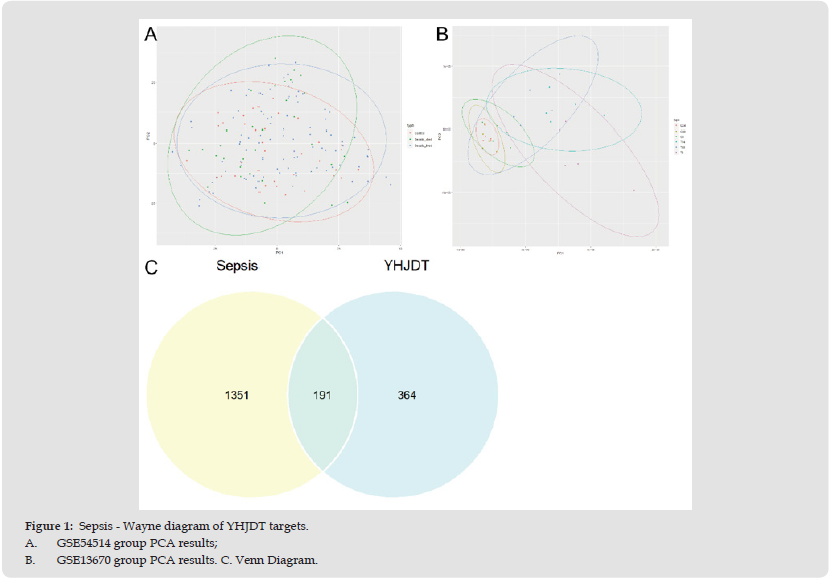
The results from the Gene Cards database, filtered by score, identified a total of 1,266 genes associated with sepsis. To further elucidate the therapeutic mechanism of Yinhua Antidote Soup (YHJDT) in the treatment of sepsis, we selected two sets of expression matrices (GSE54514 and GSE13670) from the GEO database for data analysis. Principal Component Analysis (PCA) indicated good reproducibility of the samples and high confidence in the data (Figures 1A & 1B). The analysis revealed 409 differentially expressed genes, which were then integrated with the results from the database and interacted with the potential targets of YHJDT, resulting in 191 overlapping genes (Figure 1C).
Figure 1
Constructing a ‘Traditional Chinese Medicine-Active Ingredient- Target Gene’ Network
To clarify the interactions between the potential targets of Yinhua Antidote Soup (YHJDT) active ingredients for breast cancer treatment, we generated a network diagram depicting the relationships between TCM active ingredients and target genes, as well as a network diagram for TCM sepsis therapeutic targets. A core protein-protein interaction (PPI) network was constructed, consisting of 46 nodes and 950 edges, using the STRING database and the CentiScaPe module (Figures 2A & 2B). From the core target proteins, we selected five targets-AKT1, ALB, IL1B, IL6, and TNF—for further study based on Degree, Closeness unDir, and Betweenness unDir metrics (Figure 2D). However, other core genes, such as INS and CASP3, are also significant in the sepsis disease process and treatment. Among the active ingredients of YHJDT, quercetin was found to target 92 sepsis-related genes and 31 core targets, making it the ingredient associated with the largest number of core target proteins. Additionally, other active ingredients such as wogonin, luteolin, and berberine also targeted a substantial number of sepsis core targets, indicating their important roles in the anti-sepsis effects of YHJDT. Notably, PPARG and CALM3 were among the most frequently appearing protein targets. Overall, these results suggest that the active ingredients in YHJDT can effectively interact with relevant targets to treat sepsis.
Figure 3

Pathway Enrichment Analysis Diagram
A total of 191 cross-targets were analyzed for KEGG and GO pathway enrichment. The results of the GO analysis indicated that the target genes were primarily enriched in biological processes such as proteolysis, positive regulation of gene expression, cellular response to lipopolysaccharide, and negative regulation of the apoptotic process. Their molecular functions predominantly included serine-type endopeptidase activity, enzyme binding, and identical protein binding (Figure 3A). KEGG pathway enrichment analysis revealed that the target proteins were mainly enriched in the following pathways: lipid metabolism and atherosclerosis, pathways in cancer, the AGE-RAGE signaling pathway in diabetic complications, fluid shear stress and atherosclerosis, and human cytomegalovirus infection (Figure 3B). All these pathways are associated with various pathological symptoms and processes related to sepsis.
Figure 3
Core Protein Molecular Docking Results
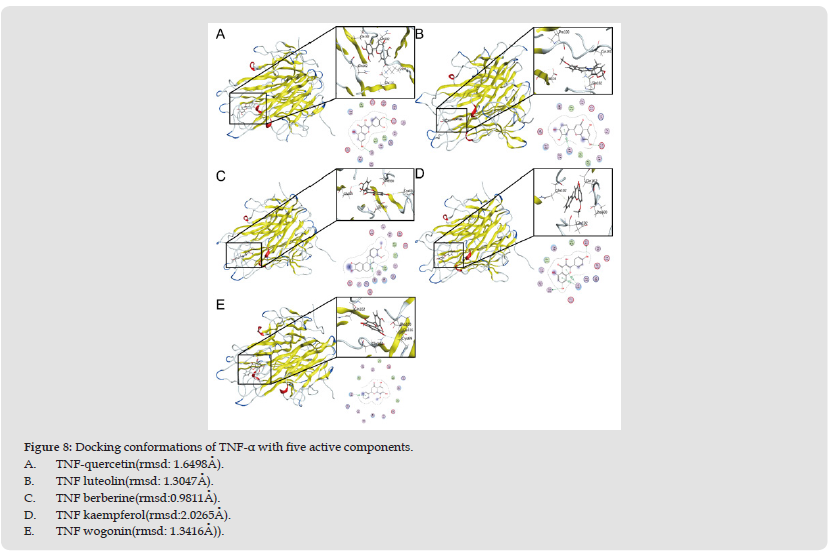
The molecular docking results reveal the potential binding conformations between the active ingredients and core targets. Five core targets—TNF, IL6, IL1B, AKT1, and ALB—were selected for docking with seven different components. A more stable ligand-receptor binding results in lower binding energy. The docking results indicated that the binding energies of the active components with all five core proteins were below -4 kcal/mol. The lowest binding energy was observed in the ALB-β-carotene complex (-8.6689 kcal/mol), with the major interaction forces being van der Waals forces, hydrophobic interactions, and C-H bonds. The second most stable binding was between AKT1 and β-carotene (-8.5998 kcal/mol). The molecular docking diagrams for the seven compounds with potential core targets are presented in Figures 4-8, and the corresponding scores are listed in Table 1.
Table 1: Docking scores of core targets and compounds
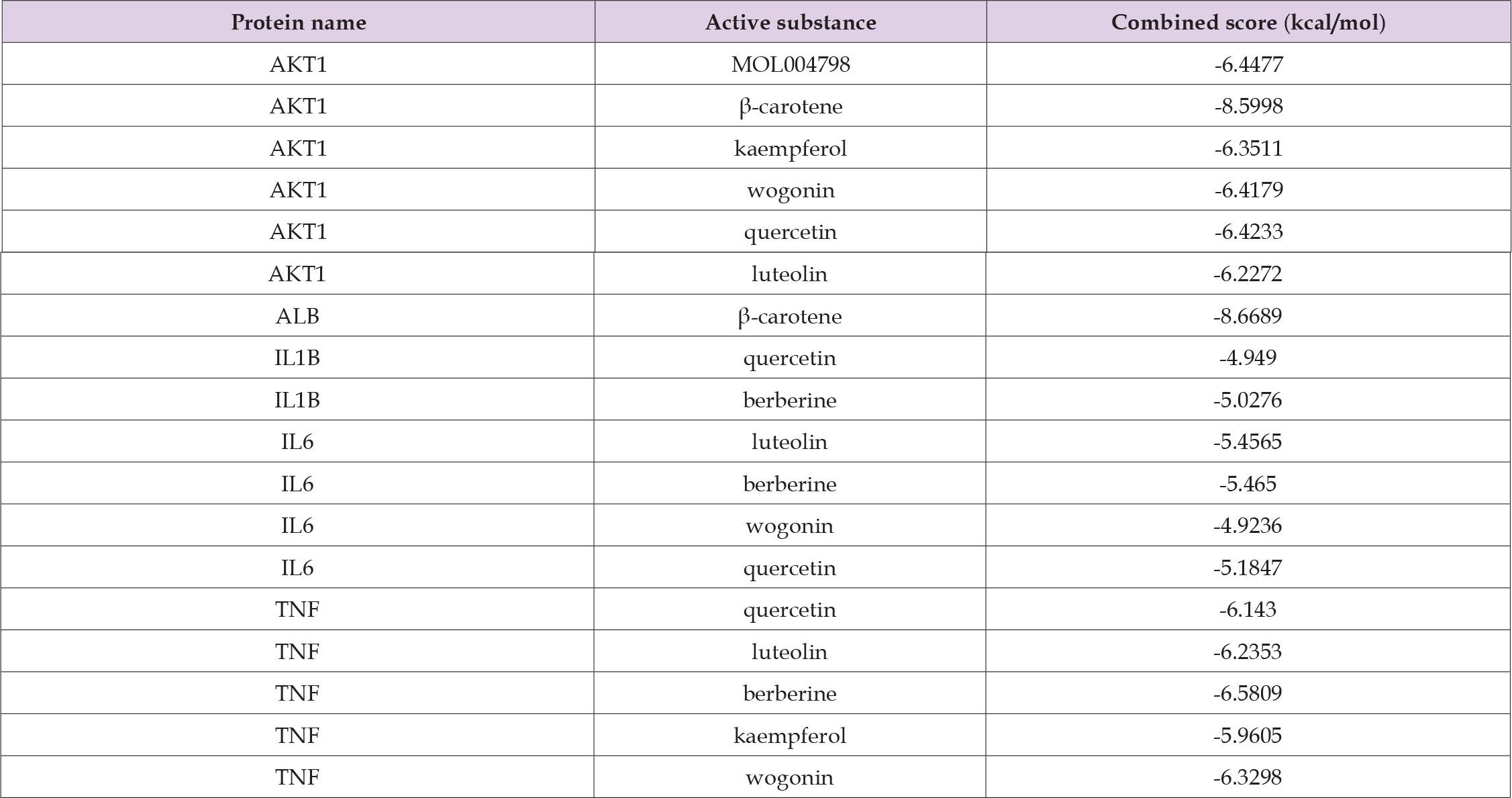
Figure 4

Figure 5
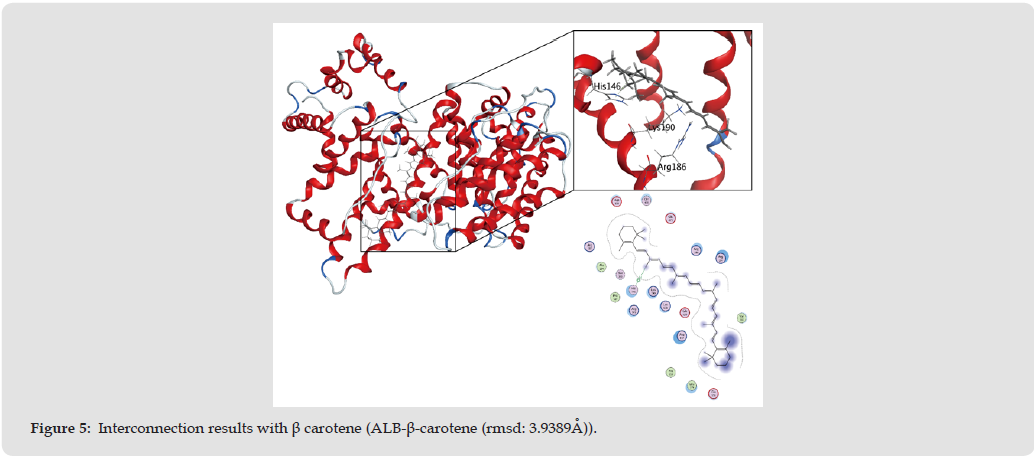
Figure 6
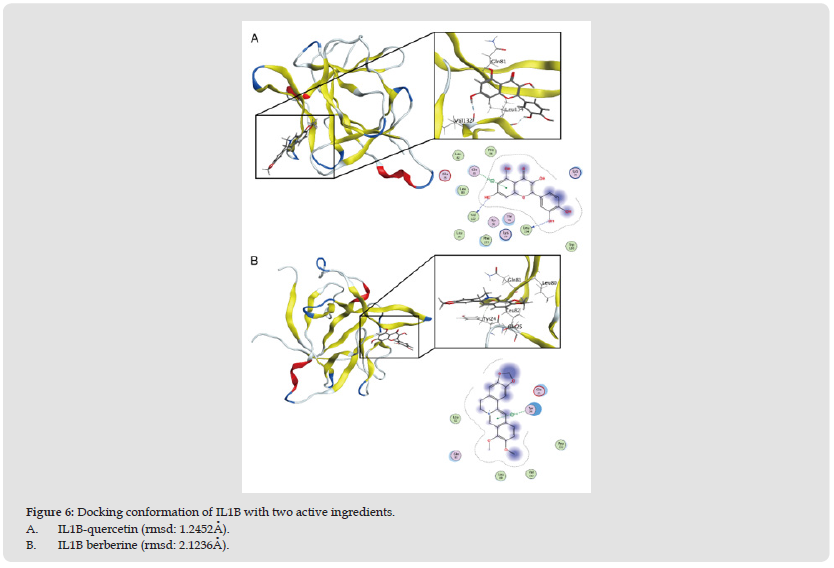
Figure 7
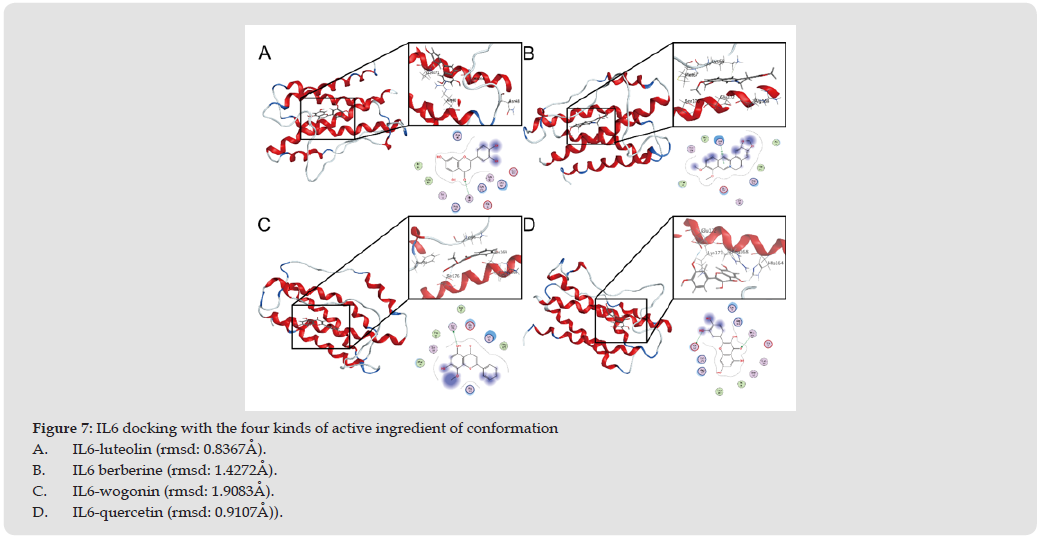
Figure 8
Inhibition of Bacteria by Compounds
To further validate the therapeutic mechanism of Yinhua Antidote Soup (YHJDT) for sepsis, we selected the two compounds with the most core targets-quercetin and berberine-for subsequent trials. Initially, for Gram-negative bacteria represented by Escherichia coli, neither compound demonstrated significant inhibitory effects. However, for Gram-positive bacteria represented by Staphylococcus aureus, berberine exhibited strong inhibitory effects (Table 2). This suggests that berberine may help alleviate sepsis to some extent through its antibacterial properties.
Table 2: MIC of quercetin and berberine.

Inhibitory Effects of Compounds on Septic Inflammation
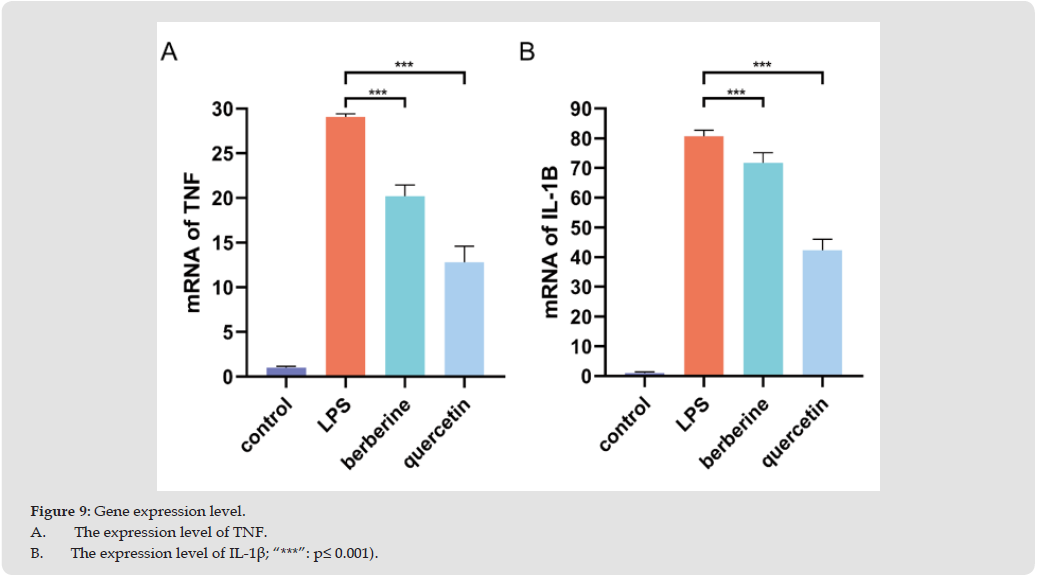
Additionally, we examined the expression levels of inflammatory factors at the cellular level. The results indicated that both quercetin and berberine could reduce the expression of TNF and IL1B compared to the model group, with quercetin demonstrating a more pronounced down-regulation (Figure 9). This suggests that both compounds are capable of alleviating inflammatory damage caused by sepsis to some extent.
Figure 9
Sepsis often arises following major injuries or severe infections, leading to circulatory failure that causes cellular and multi-organ metabolic dysfunction [15]. The mechanism of action of Yinhua Antidote Soup (YHJDT) is complex due to its diverse composition, with its pathways involving numerous targets that address various aspects of the disease from a multidimensional and multifaceted perspective. In this study, we explored the mechanism of action of the traditional Chinese medicine YHJDT in the treatment of sepsis based on network pharmacological analyses. In this study, the main components of Yinhua Antidote Soup (YHJDT) include honeysuckle, Chuanlian, Xiak oucao, Lianqiao, and Mudanpi. Research has demonstrated that the flavonoids in YHJDT possess anti-inflammatory activity, significantly reducing the expression levels of IL-6, TNF-α, and ALB in inflammation models [16-18]. For instance, the active ingredient honeysucklein from honeysuckle exhibits anti-inflammatory and antioxidant functions, reducing apoptosis, enhancing cell viability, and promoting cell migration and angiogenesis during diabetic wound healing [19]. Chuanlian has traditionally been used to treat various conditions, including respiratory and gastrointestinal infections, dysmenorrhea, and liver disorders, particularly through its ability to inhibit inflammatory responses via the NF-κB signaling pathway [20,21]. Forsythia polyphenols modulate macrophage M1 polarization to attenuate LPS-induced intestinal inflammation in mice, while also inhibiting LX2 cell activation and inflammation through the TLR4/MyD88/NF- κB signaling pathway [22]. In sepsis development, there is a positive correlation between TNF-α levels and disease severity, with IL-1β, IL- 6, and AKT1 being upregulated in vivo. These inflammatory signaling molecules can disrupt normal cell function and promote apoptosis [23,24].
Through network pharmacological analysis and construction of a protein-protein interaction (PPI) network, we identified that the active ingredients in YHJDT may act on targets such as AKT1, ALB, IL1B, IL6, and TNF. GO analysis suggested that YHJDT primarily ameliorates inflammation caused by sepsis and the resulting functional impairment of tracheal tissues through processes such as proteolysis, positive regulation of gene expression, cellular response to lipopolysaccharide, and negative regulation of the apoptotic process. KEGG pathway enrichment analysis identified several key pathways, including lipid metabolism and atherosclerosis, cancer pathways, the AGE-RAGE signaling pathway in diabetic complications, fluid shear stress and atherosclerosis, and human cytomegalovirus infection, all of which may relate to the inflammatory indicators of sepsis treated with YHJDT [25,26]. Notably, some researchers have confirmed that analyses of traditional remedies for sepsis, such as RDN, also indicated an enriched AGE-RAGE signaling pathway, similar to our findings with YHJDT. RDN includes components like Artemisia annua, honeysuckle, and gardenia, which overlap with YHJDT. These studies also demonstrated reductions in the protein expression of p-AKT and p-PI3K in HUVECs induced by LPS, leading to decreased apoptosis rates [27].
The primary cause of sepsis is often Gram-negative bacterial infections. Berberine, an active ingredient in Huanglian, exhibits both anti-inflammatory and antibacterial properties [28]. Our study found that berberine significantly inhibits Staphylococcus aureus, while both quercetin and berberine effectively reduce the upregulation of TNF-α and IL-1β caused by LPS infection. This study utilizes a network pharmacological approach to preliminarily predict the active components, drug targets, and drug-disease-related pathways of Yinhua Antidote Soup (YHJDT). The anti-sepsis effects of YHJDT are characterized by multiple targets, multiple purposes, and multiple pathways, with mechanisms potentially linked to inflammatory pathways involving TNF-α and IL-1β. However, this study has some limitations. The search for and confirmation of targets related to the active ingredients require further optimization, and the absence of experimental validation means that the reliability of these target and mechanism predictions needs to be thoroughly investigated.
The author declare that they have no competing interests.
Based on network pharmacology, this study constructs a druggene- disease protein-protein interaction (PPI) network by identifying sepsis-related genes and targets associated with YHJDT. The findings suggest that YHJDT may play a role in interfering with the development of sepsis. Furthermore, the study reveals that YHJDT exhibits inhibitory effects on sepsis-related pathogens, including E. coli and Staphylococcus aureus, and significantly down-regulates LPS-induced inflammatory cytokines, such as IL-1β and TNF-α.
None.
Jiandong Chen participated in the writing, supervision and conception of the paper. Li Huang was involved in data analysis, Hao Lu and Qinqing Lin participated in experimental verification.


 Abstract
 PDF
PDF






























