info@biomedres.us
+1 (502) 904-2126
One Westbrook Corporate Center, Suite 300, Westchester, IL 60154, USA
Site Map
 ISSN: 2574 -1241
ISSN: 2574 -1241
ISSN: 2574 -1241
Received: March 08, 2025; Published: March 19, 2025
*Corresponding author: Mark Hoffmann, Department of Chemistry, Associate Dean for Research, University of North Dakota, USA
DOI: 10.26717/BJSTR.2025.61.009538
The reliable prediction of non covalent interactions in amino acids remains challenging. Wave function-based methods have been recognized for their chemical accuracy in predicting reliable noncovalent interactions. Recently, density functional theory (DFT) has become popular because it offers a less expensive alternative than wave function-based methods that include correlation effects. In this work, we used eleven non-natural amino acids to investigate the performance of quantum chemical methods for the prediction of these challenging non-covalent interactions. Five DFT functional (PBE-D3, B3LYP-D3, HSE06, M06-2X, and ꞷB97XD) and second- order Møller-Plesset (MP2) theory were evaluated against Coupled Cluster with Single and Double excitations, with perturbative Triple excitations (CCSD(T)). Two Pople basis sets, 6-31G* and 6-311++G**, were used to examine the impact of basis sets on the properties of amino acids in vacuum and solvent. The solvent effect was then incorporated using H2O.These amino acids were modeled in their neutral and zwitterionic forms to predict the most stable form. Our results indicate that higher-level DFT methods, such as HSE06, M06-2X, and ꞷB97XD-which are range-separated hybrid and double hybrid functionals designed for systems with strong dispersion interactions-provided more accurate predictions compared to the wave function-based method (MP2).
Cancer is the generic term used to designate a large group of diseases that can affect any body part. It is caused by the loss of regulation of cells due to their uncontrolled proliferation. Cancer is a major public health problem in many countries and the second leading cause of death in the world [1]. One distinct feature of cancer cells, compared to normal cells, is the biomechanics of the cell membrane, which plays an important role in cell signaling, communication, adhesion, and transport [2]. Cancer cells activate particular signals to regulate the deformability of the cytoskeleton structure during epithelial-mesenchymal transition for tumor invasion, progression, and metastatic expansion [3]. They are known to self-regulate growth and division instead of being regulated by chemical signals like in a normal cell. Amino acids play a dual role in cell metabolism, for they are building blocks for protein synthesis and intermediate metabolites, which fuel other biosynthetic reactions [4]. They also have been recognized for the treatment of these cancer cells due to their stabilities and ability to easily form hydrogen bonds, hydrophobic interactions, and weak nonconventional interactions (like C-H---π, O-H---π,N-H---π, and Cation--- π interactions). [5-7] These noncovalent interactions are paramount both in biological and chemically recognized processes which have led to increasing interest for theoretical chemists to carry out both qualitative and quantitative investigation on amino acids to validate their interactions [5]. Noncovalent interactions in biomolecules are stabilized mainly by electrostatic, induced dipoles, and dispersion energy contributions [6]. The Hartree-Fock technique is generally reliable for treating largely electrostatic interactions but fails to treat instantaneous electron interactions, which give rise to dispersion forces [7,8]. Ab initio techniques such as MP2 have been assumed to give a good account of electron correlation with large basis sets associated with the large computational time at the expense of a precise description of non-covalent interactions [9]. Density functional theory (DFT) approaches are becoming gradually more powerful and less computationally expensive than ab initio quantum mechanical techniques for the studying of large biomolecules.55 Different DFT methods have been developed with the exchange and correction parameters to improve the accuracy of treating the noncovalent interaction of biomolecules [10]. However, chemical accuracy and computational cost have always been major problems in the description of different types of interactions and properties in biological systems [11,12], and the choice of an appropriate DFT functional for a given system is difficult. Therefore, it is crucial to assess and validate different DFT functionals [13] and compare them with wave function theory to compare their accuracy and computational cost.
In this present work, a systematic study was carried out using eleven unnatural amino acids (see Table 1) to perform a comparative study for the chemical accuracy between wave function(MP2 and CCSD( T)) and DFT (PBE-D3, B3LYP-D3, HSE06, M06-2X, and ꞷB97XD), to have adescription of the various non-covalent interactions found in their neutral and zwitterionic form. Complete geometries optimization was performed using five DFT functionals and MP2 to have a clear understanding of the different non-covalent interactions (total energies, electrostatic potentials, dipole moments, HOMO–LUMO band gaps, bond length, and angles, etc.) present in the amino acids. A comparative analysis between two Pople basis sets (6-31G* and 6-311++G**) was used to assess the accuracy between amino acids. All these calculations were performed both in a vacuum and solvent medium (H2O) to understand the effect of solvent on the amino acids.
Table 1: Energy differences (Kcal/mol) computed between neutral and zwitterionic forms for five selected amino acidscalculated at different theoretical levels with the 6-311++G** basis set.

Five DFT methods, (PBE-D3, B3LYP-D3, HSE06, M06-2X, and ꞷB97XD) along with wave function-based approaches (MP2 and CCSD( T)) were assessed. The disparity between the resultsof B3LYP-D3 and PBE-D3 might indicate the impact of altering the correlation functional on amino acid results. The variations observed among the HSE06, M06-2X, and ꞷB97XD findings could primarily expose the consequences of employing range-separated exchange functions.In this study, we utilized the generalized gradient approximation (GGA) with the pure PBE functional, based on the 1996 exchange functional by Perdew, Burke, and Ernzerhof [14,15], We also applied the hybrid DFT functional B3LYP, which combines Becke’s 3-parameter exchange with the Lee–Yang–Parr correlation[16-18]. Additionally, we included the well-known hybrid HSE06 (Heyd-Scuseria-Ernzerhof), the meta-hybrid M06-2X (Minnesota 2006 functional), and the double-hybrid ꞷB97XD (Omega B97 Exchange-Correlation with Dispersion Correction). These DFT functionals have shown a strong correlation with experimental results and were used to assess the electronic properties of amino acids [19]. For a detailed description of these functionals, please refer to the supplementary material. The initial guess for the molecular orbitals of the amino acids was obtained at the Restricted Hartree Fock (RHF) level. Here, the RHF single determinantal wave function includes exchange-correlation (that is, the correlation between electrons of the same spin) but not coulomb correlation (often referred to simply as “correlation” or as “dynamic correlation” which is the correlation of the motion of electrons) [20, 21]. The RHF wave function may be expressed as

where the denote molecular spin orbitals. Because of the imbalance of correlation in HF, some form of post-HF treatment is necessary. To validate and cross-check the applicability of DFT, we performed second-order Møller–Plesset calculations. The use of second-order Møller–Plesset Perturbation Theory (MP2) in quantum chemistry was first reported by Ditchfield and Heher in 1971 [12]. The MP2 energy equation is given below.

This post-mean field method was first derived in general in 1934 by Møller–Plesset, who added the electron correction effects via Rayleigh–Schrödinger perturbation theory (RS-PT) [22,23]. For the current study, all wave function calculations were done using a single reference wavefunction [24,25], and DFT-based approaches4 using the same basis sets [26,27]. The Gaussian electronic structure code with an Ultra Fine numerical pruned grid (99,590: 99 radial shells and 590 angular points per shell, resulting in about 9000 points per atom) was used for all calculations [28], using Gaussian 09 default convergence (Conv=10-8).The optimized geometries, frequencies, and energies of the amino acids were computed by applying the spin-restricted pure PBE-D3, B3LYP-D3, HSE06, M06-2X, ꞷB97XD, and MP2. Self-consistent reaction field (SCRF) [29-31] calculations were done to compute the effect of water solvent (with ε=78.3553) on the amino acid. The effect of solvent on the HOMO-LUMO band gap and the differences in the dipole moments of the amino acid were also investigated.
As is well known, the choice of basis sets affects both the accuracy of the computed results and the computational (or CPU) resources required [32]. In this study, complete structure optimization was performed using five DFT functionals with two different basis sets. The 6-31G* basis set includes polarized Gaussian-type orbitals (GTOs) for the inner shell, 3 GTOs for the inner valence, and a set of polarization functions on the heavier atoms. The 6-311++G** basis set, on the other hand, incorporates 6 GTOs for core orbitals, 3 GTOs for inner valence, and 2 different GTOs for outer valence (triple-zeta) basis functions [28], along with additional diffuse and polarized functions for both heavy and lighter atoms. MP2 calculations were also conducted using the same basis sets. To account for dispersion effects in the DFT calculations, the D3 correction was applied to PBE and B3LYP functionals to enhance their chemical accuracy. The HOMO-LUMO energy gap of the amino acids was obtained from HOMO and LUMO energies via gap =ԑ_LUMO -ԑ_HOMO. The LUMO and HOMO cube files were used to generate the LUMO and HOMO orbitals using VESTA.31CCSD( T) energies for both the neutral and zwitterionic forms of the amino acid were calculated using the 6-31G* and 6-311++G** basis sets. The energy differences between these forms were then assessed to determine which amino acid form is the most stable.
Empirical dispersion, designated as D3, is a crucial component in studying biological systems because it offers a more accurate description of dispersion interactions. These interactions are essential for understanding non-covalent interactions, protein folding, molecular recognition, and nucleic acid structure. Incorporating D3 in DFT calculations enhances the accuracy of interaction and potential energy predictions. We used this D3 algorithm in running our DFT calculations (see eq 2.3). The D3 contributions were calculated using the Pople basis sets and then added to the uncorrected DFT energies [33]. Since MP2 calculations inherently account for dispersion effects, no additional dispersion correction was applied [34,35].

where D3 is the Grimme empirical dispersion parameter, used in Gaussian the expression IOp (3/124 = x) where x = 30, for force dispersion type three [36,37]. In this study, we generated molecular electrostatic potential (MEP) surfaces mapped with an iso-surface value of 0.0004 au. The minimum and maximum values of these surfaces were then obtained in atomic units (Figure 1).
Figure 1
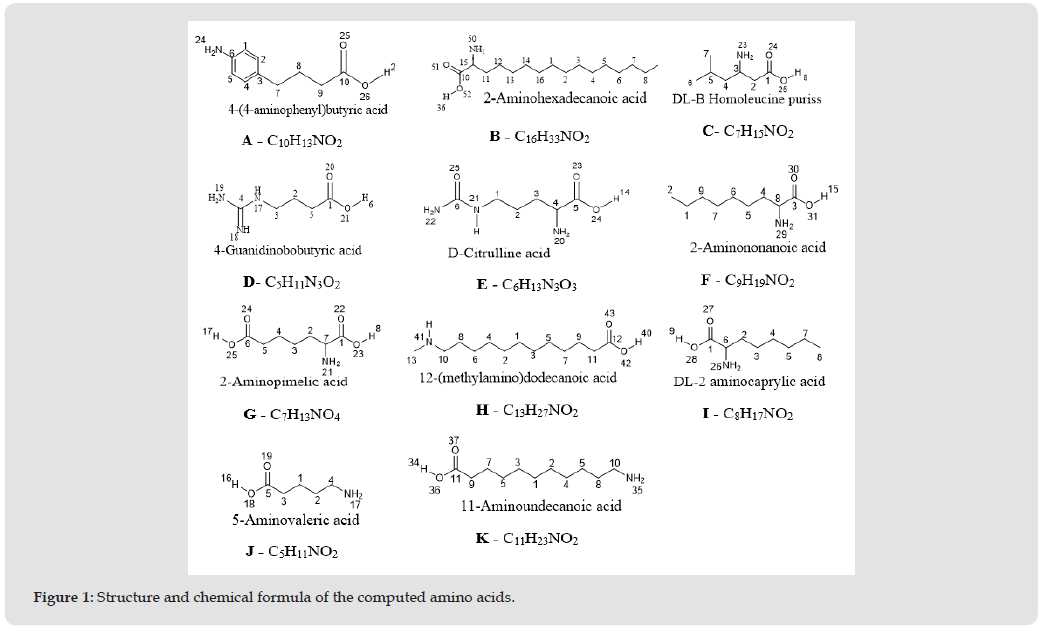
Structural and molecular formulas of the eleven amino acids modeled are drawn and labeled using Chem Draw Professional-15.0 (see Figure 1). To evaluate how these methods influence the molecular properties of amino acids, we performed calculations using PBE-D3, B3LYP-D3, HSE06, M06-2X, ꞷB97XD, MP2, and CCSD(T) on all the considered amino acids. Initially, we obtained optimized molecular structures for the neutral and zwitterionic amino acids using PBE-D3, B3LYP-D3, HSE06, M06-2X, ꞷB97XD, and MP2 by utilizing two Pople basis sets (6-31G* and 6-311++G**). The CCSD(T) energies for five neutral and zwitterionic amino acids were calculated using the 6-311++G** basis set at the MP2/6-311++G** optimized geometries. The discrepancies in these energies were then compared with those obtained from DFT functionals and MP2. The CCSD(T) energy differences (in kcal/mol) between the neutral and zwitterionic amino acids were comparable to those obtained with M06-2X and ꞷB97XD and showed greater similarity than those from other DFT functionals and MP2.Consequently, the ꞷB97XD energy difference, which was the closest to CCSD(T), was selected for benchmarking the other methods. Additionally, our evaluation showed that zwitterionic amino acids were more stable than neutral amino ones in solvent. The impact of the basis set on 11 amino acids, in both their neutral and zwitterionic forms, was also explored. As noted in the methods section, CCSD( T)/6-311++G** produced more stable energies compared to CCSD( T)/6-31G*. Table 1 below presents the energy differences between the zwitterionic and neutral forms of the amino acids, in kcal/mol, across all the methods used.
Dipole Moments
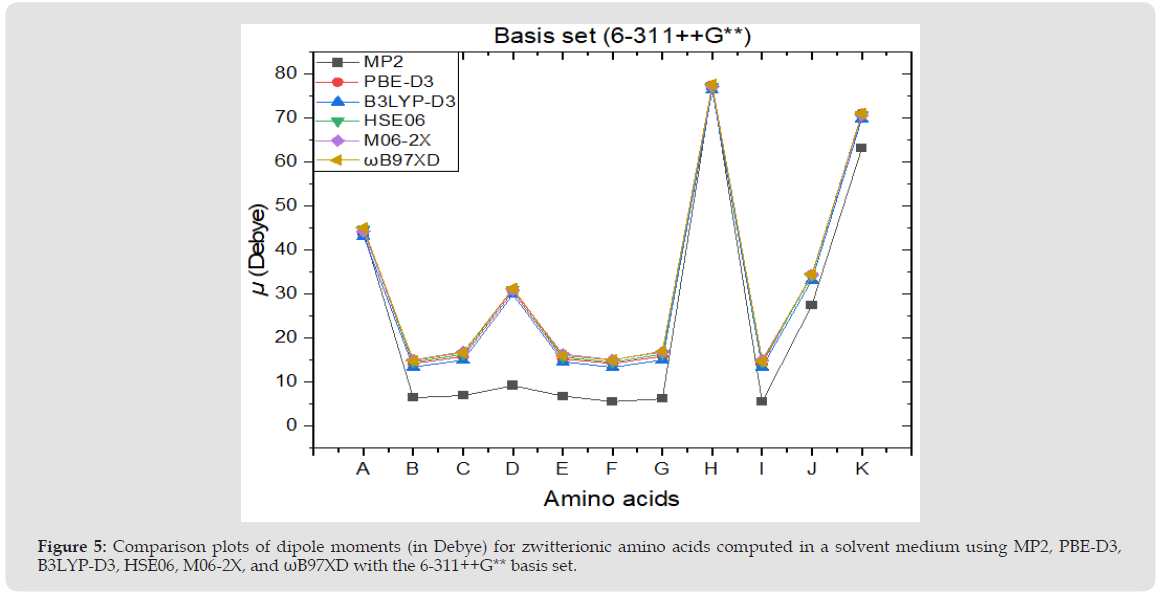
Dipole moments serve as a valuable tool for understanding the extent of charge separation within a molecule or bond, offering an average depiction of electron distribution within the molecule. This information sheds light on the molecular structure and is particularly crucial for the development of comprehensive coarse-grained models of molecules. The investigation of dipole moments for neutral amino acids using PBE-D3, B3LYP-D3, and MP2 with a 6-31G* basis set revealed consistent dipole moments in both vacuum and solvent media, except for amino acid E (see Figures 2 & 3). To resolve the inconsistency in the dipole moment of amino acid E, the DFT functionals and basis set were expanded to include HSE06, M06-2X, ꞷB97XD, and 6-311++G**. This expansion led to a more consistent dipole moment in the solvent medium, as shown in Figure 3. In a vacuum, the MP2 dipole moments for all amino acids, except for amino acids I and K, were inconsistent (see Fig. S3 for details). Additionally, to assess the stability of the amino acids, calculations were conducted on their zwitterionic forms in a solvent medium.The zwitterionic dipole moments were consistent across both basis sets (6-31G* and 6-311++G**), as illustrated in Figures 4 & 5. Additionally, the DFT dipole moments of the zwitterionic forms were approximately ten times larger than those of their neutral counterparts, while the MP2 results were often comparable to those of the neutral amino acids. Using CCSD(T) energies, the dipole moments of the zwitterionic forms were confirmed to be more stable, with ꞷB97XD dipole moments serving as the benchmark due to their energy differences being closer to those of CCSD(T). The dipole moments presented in Figures 2-5 demonstrate that the magnitude of the dipole moment increases with a greater number of -NH2 and -COOH moieties in the amino acid, both in a vacuum and in the solvent medium.
Figure 2

Figure 3
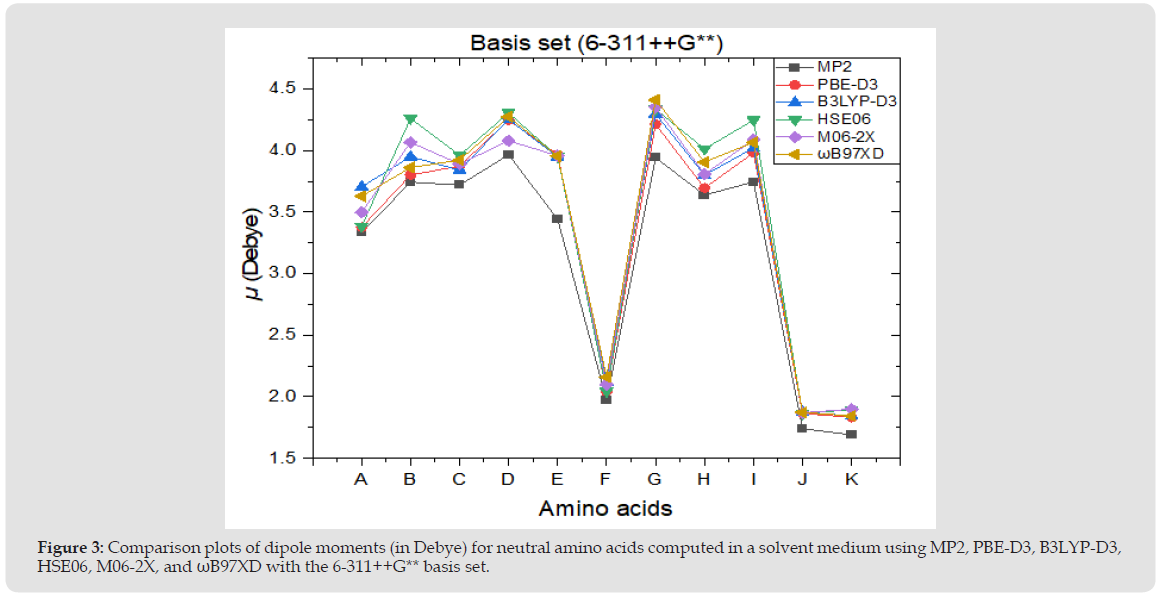
Figure 4
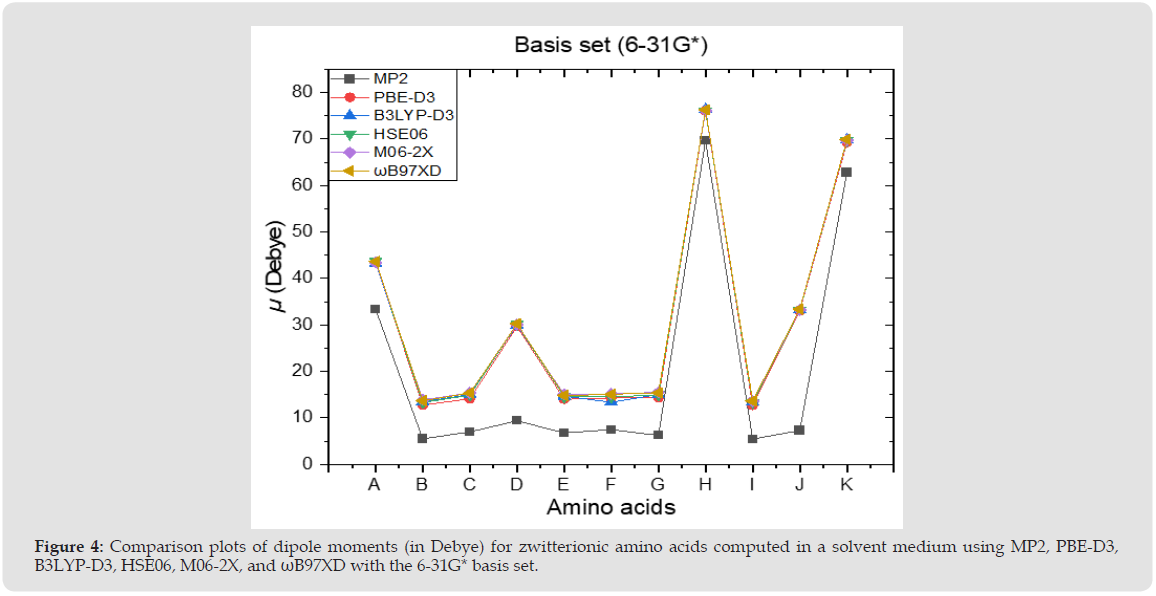
Figure 5
Structural Parameters
The structural prediction of biological molecules is crucial for understanding their functions and interactions with other molecules or surfaces. This is essential for advancements in medicine and biotechnology. [37] Amino acid E, which exhibited inconsistent dipole moments with the 6-31G* basis set when using five different DFT functionals and MP2, was further investigated with the 6-311++G** basis set to validate its structural parameters. HSE06, M06-2X, and double hybrid functionals (ꞷB97XD) with inherent empirical dispersion [20,21] revealed that the dipole moments of molecule E were inconsistent due to a significant rotation of approximately 30° in its torsion angle (N20C4C5O23) (see Table 2).Concerning the effects of solvent on the amino acid, there is a slight increase in the torsion angles in solvent as compared to those in the vacuum; see supporting formation for more details (Table 2).
Table 2: Structuralparameters of the neutral amino acid E in a vacuum and solvent medium using 6-311++G**. Torsion angles are given in degrees (°).

HOMO-LUMO Energy Gaps
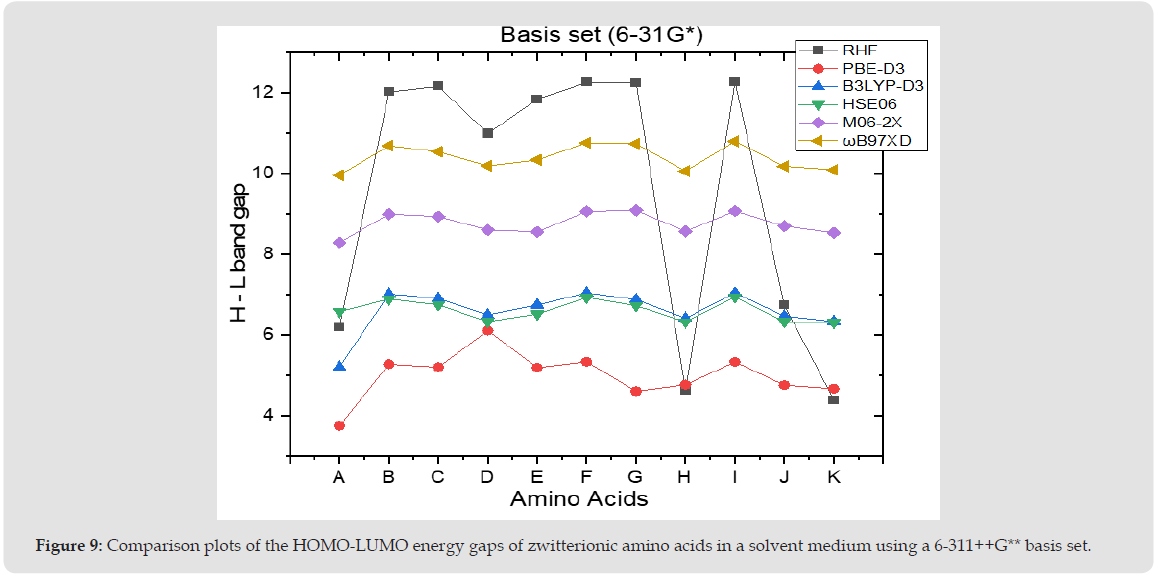
The HOMO and LUMO orbitals indicate a molecule’s ability to donate and accept electrons, respectively. These crucial factors significantly impact the electrical, optical, and chemical behavior of various molecules. The HOMO-LUMO energy gaps of the eleven neutral amino acids were computed with five DFT functionals and MP2 in the vacuum and solvent medium, using 6-31G* and 6-311++G** basis sets. In the vacuum and solvent medium, the LUMO orbitals are localized around the -COOH groups of the amino acids, whereas the HOMO orbitals are localized on the -NH2 groups except for RHF HOMO orbitals that span across the entire molecule [38]. The HOMO-LUMO energy gaps calculated in the solvent medium are larger than those in the gas phase (Figures 4-6). This increase in energy gap values in the solvent indicates that amino acid molecules exhibit greater chemical and kinetic stability in the solvent medium compared to in a vacuum or gas phase [39]. In addition, the zwitterionic amino acids (A, H, and K,) exhibit smaller RHF HOMO-LUMO energy gaps both with 6-31G* and 6-311++G** (see Figure 6) compared to neutral amino acids in the vacuum and solvent medium with an average difference of 3.5eV and 6 eV, respectively. Previous studies have demonstrated that HSE06 is an effective functional for accurately predicting HOMO-LUMO energy gaps in small peptides [40]. However, our findings indicate that ꞷB97XD is the best functional due to its inclusion of empirical dispersion correction with Hartree-Fock exchange, and its energy difference is closer to that of CCSD(T) when compared to HSE06 (see Table 1). Therefore, ꞷB97XD was used as the benchmark for the HOMO-LUMO energy gap plots in both the vacuum and solvent medium, as shown in Figures 7 & 8 below. For additional energy gap results in a vacuum, refer to Table 3 and Figure 4 in the supporting information (Figure 9).
Table 3: The LUMO-HOMO band gap of D-Citrulline acid (E) was calculated in electron volts (eV) using the 6-311++G** basis set, both in vacuum and in a solvent medium. Additionally, the charge density distribution for both the HOMO and LUMO orbitals is included.

Figure 6
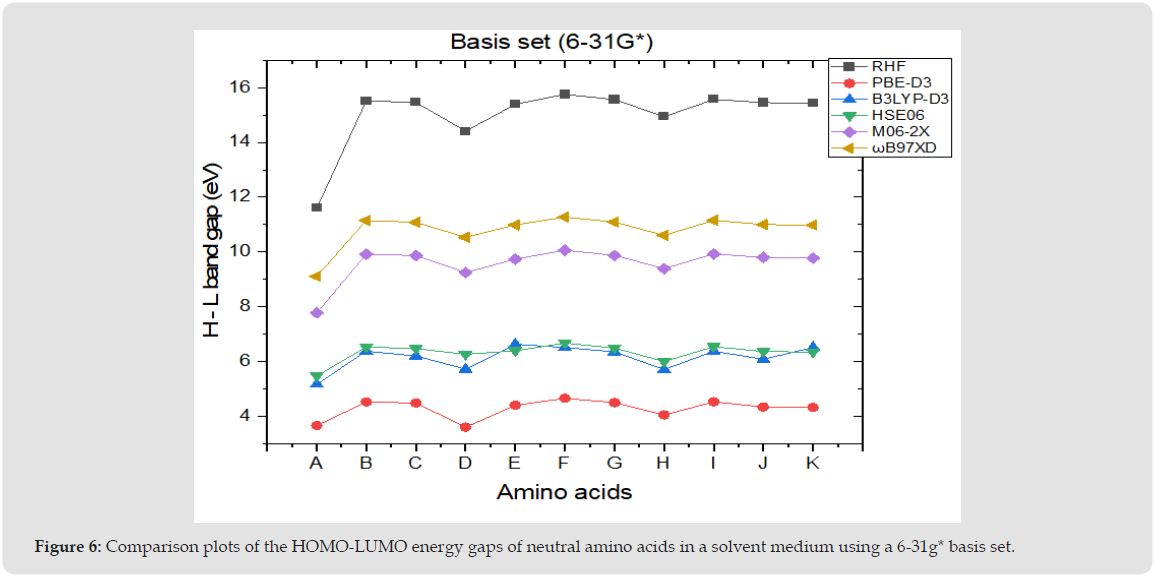
Figure 7
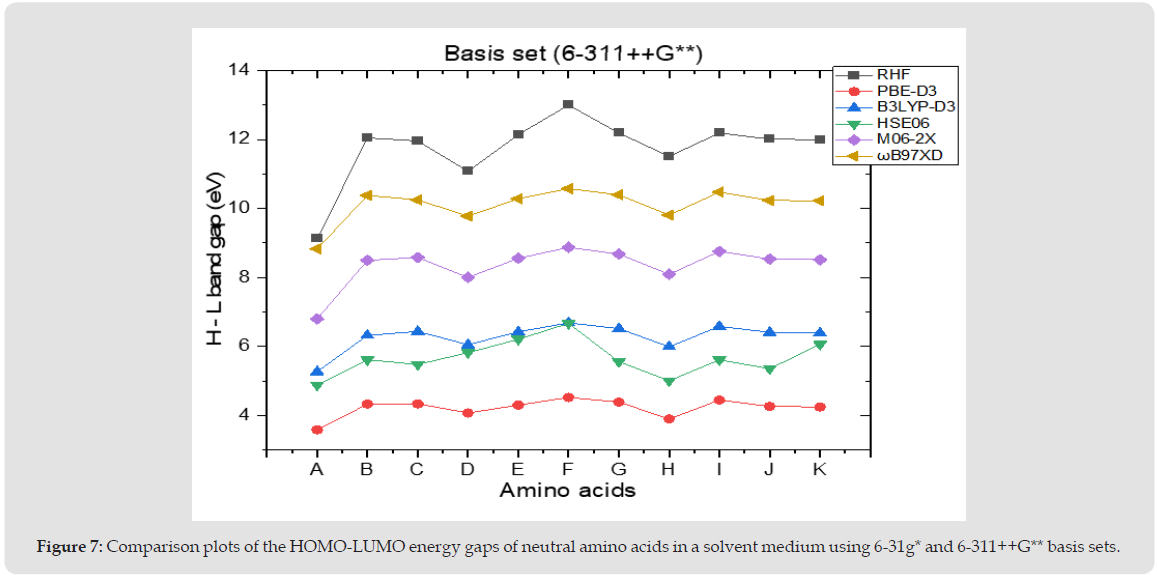
Figure 8
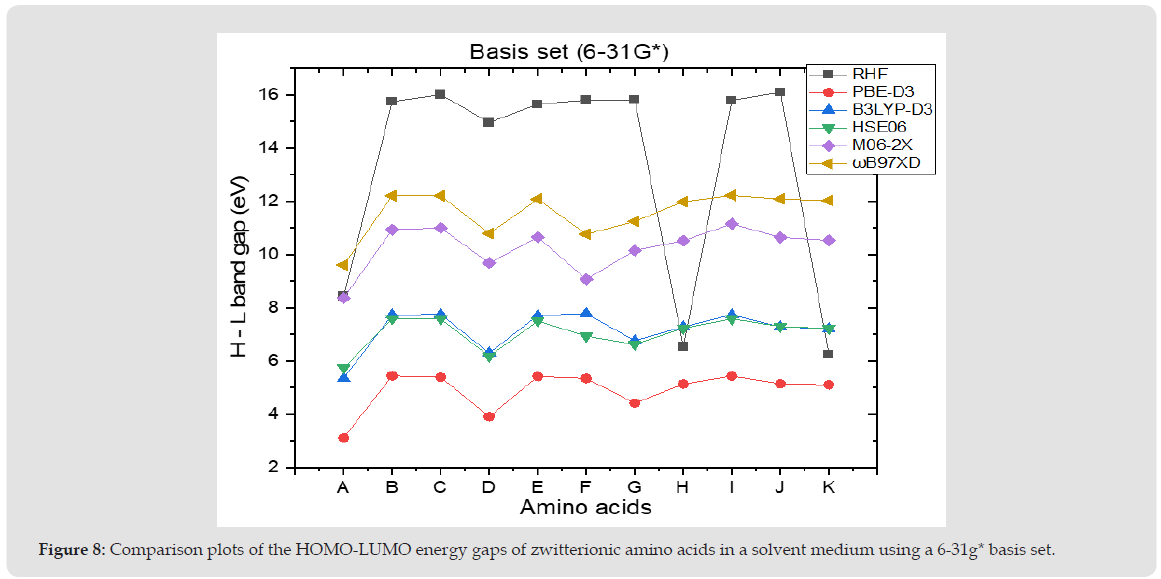
Figure 9
Molecular Electrostatic Potential (MEP)
MEP is a useful property that provides insight into which type of intermolecular interactions or associations are present in a molecule and helps to identify the likely sites for nucleophilic and electrophilic attacks in the molecule. Accurately predicting the sites of attack is crucial for identifying the binding sites within a given molecule of interest [41]. As previously mentioned, we generated MEPs for certain amino acids that exhibited significant differences in their structural parameters with the 6-311++G** basis set, using various methods such as MP2, PBE-D3, and ꞷB97XD, as shown in Table 3. As shown in the MEPs in Table 3, the red regions (more negatively charged) indicate areas with high electron density localized on the hetero atoms of the amino acids (i.e., O and N). In contrast, the blue regions (more positively charged) represent areas with low electron density localized around the hydrogen and carbon atoms of the amino acids [41]. The red regions, being more negatively charged, are expected to serve as nucleophilic sites, while the blue regions, being more positively charged, are anticipated to function as electrophilic sites. This is because the red regions can donate extra electron density, and the blue regions can accept electron density into their vacant orbitals [41-43]. Additionally, the red regions, abundant in electrons, can participate in hydrogen bonding [44]. The maximum and minimum MEPs of the neutral amino acid increased by approximately 0.0004 au iso-value compared to those calculated in a vacuum. There is little difference in the maximum and minimum MEPs between the DFT functionals and MP2, whether in a vacuum or solvent medium (see Table 4) [45].
Table 4: A comparison of the molecular electrostatic potential surfaces for D-Citrulline acid (E) calculated with the 6-311++G** basis set shows the minimum and maximum potentials. The color range is expressed in atomic units (au): blue indicates more positive regions, while red represents more negative regions.

In summary, our investigation comprehensively evaluated the efficacy of six computational methods, including five Density Functional Theory (DFT) techniques (PBE-D3, B3LYP-D3, HSE06, M06-2X, and ꞷB97XD) alongside the wave function method (MP2), in determining the optimal functional for modeling amino acids in both neutral and zwitterionic forms, under vacuum and solvent conditions. Our findings indicate that ꞷB97XD is the most effective functional, outperforming M06-2X, HSE06, and MP2, with B3LYP-D3 and PBE-D3 being less effective. Notably, the convergence of basis sets for DFT methods was observed to progress at a reasonable pace, while MP2 exhibited slower convergence rates. Contrary to a previous study, which suggested that MP2 can give a good account for electron correlation [9] in biological systems and HSE06 is suitable for HOMO-LUMO energy gap predictions[45], our results recommend ꞷB97XD as the most suitable DFT functional for accurately modeling small peptides and related biomolecular systems, particularly in capturing non-covalent interactions. As such, we strongly recommend the ꞷB97XD/6-311++G** method in the solvent medium for future investigations of amino acids both in the zwitterionic and neutral form, given its robust performance across diverse conditions and molecular configurations.

International Association of Landscape Archaeology, Czech Glass Society, Czech Republic

Department of Chemistry, Semenov Institute of Chemical Physics, USSR Academy of Sciences, Moscow, Russia

Department of Educational Sciences, Research Centre Qualities of Teachers, School of Education – HAN, Nijmegen, Netherlands

Associate Professor at Department of Breast and Thyorid Surgey, Chongqing General Hospital, China

Neurology, LA BioMed Research Institute, USA





 Abstract
 PDF
PDF



























