info@biomedres.us
+1 (502) 904-2126
One Westbrook Corporate Center, Suite 300, Westchester, IL 60154, USA
Site Map
 ISSN: 2574 -1241
ISSN: 2574 -1241
ISSN: 2574 -1241
Received: January 21, 2024; Published: February 07, 2025
*Corresponding author: Fatimah Lateef, Senior Consultant, Dept of Emergency Medicine, Singapore General Hospital, Core Faculty, Emergency Medicine Residency, SingHealth, Professor, Duke NUS Graduate Medical School, Yong Loo Lin School of Medicine, National University of Singapore and Lee Kong Chian Medical School, Nanyang Technological University, Director, SingHealth Duke NUS Institute of Medical Simulation (SIMS), Faculty, Duke NUS Global Health Institute, Singapore
DOI: 10.26717/BJSTR.2025.60.009463
Alkali containing agents are not that uncommon as there are many households as well as industrial products which contain them in varying concentrations. Besides the more serious type of exposure through ingestion, cutaneous alkali burns may not always be viewed in a critically time-dependent fashion and thus may not be given the due consideration it deserves. One very important area is the insufficient decontamination or irrigation. At times, it is assumed that just the prehospital washing is sufficient. Irrigation and flushing stops once the patient arrive in the Emergency Department. It is thus important to understand the underlying mechanism of injury and how it goes on for a longer period as it will affect the outcomes for the patient. Often this involves functionality of limbs and thus the importance of handling it appropriately with timely management as well as early consultation with Burns Specialists. We share the critical first line management steps and the rationale for this in alkali cutaneous burns.
Keywords: Alkali; Burns; Saponification; Decontamination
Burns caused by alkali can be accidental or intentional (often linked to suicidal intent). Caustic agents can be acids or alkali. Alkali containing agents are not that uncommon as there are many households as well as industrial products which contain them. Besides the more serious type of exposure through ingestion, cutaneous alkali burns may not always be viewed in a critically time-dependent fashion and thus may not be given the due consideration it deserves. Rapid diagnosis and intervention are extremely crucial for cutaneous alkali burns. Delays of 10 minutes or more in decontamination and flushing, has been said to cause significant tissue necrosis and destruction. In fact, the washing and proper decontamination may take up to 2 hours until a neutral pH is obtained. [1-5] Some examples of alkali solutions or alkali-containing agents include sodium hydroxide, sodium hypochlorite, ammonia and potassium hydroxide. Alkaline chemicals are often found in commonly used products such as drain and floor cleaners, degreasers, household detergents and hair removing creams. These products may come with a variety of trade names in different countries. The solutions may also have various combinations of alkali or other chemicals. Thus, it is important, in the event of injury or poisoning, to read the chemical data sheet and composition in planning treatment and management [3,5-7].
Even before any accidents take place, the more important approach is to ensure that when households or workplace facilities stock up on these alkali containing solutions and agents, the necessary precautions are undertaken.
For household
a. To ensure proper handling only by adults. These solutions should be kept out of reach of children.
b. Adequate labelling and preferably, to keep these solutions in their original containers instead of pouring them out into unlabelled vessels.
c. When storing these agents, do ensure they are stored with other cleaning solutions in appropriate cupboards. They should not be placed in cupboards where other consumable drinks are also kept, in order to avoid human errors which can take place when reaching out for these solutions.
For Industries and Workplaces
a. Adequate work briefing and orientation must be given to all staff who will be using and will come in contact with such agents. b. Proper PPE (personal protective equipment) must be prepared for those exposed to these agents as needed. They should be taught how to don and doff the PPE appropriately as well. Proper disposal is also important.
c. In some industries where workplace nurses or industrial nurses are available, they should be able to advise and provide initial management in the case of emergencies with these chemicals. d. The workplace should keep sufficient reference information on the chemicals they are utilizing eg. The MSDS (material safety data sheets) and the TAR (titratable alkali or acid reserve for the substance) [8-13].
e. Industries using these chemicals should come up with an algorithmic approach, made known to all relevant staff, which can be used in the case of exposures or accidents [14]. We share the approach to the management of cutaneous alkali burns and injuries.
The first step in approaching such patients would be to consider whether PPE is required on the part of the EMS (emergency medical services) personnel. Ensure patient is stable in terms of the Airway, Breathing and Circulation aspects. For cutaneous alkali burns, the highly relevant information would be:
• Agents involved and the state they are in ie. solids, liquids or gases.
• Concentration/ dilution.
• Duration of contact/ exposure.
• Amount/ volume in contact with.
• Confirm if only cutaneous contact or vapour/ fumes involved (inhalational).
• Body surface area affected, and which parts of the body in particular is important (eg. face, dominant hand).
• Depth of burns caused by agent (in view this may progress over time, the initial assessment is important).
• Ascertain if any co-exposures are present ie. more than one agent/ chemical was involved. Get the details of the chemical/ s involved.
• If possible, take a photograph of the vessel/ bottle of the chemical/ agent.
• If literature is available, bring this along to the Emergency Department (ED).
• Commence washing/ decontamination with water for irrigation or normal saline as soon as possible and this can continue enroute in the ambulance. A common error is that many stop washing once there seem to be no obvious chemicals. This is the loophole where deeper and widespread necrosis continues from the absorption and seepage of the chemicals from the skin surface [14,15].
• Call for “standby”: this will help receiving ED prepare for decontamination without delay upon the arrival of the patient. The patient with alkali burns may present with pain, erythema and blisters, loss or denuded skin exposing the subcutaneous layers and if a significantly large surface area is involved, more systemic presentation can be present as well.
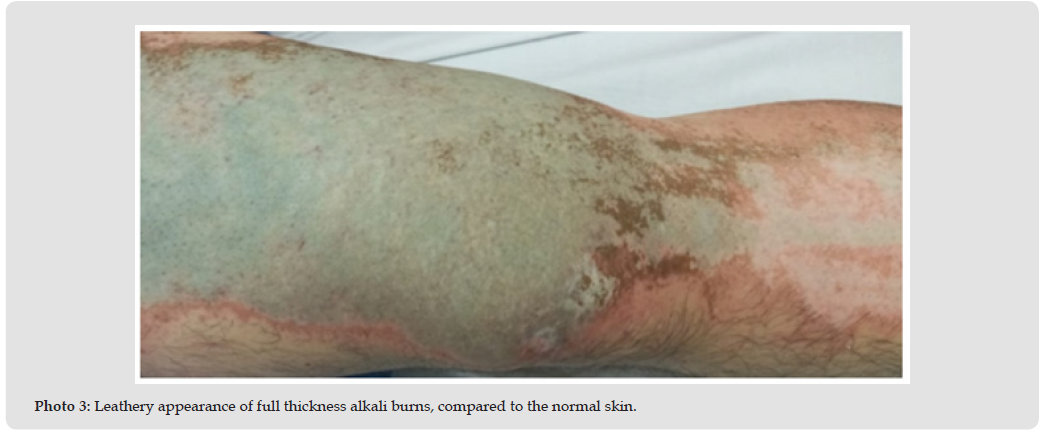
When the patient arrives at the ED, PPE must be donned as necessary, to ensure staff are protected. Washing and irrigation of the effected cutaneous areas must continue, as a take-over from the EMS personnel. This part is often overlooked and the assumption that washing has been completed in the prehospital setting is not appropriate, as explained above. At the same time, assessment for the need for resuscitation must be conducted. In some EDs the washing is done in a specially designated Decontamination Area (Photos 1 & 2a,2b), and the effluent collected separately such that it does not flow into our natural reservoir and cause contamination. If the institution has Burns specialists, they must be activated early. Blood and imaging investigations are then ordered. As burns is essentially an injury, the patient’s tetanus status must be updated accordingly and the booster given. Analgesia will also be required as the pain can be significant. This will be titrated according to individual patient’s needs and level of pain control. If a patient does not feel pain over the affected burnt area of the skin, this can mean there is full thickness or deep dermal burns, where the sensory nerve endings have been damaged. Such areas can appear pale, leathery and would have lost the normal skin tone and colour. (Photo 3) Also, when the alkali burns affect a large cutaneous area or body surface area, systemic effects will become significant, eg. metabolic and electrolyte disturbances, hypothermia with the extensive skin loss and prolonged washing and sepsis [15,16].
Photo 1
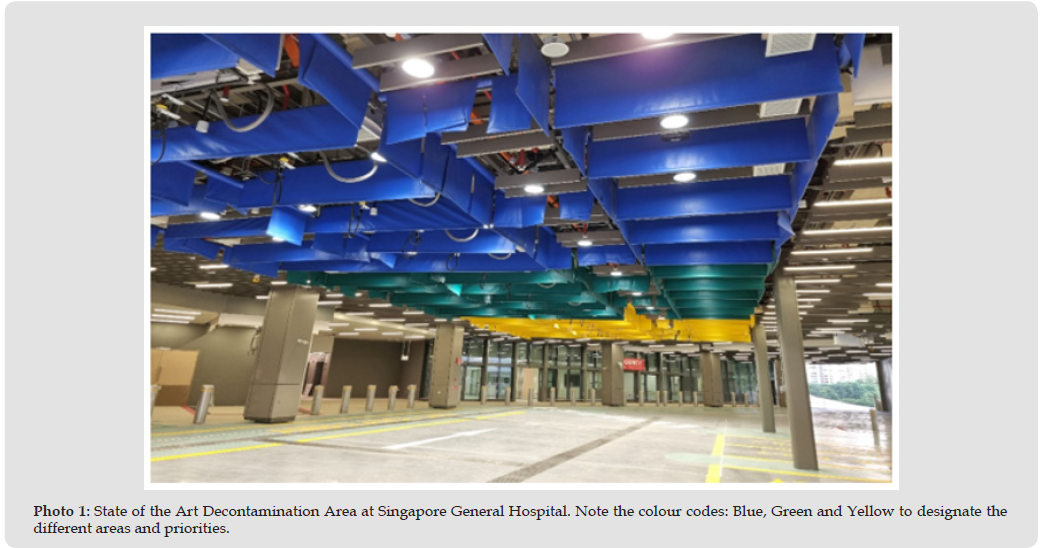
Photo 2
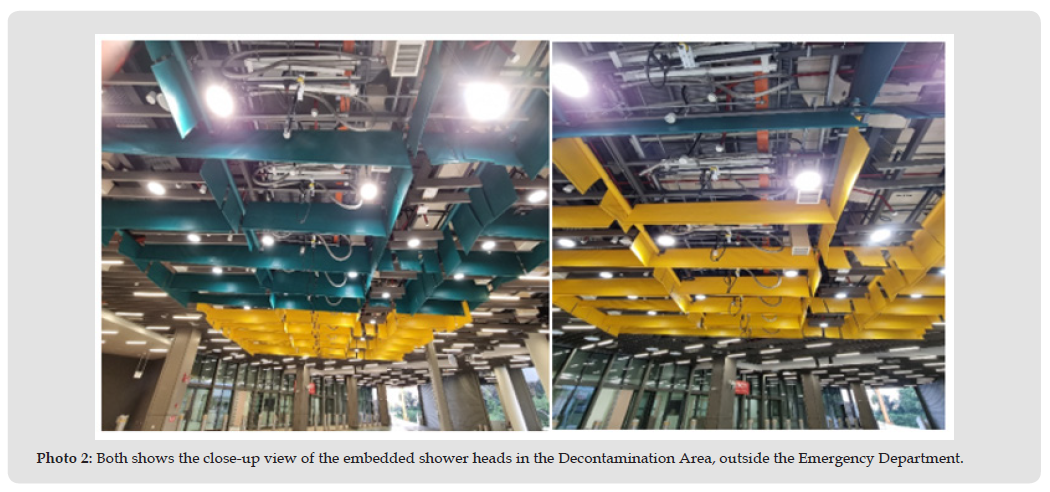
Photo 3
Decontamination [2,4,17,18]
• In performing the decontamination for alkali burns and exposures:
• Ensure appropriate PPE is donned.
• Use the designated Decontamination Area if available.
• Decontamination can be timed simultaneously with resuscitation.
• It is important to ensure all items such as clothing, jewellery and watches etc are removed and properly stored to prevent cross contamination.
• Irrigation can be done with water, preferably tepid. There must be copious flows for sufficient dilution, in order to achieve neutralization.
• Ensure washing and irrigation reaches all areas eg, skin folds, areas under the nail as relevant
• If the burns is caused by a solid form alkali, using water for irrigation can worsen the burns and spread. This is in view that the mixing of water with solid alkali releases strong bases (hydroxide). At the same time, there will be heat released (exothermic reaction). Thus, consider using powder or dry decontamination in such special cases.
Alkaline solutions cause injuries, including cutaneous injuries in the following ways [2,6,14,15,19]:
1. Via saponification of the fat and fatty tissues. This results in hydrolysis of the lipids in the skin and will result in violation and break down of the skin barrier. Despite the fact that washing removes the overtly seen chemicals on the cutaneous areas, some of the chemicals would have been absorbed and seeped into the deeper areas of the skin and thus, injury will continue. This explains why there may be progression after the initial assessment and observation. This is also the basis of the liquefactive necrosis associated with alkali burns. It also explains the often-full thickness burns with such injuries.
2. Via hydrolysis, which continues to break down 3-dimensional peptide bonds, leading to denaturation of the protein and thus alteration in the structure of these in the skin structure.
3. Via hygroscopic action, where cells involved will become dehydrated due to loss of their fluid content. They will shrink, shrivel and progress to necrosis.
4. Via the heat generated from the breakdown or saponification of the fatty tissues in the skin (exothermic reaction) Thus, the washing and decontamination must be done diligently, commencing soonest possible, even from the worksite, home or location where the injury occurred. This may have to go on for 1-2 hours. The washing helps to eliminate the chemicals but the reason for the prolonged decontamination is to help with the chemicals that have seeped into deeper tissues. The pH of the effluent from washing must be reduced, preferably till it reaches a neutral pH.
Cutaneous alkali burns can result from household or industrial agents. The extent of injury may not always be accurately discernible or obvious immediately and may take time to manifest. Decontamination must start at the earliest possible time and continue until satisfactory neutralization is achieved, which may take even up to 2 hours. It is also important to ensure Burns referral is done early, to get specialized inputs in management.

International Association of Landscape Archaeology, Czech Glass Society, Czech Republic

Department of Chemistry, Semenov Institute of Chemical Physics, USSR Academy of Sciences, Moscow, Russia

Department of Educational Sciences, Research Centre Qualities of Teachers, School of Education – HAN, Nijmegen, Netherlands

Associate Professor at Department of Breast and Thyorid Surgey, Chongqing General Hospital, China

Neurology, LA BioMed Research Institute, USA





 Abstract
 PDF
PDF



























