info@biomedres.us
+1 (502) 904-2126
One Westbrook Corporate Center, Suite 300, Westchester, IL 60154, USA
Site Map
 ISSN: 2574 -1241
ISSN: 2574 -1241
ISSN: 2574 -1241
Received: January 02, 2025; Published: January 09, 2025
*Corresponding author: Nikolay Takuchev, Ph.D., Associate professor, Trakia University, Stara Zagora, Bulgaria
DOI: 10.26717/BJSTR.2025.60.009417
A dangerous phenomenon for humanity is described. In the joint analysis of data from satellites in orbit around the Earth and from the health statistics source EUROSTAT, it became clear that, by some mechanism, flows of positively charged particles with high energy entering the Earth’s orbit increase mortality on the planet’s surface. The increase in mortality is in a band of maximum risk in the Northern Hemisphere, parallel to the equator and bounded by the parallels of 30° and 50° north latitude. Examples are given for the European Union mortality from genitourinary system diseases, confirming the described phenomenon. A hypothetical mechanism based on observational evidence has been proposed, according to which this dangerous phenomenon is due to solar alpha particles of high energy sufficient to overcome the atmosphere’s resistance and reach the Earth’s surface in a limited area of maximum death impact.
Keywords: Diseases; Mortality; Genitourinary System; Solar Alpha radiation; Satellites
Some studies have sought to link exposure to sunlight with certain diseases. The Sun’s simultaneous negative and positive effects on health have long been known. Numerous studies have proven the connection between the aforementioned health effects and solar UV radiation, which, like visible light, is a component of solar electromagnetic radiation. Solar UV radiation is composed of short wavelengths, so it does not penetrate deeply into the body, being absorbed in the skin layer. Some researchers are looking for a connection between solar radiation and its impact on specific internal organs. They suggest an indirect effect of UV radiation since it does not reach the internal organs (for example, the incidence of some internal diseases such as prostate cancer among those living in geographical areas with more sunlight or who visit such places more often is reduced compared to those living in areas with less sunlight [1,2]. This article examines the possibility of a direct effect on the body – both on the skin layer and the internal organs – of solar radiation that penetrates deeply through the atmosphere and the body and is different from that of solar electromagnetic radiation. These are streams of corpuscular radiation – positively charged particles with high energy. In a series of publications [3-29], a dangerous phenomenon of cosmic origin for humanity was described – the presence of a high correlation between the flows of positively charged particles with high kinetic energy recorded from satellites in the Earth orbit and mortality on the Earth’s surface from many diseases. The main focus of the mentioned publications was on the effect of solar alpha radiation on mortality from diseases, killer number one of humanity – those of the circulatory system. The harmful effects of solar alpha radiation are also observed on many other organs and systems in the human organism, turning this invisible effect into one of humanity’s leading causes of death. The mentioned dangerous phenomenon of cosmic origin is unevenly spread on the planet’s surface. This phenomenon is also observable in several countries from the Northern Hemisphere – Asia, America, and even Africa [3-29]. Europe and the Mediterranean are among the most affected. The European Union has a tradition of maintaining reliable mortality statistics, in which the discussed multifaceted influence of solar alpha radiation on mortality stands out clearly. Below, based on data from mortality statistics in the European Union, the unexpected association between solar alpha radiation and mortality from diseases of the genitourinary system is shown. The high-energy alpha radiation can ionize the atoms in the living organism, drastically worsening the normal metabolism in living cells. This type of radiation may be the leading external cause of neoplasms.
Mortality Data
The analysis below is based on an authoritative source of health data – EUROSTAT [30]. The parameter annual mortality rate – number of deaths per 100,000 inhabitants – was used as a mortality characteristic in the study. EUROSTAT offers free access to data on mortality rates from causes in the countries of the European Union, the European Economic Area, and the candidate countries for membership in the union. Geographically, these countries occupy Europe and the Mediterranean. Data are grouped by NUTS (Nomenclature Des Unités Territoriales Statistiques in French, the nomenclature of territorial units for statistics). In the study, mortality data from the EUROSTAT shortlist were used. In the EUROSTAT shortlist, mortality rates are grouped by causes of death into 92 groups, primarily diseases. The groups are related to the International Disease Classifier ICD-10 classes (10th revision). The shortlist contains mortality data for EU countries (NUTS-1) and EU regions (NUTS-2, smaller areas of the larger NUTS-1 countries). Currently (2023), the shortlist includes mortality rate data for the interval 2011 – 2020. Annual mortality rate data were extracted for 353 European regions (NUTS-2) separately from each shortlist group for 2011 – 2019 (the last pre-pandemic year).
Satellite Data
Satellite data on corpuscular radiation – protons and alpha particles recorded by the satellites of the series GOES (Geostationary Operational Environmental Satellites) were obtained from an NOAA site [31]. The satellites of the GOES series fly in geostationary orbit (above the Earth’s equator) at an altitude of 36,000 kilometers above the Earth’s surface, making one lap in 24 hours. They “hang” over a specific point on the Earth’s surface and are not shaded by the Earth at their circumference around it. Data on alpha-particle and proton fluxes (unit: (number of particles).cm-2. s-1.sr-1. MeV-1) with energies of 3.8 – 21.3 MeV were used. The fluxes were recorded by the satellite high- energy particle detectors: 1. Energetic Particles Sensor (EPS), and 2. Energetic Proton, Electron, and Alpha Detector (EPEAD). The data are available averaged over a 5-minute interval, during which there are up to 25 reports of the instrument.
Data Processing
The correlation coefficients [32] between the annual averaged alpha radiation flux and the annual mortality rate were calculated. Maps were created showing the distribution of the annual mortality for 353 NUTS-2 European regions from the EUROSTAT shortlist death causes: “Diseases of the Genitourinary System” (EUROSTAT mortality shortlist number 69), “Diseases of kidney and ureter” (EUROSTAT mortality shortlist number 70), “Malignant neoplasm of ovary” (EUROSTAT mortality shortlist number 22), “Malignant neoplasm of breast” (EUROSTAT mortality shortlist number 19), and “Malignant neoplasm of prostate” (EUROSTAT mortality shortlist number 23). With black isolines in the maps, the mortality rate for 2012, the year with the highest solar activity (and mortality), is shown in the studied time interval 2011 – 2019. With red isolines, the maps show the distribution across Europe and the Mediterranean of the correlation coefficient between the diseases’ annual mortality rate and the annually averaged alpha particle flux for 2011 – 2019. In the maps were used data on the coordinates, latitude, and longitude (Google Earth) of the centroids of the NUTS-2 regions included in the study. Mapping was performed with Golden Software Surfer10. The kriging interpolation procedure was selected. In mathematical statistics, the level of statistical significance [32] is a parameter indicating the degree of reliability of the calculated correlation coefficient. The smaller the number of this parameter, the more reliably the correlation coefficient is established, i.e., the more reliably a cause-and-effect relationship has been established in the case between the annual flux of solar alpha radiation and mortality from causes of neoplasms. The correlation coefficient and the level of statistical significance are related. For the 9 years included in the study, a minimum correlation coefficient of 0.668 corresponds to a statistical significance level of 0.05 [32]. In scientific studies, a level of statistical significance no greater than 0.05 is accepted as a criterion for the reliability of the correlation coefficient. Correlation coefficients with a significance level above 0.05 are of high reliability (the higher the number, the lower the significance level). I.e., a causal relationship between cosmic alpha radiation and mortality from the causes of neoplasms can be considered reliably established in the mentioned areas enclosed by red isolines of the correlation coefficient above 0.668. If there is a coincidence between some of the maxima for mortality rate and the significant correlation coefficients’ area, then in the region of these maxima, the impact of alpha radiation contributes noticeably to the mortality from neoplasms. To the extent that the hypothetical mechanism proposed below explaining the observed phenomenon assumes that charged particles of high energy pass through the atmosphere and reach the Earth’s surface, the energy required for this was calculated from databases and calculators PSTAR and ASTAR [33,34]. Geomagnetic field data were obtained from the INTERMAGNET site [35].
The described dangerous phenomenon is observed in the form of dependence between the annual average flux of radiation from positively charged particles (protons and alpha particles) with high kinetic energy, recorded by satellites in orbit around the Earth, and the annual mortality rate in the statistics of several countries from all continents in the Northern Hemisphere. The countries in whose mortality statistics the phenomenon is observed are located in a band parallel to the equator with approximate boundaries along the parallels of 30° and 50° north latitudes. It is observed in the annual mortality statistics of small countries. It is not noticeable in the statistics of large countries in the same band. It can be inferred that the impact on the Earth’s surface is short-lived and over a limited area the size of a small country but is masked in large country statistics because it does not affect the entire area of the large country simultaneously. This conclusion is confirmed for the USA, for which there is data on mortality in individual states [12]. The mortality statistic of the European Union is suitable for the study because it is based on statistical regions, smaller than a country but still big enough to include a statistically sufficient number of inhabitants. This phenomenon is also expected to influence mortality in countries south of the equator. However, their mortality statistics are scarce, unreliable, or absent, preventing reliable inferences about such an influence in the Southern Hemisphere. For particle energies of 3.8 – 21.3 MeV, the year-averaged fluxes of protons and alpha particles are highly correlated, i.e., the studied phenomenon of lethality is noticeable in both the mean proton flux and the mean alpha particle flux data. For the reason explained below, only the average flux of high-energy alpha particles is included as the incident radiation in the following examples. With black isolines, Figures 1, 2, 6, 8, and 11 show respectively the distribution of the mortality rate for the EUROSTAT shortlist death causes „Diseases of the genitourinary system (N00-N99)”, “Diseases of kidney and ureter”, “Malignant neoplasm of prostate”, “Malignant neoplasm of breast”, and “Malignant neoplasm of ovary” for Europe and the Mediterranean, for 2012 the year of maximum solar activity (and mortality), from the studied interval. The distribution of the statistically significant correlation coefficient between solar alpha particle fluxes and the mortality rate is shown with red isolines in the figure. The statistically significant influence of alpha radiation on mortality from “Diseases of the genitourinary system (N00-N99)” is limited in Figure 1 to a rectangular area covering the Central Mediterranean with approximate dimensions between 30° and 50° north latitude and 0° and 20° east longitude. The impact of alpha radiation covers the mentioned area continuously. Southern Italy, Sicily, Malta, Sardinia, and southern Britain are also affected by radiation. Large regions of increased mortality in Northern and Eastern Europe and Turkiye are not due to alpha radiation fluxes.
Figure 1

Figure 2 shows almost the same picture of the impact of alpha particle fluxes on the “Diseases of kidney and ureter”. Figures 3, 4, and 5 show the time dependence in the interval 2011 – 2019 of two numerical sequences:
• Of the recorded annual fluxes of alpha particles from satellites of the GOES series – 10, 11, 12, 13, and 14, and,
• Of the annual mortality rate for some of the NUTS-2 regions of the European Union for “Diseases of the genitourinary system (N00-N99)”, “Diseases of kidney and ureter”.
Figure 2

The high correlation between the two numerical sequences can be seen, indicating a causal relationship between them. Figure 6 shows the distribution of the mortality rate for the EUROSTAT shortlist death cause „ Malignant neoplasm of prostate” for Europe and the Mediterranean for the studied interval. The statistically significant influence of alpha radiation on mortality from “Malignant neoplasm of prostate” is limited to separate areas covering the Nordic countries Sweden, Estonia, and Denmark, as well as small areas of Central France and Spain. For Southern Sweden, the 2012 mortality peaks and their correlation with annual solar alpha fluxes coincide, indicating that high-energy solar alpha fluxes are causally related to mortality in the region from the mentioned disease. An example of a high correlation between solar alpha radiation annual flux and mortality from “Malignant neoplasm of prostate” is shown in Figure 7. Figure 8 shows the distribution of the mortality rate for the EUROSTAT shortlist death cause „Malignant neoplasm of breast” for Europe and the Mediterranean for the studied interval. The statistically significant influence of alpha radiation on mortality from “Malignant neoplasm of breast” is limited to separate areas covering Nortern France, Nortern Italy, and Nortern Germany. The 2012 mortality peaks and correlation maximums between annual mortality and annual solar alpha fluxes coincide, indicating that high-energy solar alpha fluxes are causally related to mortality from the mentioned disease in the specified regions. Examples of a high correlation between solar alpha radiation annual flux and mortality from “Malignant neoplasm of breast” are shown in Figures 9 and 10. Figure 11 shows the distribution of the mortality rate for the EUROSTAT shortlist death cause „Malignant neoplasm of ovary” for Europe and the Mediterranean for the studied interval. The statistically significant influence of alpha radiation on mortality from “Malignant neoplasm of ovary” is limited to separate areas covering Nortern France, Nortern Italy, and Nortern Germany. The 2012 mortality peaks for Lithuania, Western UK, and Eastern Bulgaria and correlation maximums between annual mortality with annual solar alpha fluxes coincide, indicating that high-energy solar alpha fluxes are causally related to mortality from the mentioned disease in the specified regions. Examples of a high correlation between solar alpha radiation annual flux and mortality from “Malignant neoplasm of ovary”, are shown in Figures 12 & 13. Examples of a high correlation between solar alpha radiation annual flux and the mortality rate from “Malignant neoplasm of cervix uteri”, “Malignant neoplasm of other parts of uterus”, “Other diseases of the genitourinary system (remainder of N00-N99)”, and “Malignant neoplasm of bladder”, are shown respectively in Figures 14-17.
Figure 3

Figure 4

Figure 5
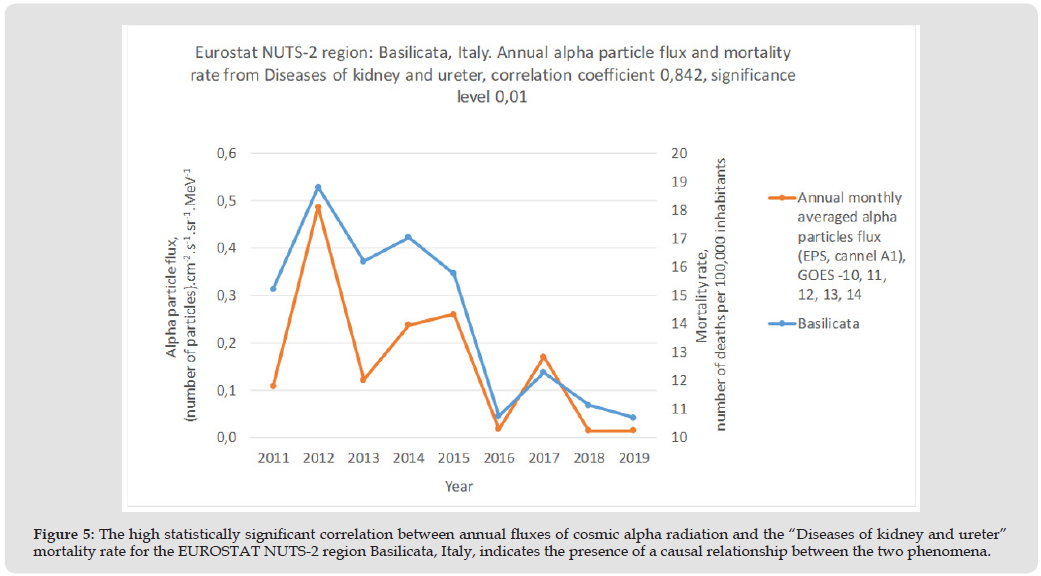
Figure 6

Figure 7
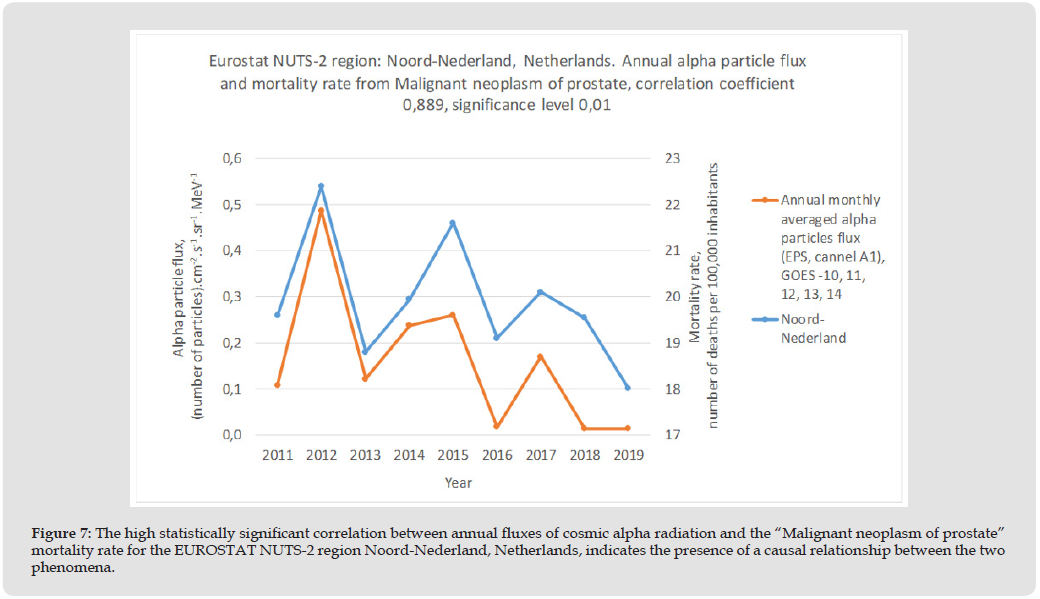
Figure 8

Figure 9

Figure 10
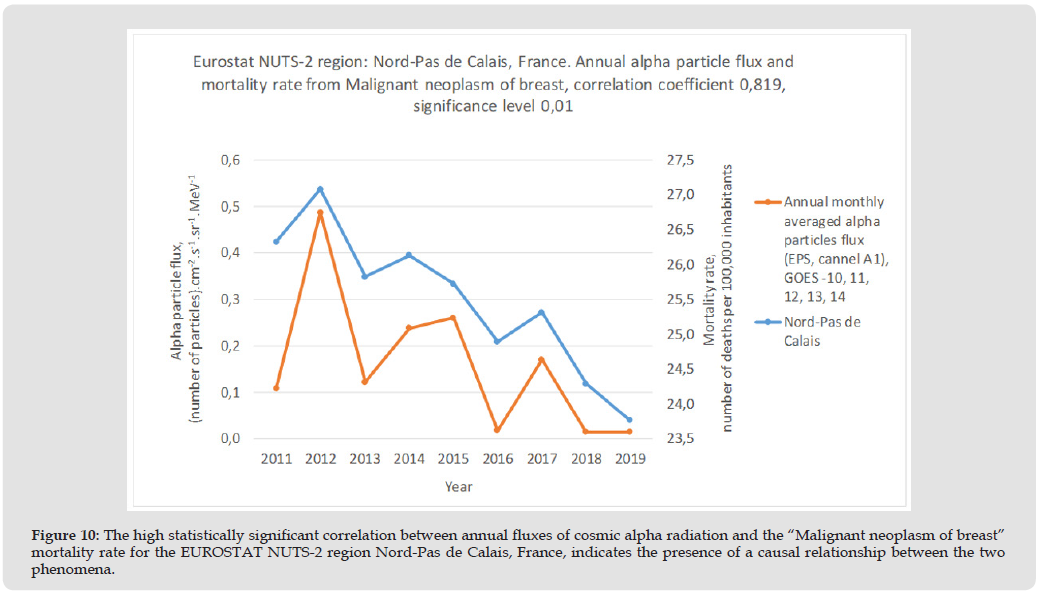
Figure 11

Figure 12
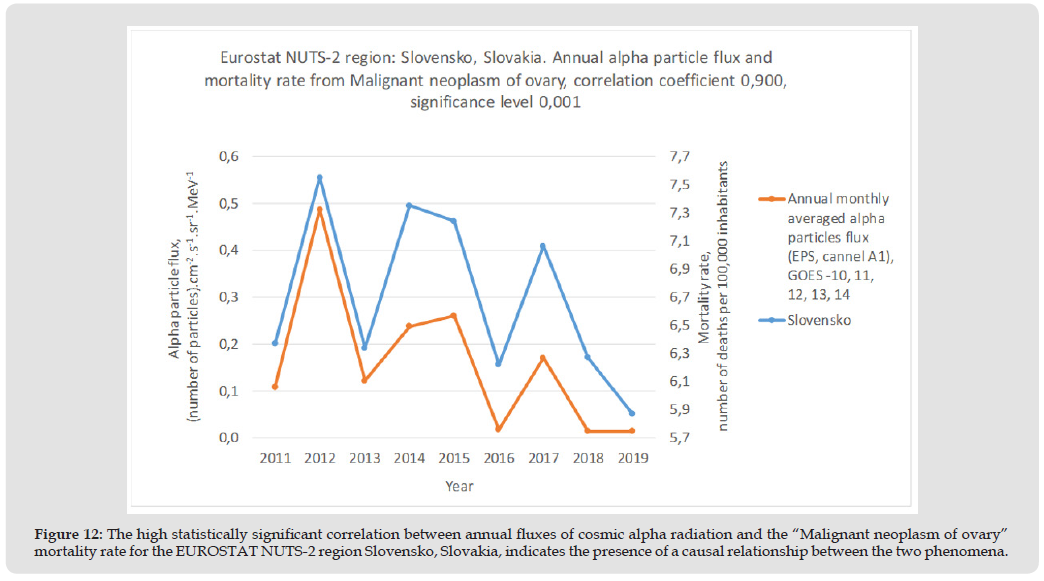
Figure 13
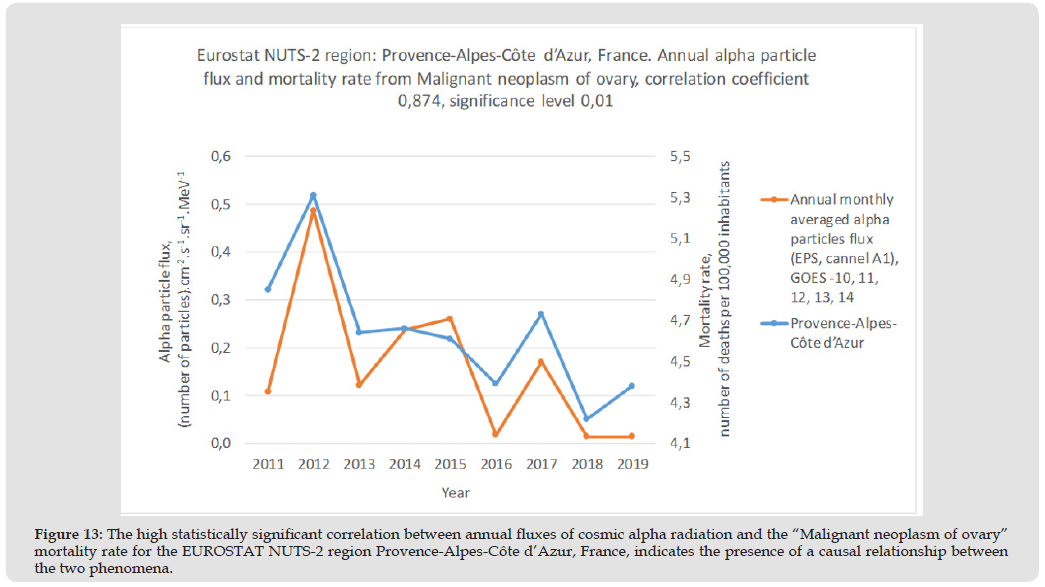
Figure 14

Figure 15

Figure 16
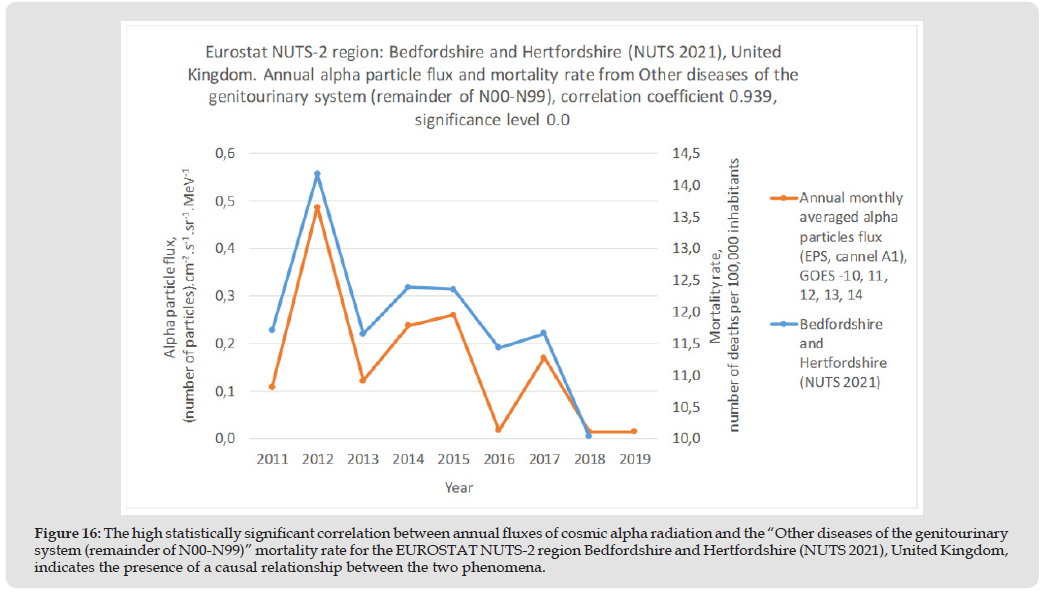
Figure 17

The given examples convincingly prove the existence of an influence of cosmic radiation on mortality from diseases of the genitourinary system. The problem of the mechanism of the described influence remains unclear. A hypothesized mechanism of this influence is outlined below, answering many of the questions that arise.
1. An observed phenomenon – mortality from many diseases in the statistics of many countries located mainly in the 30°N – 50°N band, is strongly correlated with fluxes of positively charged particles with energy of the order of 4 – 21 MeV, recorded by the GOES series satellites in Earth orbit. The recorded alpha particle flows are mostly pulses with a duration of less than 5 minutes (the averaging interval of the recording device) to a few days.
2. Proposed hypothesis – positively charged particles with high energy penetrate through the Earth’s atmosphere to the Earth’s surface and damage human health, causing death mainly in older adults.
3. Observed fact: The particle flux-correlated mortality shows an increasing trend with the average altitude of the affected area increasing [6,12]. It is probably due to the more intense radiation flux penetrating the thinner atmosphere over the mountainous region of Earth’s surface – an argument favoring the hypothesis.
4. The source of the flows of positively charged particles is the Sun – mortality increases with observable processes on the Sun – from Solar Mass Ejections directed to Earth (a phenomenon on the solar surface that could be observed with other astronomical means) [6,10]. The Alpha Magnetic Spectrometer (AMS-02) on the International Space Station measures the cosmic rays, excluding those of solar origin (when shielded from the Sun by the station’s solar panels). In particular, it measures the flow of 3He and 4He (alpha particles) in the galactic cosmic rays. The measurements show [36] increasing annual flux of alpha particles in cosmic rays for the interval of years from 2011 to 2017 (last available data), while the flux of GOES registered (solar?) alpha particles for the same interval of years is decreasing (See the Figures above). Indirect evidence for the Sun as a source of high-energy alpha particles is that this assumption convincingly explains the downstream processes that ultimately lead to death.
5. Positively charged solar particles capable of penetrating the Earth’s atmosphere to the Earth’s surface are high-energy alpha particles. Calculators PSTAR [33] and ASTAR [34] calculate the penetration parameters of protons, respectively, alpha particles in different substances, in particular in air. Calculations with data for a homogeneous atmosphere – an atmospheric model with constant density, temperature, and pressure decreasing with height [6] show that only particles whose energy is above 2.4 GeV for protons and over 6.2 GeV for alpha particles can penetrate the Earth’s atmosphere to the surface. There are no registered protons above 0.7 GeV by GOES satellites. Still, there are registered alpha particles with energy above 3.4 GeV, hypothetically also those with energy above 6.2 GeV [6,12,14], i.e., the particles that reach the Earth’s surface are probably high-energy alpha particles. Only fluxes of alpha particles with a magnitude of at least (1000 particles). cm-2.s-1.sr-1. MeV-1 is correlated with the mortality of the Earth’s surface.
6. It is assumed that the alpha particles recorded by the satellites were emitted simultaneously with the hypothetical fast alpha particles in an explosive process (flares?) on the solar surface. It can be calculated that particles with an energy of 7 GeV need 8.87 min to reach the Earth’s surface from the Sun’s surface, and particles with energies of 5 – 10 MeV registered by satellites travel about 2 hours. The registered alpha particles do not have enough energy to penetrate the atmosphere, unlike the hypothetical fast alpha particles that reach the surface of the Earth in minutes from the center of the solar disk. However, the registered alpha particles indicate that two hours earlier, there was an irradiation of the Earth’s surface with fast (unregistered) alpha particles.
7. Although alpha particle streams irradiate the entire illuminated part of the atmosphere, penetration of fast alpha particles to the surface occurs only in a limited area of the surface (death spot), for which two conditions favoring penetration are combined:
a. The Sun is culminating for the center of the death spot. During the year, the Sun’s apparent position relative to the point of observation shifts so that the maximum angle of elevation of the Sun’s disk above the horizon (solar culmination at local noon) changes depending on the date. The latitude and longitude of a point on the Earth’s surface where the solar disk is at its culmination at that moment of registration of the incoming alpha particle flow – the point of registration, can be determined from the date (latitude), and the hours and minutes of registration (longitude). The center of the dead spot can be calculated – it is approximately 30° east of the registration point [12]. The Earth’s angular velocity is 15° per hour.
b. For the center of the death spot, a coincidence is in effect – the direction of the geomagnetic induction vector coincides with the direction of the alpha particle intrusion – the alpha particle movement is not affected by the deflecting magnetic force. Such a coincidence occurs twice a year for latitudes in the band from 28°N to 48°N [6]. Such a coincidence is impossible for latitudes outside this band, as the fast alpha particles do not reach the Earth’s surface, or their flux on the surface decreases fast as they move away from the band.
The moment of occurrence of a fast alpha particle stream cannot be predicted, but the dates of increased risk for a given point on the Earth’s surface between 30°N – 50°N can be calculated by the location’s latitude [12]. For example, for the EUROSTAT NUTS-2 Région wallonne, Belgium (See Figure 17), with latitude 50.4°N, the dates with maximum risk are between June 6 and July 7. On these dates, the inclination (65.7°) of the geomagnetic vector for the Région wallonne is close in magnitude to or coincides with the culmination of the Sun (the Earth’s atmosphere is thinnest at the moment of the Sun’s culmination, and there is no deflecting magnetic force for alpha particles if they intrude at this time from the Sun). The increased risk of health incidents outdoors around local noon is a further argument for the healthfulness of the indoor midday break (‘siesta’) practiced in Mediterranean countries. The above arguments reveal a new, previously unsuspected cosmic cause of mortality from diseases of the genitourinary system – solar corpuscular alpha radiation. This type of radiation may be the hidden cause of many deadly diseases. The risk is highest for inhabitants in the mountainous regions. During the day, the hours around local noon are the riskiest for a cosmic impact, causing subsequent illness. The risk is also increased during certain days of the year (depending on the latitude of the observation point), during which the solar culmination coincides with the angle of the geomagnetic vector (inclination). If a stream of high-energy solar alpha particles were to hit the Earth at this time, there would be no deflecting magnetic force on them, making it easier to reach the Earth’s surface.

International Association of Landscape Archaeology, Czech Glass Society, Czech Republic

Department of Chemistry, Semenov Institute of Chemical Physics, USSR Academy of Sciences, Moscow, Russia

Neurology, LA BioMed Research Institute, USA

Associate Professor at Department of Breast and Thyorid Surgey, Chongqing General Hospital, China

Clinical Radiologist (MD) - Department of RADIOLOGY, Cosenza Hospital, Cosenza, Italy





 Abstract
 PDF
PDF



























