info@biomedres.us
+1 (502) 904-2126
One Westbrook Corporate Center, Suite 300, Westchester, IL 60154, USA
Site Map
 ISSN: 2574 -1241
ISSN: 2574 -1241
ISSN: 2574 -1241
Received: June 23, 2024; Published: August 02, 2024
*Corresponding author: Paul C Mocombe, West Virginia State University, The Mocombeian Foundation, Inc., 2013, USA
DOI: 10.26717/BJSTR.2024.58.009084
This work outlines the constitution and tenets of Mocombe’s philosophy of science as emanating from his theories of phenomenological structuralism and consciousness field theory. Against postmodern approaches to the philosophy of science, Mocombe offers a foundational-coherent model for understanding the philosophy of science and research methods in his theories.
Keywords: Structuration Theory; Phenomenological Structuralism; Structure/Agency; Mythopraxis; Quantum Mechanics; Social Class Language Game; Haitian Epistemology; Haitian/Vilokan Idealism; Consciousness Field Theory
Philosophy of science is the branch of philosophy that focuses on the metaphysics, ontology, epistemology, and axiology of science. That is to say, philosophy of science is concerned with the basis, methods, and implications upon which the scientific process and methods are established. Four approaches dominate the current literature on the philosophy of science: the foundational approach; coherentism; sociohistorical approach; and postmodernism. This work outlines the constitution and tenets of Mocombe’s philosophy of science as emanating from his theories of phenomenological structuralism and consciousness field theory. Against the current reliance on predominantly postmodern approaches to the philosophy of science, Mocombe offers a foundational-coherent model for understanding the philosophy of science and research methods for his theories.
The foundational approach to the philosophy of science, metaphysically, assumes that nature is a given reality with objective (natural) laws and causes that can be epistemologically ascertained by rational beings via the scientific method and process, which are based on systematic observation and experimentation. Conversely, coherentism supposes a sought of Kantian approach to science that suggests that scientific explanations are cognitive and are justified based on human cognitive metaphysical systems of the universe. In keeping with this human cognitive approach to science, the sociohistorical perspective takes the coherent approach to the extreme by positing science and reality itself as social constructs. The latter position gives rise to the postmodern and poststructural approaches, which denies science and reality altogether. The issue centers on several factors raised by postmodern and post-structural thinkers in the likes of Paul Feyerabend, Michel Foucault, Jacques Derrida, and Jacques Lacan against the structuralism of the sciences,
• They question the foundational validity regarding the Cartesian rational individual, which Foucault and Derrida deny in favor of their attempt to dissolve the subject altogether.
• They question the interdependency of the constitution of a stable structure and a distinct subject with agency, in denying the latter they undermine the former.
• They question the status of science.
• Finally, they question the possibility of the objectivity of any language of description or analysis.
Mocombeian consciousness field theory and phenomenological structuralism deny the social constructivist nature to science and reality of the sociohistorical perspective, and the denial to science altogether of the postmodern and poststructural positions. For Mocombe, there is an objective (foundational) world that we experience and come to know through coherent systematic worldviews developed out of, and through, the logic and dimensions, i.e., affect, cognition, and perception, of our consciousness. Hence science is both foundational and coherent. The former, foundational, because it assumes nature to be constituted by objective laws, which we come to know through the logic and dimensions of our consciousness, which enables us to formulate, the latter, coherent worldviews of nature, the universe, and our social and individual worlds that are subject to formulations and reformulations as we come to know the objective laws of nature through experimentation, observation, and revelations emanating out of the logic and dimensions of the consciousness of our minds and central and peripheral nervous systems, which do not constitute the world out of nothing. The world is a given that we come to know, observe, and experience in and through the logic and dimensions of our consciousness, which is connected to the probability wavefunctions of the absolute vacuum where all the possibilities of the multiverse are accumulated. The scientific method and process are just present-at-hand, conscious awareness, and systematization of what actually takes place, intuitively, in, and through, the logic and dimensions of our consciousness.
So, in the end for Mocombe, there is a direct correlation between the objective world (both quantum and physical), consciousness, science, and the scientific method, which emanates out of the logic and dimensions of our consciousness, which is tied to the probability wavefunctions of the absolute vacuum.
The literature on the ontological nature and origins of consciousness suggests a reliance on material and post-material theorizations; those perspectives that view consciousness as emerging primarily as an emergent property of complex brain neuronal computation (A), (B) as spiritual quality of the universe, distinct from purely physical actions, and (C) as composed of discrete ‘proto-conscious’ events acting in accordance with physical laws not yet fully understood. The former, (A), is a materialist perspective, which emphasizes the laws of classical physics to posit consciousness as the by-product of the neural correlates of the physical substrates of the material brain (Chalmers, [1]). The latter two (B and C) are post-materialist approaches to understanding consciousness, which emphasize the emergence of consciousness as an external phenomenon that exists outside of the physical substrates of the brain either in the form of panpsychism or cosmopsychism/panspiritism. Both post-materialist perspectives use the concepts and theories of quantum mechanics (i.e., superposition, entanglement, multiverse, etc.) to either complete the materialism of the (A) camp, i.e., the (C) camp, or to ground fourteen paranormal and parapsychological (near-death experiences, telepathy, telekinesis, out-of-body experiences, physic mediumship, etc.) empirical data as proof for the external nature of consciousness, i.e., the (B) camp, which is received and facilitated by the brain (Chalmers, et al. [1-3]).
All three positions are problematic in that they are unable to resolve the quantum decoherence and hard and binding problems of consciousness, however (Chalmers [1]). In the materialist camp (A), they are unable to account for how the neural correlates of the physical substrates of the material brain bind to give us the phenomenal subjective experience of consciousness, i.e., the binding problem (Chalmers [1]). Just the same, in the post-materialist camps (B and C), they are unable to account for the quantum decoherence problematic; that is, the latter positions are unable to account for either how consciousness in everything, panpsychism, emerges/combines, or decombines from a god or the cosmos, panspiritism and cosmopsychism, respectively, in the material brain to give rise to consciousness (Van Lommel [2]). Hence, what remains missing in the academic literature is a detailed examination of how consciousness emerges in the world from its ontological basis to its social psychological (phenomenal subjective) manifestation in human social interactions, social structure, while resolving the problematics of the two approaches. Mocombe’s consciousness field theory, which serves as a materialist theoretical framework for his overall theory of phenomenological structuralism, attempts to do just that. It is upon the logico-metaphysical materialism of the two theories that Mocombe establishes his foundational- coherent philosophy of science model.
(Mocombe, et al. [3-5]) consciousness field theory, which is part of his larger theory of phenomenological structuralism, resolves the quantum decoherence and hard and binding problematics of all three camps by positing the ontological origins and nature of individual consciousness to be an emergent fifth force of nature that is cycled and recycled throughout the multiverse as a resonating channel or station of, and on, a frequency wavelength via its embodied elementary particle, psychion, which has spin, mass, charge, and phenomenal properties, i.e., qualia (Figures 1-7) and (Table 1). In (Mocombe, et al. [3,6]) theory of phenomenological structuralism consciousness is an emergent (fifth) force of the universe, composed of an elementary particle, psychion, with mass, charge, spin (a boson with spin S=1), and phenomenal properties, qualia, that is received by the brain, from, or in, multiple, entangled, and superimposed local consciousness fields, Schumann waves, and integrated by its (the Brain’s) electromagnetic field as psychon to constitute mind, practical consciousness, and the self, as resonating channels or stations of, or on, frequency wavelengths, in material worlds of the multiverse (see Figure 5 and Table 1 for the elementary value of quantum energy for brain and Schumann waves, and their mapping, respectively; and the frequency of the psychonic wave) (Kozlowska [7]).
Table 1: Characteristics of Brain Waves.

Figure 1: The univon model composed of a superluminal primordial information quantum (sprinq).the mathematical horn torus surface on which the sprinq travels is cut away to show the interior. The black closed curve on the surface of the horn torus is the trajectory of the univon’s sprinq (indicated by the black dot.
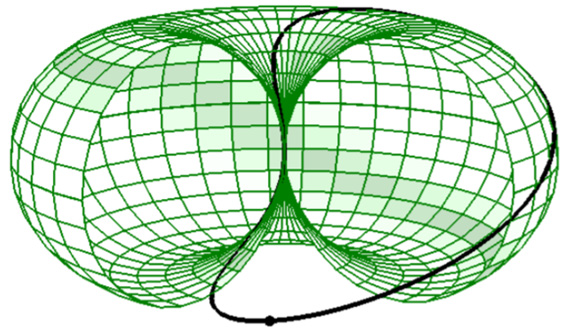
Figure 2: The parametric equations of the univon model composed of a circulating sprinq. The calculated maximum speed of the circulating
sprinq is  (at the equator of the mathematical torus) while its minimum speed is (at the center of the mathematical torus).
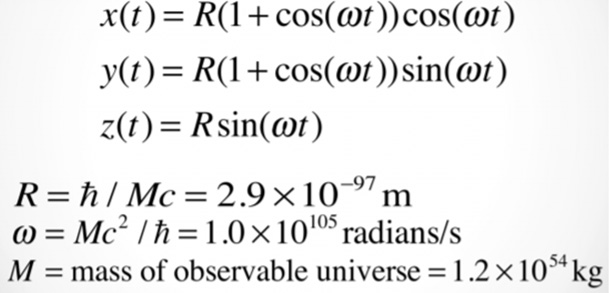
Figure 3: For Mocombe, building on BHBBT, the superverses with entangled and superimposed (via black holes) multiverses share the same informational content. So, the hypothesis here is that one superverse created (from the absolute vacuum) a universe, and its informational content is entangled and superimposed on top of another superverse with the informational content of the previous universe emerging in it via black holes. Hence what you have are a layer of multiverses and superverses, superimposed and entangled, whose informational content are shared or recycled via black holes, which organize and structure the multiverses similarly. As such, quantum fluctuation and big bangs are constantly occurring and producing the same worlds, ad infinitum. So, when physicists look out to the Cosmic Microwave Background (CMB), they are looking at the remnant from an early stage of our universe, which came forth from its older version a layer above it, and so on ad infinitum. Put more concretely, the physicists are in a superverse, of our universe, in our milky-way galaxy, looking out to the black hole of a milky-way galaxy from the superverse/multiverse above us with its own consciousness field.
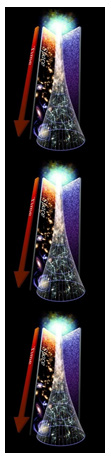
Figure 4: This figure represents how the psychions are embodied, as psychons, from the Consciousness Field (CF) in the neurons of brains (Figure a, adopted from McFadden, 2020, represents the human brain—left (L) and Right (R) hemispheres—and its EM field, which holds together and integrates the qualia of psychions, informational content of the superverse/multiverses, which becomes individuated consciousness recursively organized and reproduced as practical consciousness), which produces an EM field that holds together and integrates the qualia of the psychions as individuated consciousness on channels or stations of frequency wavelengths from the absolute vacuum. For Mocombe, building on BHBBT, the superverses with entangled and superimposed (via black holes) multiverses share the same informational content. So, the hypothesis here is that one superverse created (from the absolute vacuum) a universe, and its informational content is entangled and superimposed on top of another superverse with the informational content of the previous universe emerging in it via black holes. Hence what you have are a layer of multiverses and superverses, superimposed and entangled, whose informational contents are shared or recycled via black holes, which organize and structure the multiverses similarly. As such, quantum fluctuation and big bangs are constantly occurring and producing the same worlds, ad infinitum. The informational content, qualia, of these multiverses and worlds are encoded and transmitted as psychions (channel frequency of wavelengths) and embodied in the neurons of brains, which create an EM field that holds and integrates the psychions as individuated consciousness.
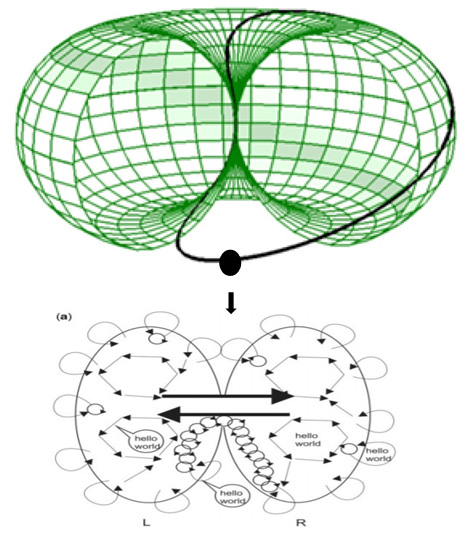
Figure 5: Adopted from Kozlowska and Kozlowski. The formula represents the elementary value of quantum energy for brain and Schumann waves.
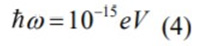
Figure 6: Garyian consciousness wave equation for individual consciousness. The formula represents the elementary value of quantum energy for brain and Schumann waves plus or minus the resonating frequency channel or station of subjective phenomenal consciousness.

Figure 7: For Mocombe, one superverse created (from the absolute vacuum) a universe, via quantum fluctuation, tunneling, and inflation, and its informational content is entangled and superimposed on top of another universe with the informational content of the previous universe emerging in it via black holes as highlighted in Figure 3. Figure 7 highlights the stages by which these multiverses emerge and unfold from the absolute vacuum. Hence what you have are a layer of multiverses, superimposed and entangled, whose informational contents are shared or recycled via black holes, which organize and structure the multiverses similarly. As such, quantum fluctuation and big bangs are constantly occurring and producing the same worlds, ad infinitum. So, when physicists look out to the cosmic microwave background (CMB), they are looking at the remnant from an early stage of our universe, which came forth from its older version a layer above it, and so on ad infinitum. Put more concretely, the physicists are in a superverse, of our universe, in our milky-way galaxy, looking out to the black hole of a milky-way galaxy from the superverse/multiverse above us with its own consciousness field.
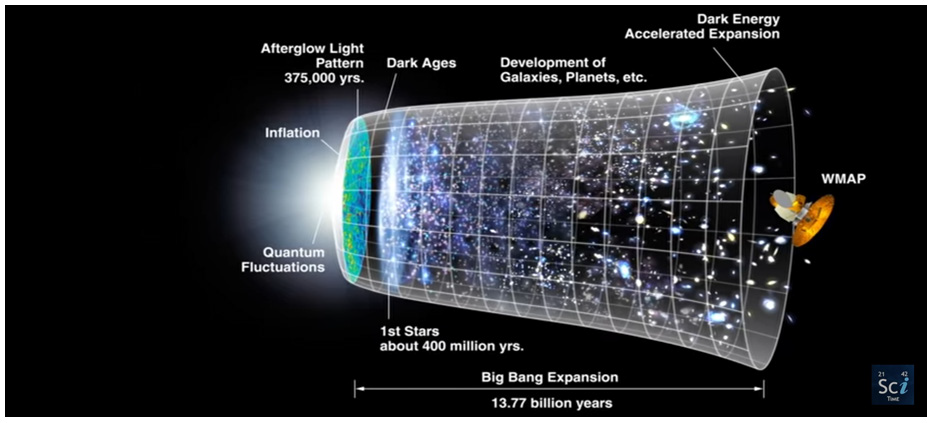
The phenomenal properties, qualia, of the psychions of a consciousness field, following matter disaggregation, disconnection as psychon from the Schumann waves, throughout the multiverse, either collapse, as a resonating channel or station of a frequency wavelength, upon other superimposed and entangled versions (wavelengths) of themselves throughout the multiverse, or are integrated, along with the other four forces (gravity, electromagnetism, and the weak and strong nuclear forces), in the absolute vacuum of a superverse to create (via quantum fluctuation, tunneling, and inflation) future beings with consciousness (the phenomenal properties of lived-experience in the form of qualia, informational content of subatomic particles, i.e., psychions) (Figure 7). As such, the psychions of the consciousness field as psychons they are local and connected to (entangled) multiple superimposed worlds with, and through, Schumann waves (see Figure 3); once assimilated in the absolute vacuum, they are psychions, the elementary particle of consciousness, an interconnected, endless, and nonlocal fifth force of nature, with qualia or phenomenal properties, which, initially, emerges following matter aggregation and disaggregation, disconnection from Schumann waves, in the multiverse. It (the psychions of the consciousness field) is an endless assimilation of all past, present, and future information (practical activities and memories) of beings of the multiverse cycled and recycled via the absolute vacuum (empty nonspatial and nontemporal phenomenon in which elementary particles, quarks, and constituents of matter and forces of nature have become one), which fluctuates as a probability wave function, to give rise to entangled and superimposed worlds, each with their own Schumann waves and consciousness fields, which produce future beings with consciousness, an individualized resonating channel or station, psychion, on the frequency wavelength of the Schumann wave and the absolute vacuum (Mocombe [3]).
As highlighted in Figure 7, the absolute vacuum is a fifth dimensional superverse or cosmic soup where all the elementary particles are one, and fluctuate, as a probability wavefunction, tunnel, and inflate to produce four dimensional spacetimes (multiverses) where consciousness emerges as individuated psychonic fields or resonating channels/stations produced by the firing of neurons in the brain where the elementary particle, psychion, of consciousness are embodied and tied to the frequency wavelength of Schumann waves of entangled and superimposed worlds, which are tied to the oscillating frequency wavelength of the absolute vacuum, which transmits the signal of phenomenal subjective consciousness to the psychions. Each individual consciousness has their own resonating psychionic channel or station (which is measurable on EEG machines) on the frequency wavelength of the earth’s Schumann wave, which is tied to the frequency wavelength of the absolute vacuum, which transmits phenomenal consciousness to the psychionic channel (Figure 4). (Figure 6), the Garyian equation, the first evidence for the consciousness field, represents the equation of, and for, individual consciousness: phi Φ is the symbol for consciousness; 10⁻15 eV₍₄₎, adopted from Kozlowska and Kozlowski, the formula represents the elementary value of quantum energy for brain and Schumann waves (see Figure 5); f(0), represents the resonating psychionic channel or station of individual phenomenal consciousness received from the absolute vacuum. The absolute vacuum houses and incorporates, as phenomenal property, qualia, all of the past, present, and future, lived experiences of all individual consciousnesses as a fifth force of nature and resonating frequency wavelength, which is transmitted to, Schumann waves of entangled and superimposed multiworlds, and received and facilitated by, in human beings, the material brain, brainstem, and central nervous system.
(Table 1) highlights the Hz level range of the psychonic wave, the second evidence for the existence of the consciousness field, in relation to other human brain waves. Finally, the third evidence for the existence of the consciousness field are parapsychological proofs of near-death experiences and reincarnation highlighted by post-materialist researchers. For Mocombe, one of, or all, three things occur to the phenomenal properties, qualia, of the psychions of a consciousness field, following matter disaggregation (death) throughout the multiverse,
1. They are recycled/reincarnated to give rise to future beings with the same consciousness.
2. Collapse upon other superimposed and entangled versions (resonances) of themselves throughout the multiverse,
3. And or are integrated, along with the subatomic particles of the other four forces (gravity, electromagnetism, and the weak and strong nuclear forces), in the absolute vacuum of a superverse to create (via quantum fluctuation and tunneling) future beings with consciousness. In terms of the latter, the psychions of the consciousness field, once assimilated in the absolute vacuum, is an interconnected, endless, and nonlocal fifth force of nature, which, initially, emerges following matter aggregation and disaggregation in the multiverse. It is an endless assimilation of all past, present, and future information (practical activities and memories) of beings of the multiverse recycled via the absolute vacuum (empty space in which elementary particles, quarks, and constituents of matter and forces of nature have become one), which fluctuates as a probability wave function, to give rise to entangled and superimposed worlds, each with their own consciousness fields, which produce future things and beings with consciousness.
Hence, according to Mocombe, early on in the multiverse, before the aggregation of matter into physical worlds, there was no consciousness; consciousness emerged as a result of aggregated matter, with sense perceiving apparatuses, affectively, perceptively, and cognitively, the dimensions of consciousness, experiencing aggregated material realities with Schumann waves where they, initially, sought pleasure and unpleasure between themselves and the material reality through three (ready-to-hand, unready-to-hand, and present-athand) phenomenal stances of the (human) brain, i.e., what Heidegger calls the analytics of Dasein, which would give rise to the contents (qualia) of consciousness. Ready-to-hand refers to the unconscious experience of material reality as it appears to the human actor; unready- to-hand refers to the contemplative problem-solving aspect of the human actor when experiencing material reality; and the presentat- hand structural stance refers to self-awareness of the human actor out of which the scientific process and methods emerge. Local (human) consciousness emerged from the electrical firing in the aggregated (material) brain (which gives rise to the initial states and structures of consciousness), and the rest of the central and peripheral nervous systems, connected to sense perceiving apparatuses, which produced a psychonic wave, which became tied to the Schumann wave of aggregated material reality created by the absolute vacuum, the nonlocal probability wavefunction out of which the multiverse emerged, where ultimately consciousness comes to reside nonlocally.
Upon death or the disaggregation of material reality, the elementary particles of the psychonic waves of aggregated matter becomes a psychion, with the qualia (contents of consciousness), phenomenal properties, from their (affective, perceptive, and cognitive) experiences as subatomic particle, that either collapses (as a resonating channel of a frequency wavelength) in other Schumann waves of the multiverse where the same matter exists or collapses into the absolute vacuum, if all of the same forms of the aggregated matter has been disaggregated, of the multiverse with the other elementary particles of the original four forces of nature. At the nonlocal level consciousness is a wavefunction, an elementary particle of the absolute vacuum or zero-point field who’s subatomic (elementary) particle, psychion, has phenomenal properties or qualia, informational content of recycled consciousness, mass, charge, and spin, which produces a consciousness field tied to the nonlocality of the absolute vacuum. The field, and its subatomic particles, psychions, are locally connected, as psychon, to material realities via their Schumann waves, material realities produced by, and connected to, the absolute vacuum, as resonating frequency wavelength channels/stations. They, psychion, the elementary particle of consciousness with phenomenal properties, mass, charge, and spin, are embodied as, psychon, a resonating channel/ station on the wavelength frequency of the absolute vacuum and entangled Schumann waves via the brain, brainstem (ARAS system), and central nervous system, which serves as a receiver and facilitator (antenna) of consciousness in material realities with Schumann waves.
The psychion, psychon once integrated or embodied by the human brain and brainstem, is neurochemically integrated in the brain via the dopaminergic Ventral Tegmental Area (VTA) in conjunction with the functional connectivity from the brainstem areas regulating arousal to the cortical networks supporting internal and external awareness. “The energetic-metabolic processes focusing on [adenosine triphosphate] ATP, glucose, and γ-aminobutyrate/glutamate is [also] indispensable for Functional Connectivity (FC) of normal brain networks that renders consciousness possible” (Chen, et al. [8]). Once internal and external awareness is determined subatomically (embodiment as a resonating channel/station on the frequency wavelength of the absolute vacuum and entangled Schumann waves with qualia, i.e., phenomenal properties, mass, charge, and spin), structurally (via the brainstem and the central and peripheral nervous systems), and neurochemically (dopamine, ATP, etc.), the firing of neurons, from the energy (current) of the subatomic particle, psychion/ psychon, produces a psychonic wave that (affectively, perceptively, and cognitively) ties, via its charge and resonance, the human being to the electromagnetic wave, Schumann wave, of the earth or material reality thereby localizing and individuating consciousness, which is now local and nonlocal and dependent upon the brainstem, brain, and central and peripheral nervous systems, and their physical substrates, acting on consciousness, to receive and facilitate an initial affective phenomenal conscious experience in material reality where the individual seeks a balance and harmony (homeostasis) between their bodies and material reality via pleasure and unpleasure.
(Local, given embodiment and connection to the Schumann wave of material reality, which is nonlocally connected to the consciousness field, which is produced by the absolute vacuum). The qualia of this initial affect, emerges and grows, cognitively, emotionally, etc., and becomes individuated consciousnesses, which are, each individuated consciousness, resonating (distinct) channels/stations on the frequency wavelength of entangled and superimposed Schumann waves, material realities, which are produced by and connected to the absolute vacuum via a fifth force of nature, i.e., the consciousness field and its subatomic (elementary) particle, psychion. Hence, consciousness, early on (at the very beginning of the evolution of aggregate matter), emerges from the initial neuronal activities of the brainstem and central and peripheral nervous systems experiencing local material reality, which produces its first phenomenal essence, i.e., qualia, which is the effect of pleasure and unpleasure (Solms, et al. [3,5,9-127]). This initial essence, which produces other emerging essences (emergent essence), phenomenal experiences, qualia, via the brain, body, and the central and peripheral nervous systems, held together by the brain’s electromagnetic field, once constituted from experience of material realities with Schumann waves, is absorbed and recycled throughout a global consciousness field (cosmopsychism) created by the absolute vacuum, zero-point field, following matter disaggregation, of the multiverse to continuously produce beings with (local) consciousness, psychion/psychon, that have phenomenal properties or qualia, which becomes embodied in the physical substrates of the brain to facilitate consciousness, which can be impaired if the mechanical brain is damaged or under the influences of drugs, alcohol, etc.
Hence neural correlates of the brain come to facilitate and act on consciousness, which following matter aggregation is a fifth force, psychion, of nature with phenomenal properties, mass, charge, and spin, resonating as an individuated channel or station of the material brain from the absolute vacuum or zero-point field in entangled and superimposed Schumann waves of material realities. In this Mocombeian view, consciousness is not fundamental as argued in the post-materialist camp; instead, it is an emergent (material) property, emergent panpsychism (once emerged from first aggregated simple beings firing neurons consciousness becomes an emergent essence of the multiverse) that morphs into the cosmopsychism, of the multiverse, as argued in the materialist camp, which is constituted and expressed, in the human sphere through subatomic particle aggregation, mode of production, language, ideology, ideological apparatuses, communicative discourse, and praxis. Simple and complex beings’, resonating as different channels/stations or wavelengths of the same frequency and phase, Schumann waves of entangled and superimposed material realities throughout the multiverse, experience (sensation) of aggregated matter created by the initial four forces of nature from the absolute vacuum gives rise to their initial (affective) qualia whose constitutive subatomic particle, psychion, is the elementary particle (with phenomenal properties, mass, charge, and spin) that constitutes emerging consciousness fields as resonating psychonic waves.
Consciousness, from this perspective, is an emergent fifth force of nature with an elementary particle, psychion, which produces a consciousness field, from the absolute vacuum, tied to the electromagnetic waves, Schumann waves, of superimposed and entangled physical worlds via the brain’s psychonic waves produced from the firing of neurons. The firing of neurons in the structures (ARAS system) of the brain, and the central nervous system, produces the psychonic electromagnetic wave, composed of the psychion with qualia, sense experiences of aggregate matter, which ties the individual to the Schumann waves, the electromagnetic fields of (superimposed and entangled) physical worlds of the multiverse, which emerge from, and tied to, the absolute vacuum or zero-point field of nonlocal space where the elementary particles of the forces of nature are one in the form of a probability wavefunction. The absolute vacuum transmits individual consciousness as a resonating frequency wavelength, channel or station with phenomenal properties, qualia, on the Schumann resonance of the earth and the psychonic wave of the individual, which share the same frequency with different amplitude. The brain is a receiver of consciousness with the elementary particle, psychion, of consciousness serving as the resonating channel or station of individuated consciousness, and the Schumann and psychonic waves serving as the bandwidth; the absolute vacuum produces a carrier wave, i.e., the psychonic waves of individual consciousness, that is modulated in frequency by the signal that is to be transmitted in the form of the psychonic wave of the psychion to individual consciousness.
Following matter disaggregation across and throughout the multiverse, the psychion, subatomic particle of consciousness, and its qualia, phenomenal property, is subsequently integrated into the absolute vacuum, the wavefunction of the multiverse, which in its inception was only four forces, where all the fundamental forces of nature emerged, of the multiverse to give rise to future worlds with conscious simple and complex beings whose qualia, phenomenal properties, is never destroyed (emergent panpsychism), but is the frequency of an individual consciousness recycled throughout the multiverse. For Mocombe what accounts for the unity of experience is the psychion, subatomic particle, of the emergent psychonic/panpsychic subatomic field of the multiverse that has phenomenal properties, qualia, which gets embodied as a resonating neuronal particle of the aggregated brain, which experiences a material resource framework as an “I,” a channel/station of, or on, a frequency wavelength, whose phenomenal properties, subjective experiences of material reality, following matter disaggregation either returns back to the field or collapses in other worlds, with their own consciousness fields, where the same matter exists as distinct resonating frequency channels of wavelengths (individual psychionic waves connected to Schumann waves of multiverses connected to the absolute vacuum as frequency wavelengths, which can be measured in Hertz).
The consciousness field is a classical field produced by accelerating psychionic charges that contain and transmit all the phenomenal properties, qualia, of the absolute vacuum to the Schumann waves of material realities, and the psychonic waves of brains, brainstems, and central nervous systems connected to the latter, Schumann waves, which are connected to the former, absolute vacuum or zero-point field as a frequency signal. The field is the combination of a psychonic field or wave (produced by the psychionic elementary particle), an electric field, and a magnetic field. The psychonic field or wave, like the magnetic field, is produced by moving charges or currents, and the electric field stationary charges. The consciousness field can be regarded as a smooth, continuous field, that propagates in a wavelike manner, and interacts with charges and currents. The reciprocal information transfer between the absolute vacuum, which constitutes a fifth dimension, the Schumann waves of entangled and superimposed material realities with consciousness fields, which exist in the four dimensions of spacetime, and the psychion/psychon of subjects of experience takes place via the distinct resonances of everyone, which is a rhythmic channel/station on the frequency wavelength that is entangled and superimposed between the absolute vacuum, Schumann waves, and the psychonic waves of subjects of experience.
Mocombeian consciousness field theory and phenomenological structuralism deny the social constructivist nature to science and reality of the sociohistorical perspective, and the denial to science altogether of the postmodern and poststructural positions in favor of a foundational-coherent model. For Mocombe, there is an objective world, created by the probability wavefunction of the absolute vacuum, that we experience and come to know through coherent systematic worldviews developed out of, and through, the logic and dimensions, i.e., affect, cognition, and perceptions of our consciousness, which is connected to the probability wavefunctions of the absolute vacuum. Hence science is both foundational and coherent. The former because it assumes nature to be constituted by objective laws, which we come to know through the logic and dimensions of our consciousness, which enable us to formulate, the latter, coherent worldviews of nature, the universe, and our social and individual worlds that are subject to formulations and reformulations as we come to know the objective laws of nature through experimentation, observation, and revelations emanating out of the logic and dimensions of the consciousness of our minds, which does not constitute the world out of nothing, but is contingent upon the wavefunctions of the absolute vacuum and the physical world, which we experience in and through consciousness created by the absolute vacuum.
The world is a given, stemming from the probability wavefunction of the absolute vacuum, that we come to know via revelations, observations, and experimentations in and through the logic and dimensions of our consciousness. The probability wavefunctions of different worlds are revealed to us given the subatomic particle connection of our consciousness to the absolute vacuum. These revelations do not necessarily constitute the world that we come to observe and experience, however. The Schumann wave of the earth constitutes a foundational (objective) world, out of a plethora of probable worlds encapsulated in the wavefunctions of the absolute vacuum, which we observe and experience in spacetime. The scientific method is just a present-at-hand, conscious awareness, and systematization of what actually takes place, intuitively, in, and through, the logic and dimensions of our consciousness, which is connected to the absolute vacuum and the Schumann wave of the earth. So, in the end for Mocombe, there is a direct correlation between the quantum and physical worlds, consciousness, science, and the scientific method and process, which incorporates three worldviews associated with the scientific research process and methods.
The postpositivist worldview, with its emphasis on scientific research into the psychology of the forms of sensibility and understanding of the brain, and the physics of subatomic particle embodiment stemming from the absolute vacuum and its manifestation as physical reality; Constructivism and critical theory, with its emphasis on the sociology of the mode of production (the means of human organization of the material resource framework) and understanding and meaning as it pertains to individuals and networks of solidarity groups, which defer the meaning of the ideologies of the mode of production and are marginalized by those in power positions for doing so; and Pragmatism/Advocacy/Participatory, with its emphasis on finding solutions to the increasing problems associated with the enchantment of the world around the contemporary ideology, the Protestant Ethic and the spirit of capitalism, which threatens all life on earth, in favor of subsistence living and homeostasis.

International Association of Landscape Archaeology, Czech Glass Society, Czech Republic

Department of Chemistry, Semenov Institute of Chemical Physics, USSR Academy of Sciences, Moscow, Russia

Neurology, LA BioMed Research Institute, USA

Associate Professor at Department of Breast and Thyorid Surgey, Chongqing General Hospital, China

Clinical Radiologist (MD) - Department of RADIOLOGY, Cosenza Hospital, Cosenza, Italy





 Abstract
 PDF
PDF



























