info@biomedres.us
+1 (502) 904-2126
One Westbrook Corporate Center, Suite 300, Westchester, IL 60154, USA
Site Map
 ISSN: 2574 -1241
ISSN: 2574 -1241
ISSN: 2574 -1241
Received: July 03, 2024; Published: July 11, 2024
*Corresponding author: Bastos L F, University Center Assis Gurgacz Foundation, Brazil
DOI: 10.26717/BJSTR.2024.57.009012
This article aims to identify the impact of the novel coronavirus pandemic on malaria cases in the North, Northeast, Midwest, Southeast, and South regions of Brazil, given the similarity of initial symptoms, the need for reallocation of resources, and the burden on public health systems, factors that may have affected the proper differentiation and timely treatment of both diseases.
Keywords: Malaria; Covid-19; Pandemic
Malaria is an infectious disease caused by parasites of the genus Plasmodium, which are transmitted to humans through the bite of infected mosquitoes of the genus Anopheles. These parasites multiply in the liver and then infect red blood cells, leading to symptoms such as fever, chills, sweating, headaches, and, in severe cases, potentially fatal complications [1]. In contrast, Covid-19, officially identified in Wuhan, China, in December 2019 (2), is caused by the SARS-CoV-2 virus. It immediately became a global concern due to its rapid spread, uncertainty surrounding preventive measures, and potential devastating impacts on global healthcare systems. The resulting pandemic has driven intensive research efforts and international collaboration to understand, control, and develop effective vaccines against the disease [2]. The correlation between the diseases exists since initial symptoms such as fatigue, high fever, difficulty breathing, and myalgia can coexist in both cases [3]. Moreover, malaria prevention and control measures such as distribution of insecticide-treated bed nets and epidemiological surveillance in endemic areas were hindered by the Covid-19 pandemic due to the fact that social isolation was initially the primary measure to reduce the spread of the novel coronavirus [3].
It is worth noting that hydroxychloroquine was widely considered as a potential therapy, despite the lack of solid scientific evidence initially, for its use in the treatment of Covid-19 (4). This hasty approach led to the indiscriminate administration of the medication, in many cases, raising a series of medical and ethical concerns [4]. One of the less discussed consequences of this practice was the potential underdiagnosis of malaria cases, a disease with similar symptoms, which is effectively treated with this drug. The rampant use of this medication in the context of COVID-19 may have caused confusion in diagnoses, obscuring the distinction between the two diseases and impairing the ability to properly identify and treat malaria [4].
For this study, the absolute numbers of reported Malaria cases were analyzed in the Department of Health Informatics of the Unified Health System (DATASUS) [5], from the years 2018 to 2022, across the Northeast, Midwest, Southeast, and South regions of Brazil. Data from the North region was analyzed using the Epidemiological Surveillance System platform (SIVEP) [6]. The number of malaria cases was tallied annually in each region covered by the study from 2018 to 2022. It’s worth noting that all utilized data were de-identified, lacking patient identification. The obtained data were allocated, tabulated, and processed into spreadsheets and graphs using Microsoft Excel® software.
To elucidate the obtained results, the data analysis was subdivided into two distinct categories: the extra-Amazon region, which encompasses the macro-regions Northeast, Midwest, Southeast, and South, and the Amazon region, consisting exclusively of the North macro-region. This approach was adopted due to the significant disparity in the number of malaria cases recorded in the Amazon region compared to the other regions, which could potentially confound the results of this article by obscuring the incidence of malaria in other regions of Brazil.
Total Malaria Cases Reported in the Extra-Amazon Region (Northeast, Midwest, Southeast, and South) Between 2018 and 2022
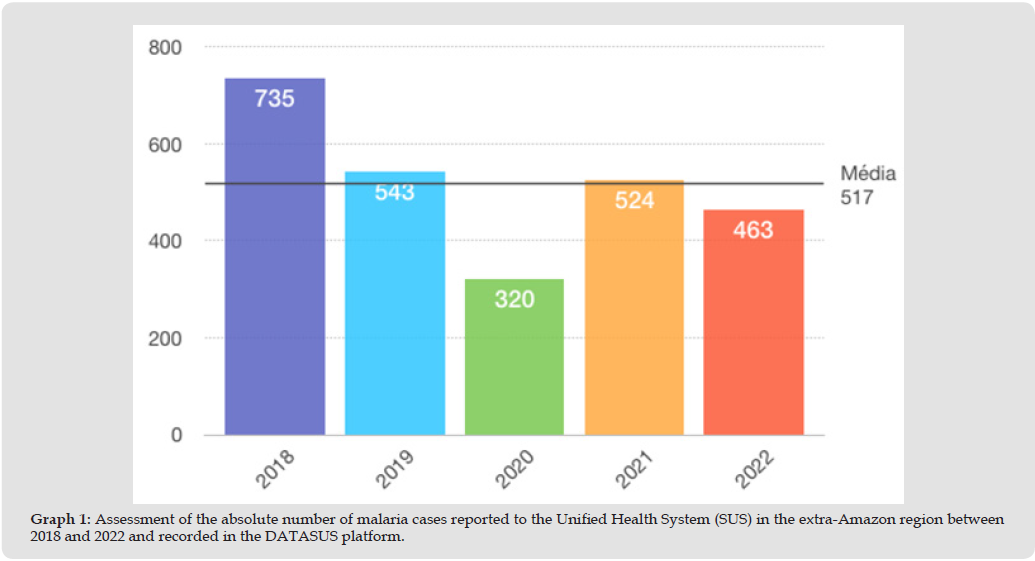
Analyzing the total number of malaria cases reported in Brazil (extra-Amazon region) between 2018 and 2022, a decrease of 41% in the number of reported cases is observed when comparing 2019 to 2020. The 320 cases reported in 2020 represent a reduction of 38.1% compared to the absolute average of all the years analyzed in the study (Graph 1).
Graph 1
Total Malaria Cases by Extra-Amazon Macro-Region (Northeast, Midwest, Southeast, and South) Between 2018 and 2022
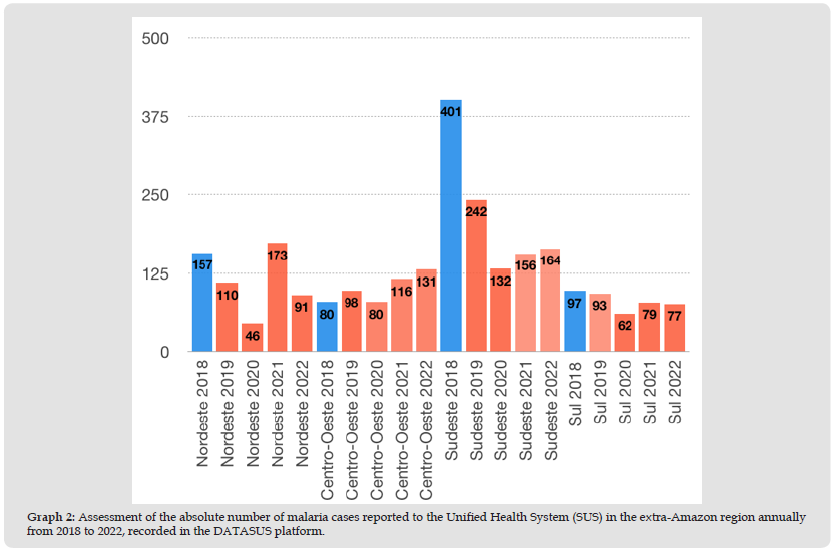
Upon analyzing each extra-Amazon macro-region individually, it was noted that the region with the greatest decrease in the number of reported cases was the Southeast. In Graph 2, we can observe an 85.6% reduction in the number of reported cases between 2019 and 2020 in the Southeast region, with 242 cases reported initially and only 132 the following year. Conversely, the Midwest region had the smallest decrease in the number of compulsory notifications of the disease, with a reduction of only 18.3% when comparing 2019 to 2020. In the South region, 93 cases of the disease were reported in 2019, and the following year, 62 notifications were recorded, resulting in a 33.3% decrease in the number of malaria cases. Lastly, in the Northeast region, between 2019 and 2020, there was a 58.1% decrease in reported malaria cases, and between 2021 and 2022, the reduction was 47.3%, with 173 cases recorded in 2021 and only 91 cases the following year.
Graph 2
Total Malaria Cases Reported in the Amazon Region Between 2018 and 2022
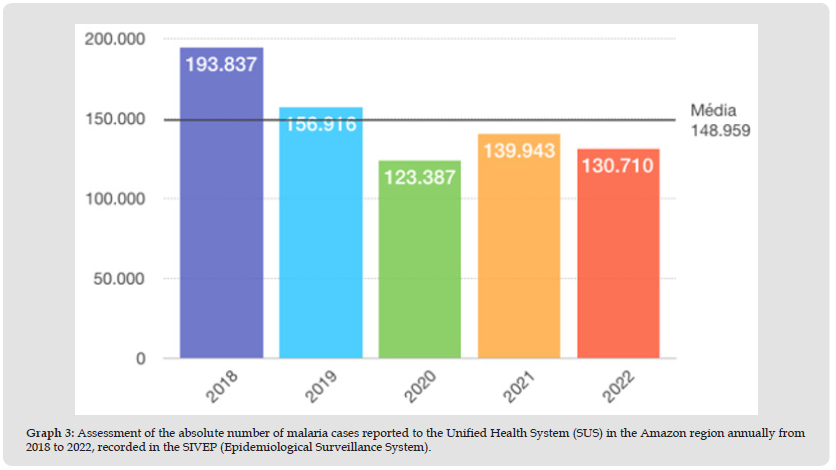
Analyzing (Graph 3), a reduction of 21.36% in the number of reported malaria cases in the Amazon region is observed when comparing 2019 to 2020. Furthermore, in relation to the average number of cases, a decrease of 17.1% in the number of notifications was noted in 2020. The results, depicted in Graph 2, analyze the absolute values of malaria cases by macro-region, before the COVID-19 pandemic (years 2018 and 2019) and during the pandemic (years 2020, 2021, and 2022). It confirms a decrease of 85.6% in the Southeast region, 58.1% in the Northeast region, 33.3% in the South region, and 18.3% in the Midwest region, between 2019 and 2020. (Graph 3) Examined the absolute values of malaria cases in the Amazon region between pre-pandemic years (2018 and 2019) and pandemic years (2020, 2021, and 2022), confirming a reduction of 21.3% in the number of cases when comparing 2019 to 2020.
Graph 3
The COVID-19 pandemic has brought about a profound transformation in the global medical landscape, indirectly impacting infectious diseases such as Malaria. Resource allocation, medical research, and epidemiological surveillance have been redirected to combat COVID-19, affecting the continuity of efforts to control other infectious diseases [2]. The decrease in the number of reported malaria cases, particularly between 2019 and 2020, involves various factors, including the strain on healthcare systems in Brazil and worldwide caused by the pandemic. It is assumed that this scenario negatively affected the capacity for malaria diagnosis, as the initial symptoms of both COVID-19 and malaria often resemble each other [3]. The high demand for tests, hospital beds, and medical resources for COVID-19 sometimes diverted attention from efforts to diagnose and treat malaria, leading to underreporting of the disease and potentially undiagnosed cases. This scenario, combined with the indiscriminate use of hydroxychloroquine in the treatment of COVID-19, lacking robust scientific basis [4], likely resulted in the inappropriate management of cases that actually corresponded to malaria due to the initial similarity in symptomatology between both diseases. Another factor predisposing to the reduction in reported cases was the period of social isolation, travel restrictions, and limitations on outdoor activities during the COVID-19 pandemic, which may have played a role in the decrease in the number of reported malaria cases [6].
With the limitation of human mobility and the decrease in social interactions, exposure to malaria-transmitting mosquitoes was potentially reduced. These pandemic containment measures may have contributed to the decrease in malaria transmission, resulting in a temporary underreporting of the disease. An epidemiological study conducted in Mexico, analyzing the indirect impact of COVID-19 on the incidence rates of vector-borne diseases, demonstrated that certain measures such as social distancing and home confinement contributed to temporarily reducing the number of cases of vector-borne diseases, including malaria. The research showed that 609 malaria cases occurred in Mexico in the year 2019, and in 2020, 345 cases of the disease were recorded, corresponding to a 43.4% decrease in the number of cases. During the same period, the extra-Amazonian Brazilian macro-regions also exhibited a similar reduction of 41% between the years 2019 and 2020.7 The same article, “Indirect Impact of COVID-19 on Incidence Rates of Vector-Borne Diseases in Mexico” [7], mentions that the Amazon region of Peru also experienced a drastic reduction in malaria cases during the pandemic, which was correlated with the increase in COVID-19 cases that overwhelmed Peru’s healthcare systems and public medical institutions. This impact can also be observed in the Brazilian Amazon region, which recorded 159,916 malaria cases in 2019 and 123,387 cases the following year, a decrease of 21.3%.
Another article linking Malaria and COVID-19 in native communities of Rio Santiago, Condorcanqui province, in the Amazon region of Peru in 2020 [8], demonstrated that prior malaria infection significantly associates with COVID-19 symptoms such as fever, odynophagia, and respiratory difficulty. During the pandemic, efforts to reduce the transmission of the novel coronavirus led to neglect of other diseases like malaria, a situation similar in Brazil, as evidenced by the reduction in the number of reported cases of the disease in Brazilian macro-regions. The underreporting of malaria cases was investigated in a study that analyzed the incidence of hospitalizations and mortality related to febrile syndromes and parasitic diseases during the COVID-19 pandemic in Brazil [9]. The results indicated that in 2020, the number of malaria-related hospitalizations in the country represented only 29.31% of the total; however, the mortality rate among hospitalized cases reached 82.55%. This high mortality rate is likely due to underreporting of the disease and late diagnosis, supporting the downward trend in notifications mentioned in this article.
The author successfully achieved the intended goal, which aimed to evaluate the impact of the Covid-19 pandemic on the number of malaria cases in the North, Northeast, Midwest, Southeast, and South macro-regions of Brazil from 2018 to 2022. The results demonstrated that indeed, the pandemic led to a negative variation in the number of reported malaria cases in all macro-regions analyzed in the study, especially when comparing the years 2019 and 2020. Regarding the total variation in the number of reported malaria cases in the Northeast, Midwest, Southeast, and South regions, a global negative variation of 41% was obtained in the number of compulsory notifications when comparing the pre-pandemic year of 2019 with the pandemic year of 2020. In other words, during the onset of the pandemic (2020), the number of reported malaria cases saw a significant reduction. In the Amazon region, between the pre-pandemic years (2018 and 2019) and the pandemic years (2020, 2021, and 2022), there was a 21.3% reduction in the number of cases when comparing 2019 with 2020. It is assumed that this decrease may be explained by the overload of the public health system with Covid-19-infected patients, similar symptomatology between the diseases complicating diagnosis, treatments for the new coronavirus lacking scientific evidence leading to underreporting of malaria cases, and social isolation possibly reducing population contamination by the vector.

International Association of Landscape Archaeology, Czech Glass Society, Czech Republic

Department of Chemistry, Semenov Institute of Chemical Physics, USSR Academy of Sciences, Moscow, Russia

Neurology, LA BioMed Research Institute, USA

Associate Professor at Department of Breast and Thyorid Surgey, Chongqing General Hospital, China

Clinical Radiologist (MD) - Department of RADIOLOGY, Cosenza Hospital, Cosenza, Italy





 Abstract
 PDF
PDF



























