info@biomedres.us
+1 (502) 904-2126
One Westbrook Corporate Center, Suite 300, Westchester, IL 60154, USA
Site Map
 ISSN: 2574 -1241
ISSN: 2574 -1241
ISSN: 2574 -1241
Received: March 27, 2024; Published: April 08, 2024
*Corresponding author: Rofiat Funmilola Adewunmi, Department of Biochemistry, University of Maiduguri, Maiduguri, Borno State, Nigeria
DOI: 10.26717/BJSTR.2024.56.008785
Snake venom is a complex mixture of active proteins that induce toxic effects, such as edema, hemorrhage, paralysis and death. The clinical management of snake envenomation is by the administration of antivenom, which induces adverse reactions such as serum sickness, pyrogen reaction etc. In view of these limitations, the plant kingdom is explored for possible antivenin compounds. Solanum dasyphyllum Schum & Thonn (Africa eggplant) belong to the family of Solanaceae and the plant is reported to possess anti-poison, anticonvulsant and neuromuscular properties. The aim of this work was to investigate the inhibitory ability of solvent fractions of S. dasyphyllum leaves extract on Naja nigricollis venom. The in-vitro enzyme inhibition activity of the fractions on venom proteases, phospholipase A2 (PLA2), and acetylcholinesterase were evaluated using standard methods. The results of enzyme inhibition studies of various fractions from methanol leaf extract of S. dasyphyllum revealed that all the fractions were able to reduced the activity of all the enzymes; however, ethylacetate fraction has the highest inhibition potentials. Therefore, ethylacetate fraction of S. dasyphyllum leaves extract could be a promising source of molecules to treat local toxic effects of envenomation by N. nigricollis venom.
Keywords: Enzyme; Inhibition; Phospholipase A2; Acetylcholinesterase; Protease
Abbreviations: AChE: Acetylcholinesterase; DTNB: 5, 5-Dithio-Bis-(2-Nitrobenzoic Acid) Ml Milliliter; PBS: Phosphate Buffer System; PLA2: Phospholipase A2; S. dasyphyllum: Solanum Dasyphyllum; N. nigricollis: Naja Igricollis; CaCl2: Calcium Chloride; NaCl: Sodium Chloride
Snake venoms are modified saliva that is stored in structures called alveoli, which are located behind the snake’s eyes [1]. Venom is a mixture of powerful enzymes such as phosphodiesterases, metalloproteinases, acetylcholinesterases, L-amino acid oxidases, phospholipases A2, hyaluronidase etc, which is capable of inducing different arrays of biological effects, such as heamolysis, paralysis of the muscles and even death [2]. Naja nigricollis commonly known as the black-necked spitting cobra belongs to the family of a snake called Elapidae and it is found mostly in sub-Saharan Africa [3]. It is one of the important venomous snakes that cause envenomation in West Africa, including Nigeria, and the major component of N. nigricollis venom are neurotoxins, phospholipase A2, cytotoxins, and non-enzymatic anticoagulant proteins such as Three-finger toxins [4]. The venom's toxic effects are manifested in form of local tissue reaction and occasionally with bleeding from the site of the bite. Naja nigricollis envenomation may lead to complications such as amputation, bleeding, blindness, fetal loss, convulsions muscle cramps, wound infection, tetanus and malignant transformation [5]. Solanum dasyphyllum is a semi-woody perennial herb that is heavily armed with prickles, occurring throughout the Region and tropical Africa to South Africa [6]. Solanum dasyphyllum is generally used locally as an antidote (venomous stings, bites, etc.), treatment of toothaches, stomach pains, parasitic infections, swellings, etc. It is known to have anticonvulsant, neuro-modulatory, and cardiovascular (hypotensive) properties [7].
Materials
All the chemicals and reagents were of analytical grade. Ethylacetate, n-hexane, n-butanol, chloroform cetyltrimethylammonium bromide, tyrosine, casein, hyaluronic acid, lecithin, 5, 5-dithiol-bis-(2-nitrobenzoic acid), acetylthiocholine iodide were from Central Drug House (CDH) India and sigma Aldrich USA.
Plant Collection, Preparation of Extract and Partition Leaves of Dasyphyllum
The leaves of Solanum dasyphyllum were collected (June-July, 2018) from Odeomu town (Latitude: 7°32'0"North; Longitude: 4°24'0"East) in Ayedaade Local Area, Osun State. They were identified and authenticated in the Department of Botany, Obafemi Awolowo University, Ile-Ife, Osun state, and voucher specimen number IFE-17489 was issued. They were air dried, and pulverized. Exactly 1 kg of the pulverized sample was macerated in 85% methanol for 72 h and then filtered. A portion of the crude extract (120 g) was partitioned with n-hexane, chloroform, and ethylacetate and methanol. Each fractions collected was concentrated in a rotary evaporator to obtain n-hexane fraction (HF), chloroform fraction (CF), ethylacetate fraction (EF) and butanol fraction (BF), which were used for analysis. They were stored in an amber bottle and stored at -4°C until use.
Venom Acquisition
Lyophilized Naja nigricollis venom was obtained from the Department of Pharmacognosy and Drug Development, Ahmadu Bello University, Zaria, Nigeria, and was preserved at 40C. Before use, the venom was reconstituted in phosphate buffer, pH 7.2, centrifuged at 2000rpm for 10 minutes and the supernatant was used for further studies.
In-vitro Enzyme Inhibition Studies
Protease: Protease assay of crude venom was performed according to the Greenberg method [8]. The reaction mixture was composed of 5 mls of 0.5% casein, 1 ml of 0.2M Tris-HCl buffer (pH 8.0), 0.5 ml of 0.25% crude venom, and the mixture was incubated for four hours at 37°C. At the end of four hours, the reaction was stopped by adding 0.5 ml of 10% trichloroacetic acid (TCA) and filtered. The filtrate (1 ml) was used for protein estimation by the method of Lowry [9], using 1.1 mM L-tyrosine stock solution as standard. In the above investigation, one unit of enzyme activity was defined as the amount that yields 0.02 μmole of tyrosine/hour under the experimental conditions described. For the Inhibition study, the plant extract was pre-incubated with venom at 37°C for 45 min.
Phospholipase A2 (PLA2): Phospholipase A2 was determined according to the titrimetric method of Adamich [10] with slight modification. Lecithin emulsion was prepared by dissolving 4g of lecithin in 30 mls 1M NaCl and 10 mls 0.1 M CaCl2; the mixture was made up to 200 mls with distilled water. The reaction mixture that contained 15 mls of lecithin emulsion and 1 ml (1mg/mg) of the reconstituted venom was adjusted to pH 8.9 with 0.02 M NaOH. The volume of 0.02 M NaOH required maintaining the pH at 8.9 for 4 minutes via titration was recorded. A decrease of 1 pH unit corresponds to 133 μmoles of fatty acid release. Enzyme activity was expressed as μmoles of fatty acid released/per minute. For the Inhibition study, the plant extract was pre-incubated with venom at 37°C for 45 min.
Acetylcholinesterase: Acetylcholinesterase was assayed according to the method described by Ellman [11], 0.1 ml of 0.01 M DTNB (5,5-dithiol-bis-(2-nitrobenzoic acid)) was added to 2.6 mls of 0.1 M phosphate buffer (pH 8.0), 0.04 ml (1mg/ml) of the reconstituted venom was added to the above mixture followed by incubation at 37°C for 5 min, after incubation, 0.04 ml of the substrate (0.075 M acetylcholine iodide) was added to the reaction mixture. Absorbance readings were taken at 420 nm continuously for 3 min at 30 seconds intervals. The results were expressed in µmolmin-1mg protein-1 using a molar extinction coefficient 1.36 x 10⁻⁴M-1cm-1. For the Inhibition study, the plant extract was pre-incubated with venom at 37°C for 45 min.
The results of the attenuation effect of different fractions (n-hexane, chloroform, ethyl acetate, and butanol) on protease, phospholipase A2 and acetylcholinesterase activity in N. nigricollis venom are presented in Figures 1-3. The results revealed that all the fractions at the different concentrations were able to reduce the activity of the assayed enzymes in the venom. However, the ethyl acetate fraction of S. dasyphyllum had the best inhibitory potentials as compared with the other fractions.
Figure 1
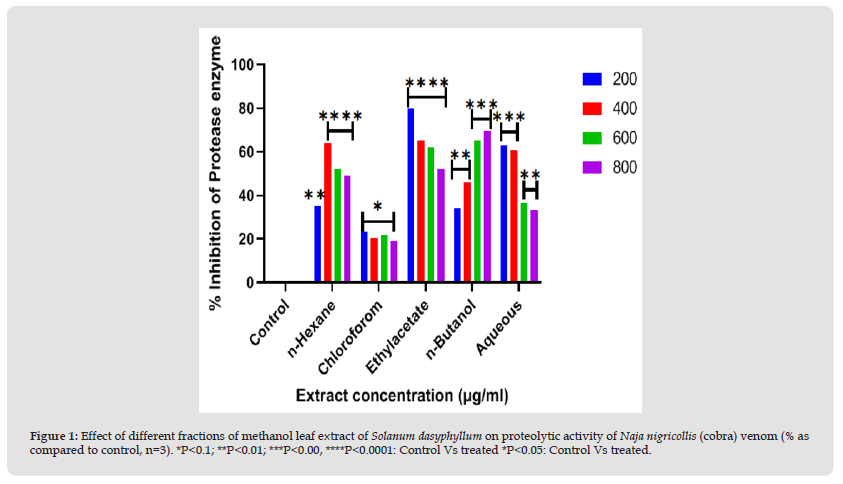
Figure 2
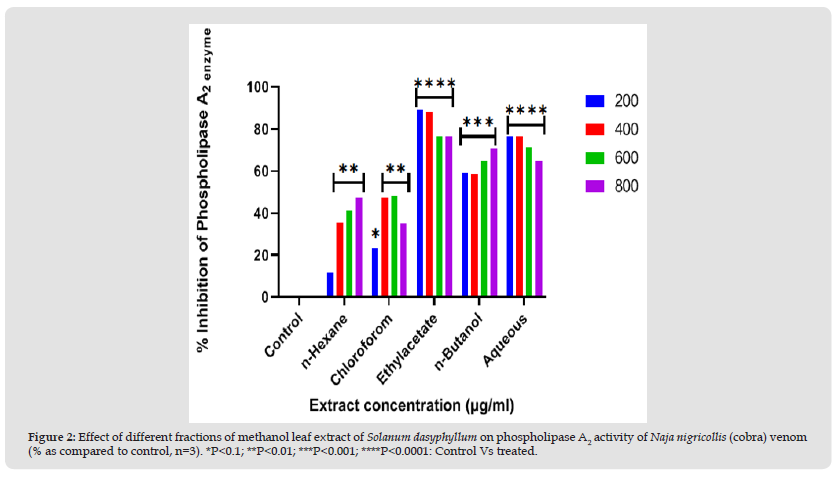
Figure 3
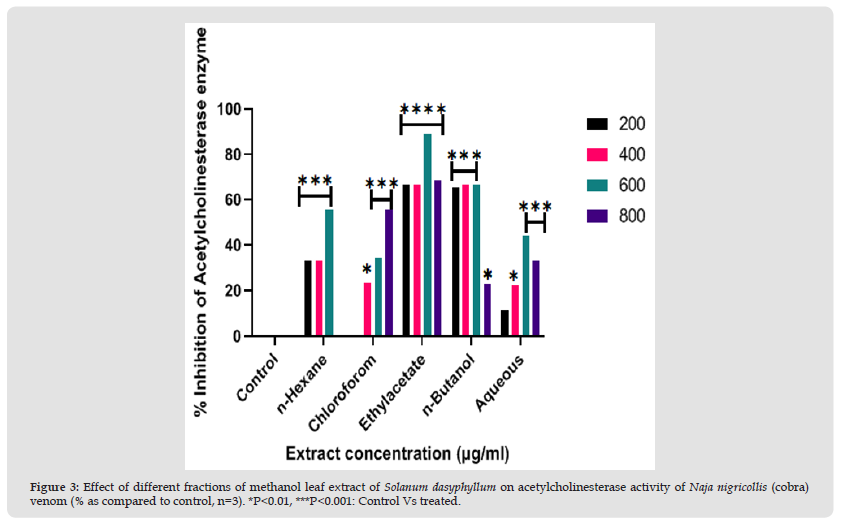
Venoms contain pharmacological active substances such as enzymes, nucleotides, aminopolysaccharides, amines, neurotransmitters and other compounds, and are capable of inducing many biological effects. Snakes such as N. nigricollis, N. naja etc. have higher concentrations of esterase, such as acetylcholinesterase, whose effects is on the nervous system. Also, the venom contains proteolytic enzymes and Phospholipase A2 [12]. Proteolytic enzymes like trypsin are account for much of the digestive reactions of snake venoms. Phospholipase A2 degrades lipids in the cell membrane, leading to the disruption cell membrane integrity causing lysis and apoptosis of the cell [13]. In the assessment of the in-vitro enzyme inhibition activity of S. dasyphyllum leaf solvent fractions on Naja nigricollis venom, the fractions shows significant inhibition of the venom proteases, phospholipase A2 and acetylcholinesterase at different concentration as compared to control. Although, the quantitative estimation of each of the phytochemicals in the fractions was not evaluated, the inhibition of these enzymes suggested that the fractions might contain phytochemicals, which probably bind to the enzymes, thus preventing it from binding to its substrate, thereby leading to its inhibition. In 2020, Oladapo and his colleagues [14] reported that S. dasyphyllum possesses antioxidant activity; hence, it can mop up the free radicals produced as a result of snake venom phospholipase A2 activity on the cell membrane. Similarly, significant inhibition of acetylcholinesterase enzyme by Solanum dasyphyllum extract was reported by Obade7 and this concisely with Pushpendra [15] research that reported that Atropine, an alkaloid found in the Solanaceae family is a potent cholinergic blocker, thereby decreasing the effect of neurotransmitter released at the cholinergic nerve terminals by snake venom. Therefore, S. dasyphyllum can be classified as an anti-cholinesterase plant and this activity might be a result of various phytochemicals present in the plant, such as alkaloids, flavonoids, coumarin and steroids, which have been reported to possess anticholinesterase activity [16].
The in-vitro enzymes inhibition studies reveals that the solvent fractions of methanol leaf extract of S. dasyphyllum could inhibit most of the toxic enzymes of the N. nigricollis. This study suggests that the plant may be a promising candidate for the treatment or management of snakebite envenomation.
Authors have declared that no competing interests exist.


 Abstract
 PDF
PDF