info@biomedres.us
+1 (502) 904-2126
One Westbrook Corporate Center, Suite 300, Westchester, IL 60154, USA
Site Map
 ISSN: 2574 -1241
ISSN: 2574 -1241
ISSN: 2574 -1241
Received: January 26, 2024; Published: February 05, 2024
*Corresponding author: Brando Guarrera, Neuroscience, Ospedale dell’Angelo-Mestre, Mestre, Italy
DOI: 10.26717/BJSTR.2024.54.008610
Background: In the realm of severe traumatic brain injury (TBI), where high intracranial pressure (ICP) reigns as a chief contributor to mortality and disability, approximately one-third of European patients necessitate neurosurgical intervention. Decompressive craniectomy (DC), positioned as an ultimate surgical recourse, though ostensibly straightforward, conceals a labyrinth of potential complications, notably extradural hematoma (EDH) linked to contralateral fractures. While the recognized incidence stands at 5–12%, a distinct perspective emerges from Singh et al., who, scrutinizing 2108 DC procedures sans the use of a skull clamp, propose a markedly lower figure of about 0.48%. The intricate interplay between EDH post-DC in trauma patients with skull fractures and the employment of a head immobilization device (HID) remains an underexplored facet.
Materials and Method: This retrospective analysis envelops the cohort undergoing frontotemporoparietal DC and bifrontal DC following TBI at Venice Angel Hospital over a span of five years and six months (January 2017-June 2022). Inclusion criteria encompassed patients displaying skull bone fractures on CT brain scans, coupled with clinical and neuroradiological cues indicating escalating ICP. A comprehensive examination of variables, including age, gender, neurological status (GCS at trauma and pre-surgery, pupillary characteristics pre-and post-surgery), neuroimaging evolution, and DC timing, was conducted for each patient. The uniform utilization of the DORO© Mayfield skull clamp characterized the surgical approach.
Results: The resultant surgical cohort, comprising 20 patients with a male-to-female ratio of 3:2 and an average age of 47 ± 17, witnessed 16 patients undergoing primary DC in urgent scenarios, while 4 underwent secondary DC following an average observation period of 50 hours. Notably, 90% of patients underwent frontotemporoparietal DC, with the remaining 10% opting for bifrontal DC. Postoperative scrutiny via CT scans unfolded brain contusion enlargement in 4 patients (20%), EDH in 4 patients (2 contralateral to the DC and skull fracture, 1 contralateral to the DC, and 1 homolateral to the DC), and SDH in 2 cases (both homolateral to the DC). Surgical intervention for EDH emerged as a necessity in 3 patients.
Conclusions: In summation, our findings intimate an augmented propensity for the development of remotesite EDH in our patient cohort, with other prevalent complications exhibiting comparable or marginally elevated frequencies. In light of the perceived heightened risk-benefit ratio associated with skull bone application, we advocate for the embracement of safer HID alternatives, such as surgical adhesive tape or a horseshoe headrest.
A total of twenty-six patients underwent Decompressive Craniectomy (DC) after Traumatic Brain Injury (TBI). Notably, four cases within this cohort exhibited an absence of skull fractures, while two cases were subjected to suboccipital DC. The remaining twenty patients conformed to the predefined inclusive criteria, displaying a gender distribution with a male-to-female ratio of 3:2 and an average age of 47 ± 17 years.
During the initial medical intervention, the Glasgow Coma Scale (GCS) registered an average of 7 ± 4. Of these, thirteen patients underwent intubation on-site, whereas in seven cases, the GCS exhibited a decrease to an average of 8 ± 2 before intubation. Pupillary responses were uniform, being bilaterally isochoric, isocyclic, and light-reactive in eleven patients. Among these, ten maintained consistent pupillary characteristics, while one exhibited a rapid transition to anisocoria. Noteworthy instances include a patient who was rescued and treated while presenting anisocoria and another who initially recovered anisocoria but subsequently transitioned to bilateral mydriasis. Additionally, pupils were mydriatic in five patients and miotic in two cases before undergoing surgery.
Diagnostic assessment through CT brain scans unveiled varied pathologies. Notably, one case revealed Extradural Hematoma (EDH) in conjunction with bilateral Subdural Hematoma (SDH) and brain contusions. Fourteen patients demonstrated the presence of SDH, with 80% being frontotemporoparietal and 60% exhibiting concomitant significant brain contusions. Furthermore, 45% of patients displayed Epidural Subarachnoid Hemorrhage (ESA). Frontal bone fractures were evident in seven patients, with four cases extending to the parietal bone, three to the temporal bone, and one to the occipital bone. Temporal bone fractures were observed in six patients, with two cases affecting the parietal bone, one involving the skull base, and one affecting the occipital bone. Finally, six patients displayed occipital bone fractures, with one case impacting the temporal bone, one involving the parietal bone, and one affecting the skull base.
Sixteen patients underwent expeditious surgery (primary DC), while four were initially subjected to clinical monitoring. Subsequently, following an evaluation indicating Intracranial Pressure (ICP) refractory to maximal medical management and a declining Glasgow Coma Scale (GCS), the latter group underwent surgery after an average observation period of 50 hours (secondary DC). Notably, 90% of patients undergoing surgery experienced frontotemporoparietal DC, with the remaining 10% undergoing bifrontal DC. Operative records uniformly reported the presence of a significant brain bulge during surgery in all cases.
Postoperative CT brain scans identified the enlargement of brain contusions in 20% of patients. Notably, four patients exhibited EDH, with two cases occurring on the side contralateral to the skull fracture, one presenting contralateral to DC and skull fracture, and one manifesting occipitally on the side homolateral to DC. Additionally, two cases presented SDH, both homolateral to DC. Surgical intervention for EDH was deemed necessary in three patients following DC.
Traumatic brain injury (TBI) represents an escalating and formidable global health and socio-economic challenge, affecting individuals across diverse age brackets in both affluent and economically challenged nations. It stands as a significant contributor to mortality and disability, particularly impacting those under the age of 45 [1,2]. Despite a reported decrease in mortality rates to an average of 10.5/100,000, the incidence of TBI is on an unwavering ascent, notably affecting the elderly population [4,6]. In Europe, the annual incidence of head injury stands at 2.3 per 1000 person-years, with 33% requiring neurosurgical intervention [4].
Decompressive craniectomy (DC) emerges as a pivotal surgical intervention for managing medically refractory intracranial hypertension (ICP) resulting from TBI, often compounded by intracerebral hemorrhage, subarachnoid hemorrhage (ESA), acute subdural hematoma (SDH), extradural hematoma (EDH), among other factors [16- 18]. While primary DC is frequently performed urgently after major trauma, secondary DC, following an intracranial pressure monitoring period, is also considered based on various clinical factors. Despite its perceived simplicity, DC is associated with numerous complications [19], including contusion expansion (12.6-14%) and extracerebral hematomas, particularly subgaleal hematoma and, less frequently, SDH [8,19,20]. Notably, EDH contralateral to the surgical site, often linked with skull fractures, has a reported incidence ranging from 5-12% (8–10,23,24), with adverse patient outcomes. The causes are not defined but are thought to be due to the loss of the tamponing effect of increased ICP after DC [8-10].
The Mayfield© skull clamp, a widely used Head Immobilization Device (HID), lacks comprehensive guidelines for its application [11,25]. While complications related to its usage, such as skull fractures with or without EDH, are rare and generally avoidable, the literature has not excluded its use in major trauma patients with skull fractures. In such cases, it is imperative to confirm skull integrity through CT scans before pin placement, preventing penetration, fragment displacement, fracture line enlargement, or inadequate stabilization [11,29].
Despite numerous studies analyzing acute complications of DC, the role of the skull clamp in the context of EDH associated with post-traumatic fractures following DC has not been elucidated. In the context of the study, Singh, et al. [9] conducted 2108 decompressive craniectomies (DC) without utilizing a Head Immobilization Device (HID). They identified a total of 9 instances of remote side extradural hematomas (EDH), constituting 0.4% of the cases. These occurrences were observed at various sites, predominantly without any associated fractures. Importantly, Singh and colleagues suggested that heightened mass effect and the presence of a brain bulge during surgery could serve as predictive indicators for such complications.
In our retrospective analysis, noteworthy findings emerged. Of these patients, 14 presented with a Glasgow Coma Scale (GCS) of ≤ 8 at the time of first aid. The initial CT brain scans revealed different pathologies, including EDH associated with bilateral SDH and brain contusions in one case, significant brain contusions in five patients, SDH in 14 patients and 60% associated with significant brain contusions. All patients exhibited skull fractures (Table 1). Sixteen patients underwent urgent surgery (primary DC), while four were initially clinically monitored. Secondary DC was performed in the latter group after an average observation period of 50 hours, with 90% experiencing frontotemporal DC and 10% bifrontal DC. Operative records consistently indicated significant brain bulges during surgery. Postoperative CT scans revealed complications, including brain contusion enlargement in four patients, SDH in two cases (both homolateral to DC), and EDH in four patients, necessitating new surgical treatment for three (Table 2).
The study highlighted three specific cases to underscore the complications associated with EDH following DC.
Table 1: GCS I: at the moment of the first aid; GCS II: before surgery. Iso: Isocyclic; Mio: Miotic; Ani: Anisocoric; Myd: Mydriatic.

Note: Patients neurological statement.
Table 2: SDH: subdural hematoma; ESA: subarachnoid haemorrhage; EDH: extradural hematoma. F: frontal; P: parietal; T: temporal; O: occipital; L: left; R: right.

Note: Radiological findings.
Patient 1: Severe Head Injury
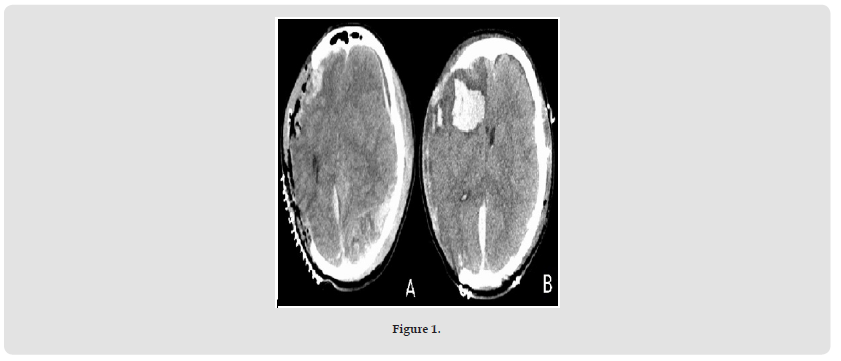
Patient 1, initially presenting with a Glasgow Coma Scale (GCS) of 10, experienced a decline to 6 during transport with anisocoric pupils. Urgent computed tomography (CT) revealed a right frontotemporoparietal subdural hematoma (SDH) and a left temporoparietal fracture. An immediate primary right decompressive craniectomy (DC) was performed, utilizing a skull clamp (single pin on the left forehead, two pins on the right occipital bone – Figure 1a). The surgery involved SDH evacuation, revealing a significant brain bulge. Duraplasty was executed without replacing the bone flap. Post-surgery, mydriatic pupils were observed after removing the skull clamp. A subsequent CT scan identified a voluminous left-brain intracerebral hemorrhage, leading to evacuation after 9 hours (Figure 1b). Almost a year later, bone flap repositioning occurred, resulting in a moderately disabled patient (Glasgow Outcome Scale [GOS] 4).
Figure 1
Patient 2: Severe Head Injury
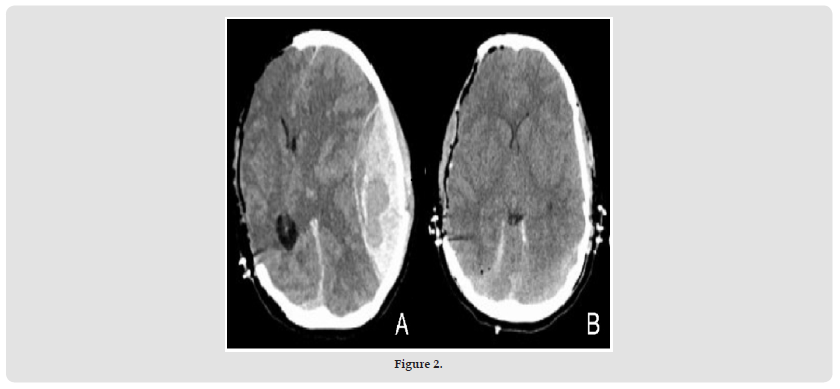
Patient 2, with a GCS of 4, mydriatic pupils, and absent reflexes except the carinal reflex, underwent urgent CT revealing a right frontotemporoparietal SDH and a left occipital-parietal fracture extending to the skull base (Figure 2a). Immediate primary right DC, with the application of a skull clamp (single pin on the left forehead, two pins on left occipital), involved SDH evacuation, uncovering a significant brain bulge. Duraplasty was performed, and the bone flap was not replaced. Post-surgery, anisocoric pupils (right>left) were noted after removing the skull clamp. Subsequent CT scan revealed a voluminous left temporoparietal-occipital EDH (Figure 2b), requiring evacuation. Despite bone flap repositioning, the patient remained unaware of self and environment after almost a year (GOS 3).
Figure 2
Patient 3: Apparent Mild-Moderate Head Injury, Major Dynamics
Initially presenting with a GCS of 14, Patient 3 experienced a rapid decline to 9 during transport, necessitating intubation. CT scans unveiled a right frontotemporoparietal SDH, diffuse epidural subarachnoid hemorrhage (ESA), and frontotemporal brain contusions associated with a right frontoparietal fracture. Urgent primary right DC, facilitated by a skull clamp (single pin on the left forehead, two pins on right occipital), included SDH evacuation, revealing a moderate brain bulge. Duraplasty was performed without bone flap replacement. Post-surgery, isochoric-isocyclic pupils persisted after removing the skull clamp. A subsequent CT scan identified a left temporoparietal EDH, leading to evacuation after 7 hours. Two years later, the patient exhibited moderate disability (GOS 4).
The study’s revelations unveiled a substantial 20% incidence of extradural hematoma (EDH) following decompressive craniectomy (DC), occurring contralateral to the surgical site and associated with skull fractures. This percentage significantly surpassed the documented range in existing literature, which typically falls between 5% and 12%. Strikingly, the observed rate stood notably higher than the mere 0.4% indicated by Singh et al. This stark contrast underscored a distinct and elevated risk in the context of patients undergoing DC.
A critical aspect brought to light was the potential peril associated with the application of skull clamps during DC procedures. The study posited that the utilization of these clamps could be linked to a precarious risk-benefit ratio, contributing substantively to the emergence of complications, specifically the occurrence of EDH. The authors put forth several theories to elucidate these complications. Firstly, they pointed to the loss of the tamponing effect of increased intracranial pressure (ICP) post-DC as a plausible contributing factor. Additionally, the precise placement of pins and their subsequent sudden removal were identified as potential key elements in the genesis of complications.
Importantly, the study refrained from explicit details, opting for a more general perspective on the role of skull clamps as potential risk factors. This vagueness in detailing the risk relationship between the head immobilization device and complications encourages a broader consideration of the implications. It emphasizes the need for cautious reflection on the prevalent practices involving skull clamps in decompressive craniectomy, urging a broader exploration of alternative approaches to enhance patient safety without delving into specific risk quantification.
In light of these findings, the study recommended considering alternative Head Immobilization Devices, such as surgical adhesive tape or horseshoe headrests, for DC procedures following TBI associated with bone fractures, until further research verifies or refutes the proposed theories.
Limitations and future directions
The study acknowledges several limitations that merit consideration. Firstly, the restricted number of patients enrolled in the investigation may constrain the generalizability of the findings. Additionally, the retrospective nature of data collection introduces inherent biases and limitations associated with reliance on historical records. Furthermore, the absence of corroborating evidence from other authors to either support or challenge the proposed theories underscores the need for caution in interpreting the study’s outcomes.
Despite these constraints, this preliminary study addresses a pertinent aspect of daily surgical practice, providing a foundation for future investigations. It serves as an initial exploration into a crucial area of interest, prompting further research endeavors to validate and refine its findings. As part of future directions, the aim is to broaden the scope of the case series by including patients who undergo decompressive craniectomy (DC) without a history of trauma and skull fractures. This expansion could provide a more comprehensive understanding of the role of DC in varied clinical contexts, offering valuable insights for enhanced patient care and surgical decision-making [30-33].
Our study highlights a heightened probability of remote-site extradural hematoma (EDH) development in patients undergoing decompressive craniectomy (DC) with a skull clamp following traumatic brain injury (TBI) involving skull bone fractures. Interestingly, other complications associated with this surgical procedure demonstrated comparable or slightly increased frequencies compared to existing literature.
Acknowledging the limitations inherent in our analysis due to the restricted number of patients, the observed high risk-benefit ratio linked to skull clamp application in these cases calls for caution. As a prudent measure, we propose the adoption of safer Head Immobilization Devices (HID), such as surgical adhesive tape or a horseshoe headrest. This recommendation stands until further research and comprehensive validation either substantiate or refute the observed association between skull clamp usage and complications, particularly remote-site EDH.
This research received no specific grant from the public, commercial, or not-for-profit funding agencies.
None.


 Abstract
 PDF
PDF






























