info@biomedres.us
+1 (502) 904-2126
One Westbrook Corporate Center, Suite 300, Westchester, IL 60154, USA
Site Map
 ISSN: 2574 -1241
ISSN: 2574 -1241
ISSN: 2574 -1241
Received: April 11, 2025; Published: May 12, 2025
*Corresponding author: Emin Taner ELMAS, Assistant Professor Dr., Vocational School of Higher Education for Technical Sciences, Division of Motor Vehicles and Transportation Technologies, Department of Automotive Technology & Graduate School of Natural and Applied Sciences - Major Science Department of Bioengineering and Bio-Sciences, Iğdır University, Turkey
DOI: 10.26717/BJSTR.2025.61.009658
This article gives introductory information about the “General Aspects of Advanced Biomechanics”. The study has been realized within the scope of a Ph.D. lesson which is lectured by Asst. Prof. Dr. Emin Taner ELMAS. The name of this Ph.D. lesson is “Medical Engineering and Advanced Biomechanics” and taught at the Major Science Department of Bioengineering and Bio-Sciences at Iğdır University, Turkey. İsmail KUNDURACIOĞLU is a Ph.D. student, and he is one of the students taking this course. This article has been prepared within the scope of this Ph.D. lecture, as a part of one of his (İsmail KUNDURACIOĞLU) homework assignment tasks which was prepared using the summary translation of Reference [19]: Book Part 1. [1-61]
Keywords: Advanced Biomechanics; Biomechanics; Comparative Biomechanics; Anatomy; Physiology; Thermodynamics; Energy Transfer; Fluid Mechanics; Heat Transfer; Mathematics; Medical Technique; Medical Engineering; Medicine; Biomechanical Analysis; Bioengineering; Health Science
Doing science always starts with a question about the world around us; These questions can sometimes be qualitative, sometimes quantitative. One of the most important elements that distinguish different fields is the questions that each field asks. This article seeks answers to some interesting questions in the field of biomechanics. These questions, which are very closely related to everyday life, deal with ordinary issues that form the basis of biomechanical research. For example, what are the factors that determine the transition from walking to running as you increase your movement speed? Or what are the factors that influence the concentration of red blood cells in marine mammals? [19] In addition, issues such as questioning why the mechanical properties of the threads produced by spiders are unusual, and the relationship between blood pressure and height of other mammals are touched upon. The swimming problems of various creatures moving on the surface and the factors affecting the maximum heights of trees are other topics discussed. As a result, these questions are both directly related to everyday life and play an important role in the development of scientific thinking. Fields such as biomechanics stand out as a resource that current education does not benefit enough from, offering the opportunity to put scientific thinking into action [1-61].
Intersection of the Physical and Biological Worlds
Science has evolved over the past few centuries in a fragmented structure, and this provides complex ground in understanding the interactions of organic life with its physical world. Using the differences in habitat in which organisms live, it is important to understand how the structures of each species help with certain functions. In this context, their evolutionary history, ancestry, and especially their similarities offer clues to the functioning of organisms. When biology and physics are combined with information from engineering courses, important insights into how organisms work can be provided. However, chemistry and geology are less useful in this context [19]. Biology conveys the message that, from a genetic point of view, all organisms are a family. However, the heterogeneity of life reveals rich and diverse forms that exhibit the creativity of the evolutionary process. The squirrel cannot be confused with the tree it climbs, nor does it bear any resemblance to its own order of microorganisms. This gives rise to the idea that nature can create anything through evolutionary innovations. However, some factors cannot be changed by natural selection. As one of the few species that can resist surface tension, when a particular object is enlarged, its surface area decreases relative to its volume if its shape remains unchanged. In this context, life has to cope with a non-biological world [19].
The fundamental laws of physics impose strong constraints on the design of living systems. Rather than limiting the effects of organisms in the physical world, these constraints provide opportunities for observers and researchers. For example, thin-walled cells can withstand pressures that would cause an explosion in the arteries. On the other hand, the slippery substance on which a slug glides can exhibit both solid and liquid properties. The theme argues that the design of organisms reflects the inevitable characteristics of the physical world, that this world imposes constraints and offers opportunities. However, instead of a comprehensive examination of all physical information, the focus will be on mechanical and macroscopic issues. In particular, given the terminological differences between biology and physics, the specific terms of these two fields create difficulties in understanding. Terms used in biology often have complex origins, while terms in physics and engineering give different definitions to ordinary words. Although the concept of energy has a specific meaning in the physical sciences, it is difficult to express in simple words [19].
Adaptation and Evolution—Biological Context
This chapter is an introduction to understanding how the concepts of evolution and design interact. The process of evolution, if it is completely blind and aimless, is misleading, the term design is misleading; Because design usually points to a foresight and purpose. Questioning why organisms appear to be well-designed poses a significant problem. Therefore, it is worthwhile to review the concept of “evolution by natural selection” [19].
Observations:
• Each organism can produce more than one offspring, so populations of organisms have the potential to increase continuously.
• An organism needs a certain amount of resources to survive and reproduce, and these resources are never unlimited.
• A population reaches a certain maximum level in an area. When the maximum level is reached, more individuals are produced who do not find enough resources; This means that some individuals will not survive.
• Individuals in any population show differences that affect their reproductive success, and some of these differences are passed on to the offspring.
• Traits that lead to greater success in reproduction will be seen more often in the next generation; therefore, these traits are said to be “naturally selected”. Here we mean the choice between pre-existing variations, not in the sense of design.
Reflections of the Model
The model is portrayed as a positive feedback loop. The indirect effects of natural selection arise when the system is compared to a more direct model. Darwin could not accept that acquired traits are usually not inherited; However, today this situation is clearly understood. In modern biology, this model is one of the least controversial; All aspects have been observed and tested. Competing models’ efforts to produce biodiversity often do not correspond to reality. Given geological time and faulty inheritance mechanisms, it is difficult to understand how evolution could have been avoided [19]. In Figure 1a, the model is depicted as a positive feedback loop. This emphasizes an indirect effect of natural selection and is presented as a system that works on its own success. Figure 1b represents a more direct model. Darwin could not rule out the inheritance of acquired traits; However, today it is understood that acquired traits are generally not inherited. These explanations show how two different approaches to understanding the workings of natural selection are compared. Figure 1a emphasizes how natural selection works and the cycle of success, while Figure 1b offers a more direct model by addressing the inheritance of acquired traits. Both figures are important reference points to illustrate the complexity and controversial points of natural selection [19].
Figure 1
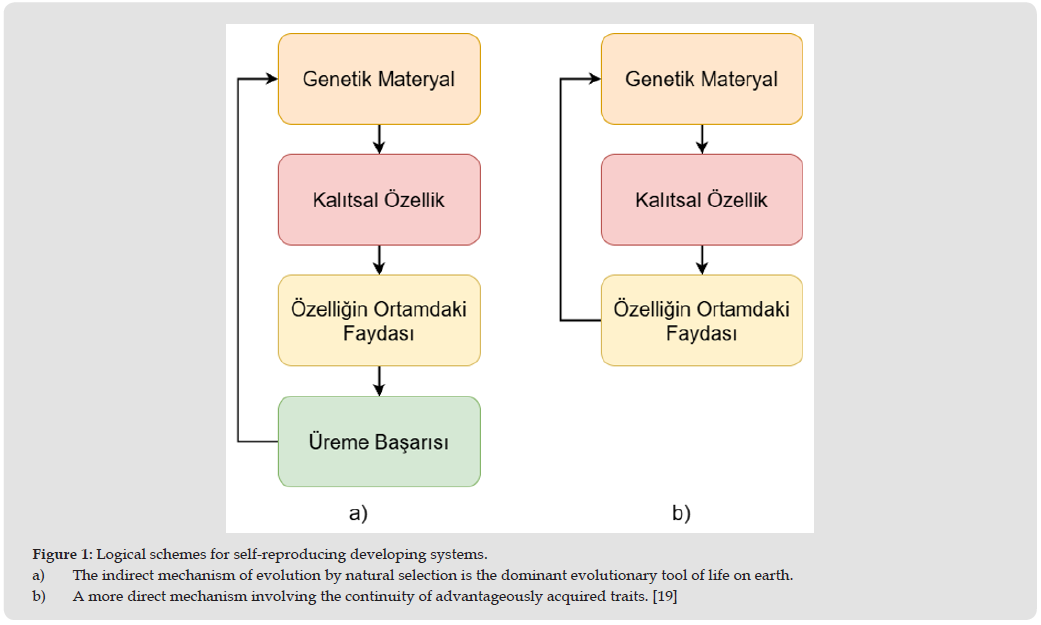
Natural selection operates most directly on organisms; not on cells or communities. An organism is considered to be the reproductive unit and defines its “fitness” for its success in producing offspring. (There are cases when indirect contributions need to be made to the reproduction of relatives or other relatives, but this is not of much importance at the moment.) The selection process knows almost nothing about the species; On the contrary, there is little he does “for the benefit of the species”. This process also does not directly deal with the parts of an organism. In the process of development, a large number of cells die in a timely manner; It is not possible to describe these cells as more “fit” than others. A tree often sheds its leaves; These leaves were not as suitable as the others—the term “fitness” refers only to the reproductive potential of the potentially reproducing individual, the organism referred to here as the whole tree [19].
We functional, organismal biologists are often accused of assuming perfect design in the living world; This is because we think that a reasonable fit between the organism and the habitat is a useful working hypothesis. For some, “adaptationism” has become a pejorative term for this practice. However, it is not easy to show that a particular structure performs a specific function and evolves only under selection for that function. At the very least, perfection requires an infinite number of generations in an unchanging world, and “unchanging” implies not only a stable physical environment, but also an absurd scenario in which no competitive species undergoes evolutionary change. Beyond that, we see that the process of experience is an incremental process. In such a scheme, major innovations are not a simple matter. Traits that may eventually be useful are rarely permanent in phases where they are not useful. Finally, a design that is fundamentally better can compete with a fundamentally worse but well-tuned design; Paleontologists call this “session priority” [19].
Two Areas of Biomechanics
Biomechanics occupies its own unique place among the various fields of biology. Today, biomechanics can be studied in two branches. In North America, the term “biomechanics” is recognized as a branch of human functional biology. This area covers topics such as the efficient design of devices that people will use, mechanical prosthetics, rehabilitation or movement associated with athletics. Biomechanics has specialized journals and active national and international organizations; Its practitioners are often involved in physical education departments, engineering and medical schools. The other field studies biological systems in terms of size, structure, lineage, and habitat diversity. Evaluates biological materials, structural mechanics and all kinds of movements. It also addresses issues related to fluid mechanics, from how organisms resist flow forces to the functioning of circulation and other internal fluid transport systems. It investigates the effects of environmental factors on biological structures by asking questions about both living and extinct species. Thus, the design and functioning of organisms; It reveals how it reflects physical variables such as gravity, viscosity, elastic modulus and surface tension [19].
Some researchers have begun to refer to this latter field as “comparative biomechanics”; This bears a similarity between “comparative anatomy” and “comparative physiology” and their human or medical equivalents, “anatomy” and “physiology”. This field is part of a larger subject defined as the study of functions at the organism level; In more formal terms, it is physiology and functional morphology [19]. Figure 2 highlights how the field of comparative biomechanics relates to fields such as physical education, engineering, and medicine, and how it forms a whole with these fields. That is, the figure visually represents the relationship of the discipline of biomechanics with other branches of science and explains what position it occupies in this context [19]. Comparative biomechanics has a history dating back to Borelli’s 1680 work De Motu Animalium, et al. [56] and perhaps Aristotle’s work of the same name. However, in this area, to a certain extent, there seems to be a revival. According to the (subjective, of course) summary counts made at the annual meetings of the Society for Integrated and Comparative Biology, between 1985 and 1995 significant biomechanical contributions increased from 5% to 12%; At the 2001 meeting, it was 27%, and now it is about 33%. However, by today’s standards, it still remains a field with relatively few researchers; This shows that it has a good potential in terms of more problems. Therefore, even a new researcher can gain a significant foothold in this field [1-61].
Figure 2

The topics discussed in this study have revealed how broad and multidimensional the questioning processes that form the basis of scientific research can be. While curiosity about the phenomena around us plays a key role in shaping qualitative and quantitative questions, these questions also pave the way for the development of scientific thought. The study of issues closely related to everyday life in the field of biomechanics provides an understanding of how movement interacts with environmental factors as well as the structural and functional arrangements of organisms. For example, issues such as the transition between walking and running, the distribution of blood cells in marine mammals, the extraordinary mechanical properties of spider silks, the swimming dynamics of living things, or the factors affecting the maximum height of trees make it possible both to seek answers to fundamental questions about natural phenomena and to transform scientific thinking into practical applications [19].
The processes that take place at the intersection of the physical and biological worlds offer important clues in understanding the evolutionary past and the ways in which organisms adapted to habitats and habitats. While natural selection, through dynamics such as the reproductive capacity of organisms, the limitation of resources, variation and adaptation, helps to explain how living things appear to be “well designed”; The reflection of the laws of physics, structural mechanical principles, and environmental factors on the forms and functions of organisms reveals the complexity of evolutionary processes. This approach emphasizes how organisms are shaped under the inevitable constraints of the physical world and how subtly their survival strategies evolve. Furthermore, it is possible to see that evolutionary processes are driven not only by randomness or coincidence, but also by certain genetic mechanisms and feedback loops behind natural selection. Observations reveal that the reproductive potentials of organisms and the limited nature of environmental resources lead to a continuous process of competition and adaptation between species. This can be better understood through models that depict both the indirect and direct effects of natural selection. Therefore, the process of evolutionary change should be considered as a continuous and complex set of interactions, rather than a single directional or predictive design [19].
The two main branches of biomechanics reveal the distinction between approaches that study the functions and performance of the human body and methods that deal with the general structure and mechanical properties of biological systems. The part that focuses on human functional biology covers a wide range from the design of mechanical prostheses to the analysis of athletic performance; The comparative biomechanics approach traces evolutionary processes by comparing the structural and functional characteristics of different species. The interaction and integration between these two fields enables biomechanical research to shed light on both practical applications and fundamental scientific questions [19]. Overall, this study reveals how scientific thought and research can be enriched with an interdisciplinary approach. The fact that both the structural and functional features of organisms are shaped by the complex order of nature and evolutionary dynamics highlights the fundamental principles found at the intersection of biomechanics and evolutionary biology. The interactions of environmental factors, physical laws and genetic mechanisms show how multidimensional the evolutionary journey of organisms is. While this perspective offers new opportunities to seek answers to questions that cannot be adequately addressed in current education and research systems, it is clear that it will open important horizons for scientists and researchers in the future. As a result, these investigations in the field of biomechanics provide a solid foundation in understanding the complexity of nature’s unique design principles and evolutionary processes [1-61].

International Association of Landscape Archaeology, Czech Glass Society, Czech Republic

Department of Chemistry, Semenov Institute of Chemical Physics, USSR Academy of Sciences, Moscow, Russia

Neurology, LA BioMed Research Institute, USA

Associate Professor at Department of Breast and Thyorid Surgey, Chongqing General Hospital, China

Professor of Nuclear Medicine, Faculty of Medicine and Surgery, University of Milan, Milan, Italy





 Abstract
 PDF
PDF



























