info@biomedres.us
+1 (502) 904-2126
One Westbrook Corporate Center, Suite 300, Westchester, IL 60154, USA
Site Map
 ISSN: 2574 -1241
ISSN: 2574 -1241
ISSN: 2574 -1241
Received: April 09, 2025; Published: April 21, 2025
*Corresponding author: Uthen Bunmee, Faculty of Medicine, Ramathibodi Hospital, Mahidol University, Bangkok, Thailand
DOI: 10.26717/BJSTR.2025.61.009603
Echocardiography has a basic imaging modality of choice for evaluating pulmonary artery size and pressure gradient. The peripheral stenosis was a common cardiac problem occurs in Alagille syndrome leading to increase right side heart pressure and developed to right ventricular hypertrophy, but many cases can decide in next period. In case of biliary atresia related hepatomegaly may be should be screened echocardiography to exclude cardiac problem and associated. The common finding of biliary atresia was chamber enlargement greater than hypertrophy related to imbalance blood volume. In case of Alagille, although the assessment right ventricular pressure and pulmonary pressure and extra cardiac vessel should use another golden standard equipment, but the echocardiography still important popular for examination equipment in the primary.
Alagille syndrome was rare condition in prevalence 1:70,000, and has also termed as syndromic bile duct paucity or arteriohepatic dysplasia involving the liver, heart, eyes, face and skeleton, is an autosomal dominant disorder due to mutations of the Jagged1 (JAG1) gene of the Notch signaling pathway, [1,2] but may exhibit a considerable overlap with biliary atresia [2] Although hepatomegaly is main sign and reason for finding associated cardiac abnormalities such as right-sided obstruction or pulmonary artery stenosis and right sided or portal hypertension, cardiac enlargement due to various causes.
In patients with hepatomegaly, the apical 4 chambers angle is easier to perform and provides a clearer echocardiography image (Figures 1 & 2). This is because of two reasons:
1. These children are usually underweight, and have thin chest walls, which makes it not difficult to examine the apical area. The transducer can send ultrasound waves to the heart.
2. In hepatomegaly case, the liver pushes the heart 1-2 intercostal spaces higher than normal, which pushes the apex closer to the wall too [3] Although CT or MRI are the standard equipment for demonstrating pulmonary branch structure in long segment.
Figure 1
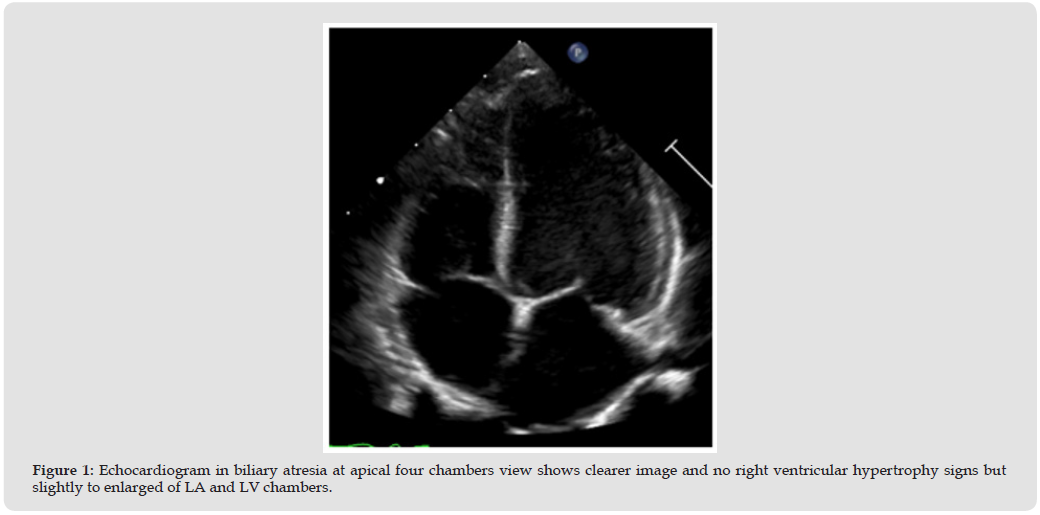
Figure 2
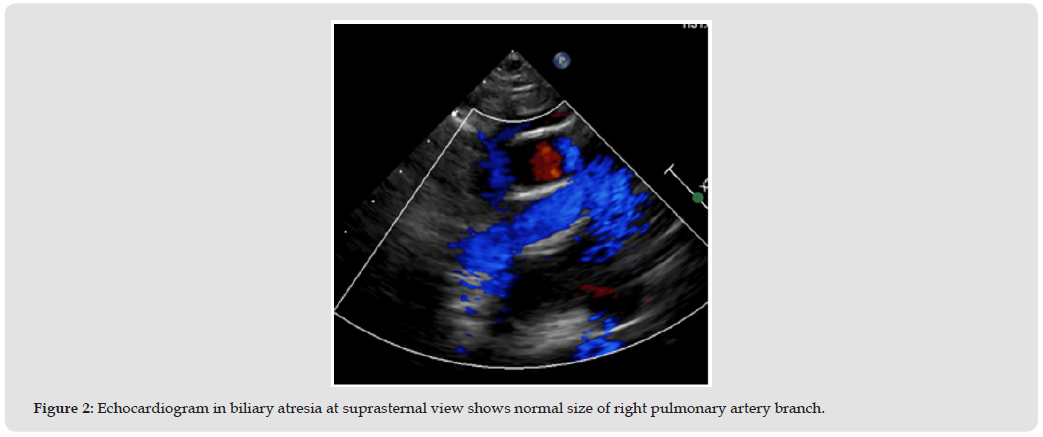
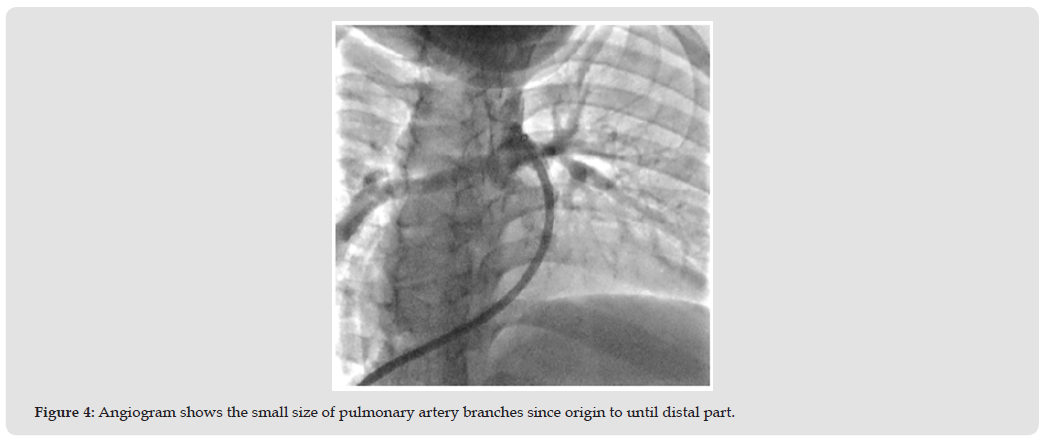
But the better property of echocardiography consist of inexpensively, non-invasively, portability and radiation safety, promote echocardiography popular equipment of imaging [4]. The Alagille syndrome and biliary atresia or liver cirrhotic most often cause patients to have liver enlargement [5] This condition is an obstacle to echocardiography in the parasternal area because it will cause the apex to be raised, resulting in difficult images adjust. This condition is also a limitation of examination in the subcostal view, Because the liver is enlarge and the tissue changes, it has a hard appearance, making it impossible to apply pressure to produce a clear image. [6] (Figure 3) The angiogram was used in case of need evaluated pulmonary hypertension and the role of intervention. (Figure 4).
Figure 3
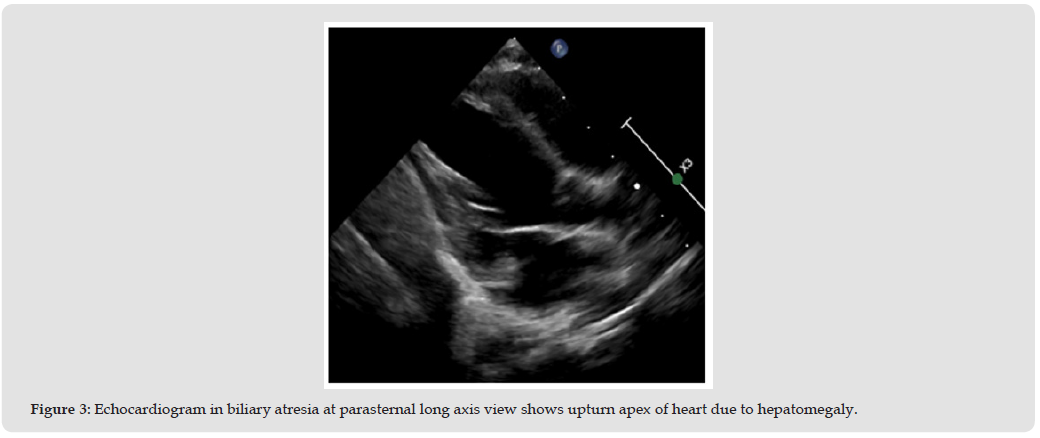
Figure 4
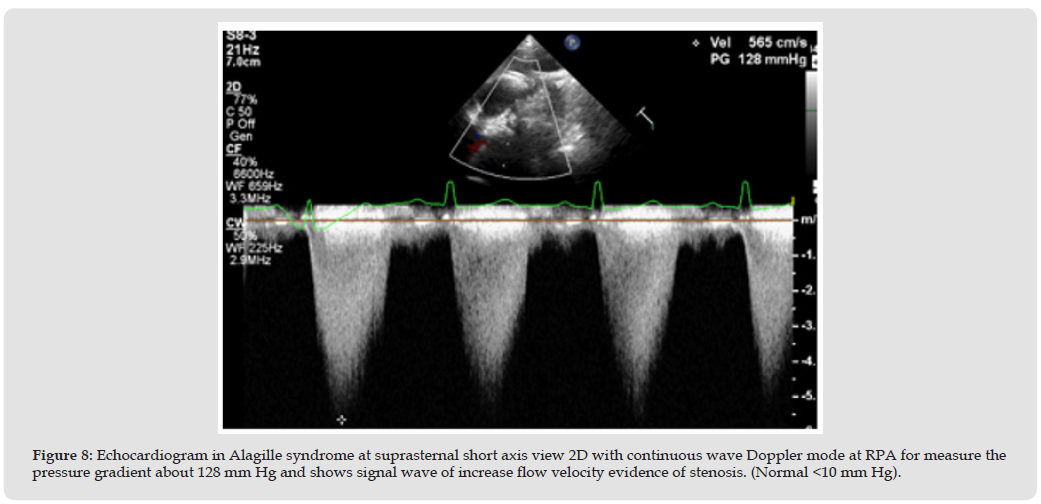
Alagille syndrome have main condition associate with cardiac are right side heart obstruction such as peripheral pulmonary artery stenosis (PPS). PPS was a common problem and cause for check echocardiography, lead to right heart hypertrophy or pressure elevated and relate to cyanotic signs in some case [7] (Figure 5) The remodeling of vascular intima, tunica media and adventitia lead to not progression of pulmonary artery branches size [8] In normal population, the echocardiography uses McGoon ratio for assessing PA size compare with abdominal descending aorta [9] If McGoon ratio = RPA+LPA/DAo has a value greater than 1.5 or 2.0 indicate to good size of the pulmonary artery [10] If z-score less than -2 may be considering pulmonary artery size abnormal or small, and need to measure pressure gradients across of dual branches, main pulmonary artery, and annulus valve of pulmonic if greater than 60 mm Hg May be considered severe stenosis [11,12] (Figure 6) However, the parasternal short axis of aortic valve level view focusing MPA, PV, and PA branches was a necessary view of measure size and PG across due to the direction of blood flow parallel the echo beam. In the children have a suprasternal long and short axis view is necessary window identified pulmonary artery structure, confluence appearance and size. Especially if we keep transducer marker to the left of the patient about 3 o’clock direction posterior angulation, this view able to visuals the first-loba branches of RPA too. (Figures 7 & 8).
Figure 5
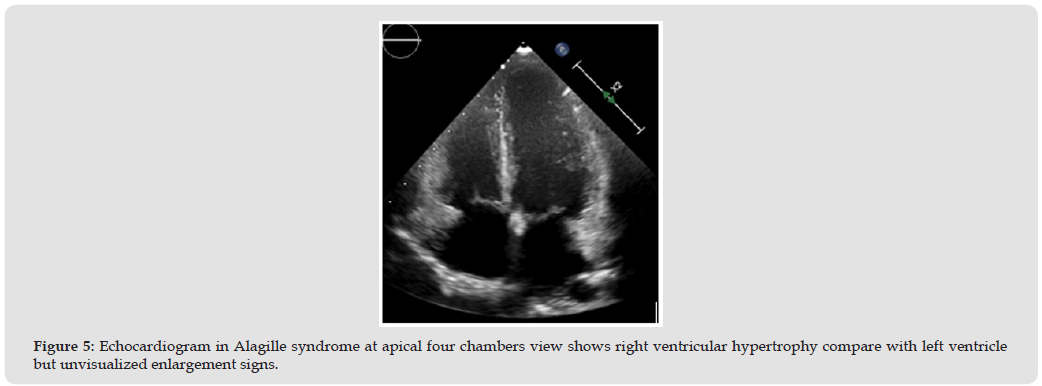
Figure 6
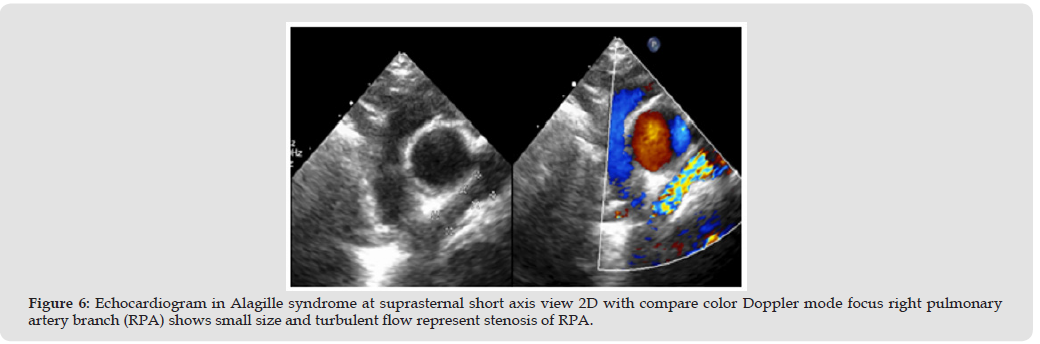
Figure 7
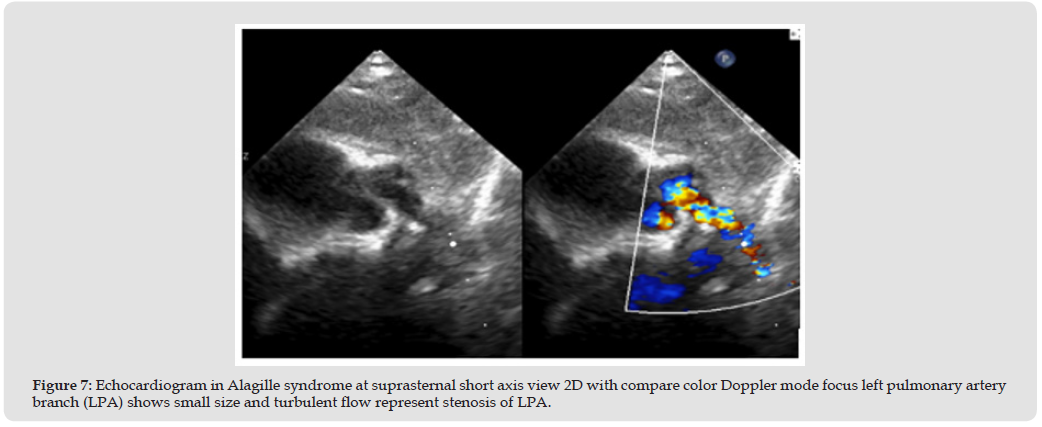
Figure 8

International Association of Landscape Archaeology, Czech Glass Society, Czech Republic

Department of Chemistry, Semenov Institute of Chemical Physics, USSR Academy of Sciences, Moscow, Russia

Neurology, LA BioMed Research Institute, USA

Associate Professor at Department of Breast and Thyorid Surgey, Chongqing General Hospital, China

Professor of Nuclear Medicine, Faculty of Medicine and Surgery, University of Milan, Milan, Italy





 Abstract
 PDF
PDF



























