info@biomedres.us
+1 (502) 904-2126
One Westbrook Corporate Center, Suite 300, Westchester, IL 60154, USA
Site Map
 ISSN: 2574 -1241
ISSN: 2574 -1241
ISSN: 2574 -1241
Received: October 01, 2024; Published: October 22, 2024
*Corresponding author: Vuni Godfrey Clement, Bachelor’s degree in public health in Victoria University, Uganda
DOI: 10.26717/BJSTR.2024.59.009259
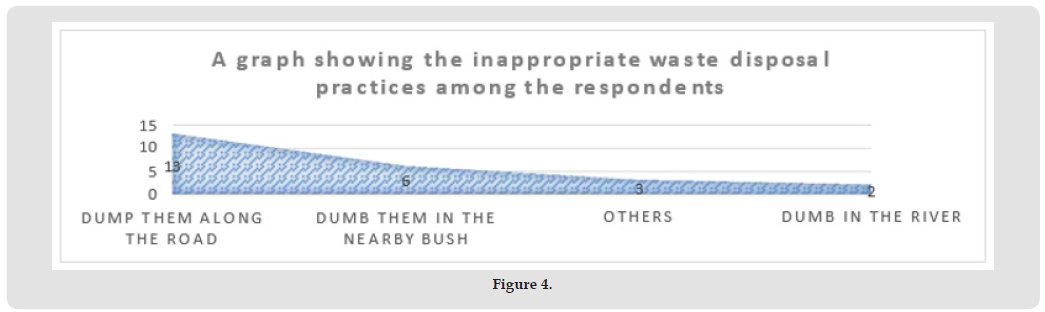
Municipal waste, which is generated and discarded from day-to-day life, is a major source of health and environmental hazards calling for better MSWM interventions to address the hazardous aspects of municipal waste management. In Juba-South Sudan, about 536 t/day of municipal waste is produced with 58.3 t/day disposed at illegal dumping sites. This quantitative research study was carried out in Juba with the major aim to determine the factors that lead to poor municipal waste management among residents in Juba, a sample size of 384 respondents was considered and data collected from individual respondents using the probability sampling method considering simple random sampling with aid of questionnaire and data analyzed using SPSS, Excel. The study revealed that 90% of the residents are aware of the adverse implications of SW to the people/environment with 16% not sensitized about the exact problem it can cause. 10% of the population are completely not aware that MSW can cause problem. 90% of the population do know that poor management of MSW can cause spread of diseases like 46% relate SW to cholera, 42% to diarrhoea, 36% to typhoid, 34% to malaria, 26% to dysentery, 10% to Hepatitis E and 14% to other diseases with 10% lacking information. 76% of population practice appropriate WM unlike 24%. The SW disposal practices included, 35% incineration, 21% landfill, 15% compaction, 4% composting and 2% biogas generation. 13% dump their wastes along the road, 6% in the nearby bush, 3% in other places while 2% in the river. 79% of the residents were penalized for illegal waste disposal with 21% not penalized.
78% were able to change while 22% remained hesitant. 62% of the people were charged for the waste they produced, however 38% were not. 78% charged per quantity, 22% on lump sum. 76% of the population are comfortable with charges, 24% are not. Hence minimum level of awareness on health and environmental problems associated with poor MSWM, Inadequate information on better practices of waste management contributes to poor municipal solid waste management among residents in Juba. Recommendation(s); Awareness campaign to educate people on the methods of proper waste management and implications of poor municipal solid waste management, establishing appropriate waste management bi-laws, waste collection sites, dustbins in markets and streets for different types of solid wastes that promotes waste segregations in public places and residents. The authority (JCC) should continue the charges for waste production and ensure that all the waste disposed are collected facilitated by the charges.
Abbreviations: BCC: Behavior Change Communication; CMS: Church Missionary Society; FGD: Focus Group Discussion; ISWM: Integrated Solid Waste Management; ITR: Institute of Training and Services; MSW: Municipal Solid Waste; MSWM: Municipal Solid Waste Management; SW: Solid Waste; SWM: Solid Waste Management; SWMS: Solid Waste Management System; TVs: Televisions; WHO: World Health Organization; WM: Waste Management
Background
Municipal solid waste is define as waste collected and treated by or for municipalities. It covers solid waste from households, including bulky waste, similar waste from commerce and trade, office buildings, institutions and small businesses, as well as yard and garden waste, street sweepings, the contents of litter containers, and market cleansing waste if managed as household waste. This excludes industrial hazardous wastes but including treated bio-medical wastes. (Saurabh, et al, [1]) Globally, 7–9 billion tons of solid waste are produce yearly (Wilson and Velis 2015). The majority of global waste generated ends up in open dumps or landfills. China is the largest waste producer, while Denmark tops the ranking on a per capita basis. Waste generation has increased massively around the world in recent decades, and there are no signs of it slowing down. By 2050, worldwide municipal solid waste generation is expected to have increased by roughly 70 percent to 3.4 billion metric tons. This is due to a number of factors, such as population growth, urbanization, and economic growth, as well as consumer shopping habits. However, less than 20 percent of waste is recycled each year, with huge quantities still sent to landfill sites. Waste is also often disposed of at hazardous open dump sites, especially in developing nations. Richer countries produce more waste than poorer countries, but typically have better waste management to help deal with these issues. The region that generates the most municipal solid waste (MSW) is East Asia and the Pacific Region. In Europe, Denmark is perhaps surprisingly the biggest producer of waste per capita, with Danes producing a similar volume as Americans each year. (Bruna Alves, et al. [2]) In sub-Saharan Africa (SSA), MSW increased from 81 million tons to 174 million tons per year between 2012 and 2016 and is projected to reach 269 million tons in 2030. (Mayiwa, et al, 2022) Municipal waste, which is generated and discarded from day-to-day life, contains both hazardous and nonhazardous constituents. Thus, this is a major source of health and environmental hazards as the amount of municipal solid waste is constantly increasing globally due to economic growth, urbanization, population expansion, and increasing human activities. (Onkar Singh, et al. [3]) This calls for better MSWM interventions to address the hazardous aspects of municipal waste management, the prominent ones are incineration, composting, anaerobic digestion, obtaining fuel from waste, material recovery, and landfilling.
Introduction
Municipal solid waste management includes the collection, separation, reuse, storage, transport, recycling, and end-of-life processes such as disposal in landfills, land application, and energy generation using the caloric content of the wastes. Oftentimes when systems are breaking down and problems are escalating, people look to societal factors to fix the issue. This has often been the case when dealing with the mismanagement of solid waste in the developing world. Many researchers have argued that the waste problem is cause by human behavior and therefore the solution lies in changing that behavior (Milea, 2009). Majority of people living in the developing world that see waste as a burden and a problem that needs to be address. To say people in developing countries do not recognize trash as an issue is an untrue statement. The opposite is often true. However, recognizing trash as a problem does not prevent littering or other negative behaviors concerning waste management 8 (Moore, 2012). This attitude- behavior gap often emerges and can be further affected by a variety of reasons including convenience, social norms, lack of public participation, and lack of education and awareness of effective waste management techniques (Milea, 2009; O’Connell, 2011). Other study cites that lack of social pressure to prevent littering, absence of realistic penalties or consistent enforcement, and lack of knowledge of the environmental effects of littering also contributes to poor MSWM (Al-Khatib et al., 2009). Amount of litter already present at a particular site, presence of signs referring to litter, and the number and/or placement and appearance (if any) of waste collection bins at the site also contributes to poor MSWM.
(Henry et al., 2006). Many studies have been conducted in the developed world to evaluate and apply strategies to reduce littering by means of behavioral interventions (Al-Khatib et al., 2009), but in developing countries little has been done. Lack of Education and awareness another major constraint seen throughout the developing world is the lack of education and awareness of effective waste-management practices. (Bolaane, 2006). Other municipal solid-waste management system (SWMS) of developing countries typical problem areas identified includes; budgetary constraints, inadequate service coverage and operational inefficiencies of services including unskilled manpower, ineffective technologies and equipment, inadequate landfill disposal, and limited utilization of waste reduction activities such as recycling. (Jessica, et al. [4]) social, cultural, financial, political, environmental, physical and institutional and so on. (Tareq, et al, [5]) In Juba-South Sudan, it has been observe that hips of solid waste dump along the; roadsides, market places, residential places, slums with minimum SWM procedures hence MSW becomes a public health threat. With little study or no study conducted to determine the contributing factors for the poor SWM, this research is necessary, as it will suggests measures to improve MSWM in the city. The study aim to determine the factors that contributes to poor municipal solid waste management among residents in Juba. MSWM has been an issue globally, regionally and nationally. In South Sudan, poor solid waste management predispose communities both in the rural and urban places to waterborne diseases like typhoid, cholera, hepatitis E, vector borne diseases like malaria, dengue fever and other diarrheal diseases have always been a problem in the country of which all are partly associated to poor MSWM. Having a better MSWMS in place would require a root cause for the latter that the answer can lie in this study.
Problem Statement
In Juba-South Sudan, about 536 t/day of municipal waste is produced with 58.3 t/day disposed at illegal dumping sites (Vaccari, et al. [6]). This 10% of the illegally disposed waste is secondary to JCC taking the responsibility for developing its own by-laws on SWM, collection of all SW and disposal procuring waste collection trucks, subcontracting companies like Go-Green. While supporting and ensuring regular waste collection, JCC imposes waste collection charge in addition to issuing fee off permission on SWM vehicles, and fines and penalty for those involved in mismanagement of MSW. (JICA, 2022). However, despite the little amount of illegally dumped waste (10%) according to Vaccari, [6] this still poses a public health threat and could be attributable to factors such as knowledge gap, charges imposed on waste collection among others promoting illegal dumping of solid waste and improper management of solid wastes among residents in the city. However, studies on these factors in Juba are limited creating a gap in knowledge for proper planning and implementation of appropriate SWM. Exposure to improperly managed MSW can cause multiple adverse health problems among the vulnerable cohorts in the population [7]. Thus, an untapped potential to completely eradicate illegal waste disposal in Juba city lies in exploring the gap created by factors influencing poor solid waste management among residents. This will be a basis for designing urban-based interventions to better MSWM programs. This study will greatly contribute to reducing poor MSWM in Juba and other parts of the world at the population level.
Scope of the Study
Geographical Scope: The study was carried out in Juba since it is the capital city and the largest city of South Sudan with the highest population and poor MSWM system at household and commercial level in the country. The city is situated on the White Nile and serves as the capital of the Central Equatoria State. It is the world’s newest capital city to be elevated as such and has a population of 459,342. It has an area of 52 km2 (20 sq mi), with the metropolitan area covering 336 km2 (130 sq mi). Juba was established in 1920–21 by the Church Missionary Society (CMS) in a small Bari village, also called Juba. The city was made as the capital of Mongalla Province in the late 1920s. The growth of the town accelerated following the signing of the Comprehensive Peace Agreement in 2005, which made Juba the capital of the Autonomous Government of Southern Sudan. Juba became the capital of South Sudan in 2011 after its independence. Coordinates of Juba: 4°51′N 31°36′E.
Content Scope: The study was to determine the factors that contributes to poor municipal solid waste management among residents in Juba, South Sudan.
Time Scope: The study ran from July,2023 to July,2024, a period of 12 months.
Objective
Aim: To determine the factors that lead to poor municipal waste management among residents in Juba, South Sudan.
Specific objectives
i. To determine the knowledge of residents in Juba town on
danger of MSW
ii. To determine the practices of residents of Juba in managing
MSW
iii. To determine the attitudes towards penalties imposed on
illegal waste disposers to MSWM
iv. To determine the influence of charges imposed per quantity
of SW production to MSWM.
Study Hypothesis
The following null hypothesis were tested in this research study.
i. There is no difference in knowledge of residents in Juba
town regarding danger of MSW
ii. There is no difference in the practices of residents of Juba in
MSWM
iii. There is no difference in the attitude towards penalties imposed
on illegal disposers to MSWM
iv. There is no difference in the influence of charges imposed
per quantity of SW production to MSWM
Conceptual Framework
The analytical conceptual framework focused on factors that contributed to poor MSWM in Juba, South Sudan. It was based on the Health Belief Module and Ecological Module: Perceived susceptibility/ individual level where people who knows the danger to waste exposure ensures proper waste disposal unlike the counterpart.
Perceived self-efficacy where individuals with the ability of practicing the cheap and reliable waste management methods are able to ensure better waste disposals unlike the counterpart.Perceived barriers, where the individuals with low socio economic status are not able to afford fees for waste disposal and hence practicing illegal waste disposal unlike the counterpart. Perceived severity/public level or policy, where individuals are assumed to consider proper waste disposal fearing the consequences of taxes on their finances that will be imposed on them when found guilty of illegal waste disposal.
Every year, an estimated 11.2 billion tons of solid waste are collected worldwide with poor waste management - ranging from non-existing collection systems to ineffective disposal -causes air pollution, water and soil contamination [8].
Significance of Knowledge of Residents on Danger of Municipal Solid Waste to MSWM
In South Sudan, a significant and growing number of individuals known as waste pickers earn a living by salvaging recyclables from the waste stream for income or personal consumption with minimum or no protections causing diseases unlike the knowledgeable ones. [8] in the health facilities, unskilled medical health workers like the cleaners, security guards who directly are involved in waste disposals at most mishandle the wastes with minimum protections, and poor disposal practices (RSS MoH, et al. [9]).
Practices Associated with Municipal Solid Waste Management
The inadequate and unscientific management practices have resulted into major hazards to human health and the environment; contamination of both surface and ground water which is in turn a serious human health risk. In Juba, River Nile and the streams within Juba are highly contaminated; with an average range of 15.25 – 102.6 CFU/100ml for the river Nile. TDS showed very high values with range of 47 – 123 mg/100ml which is far beyond the EPA and WHO recommended 500 ml/L. For the streams, the CFU/100ml was found to be abnormally high ranging from 1.25 – 11,540.5 CFU/100ml hence poor municipal solid waste management in Juba is posing high risk to the human health and the environment. (Loboka, et al. [10]) In South Sudan, there is an observed low practice of segregating solid wastes among the population. However, the major types of solid wastes generated is projected to include plastic (41%), organic waste (29%) and papers (15%) which were obtained from places of residence, commercial, agricultural fields, institutions and construction sites. (Garang, et al. [11]). With proper waste segregations, waste generated can be recycled (metals, glass, plastic), efforts should be made to link up with agencies dealing with waste recycling hence enabling better MSWMS. (Garang, et al. [11]).
Attitudes towards Penalties Imposed on Illegal SW Disposal to MSWM
Main sources of revenue on Juba city’s SWM activities are
1. Waste collection charge,
2. Issuing fee of permission on SWM and fecal sludge management
vehicles, and
3. Penalty charge. Most part consists of waste collection charge
and 62% comes from the charge from the markets. [12].
Imposing of fines on individuals found to be illegally dumping solid
wastes is belief to change the attitude of the people practicing such
acts [13].
Influence of Charges Imposed Per Quantity of Solid Waste Production to Municipal Solid Waste Management
With the high cost of living in South Sudan, it has been found that there is high rate of illegal dumping of waste and over 90% of the cases attributes to refusal to paying SW collection fees (Andrew, et al. [14]).
Study Design
A quantitative research method was used in this study since it provides information in large numbers hence considering it more reliable due to its use of statistical methods that includes quantifying attitudes, opinions, behaviors, and other variables, allowing for generalization of results to the large population of this study analyzing the data obtained from the respondents in Juba city who were selected for the study. The data were collected using questionnaires.
Study Area
The study was Juba town where there was an observed high rate of illegal waste disposal in the market, along the street, in the residents and slums.
Study Population
The study population consisted of adolescents, adults and elderly. This was to easy capturing information representing the entire population of the city. This was because these age groups were believed to be responsible in participating for the daily economic activities and taking care of the solid wastes in homes and markets.
Sample Technique and Sample Size
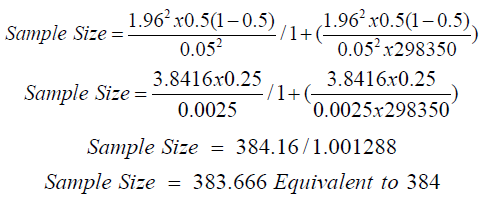
A total of three hundred and eighty four (384) respondents were considered for this study as the sample size. This sample size was calculated using the standard formula since the population of study is known as below;

Where;
N=Population size
z=z-score
e=margin of error
p=standard deviation
Study Variables
Dependent Variable: Poor Municipal solid waste management that includes; Littering, open place disposal of solid wastes in public places/residents, untreated solid wastes, hazardous waste that is disposed on the ground and not recycling items that should have been recycled.
Independent Variables:
• Knowledge that exposure to wastes can cause disease or
problem
• Practices associated with MSWM
• Attitude towards penalties imposed on illegal MSW disposal
• Charges imposed per quantity of MSW production
Data Collection Methods
Data collected from individual respondents using the probability sampling method considering simple random sampling. This was aid by questionnaire-developed suiting the study topic.
Study Instruments
The study instruments included questionnaire and checklists.
Data Analysis
Data was analyzed using SPSS version 20, excel and analyses was done including descriptive statistics, hypothesis testing and correlation analysis to establish relationships between the factors and MSWM practices.
Anticipated Constraints
Limited budget, constrained timeline affected extensive discussions and indebt lengthy study period.
Ethical Considerations
A letter for introduction was obtain from college of Public Health Victoria University and approval from JCC/REC South Sudan. A prior consent from all the respondents considered.
Study Limitations
The study only target three selected payams of settlement in Juba (Juba, Kator and Munuki) and not the entire settlement sites of the city because of the bigness of the city with limited resources data collection from the whole corners of the city was in evitable. Adult age group were only considered for this study age range of 15 to 59 who are directly involve in waste management at household and community level.
Introduction
In this chapter, the findings of the study presented is relating to the specific objectives considering consented respondents of the study group. Data was analyzed using SPSS version 20, excel and analyses was done including descriptive statistics, hypothesis testing and correlation analysis to establish relationships between the factors and MSWM practices.
Significance of Knowledge of Residents in Juba Town on Danger of Municipal Solid Waste to MSWM
As far as knowledge on potential danger of solid waste to the community/ environment, 384 responded to this question out of which, 346(90%) says they are aware that solid waste poses danger to the community or environment while 38(10%) are not aware. From the study conducted, 161(42%) says that SW causes soil pollution, 153(40%) water pollution, 123(32%) water pollution, 61(16%) do not know, 46(12%) others. Surprisingly, some of the respondent’s were able to state that SW can cause two or more of the problems above this is evidenced by the obtained results above. This question was answered by 379 respondents; most of the respondents 346(90%) knows that MSW causes disease whereas 38(10%) do not know. From their response, 177(46%) are aware that cholera can be spread as a result of poor MSWM, 161(42%) aware of diarrhoea, 138(36%) aware of Typhoid, 131(34%) aware of Malaria, 100(26%) aware of Dysentery, 56(14%) aware of other diseases not mentioned here, 34(10%) aware of Hepatitis E and 23(6%) not aware. Some of the respondents are also able to state that SW can cause two or more of the diseases above (Figures 1 & 2).
Figure 1
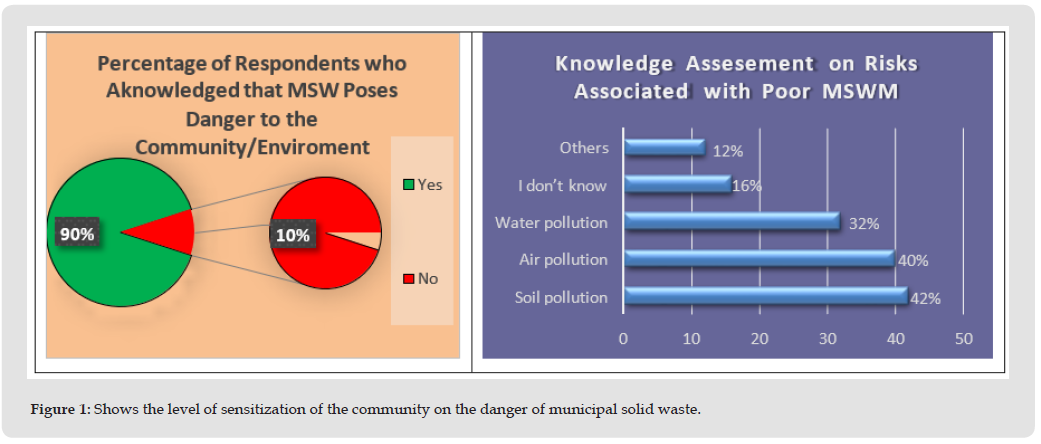
Figure 2

Practices Associated with Municipal Solid Waste Management in Juba
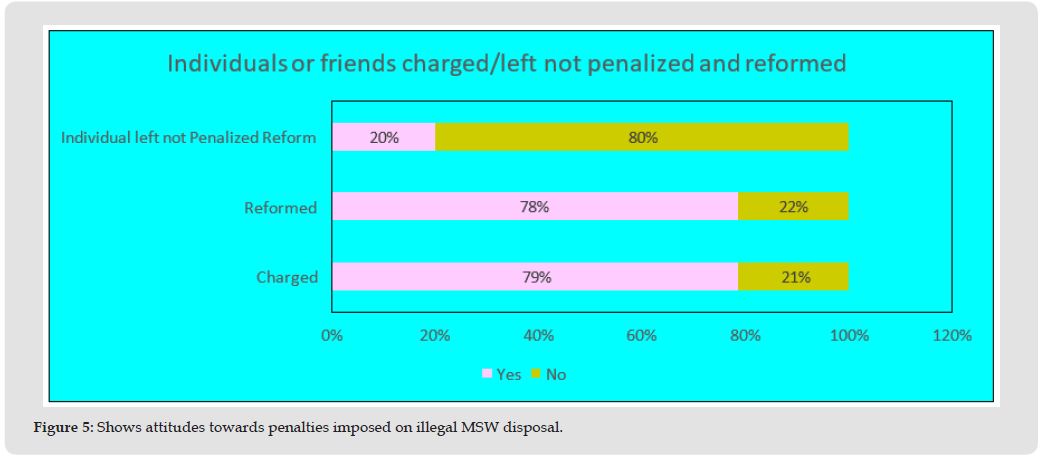
A total of 384 responded to this question; attesting to the figure above, 292(76%) of the respondents says yes they know and are practicing the appropriate waste management methods while 92(24%) do not know hence practicing inappropriate methods of managing municipal solid waste. Among the respondents who practices appropriate waste management, 370 of them answered question on the waste management methods they use among where 134(35%) practices incineration, 80(21%) practices landfill, 57(15%) practices waste compaction, 15(4%) practices composting and 7(2%) practices biogas generation. Amongst the respondents of 92(24%) who inappropriately managed their wastes, 50(13%) dump their waste along the road, 23(6%) dump them in the nearby bush, 11(3%) dump them in other places while 8(2%) dump them in the river. In determining the attitudes towards penalties imposed on illegal MSW disposal, a total of 384 responded to this question out of them, 303(79%) said they or person renown to them was charged for illegal waste disposal while 81(21%) said no and out of the people charged, when asked of positive change of behavior on imposing the fine, 374 responded whereby 292(78%) reformed while 82(22%) didn’t even when left un penalized. From the 81(21%) left not penalized, only 16(20%) switched to practicing appropriate waste disposal while 65(80%) continued with their ill practices (Figures 3 & 4).
Figure 3
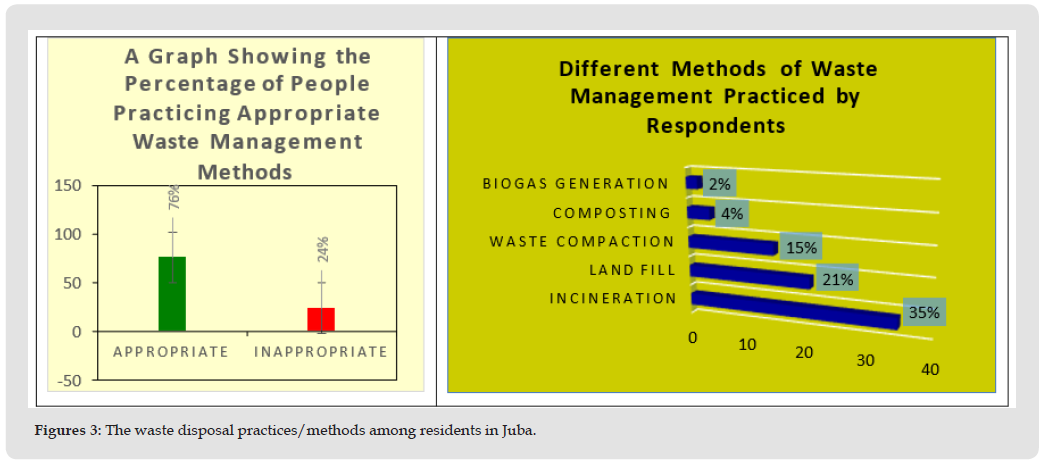
Figure 4
Influence of Charges Imposed Per Quantity of Solid Waste Production to Municipal Solid Waste Management
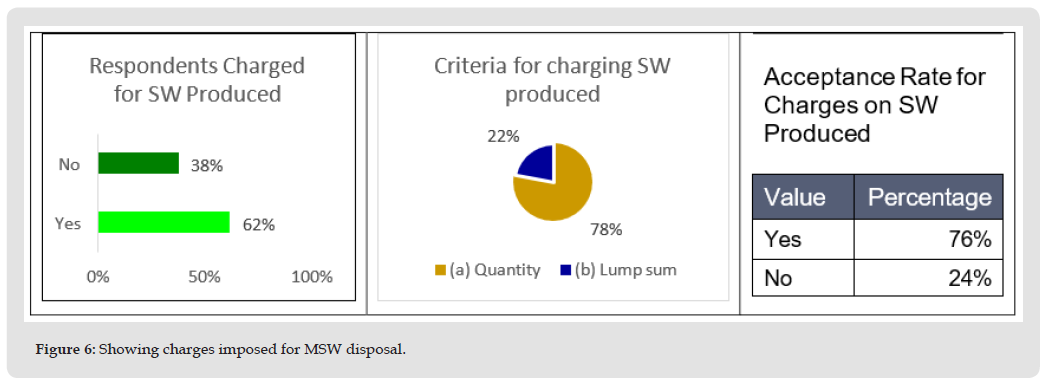
Total respondents of 384 answered this question; as observed from the figure above, 238(62%) confirmed being charged for the waste produced, 146(38%) said they were not charged for the waste they have produced. Among the 238(62%) of the people charged, 186(78%) were charged per quantity while 52(22%) as lump sum. Having been charged, 181(76%) of the respondent are comfortable whereas 57(24%) are not.
Introduction
In this chapter, the results of the study to determine the factors contributing to poor municipal solid waste management among residents in Juba South Sudan is discussed in depth. In order to adorn the discussion, some of the literature is used.
Knowledge of Residents in Juba Town on Danger of Municipal Solid Waste
The study revealed that 90% of the residents are aware of the adverse implications to the people and environment that can arise upon exposure to solid wastes as a result of improper waste disposal whereas 10% are unaware. The sensitized group were able to attest that solid waste causes soil pollution, water pollution, air pollution with a fragment of 12% who says other problems not labelled here can as well be caused by solid wastes however, 16% don not know what it could cause but are certain that solid waste pose danger to the community/environment. Despite the high percentage of individuals who are aware of the danger to exposure to municipal solid waste, there is small set (10%) that comprised of the people who are not aware and those who are aware of its potential danger but does not know the exact problem(s) (16%). This mean a lot in the municipality as for the waste they illegally dispose can amount to several hazardous effect ranging from environmental problems to health problems. Again, 90% of the population do know that poor management of municipal solid waste can cause spread of disease for example only 46% of the population knows that cholera can be caused by poor waste management, 42% knows diarrhoea, 36% typhoid, 34% malaria, 26% dysentery, 10% Hepatitis E and 14% other diseases. It is hence certain that 10% of the population don’t know that the waste produced can be of a health problem and are most liable to inappropriately dispose this waste that could lead to disease outbreaks of which is termed as public health threat.
This is in line with a study conducted by UNFP where they sight that in South Sudan, a significant and growing number of individuals salvaging recyclables from the waste stream for income or personal consumption with minimum or no protections causing diseases [8]. and also why in the health facilities, unskilled medical health workers like the cleaners, security guards who directly are involved in waste disposals at most handle the wastes with minimum protections, and poor disposal practices giving room for outbreak of communicable diseases (RSS MoH, et al. [9]).
Practices Associated with Municipal Solid Waste Management in Juba
According to the study, 76% of the respondents practice the appropriate waste management methods while the latter lies at 24%. Most of the people who do not practice appropriate waste management methods are unaware of the better practices that can be used to manage their wastes. Comparing the most practiced method by people who are educated on the different forms of appropriate waste management, 35% practices incineration, 21% practices landfill, 15% practices compaction, 4% practices composting and 2% practices biogas generation. The most preferred method is hence incineration mainly because of the applicability/affordability. Sadly among the population 13% dump their wastes along the road, 6% dump them in the nearby bush, 3% dump them in other places while 2% dump them in the river. This is in support to the study conducted by (Loboka, et al. [10] whereby in his finding, an average range of 15.25 – 102.6 CFU/100ml found in the river Nile with TDS of very high values ranging from 47 – 123 mg/100ml which is far beyond the EPA and WHO recommended 500 ml/L. For the streams, the CFU/100ml was abnormally high ranging from 1.25 – 11,540.5 CFU/100ml seconding poor municipal solid waste management among residents in Juba hence the high prevalence of some waterborne diseases like typhoid in Juba.
Attitudes Toward Penalties Imposed on Illegal Waste Disposers to Municipal Solid Waste Management
The study stipulated that 79% of the residents in Juba were or somebody they know was penalized for illegal waste disposal with only 21% of the population not penalized. Among those penalized, 78% were able to refrain from the bad practices while 22% remained hesitant and the reverse is true as from the 21% of the un penalized illegal waste disposers 80% could not change their ill practices with only 20% able to adjust their bad practices of illegally disposing SW of which is only a tip of ice in the sea. This is a very crucial finding making it crystal clear that people once left exempted from illegal waste disposal, they will definitely continue in those practices endangering the entire population health, changing their bad attitudes by imposing fines with an enforced law is necessary (Figure 5). This is thus in support with JCCs intention of imposing fines on individuals found to be illegally dumping solid wastes with the belief that it will change the attitude of the people practicing such acts [8].
Figure 5
Influence of Charges Imposed per Quantity of Solid Waste Production to Municipal Solid Waste Management
In this study, it is further found that 62% of the people have been charged for the waste they produced, however 38% were not charged for the waste they have produced. This is normally done per quantity as 78% of the people acknowledged so moreover 22% of the people echoed they were charged on lump sum basis. The study illuminated that 76% of the population are comfortable with the charges whereas 24% are not. This explains why individuals fined were able to refrain suggesting that it’s not about the charges imposed for waste disposed, but JCC being there to collect the wastes disposed at the collection sites with waste collection fees to ensure better municipal solid waste management among residents in Juba city hence ruling out the perceptions that people once charged for the waste they produce will trigger illegal or inappropriate waste disposal (Figure 6).
Figure 6
Conclusion
Above all the factors under the study, it is determined that poor municipal solid waste management among residents in Juba is as result of lack of awareness among on the danger of exposure to waste and to the environment. In adequate information on better methods of waste management. On observation during the study, many people collect waste in sacks dumping them in undesignated locations polluting the environment and increasing the risks of disease outbreaks. The study also found out that penalties to people practicing illegal waste disposal is necessary in changing the behavior however it has nullified the saying that charges imposed on waste disposed prompts illegal waste disposal.
Recommendation
There should be an awareness campaign to educate the people on the methods of proper waste management and implications of poor municipal solid waste management targeting schools/institutions (private and government) including markets. JCC should continue the charges for waste production and expand it to other locations per either quantity or lump sum and ensure that all the waste disposed are appropriately managed. The authority (JCC) should designate waste collection sites and communicate through media houses (Radio/TV) market places Facebook etc. so that people can dispose the wastes at such sites from where their trucks can pick on regular basis. Dustbins for wastes of different kind can be positioned in the streets/markets so people can discard wastes in them as a matter of promoting appropriate waste disposal practices. The authority (JCC) should set a bi law that prohibits discarding wastes in public places including roads and markets. Any person breaking this law should be fine and bilaws on illegal waste disposers should be reinforce/strengthened [15-24] (Appendices).

International Association of Landscape Archaeology, Czech Glass Society, Czech Republic

Department of Chemistry, Semenov Institute of Chemical Physics, USSR Academy of Sciences, Moscow, Russia

Neurology, LA BioMed Research Institute, USA

Associate Professor at Department of Breast and Thyorid Surgey, Chongqing General Hospital, China

Clinical Radiologist (MD) - Department of RADIOLOGY, Cosenza Hospital, Cosenza, Italy




 Abstract
 PDF
PDF