info@biomedres.us
+1 (502) 904-2126
One Westbrook Corporate Center, Suite 300, Westchester, IL 60154, USA
Site Map
 ISSN: 2574 -1241
ISSN: 2574 -1241
ISSN: 2574 -1241
Received: May 05, 2026; Published: May 13, 2026
*Corresponding author: George B Stefano; Mind-Cell LLC, Baltimore, MD, USA
DOI: 10.26717/BJSTR.2026.65.010221
Life diversity throughout centuries is related to particular biological types depending on vertical gene transmission characteristics. However, the scientific data gathered in molecular biology, microbiology, virology, and bioenergetics fields point to the existence of the holistic nature of life processes. At every stage of cosmic evolution, the process of nucleic acid architecture formation depends on energy gradients, enabling the ability to replicate and adapt to the changes in the environment. Such evolution served as a base for development of a common biochemical foundation of all living beings. Therefore, genetic exchange in accordance with a holistic approach does not seem to be exceptional but a regular biological process. Genetic exchange, viruses integration as well as mitochondrial transfer between cells prove that genetic material can be easily transferred from bacteria, viruses to eukaryotic organisms. This results in rapid adaptation of the organism to the new conditions thanks to assimilation of genetic information and its further incorporation. Mitochondrial symbiogenesis and their following transfer to another cell demonstrate that independent biological objects are integrated into a larger biological entity. Integration and molecular mimicry processes used by viruses provide yet another example supporting the theory of genetic exchange between biological domains being one of the features of life. All these processes altogether suggest a view where biological organization evolves as a network of information exchange based on energy principles.
Biological entities’ diversity should not be viewed as independent and separate organisms but rather as continuous outcomes of cosmic evolution taking place in diverse thermodynamic environments. The universe since its formation during cosmic inflation has been expanding and cooling down resulting in the formation of energy gradients responsible for particle, atomic and molecular formations. Along with regulation of matter structuring processes, energy gradients were limiting factors for them, contributing to complexity of the processes occurring. Current astrophysical observations confirm that energy level of the universe has undergone transformations over time reaching the maximum at “cosmic noon”, when afterward started to decrease owing to growing effectiveness of life sustainability processes [1-3]. Hence, life evolution on our planet is only another of many processes through which matter acquires self-organization, replication, and cognitive abilities (awareness). As far as modern scientific research about the emergence of life is concerned, there is a lot of information that supports the idea of biological continuity too. Currently, various pathways have been discovered by scientists, based on which simple chemical compounds may transform into protocells able to perform early-stage Darwinian evolution [4,5].
Moreover, the latest discoveries regarding presence of amino acids, nitrogen-containing compounds, and other organic substances among extraterrestrial materials, such as asteroids, for instance Bennu, prove that prebiotic chemistry occurs commonly, and prebiotic matter is found on different planets [6,7]. Nevertheless, at the same time, one needs to acknowledge that even though matter is universal in nature, it is not deterministic; hence, environmental effects in terms of thermodynamic changes influence significantly the course of evolutionary processes. Environmental effects result in differentiation due to formation of biological diversity. Nonetheless, there is also homogeneity in biology because all living organisms consist of similar biochemical molecules. For example, nucleic acids, DNA, and RNA are used as tools by all living organisms for storing and transferring genetic information. Regardless of great differences between prokaryotes, eukaryotes, archaea, fungi, bacteria, and viruses, their molecular structures are absolutely the same; therefore, there is much similarity in evolution (Figure 1). The traditional taxonomic system copes very well with organizing biological entities; nevertheless, at the same time, it obscures biological continuity and, thus, connections between organisms. Today, extensive horizontal gene transfer is acknowledged as one of the main evolutionary factors (Figure 1) [8,9].
Figure 1
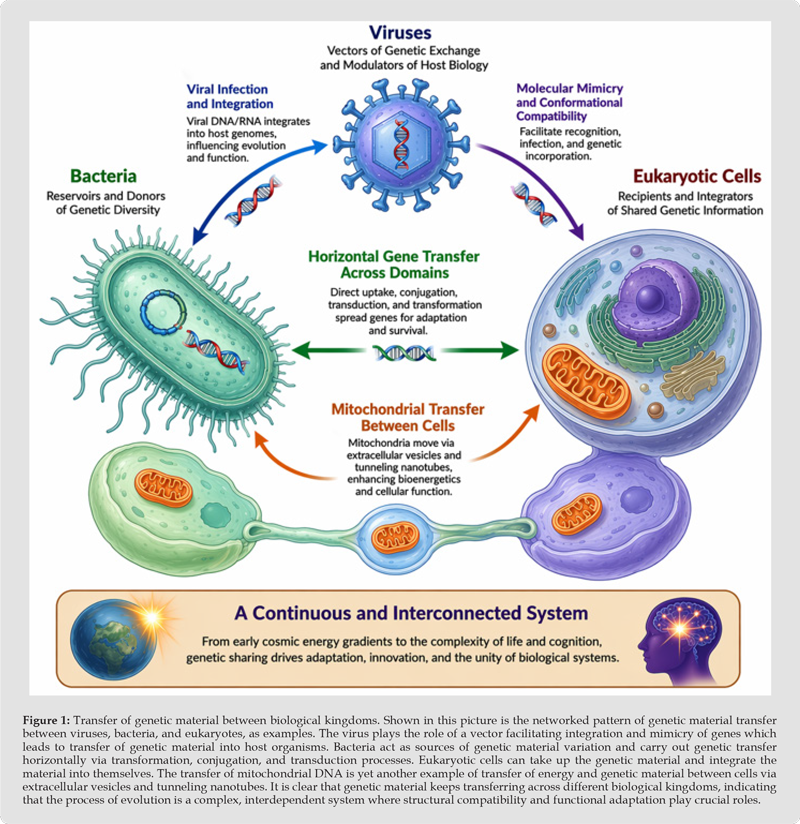
There are vivid examples of biological continuity that include mitochondria – remnants of the ancient prokaryotes, having turned into cellular organelles and preserving many traits typical of free-living organisms, including genome and metabolic features [10,11]. Endosymbiosis exemplifies how free organisms merge into one whole and evolve together in order to get more complex and differentiated. Recent discoveries have shown one more important aspect of the endosymbiotic theory – apart from being included into the structure of individual cells, mitochondria move between cells within extracellular vesicles and tunneling nanotubes, being able to exist independently and performing bioenergetic and signaling functions (Figure 1) [12- 14]. These facts imply that biological objects are not isolated systems but rather interact as integral parts of a complicated network, where materials and information circulate permanently. The same network is formed by viruses carrying genetic information and influencing biological activity [15,16]. Viruses perform the role of transporters in this network, using conformational compatibility for mimicking molecules in order to become part of host organisms and participate in evolution as genetic information carriers (Figure 1). It means that, once again, “conformational matching” proves itself to be a universal principle of molecular interactions and evolutionary processes [17].
One more example in support of the conservation of biological processes is the pathogenesis of different diseases. In particular, one can point to the involvement of hypoxia in the control over inflammatory responses and inflammation signaling [18,19]. Neuroinflammation may occur due to the impaired mitochondria and related mitochondria signaling, which leads to the development of neurodegenerative disorders [19-21]. One should emphasize the nature of aging as a multifaceted process featuring different hallmarks, including changes in bioenergetics, cell communication, damage to DNA molecules, among other vital elements [22]. Based on the examples provided, it seems obvious that pathology may be considered as a type of variation of living principles as a result of some forms of dysregulation. This point can be proved by considering the results gained in mitochondrial transplantation as a tool of efficient treatment for numerous diseases. As a result, one can note the importance of bioenergetic regulation for proper development [12,13]. In light of the above observations, the division into three main groups of living creatures concerning evolutionary continuity seems rather logical. In this respect, viruses, prokaryotes, and eukaryotes, for example, may be considered as relatively stable biological entities possessing corresponding structures adapted to environmental factors and ready to evolve under new conditions (Figure 1).
In this case, it should be emphasized that lower complexity organisms, namely viruses and bacteria, dominate on Earth, which shows that increasing complexity is not the key to survival and provides no advantages. Therefore, increased biological complexity may be viewed as a next step of evolution from simple organisms as well as its defense against external conditions. As a consequence, the exchange of genetic material and biochemical signals happens among various biological structures. Pathological Examples of “Sharing”. The advances in microbial immunology have allowed proving the existence of complex and evolutionarily meaningful systems that allow bacteria to defend themselves against viruses. Thus, as emphasized by De Weirdt, et al. [23] the identification of almost 250 bacterial antiviral proteins and systems means that these discoveries represent merely a tiny fraction of all available antiviral defense mechanisms [23]. Additionally, the computer analyses of bacteria and viruses performed by Mordret et al. using the protein and genomic language models revealed the possible presence of tens of thousands of other such mechanisms in the coding genome [24]. Therefore, these results support the assumption that the immune-like defensive strategies developed by living creatures are ancestral in nature and diversified and modularized under the influence of viral selection pressures through evolution. It may be surmised and concluded that the processes of the constant exchange of genetic material between bacteria and viruses include horizontal gene transfer, prophage integration into a bacterial genome, and molecular mimicry. This “genomic sharing” strategy not only ensures the development of innovative systems but also allows considering the possibility of the evolution of antiviral strategies in a way that provides transferability and adaptability characteristics, which could be used for various organisms. From the translational perspective, it may be considered that such shared systems are good material for the creation of new therapies, including the use of engineered antimicrobials, phage therapy, and mitochondria-based approaches taking into account the evolutionary continuity of prokaryotic cells and eukaryotic organelles.
As demonstrated in a recent article by López-Bigas et al., the presence of driver mutations in cancerous cells is accompanied by the presence of mutations within numerous normal cells in the respective tissues without disrupting the tissue function [25]. It may be stated that cancer relies not on mutations per se but on interaction with various selective factors such as carcinogenic chemicals, inflammation, tissue organization alterations, immune resistance, metabolism disruption, and others. Following this consideration, cancer may be perceived as a Darwinian selective process where cells compete against one another in their respective environment [5]. Therefore, the principle of “genetic sharing/conformational matching” is applicable in regard to tumors because their effect is dependent upon the ability of genomic information to match ecology and metabolism. As discussed before, mitochondria are quite interesting with regard to their evolutionary origins, genomes, and involvement in innate immunity mechanisms. For example, they take part in the signaling interactions between metabolic stress signaling, virus-induced signaling, and inflammatory signaling pathways. Specifically, the protein MAVS mediates the participation of mitochondria in the innate antiviral immune response, and mitochondrial DNA leaking from cells experiencing stresses induces antiviral cGAS-STING and inflammasome activation causing inflammation via genomic information [26,27].
At the same time, the viruses target the mitochondria metabolism and signaling, which means that the mechanism utilized by viruses involves the disruption of molecular compatibility rather than the genetic transmission. Furthermore, the extracellular vesicles, which deliver genetic information using various proteins, RNAs, DNAs, lipids, signaling molecules, and so forth, also supports the notion of “genetic sharing” and are related to cancer, inflammation, and neurodegeneration [28]. On the other hand, taking into account the recent discoveries made by Laura Pernas, et al. [29] the appearance of organelles within mitochondria due to mitochondrial damage can be rationalized in the context of mitochondrial immune responsiveness. Indeed, while the impact of pathogens, metabolic malfunctions, redox dysfunction, and other adverse conditions on mitochondria might be considered the direct damage suffered by mitochondria, a more reasonable explanation of these phenomena includes the idea of programmed response of the cell. Namely, after exposure to some stimuli, mitochondria are able to reconfigure their membranes and signaling interfaces, which results in compartmentalization. It helps to isolate the damaging elements, as well as mediate the process of signal transmission in order to maintain energy balance. This approach could be generalized and applied to mitochondria involvement in the innate immunity, including MAVS signaling, ROS-mediated defense, and mitophagy-based quality control. Moreover, in the context of the hypothesis about “genetic sharing/conformational matching”, one could assume that structural changes in mitochondria occur selectively in order to stabilize interactions between proteins under stress. Hence, it seems reasonable to conclude that mitochondria have developed an evolutionary mechanism of immune activity.
In every case of structuration and organization in the realm of cosmos, molecules, and physiology, there is a commonality principle which appears to be central to them – conformative matching [17]. Such a principle links thermodynamic constraints to the functional role of genes and biochemical systems. For these biological entities to be effective, they must adjust themselves energetically and morphologically to their environment. As far as gene transfer is concerned, the transfer process occurs in a specific manner since only those configurationally-compatible ones are selected and retained. Conformative matching, with its complementary stereospecificity, could account for many phenomena in biology like gene transfer across species boundaries, virus infection, mitochondria behavior, and pathogenicity, among others. It is important to note that mitochondria as evolutionary products of prokaryotes and viruses represent an instance of genetic and functional continuity, in which host-pathogen or organelle-host interactions happen under the rule of conformative matching. Vertical evolution, which proceeds from prokaryotes to eukaryotes and further to multi-cellular organisms, could also be considered the stabilization of relatively long-lasting configurations along the evolutionary flow (Figure 1).
Relatively stable configurations lead to discrete biological entities; however, this is just an illusion, resulting from the particular scale on which such entities are viewed. The process of evolution itself, which entails genetic and conformational interaction and thermodynamic selection, continues to remain a continuous phenomenon. In addition, the mitochondrial-derived peptide (MOTS-c) provides an easily interpretable example in terms of the genetic sharing and conformational matching models, representing an instance of how mitochondria use specific peptides for communicating about its metabolic status. Indeed, MOTS-c (12S rRNA) under metabolic stress, translocates from the mitochondria to the nucleus and controls the transcription of genes regulating the balance of metabolism, demonstrating the ability to retain and utilize the conformational compatibility of mitochondrial and nuclear genetic compartments [30,31]. The connection between the genetic compartments via the above-described mechanism is also indicative of the fact that evolutionarily ancient endosymbiotic mechanisms provided the cell with the necessary tools for a continuous concerted activity on the molecular scale. Regarding functionality, this peptide serves as a sensor not only for the oxidative state and nutrients but also regulating the activities of metabolic pathways such as AMPK and sirtuins, which modulate intergenomic signaling in the context of mitochondrial–nuclear communication [30,32]. Moreover, MOTS-c illustrates systemic signaling features of mitochondria, supporting the concept of metabolic sharing across multiple organizational levels [33,34].
In conclusion, although the concept of classifying organisms according to their biological nature might be beneficial in describing their features, it does not entirely apply to the case that they originated from the same source and have evolved together throughout the millions of years. In addition to the examples presented in the previous sections dealing with cosmology and chemistry, results pertaining to molecular biology and disease etiology also suggest that there is a continuum of life in its ability to exchange energy and adapt to changes in structure as the matter develops in the universe. Genetic and biochemical exchanges are among its fundamental properties.
Not applicable.
Not applicable.
This research received no external funding.
The author declares no conflicts of interest.
Process
During the preparation of this work, the authors used ChatGPT 5.2 for organizational information and copyediting purposes and original figure generation. The author reviewed and edited the document and takes full responsibility for its content.

International Association of Landscape Archaeology, Czech Glass Society, Czech Republic

Department of Chemistry, Semenov Institute of Chemical Physics, USSR Academy of Sciences, Moscow, Russia

Department of Educational Sciences, Research Centre Qualities of Teachers, School of Education – HAN, Nijmegen, Netherlands

Associate Professor at Department of Breast and Thyorid Surgey, Chongqing General Hospital, China

Neurology, LA BioMed Research Institute, USA





 Abstract
 PDF
PDF



























