info@biomedres.us
+1 (502) 904-2126
One Westbrook Corporate Center, Suite 300, Westchester, IL 60154, USA
Site Map
 ISSN: 2574 -1241
ISSN: 2574 -1241
ISSN: 2574 -1241
Received: April 21, 2026; Published: May 04, 2026
*Corresponding author: George B Stefano, Mind-Cell LLC, Baltimore, MD, USA
DOI: 10.26717/BJSTR.2026.65.010203
The emergence and evolution of life are a continuum of processes governed by thermodynamics, which allows the continuous formation of increasingly complex systems able to store information and utilize energy. The current paradigm of evolution involves vertical inheritance, where organisms inherit genetic information from their progenitors and pass this genetic heritage to their descendants through reproduction. However, a growing body of evidence supports an alternative view of evolution as a distributed biochemical phenomenon with horizontal exchange of genetic information between individuals and even species. One of such sources is environmental DNA (eDNA), which is genetic material present in the environment but not enclosed in any organism. In this article, we hypothesize that eDNA may be a permissive source of genetic material that is used by molecules as a platform for molecular interactions, including recombination.
The origins of life and its further evolution are processes driven by thermodynamic potentials that facilitate the development of systems able to maintain their integrity through dissipation of energy in the environment [1,2]. Early life emerged in highly energetic environments characterized by thermodynamic potentials and the presence of molecules needed for the synthesis of simple organic compounds, which included precursors for nucleotide and amino acid building blocks [3]. Alkaline hydrothermal vents, in particular, provided an abundance of hydrogen and carbon dioxide needed to synthesize organic molecules, while the presence of mineral catalysts allowed for the formation of chemical gradients and redox reactions. In the presence of these gradients and mineral structures, chemical bonds were easily formed and stabilized, and the next crucial step was achieved through the emergence of nucleic acids capable of base pairing. It was the moment when information started to be stored on the molecular level and could potentially be replicated to allow for further evolution of these molecular complexes.
Crucially, the earliest molecular systems might not exist within cell membranes or other compartmentalized structures, being rather similar to coacervates or molecules attached to mineral surfaces [3]. In these cases, in addition to energy considerations, the assembly of these systems required structural compatibility, or conformational matching of components. Extracellular genetic materials, or analogues of today’s eDNA, thus become an important source of genetic information in these systems. Rather than autonomous entities, genetic fragments may serve as permissive templates for the formation of new, more stable and efficient assemblies of molecules, driven by thermodynamically favorable interactions and conformational matching. This notion is supported by the concept of dissipative adaptation [1].
Alongside the emergence of cells from distributed molecular networks, extracellular genetic material was integrated into ecological and evolutionary interactions (Figure 1). Contemporary ecosystems demonstrate the presence of eDNA from all domains of life due to mechanisms such as cell death, secretion, and virion formation [4,5]. Such extracellular genetic material preserves functional properties and is involved in horizontal gene transfer (HGT), allowing acquisition of genetic traits independent of vertical inheritance [6,7]. Bacteria may integrate environmental DNA to rapidly adapt to challenges, including antibiotic resistance and metabolic flexibility [8]. In addition to informational roles, eDNA contributes structurally and metabolically within microbial communities. It is essential in biofilm formation and serves as a nutrient source under limiting conditions [9,10]. Thus, eDNA can be conceptualized as an environmental information medium supporting distributed evolutionary processes. Viruses further exemplify distributed genetic exchange. Although metabolically dependent on hosts, they act as vectors for gene transfer across domains of life. Genetic recombination and host DNA incorporation into viral genomes reinforce the concept of extracellular nucleic acids as reservoirs of diversity [11,5]. Environmental persistence of viral genetic material, such as SARS-CoV-2 RNA in wastewater, illustrates ongoing environmental genetic circulation [11].
Figure 1
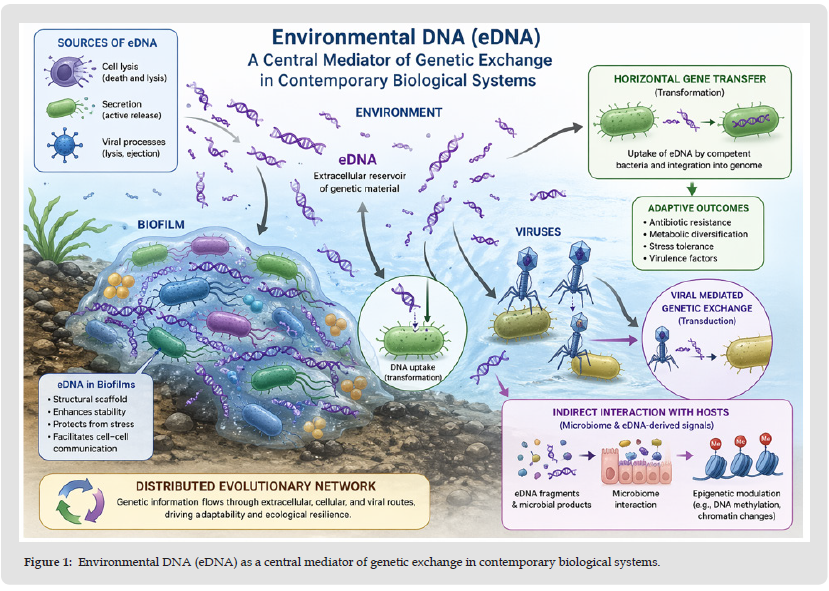
These observations support a shift toward an evolutionary model emphasizing distributed genetic exchange rather than strictly vertical inheritance. In this framework, eDNA is not the primary driver of evolution but a permissive substrate enabling genetic interactions. Evolution thus emerges from energy gradients, environmental constraints, and molecular interactions mediated by genetic exchange. This perspective aligns with symbiotic and endosymbiotic models, including mitochondrial evolution from α-proteobacteria [2]. Additionally, viral modulation of mitochondrial pathways further demonstrates interconnected genetic systems. eDNA may therefore serve as a bridge linking prebiotic chemistry to contemporary biological evolution.
Epigenetics involves regulation of gene expression through chemical modifications of DNA, chromatin, or RNA without altering nucleotide sequences [12,13]. These mechanisms enable rapid phenotypic adaptation in response to environmental stimuli, bypassing slower genetic evolution via natural selection [12,13]. Thus, epigenetics acts as an interface between genome and environment. In relation to eDNA, its environmental abundance raises the possibility of indirect genomic interactions. While incorporation into eukaryotic genomes is rare [14], interactions may occur via microbial intermediates, vector- mediated transfer, or microbiome-associated HGT [15,16].
Incorporating environmental DNA into evolutionary frameworks provides a unifying model bridging prebiotic and biological systems. As a distributed and permissive genetic reservoir, eDNA contributes to complex interaction networks shaping evolutionary dynamics. This paradigm enhances understanding of life’s origins and evolution, with implications for microbiology, virology, biotechnology, systems biology and medicine.
Not applicable.
Not applicable.
This research received no external funding.
The author declares no conflict of interest.
Process
During the preparation of this work, the authors used ChatGPT 5.2 for organizational information and copyediting purposes and based on the text original figure generation. The author reviewed and edited the document and takes full responsibility for its content.

International Association of Landscape Archaeology, Czech Glass Society, Czech Republic

Department of Chemistry, Semenov Institute of Chemical Physics, USSR Academy of Sciences, Moscow, Russia

Associate Professor at Department of Breast and Thyorid Surgey, Chongqing General Hospital, China

Professor of Nuclear Medicine, Faculty of Medicine and Surgery, University of Milan, Milan, Italy

Department of Pharmaceutical Sciences, South University School of Pharmacy, USA





 Abstract
 PDF
PDF



























