info@biomedres.us
+1 (502) 904-2126
One Westbrook Corporate Center, Suite 300, Westchester, IL 60154, USA
Site Map
 ISSN: 2574 -1241
ISSN: 2574 -1241
ISSN: 2574 -1241
Received: April 08, 2026; Published: April 30, 2026
*Corresponding author: Atsushi Imai, Department of Obstetrics and Gynecology, Matsunami General Hospital, 185-1 Dendai, Kasamatsu, Gifu 501-6062, Japan
DOI: 10.26717/BJSTR.2026.65.010198
The occurrence of pulmonary metastasis from choriocarcinoma has become exceedingly rare, owing to the high efficacy of chemotherapy and the limited indications for surgical intervention. A 53-year-old woman with a history of a hydatidiform mole four years earlier was found to have a nodular shadow in the right middle lung field on chest radiography. Computed tomography (CT) revealed a well-circumscribed nodule in segment 6 (S6) of the right lung and in segment 5 (S5) of the liver. An elevated human chorionic gonadotropin (HCG) level, in conjunction with radiologic evidence of distant metastases, strongly suggested a diagnosis of metastatic choriocarcinoma. Robot-assisted partial resection of the right S6 pulmonary nodule was performed following an initial laparoscopic partial resection of the S5 hepatic lesion. Histopathological examination confirmed metastatic choriocarcinoma, and combination chemotherapy with methotrexate, etoposide, and actinomycin D was subsequently initiated. We advocate surgical resection of distant metastatic lesions with pathological evaluation to prevent misdiagnosis of other pulmonary conditions, including primary lung carcinoma.
Abbreviations: CT: Computed Tomography; S6: Segment 6; S5: Segment 5; HCG: Human Chorionic Gonadotropin; GCC: Gestational Choriocarcinoma; D&C: Dilatation and Curettage; CA: Carbohydrate Antigen; CT: Computed Tomography
Gestational choriocarcinoma (GCC) is the most common gestational trophoblastic neoplasia; it is often secondary to a hydatidiform mole and to abortion, ectopic pregnancy, premature delivery, or term delivery [1,2]. This malignant tumor grows rapidly and metastasizes in the lungs, brain, liver, kidney, intestine, pelvis, and vagina [3,4]. Approximately 60% of patient with GCC develop pulmonary metastases. The incidence of molar pregnancy has declined worldwide, with a resulting sharp decrease in the incidence of GCC [5-7]. Moreover, because of the high cure rate of gestational trophoblastic neoplasia using chemotherapy, the indication for surgical therapy for solitary lung metastasis is limited [7]. Here, we report a rare case of lung and liver metastases from GCC arising four years after a complete hydatidiform mole.
The patient was a 53-year-old woman with a past history of a complete hydatidiform mole four years previously. She had undergone a dilatation and curettage (D&C) and adjuvant methotrexate therapy. Her pre-treatment serum human chorionic gonadotropin (HCG) value had been high at 189,000 IU/L and decreased to within the normal range at two months. A nodulous chest shadow in the middle lung field was pointed out on a chest radiography performed during a routine health examination. No respiratory symptoms, and her physical examination showed no abnormalities. Her laboratory data including tumor marker (carbohydrate antigen (CA) 19-9, CA125 and SCC) levels were within the normal ranges and high HCG level of 39,600 IU/L. A computed tomography (CT) scan showed a well-circumscribed node (2.2 cm) in segment 6 (S6) of the right lung and S5 of the liver (0.9cm) (Figure 1, inset). An elevated HCG level along with the identification of imaging evidence of distant metastases directed us toward metastatic choriocarcinoma diagnosis.
Figure 1
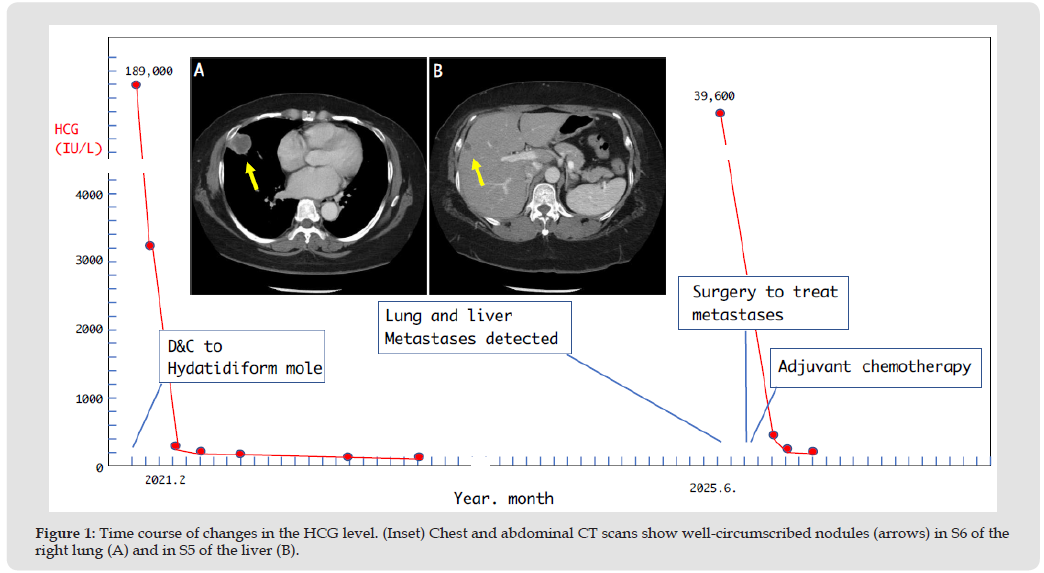
A robot-assisted partial resection of the right S6 nodule was performed after the initial a laparoscopic partial resection of S5 of the liver. Macroscopically, a white to reddish brown-coloured, well-define tumor was found within the resected specimen. Histopathology revealed metastatic choriocarcinoma. Thus, the patient was diagnosed as having a pulmonary metastasis from of a GCC arising four years after a complete hydatidiform mole. After the diagnosis of metastatic choriocarcinoma, she was started a combined chemotherapy with methotrexate, etoposide and actinomycin D. She completed a total of five cycles. Serum HCG value decreased to 2.4 IU/L on postoperative day 60 day, and it had returned to within the normal range at two months after the lung surgery. She was followed for one years and showed no signs of recurrence.
GCC frequently exhibits hematogenous dissemination to multiple distant organs. The lungs (70%) and vagina (20%) are the most common metastatic sites [8]. Metastases to other organs, such as the liver and brain, are uncommon in the absence of pulmonary involvement. Notably, up to 40% of patients with no detectable pulmonary metastases on chest radiography may have lesions identified on CT imaging. Prognostic factors associated with favourable outcomes include [9]: absence of systemic metastases, lack of a serum HCG level below 1500 IU/L, and uterine involvement. Diagnosis is typically suggested by the patient’s clinical history, elevated HCG levels, and abnormal findings on imaging studies or unusual postpartum hemorrhage. When appropriately referred to specialized centres and treated promptly with chemotherapy, GCC has an excellent prognosis. The survival rate approaches 100% in low-risk patients and approximately 94% in highrisk cases. Prognosis is comparatively poorer in non-molar pregnancies, likely due to delayed diagnosis or more advanced metastatic disease at presentation. Standard treatment consists of chemotherapy, with single-agent regimens for low-risk patients and combination regimens for high-risk patients [10]. Emerging evidence highlights the potential role of immunotherapy in the management of gestational trophoblastic neoplasia. In cases of chemotherapy-resistance, immune checkpoint inhibitors may represent a promising and effective therapeutic alternative [11,12]. We recommend wedge resection and histopathological evaluation of suspicious lesions to avoid misdiagnosis of other pulmonary diseases, including primary lung cancer.
The authors declare no conflict of interests regarding the publication of this report.

International Association of Landscape Archaeology, Czech Glass Society, Czech Republic

Department of Chemistry, Semenov Institute of Chemical Physics, USSR Academy of Sciences, Moscow, Russia

Associate Professor at Department of Breast and Thyorid Surgey, Chongqing General Hospital, China

Professor of Nuclear Medicine, Faculty of Medicine and Surgery, University of Milan, Milan, Italy

Department of Pharmaceutical Sciences, South University School of Pharmacy, USA





 Abstract
 PDF
PDF



























