info@biomedres.us
+1 (502) 904-2126
One Westbrook Corporate Center, Suite 300, Westchester, IL 60154, USA
Site Map
 ISSN: 2574 -1241
ISSN: 2574 -1241
ISSN: 2574 -1241
Received: April 03, 2026; Published: April 28, 2026
*Corresponding author: Rene Obscura Torres, General surgery resident, Dr. Darío Fernández Fierro General Hospital, ISSSTE, Mexico
DOI: 10.26717/BJSTR.2026.65.010189
Introduction: The superior mesenteric artery syndrome (SMAS), also known as Wilkie’s syndrome, when it
is promptly diagnosed has a good prognosis. It is a rare condition that causes intestinal occlusion, which is
misdiagnosed and even given to the patient a psychiatric diagnosis. A delayed diagnosis could implicate serious
complications, such as hydroelectrolyte imbalance, gastric/duodenal perforation and renal failure.
Objective: to present our 3 cases of experience on Wilkie’s syndrome.
Cases: From 2016 to 2025, we had 3 occlusive cases secondary to SMAS. First case was resolved by duodenojejunostomy;
The other 2 cases, by Strong procedure, with open and laparoscopic approach. The last 2 cases died
by hydroelectrolytic and intestinal complications.
Conclusion: It has a good prognosis in patients with an early diagnosis; also, when the Strong procedure is
provided early.
Keywords: The Superior Mesenteric Artery Syndrome; Strong Procedure; Wilkie Syndrome; Duodenal Compression Syndrome; Aortomesenteric Syndrome
Abbreviations: SMAS: Superior Mesenteric Artery Syndrome; AOMA: Aortomesenteric Angle; WS: Wilkie Syndrome; SMA: Superior Mesenteric Artery; ATC: Angiotomography
The third or inferior duodenal portion, (horizontal) and fourth (upward) are retroperitoneal structures. D3 crosses horizontally the vena cava, L3 vertebrae and the aorta, passing behind superior mesenteric vessels. D4 ascends to the left of L2 to the duodenojejunal flexure, fixed by the ligament of Treitz. The suspensory duodenal muscle or ligament of Treitz, was described by was described by the Czech pathologist Vάclav Treitz in 1853 [1]; According to Dr. Fernando Quiroz’s description, it is the fibromuscular structure that “suspends” or fixes the duodenojejunal junction to the right crus of the diaphragm, which is located behind the pancreas and the left renal vein; it is composed of smooth muscle fibers (originated from the muscularis of the duodenum) and occasionally, striated fibers (from the diaphragmatic crus), which allows it to have a “suspensory” function; it delimits the upper part of the small intestine, with great relevance in surgical anatomy and embryonic development, since during this, it holds the duodenum in place while the intestine rotates around the SMA [2].
The duodenum may end at the duodenojejunal flexure before reaching the right border of the aorta. In less than half of Piersol’s cases, this flexure was located to the left of the aorta, and in about 10%, the duodenum laid “entirely on the right side of the aorta.” Thus, in some individuals, it is anatomically possible for the duodenum to be compressed between the aorta and the SMA in the sagittal plane [3].
The duodenum, in its transverse or ascending portion, although frequent anatomical, morphological, and complex variations exist among individuals, is generally located at an acute angle between the aorta and the upper part of the SMA. Together with the descending duodenum, it describes a curve that can vary from a broad, shallow “U” to a sharp “V.” In the “U” type, if the SMA crosses the base of the “U,” the ascending limb may pass to the left, anteriorly, and superiorly over the aorta to an insertion to the aorta´s left without vascular compression [3,4]. The aortomesenteric angle (AOMA), also known as the aortomesenteric clamp, is an anatomical space between the abdominal aorta anterior face and the SMA; It is located between L1 and L2; the following anatomical structures are located in the AOMA: the duodenum third portion, left renal vein, uncinate process of the pancreas, lymphatic and venous vessels, and adipose cushion whose function is to muffle the mechanical injury resulting from both the aortic and SMA pulse on the structures that cross it [5]. The SMA forms an angle with the abdominal aorta, which, measured by computed tomography angiography (CTA), varies between 38° and 60°, with an average of 50°; an aortomesenteric distance of 10 to 34 mm. Alterations in this angle have been associated with SMAS and nutcracker syndrome (an unusual compression of the left renal vein, causing flank pain, hematuria, proteinuria, and pelvic varices), which can be present in the same patient; of those, 13 cases have been reported, such as the case reported in Chile [6].
This syndrome was first described by the Austrian professor Carl Freiherr von Rokitansky in 1861, who performed over 30,000 autopsies. It was later named after Sir David Wilkie, who, in 1927, described a series of 75 cases detailing the diagnosis and treatment approaches. Four hundred cases have been reported in the English literature. Nowadays, there is a controversy of its existence, because of its insidious symptomatology and a quite variety of differential diagnosis. Most authors mentioned that the syndrome is present when the AOMA is equal or smaller than 20°; and could be less in pediatric patients [7]. CTA and MRI have improved the diagnosis rate. A delayed diagnosis can lead to serious complications such as electrolyte imbalance, catabolic wasting, peritonitis, and gastric or duodenal perforation. The conservative treatment consists initially with weight gain by oral or enteral feeding to enlarge the adipose mesenteric cushion and increase the AOMA. If it fails, the ligament of Treitz division (Strong procedure), digestive or vascular bypass surgery is indicated [3,7].
We present our three cases experience seen in a 9 years period; The first one, A woman in her fifties was diagnosed at the La Raza General Hospital by the Surgery Department. A consultation was requested to the vascular surgery department for a possible transposition of the great arteries. Unfortunately, the patient’s follow-up was lost. It appears she underwent diverting digestive surgery, the type and outcome of which are unknown to us. The second patient, a man in his eighties, was admitted to our medical unit, the Darío Fernández Fierro General Hospital, via emergency room, with a diagnosis of intestinal obstruction and abdominal sepsis. An exploratory laparotomy was performed, revealing significant dilation of the stomach and duodenum, with color changes in the duodenum and mesentery. The duodenum was firmly adhered to adjacent structures, and fibrosis was observed at the duodenojejunal flexure, also known as the ligament of Treitz. Adhesiolysis was performed on the duodenum, jejunum, and duodenojejunal flexure, but the duodenum was not completely freed, and adequate peristalsis was not achieved. The ligament of Treitz was cut, confirming hemostasis. The patient’s condition deteriorated rapidly and died within the first 24 hours postoperatively.
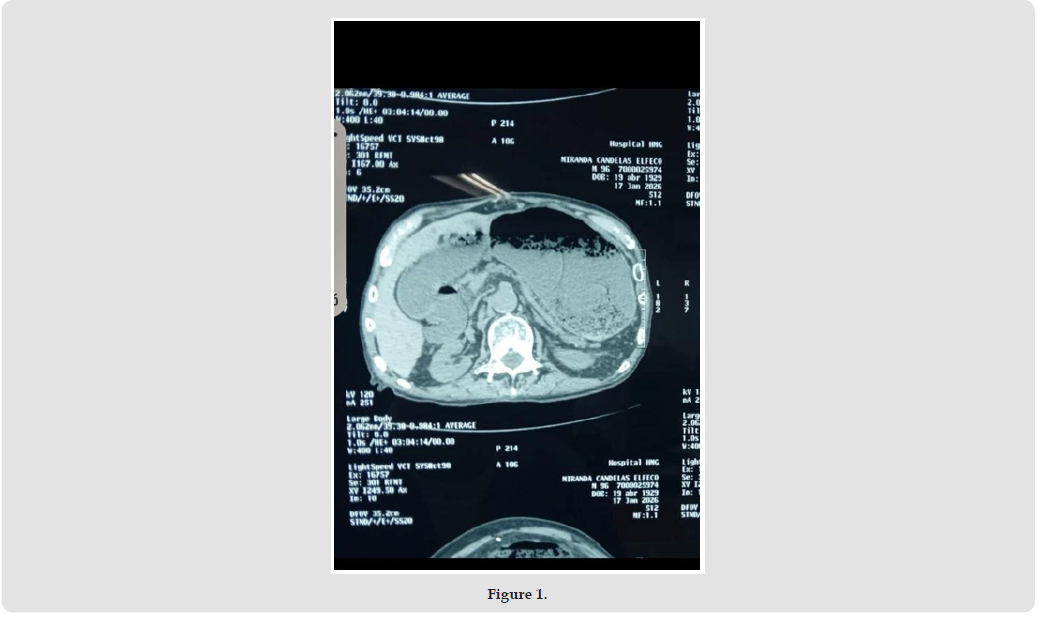
The third patient, a 96 year old male which was admitted on January 17th, 2026, with acute abdomen suspicion secondary to intestinal occlusion; with a history of uncontrolled hypertension for 30 years; chronic antacid intake referred by family member, fundoplication 30 years ago; We were asked for a consultation and found the patient in right lateral decubitus position, uncooperative, with a distended abdomen, decreased peristalsis; pain on medium and deep palpation, poorly hydrated, and stable vital signs; a plain abdominal CT scan was requested; the patient was reassessed an hour later and continued to have significant pain; the CT scan showed significant dilation of the gastric chamber and duodenum, without evidence of free air in the cavity or collections (Figure 1); The diagnosis of aortomesenteric clamping was made; arterial blood gas analysis was requested, and if it demonstrated evidence of intestinal injury, intervention would be indicated; the blood gas analysis result was pH 7.44, PaCO2 34.8 mmHg, HCO3 24.2mEq/L, PaO2 63.7 mmHg, O2 saturation = 90% at an FiO2 of 22%; DB -0.5mEq/L; lactate of 1.7 mmol/L. With these results, and since there were no changes and the patient refused any intervention, the patient was admitted to the surgical service for hemodynamic and hydroelectrolytic stabilization and expectant management, considering that most cases (consulting the literature) resolve favorably.
Figure 1
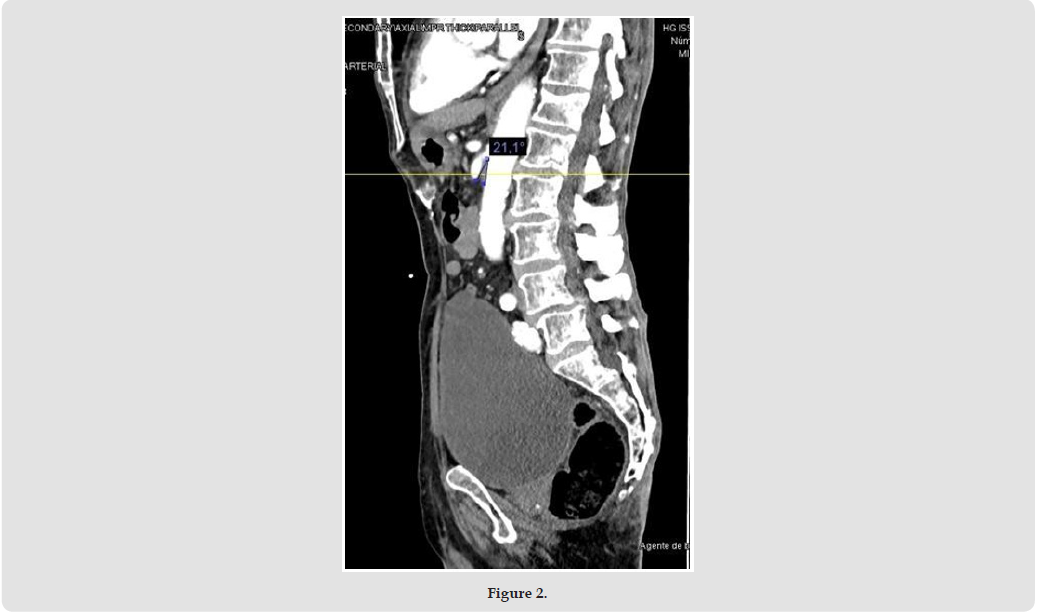
During his inpatient stay, he refused the placement of a nasogastric and Foley catheter; 4 days after admission, he remained unchanged; plain abdominal x-ray showed gas in the rectal ampulla; a new CT scan demonstrated findings related to chronic cystitis, bilateral dilation of the pyelocaliceal system; vesicoprostatic ultrasound showed grade II prostatic enlargement, with 90% residual urine; a CT scan was performed, which confirmed the diagnosis of SXW with an AAOM of 21.1° (Figure 2); days later, showing no improvement, the need for surgical intervention was explained to the family, who did not accept it, so oral intake was restarted; 24 hours later, they accepted the surgical intervention, so a Strong procedure was scheduled via laparoscopy for the 29th of the current month; the surgery was performed with the following findings: dilation of the duodenum in its three proximal portions; narrow AAOM; The duodenojejunal curvature was suspended by the broad-based ligament of Treitz, with multiple firm adhesions of the omentum to the anterior parietal peritoneum in the midline. A follow-up CT scan with oral contrast showed adequate passage of the contrast agent without evidence of leakage; the patient was discharged on the third day. On the 13th postoperative day, the patient was readmitted with abdominal pain, nausea, and vomiting; a duodenojejunostomy was proposed, but the family refused further procedures; three days later, the patient died from respiratory failure secondary to multifocal pneumonia.
Figure 2
SXW is an extremely rare cause of intestinal obstruction; it is much more common in young adults and generally presents as chronic pain with insidious symptoms, that is to say, symptoms that are subtle, vague, or absent at first [8]. Among emergency department visits, abdominal pain accounts for 5% to 10%, and of these, 25% are classified as undifferentiated; patients are either discharged or diagnosed with psychological conditions (anxiety or eating disorders) [9]. It is of utmost importance to note that higher rates of these conditions are observed in patients who have undergone Roux-en-Y gastric bypass and sleeve gastrectomy [10]. We must bear in mind that this syndrome occurs not only when the angle at the aortomesenteric junction is reduced, whether due to spinal problems (alterations in normal lumbar lordosis), alterations in the aortomesenteric distance, or lateral widening, a short Treitz ligament, multiple insertions of this ligament into the duodenum, or high attachment to the duodenum; a short origin or other lateral branches of the AMS, diabetes mellitus, blunt abdominal trauma, application of a full- body cast, reduction in the adipose cushion, or other causes leading to enteroptosis of the intestinal loops (intestinal ptosis: descent or sagging of the intestines); due to fat loss in the mesentery, resulting from the loss of the structural support provided by this fat, as the mesentery loses volume and rigidity, allowing the intestinal loops to descend toward the pelvis, (visceroptosis or enteroptosis), such as anorexia nervosa, malabsorption, states of hypercatabolism (burns, major surgery, neoplasms), and congestive heart failure causing cachexia [11].
This condition should be considered and distinguished from other common problems such as diabetic gastroparesis and scleroderma with duodenal involvement (although it affects the esophagus in 90% of cases, it can affect any part of the digestive tract; when it affects the duodenum, it causes fibrosis and atrophy, weakening its walls; Intestinal hypomotility (lazy bowel), which can lead to intestinal pseudo-obstruction with bacterial overgrowth, causing malabsorption, diarrhea, weight loss, and nutritional deficiencies;11 hereditary megaduodenum; megaduodenum due to aganglionosis, it is of the utmost importance to take these factors into account if surgery has been considered [12]. Regarding treatment, the best approach would be to release the duodenum by sectioning the ligament of Treitz; however, the Strong procedure has a failure rate of up to 20% [13]. Gastroduodenal or duodenoyunal bypasses, the former of which carries frequent functional complications; the stomach empties its contents too slowly or too quickly into the jejunum; this bypass disrupts normal physiology, with delayed emptying being more common (not forgetting that, in a chronic stage, the stomach may already be paretic) with an incidence of 20 to 40%; characterized by nausea, vomiting, early satiety, and epigastric pain, symptoms and signs that may appear beforehand and that the patient may interpret as a complete failure of their surgery.
Furthermore, gastrojejunostomy does not resolve the duodenal problem. Regarding duodenojejunostomy, which is considered the gold standard, it has a 90% [14] success rate; however, if the duodenum already has structural damage to its wall, as well as both external and internal adhesions, it is clear that it will not resolve the problem [13]. Regarding the use of robotic techniques, they offer better visualization of the surgical field as well as better control of movements [13]. Given our limited experience, we are unable to pass judgment on established treatments or draw conclusions about them, but we can offer observations. Both cases had poor outcomes due to their delayed diagnosis; therefore, it can be inferred that delayed diagnosis leads to dilation of the digestive tract (gastroparesis) and, consequently, malfunction that is, stasis due to muscular and even neurological damage, defective peristalsis, proliferation of bacterial flora, and electrolyte imbalances. Therefore, when performing the bypass, it does not ensure adequate emptying of either the stomach or the duodenum, structures that have chronically exhibited stagnation of their contents, and performing the bypass in a cachectic patient can lead to serious infectious complications, such as septic shock, due to the proliferation of bacterial flora stagnating in the residual stomach or the blind loop, especially when a gastrojejunostomy is performed.
Furthermore, it is not as simple as performing a section of the suspensory muscle of the duodenum to resolve the problem, since the chronic nature of the condition causes peristalsis, the aortic pulse, and the AMS pulse to induce chronic inflammation with adhesions that prevent adequate release of the affected segment; or even if AMS transposition is performed, the obstructive problem may remain unresolved. Ideally, one should be aware of this condition, which is more common in women (who are generally overlooked, as they are labeled as neurotic and their actual physical symptoms are ignored, leading to misdiagnoses), and we will surely see more cases due to the aging population, bariatric surgery, chronic degenerative diseases, accidents (currently orthopedic emergencies are the main cause), or through timely detection—which would be best—thanks to technological advances and better- equipped hospitals. Delayed diagnosis and the cachectic state of the patients were the main causes of our poor outcomes. The prognosis may be favorable in patients diagnosed at an early stage; similarly, in those requiring surgery, the Strong procedure is effective, provided it is performed early. This is evidenced in the report by Benavides Olivera, J. G., et al., who, after only 48 hours of conservative management with no response, performed an early laparoscopic duodenoyeyunostomy [15].
A similar case with a favorable outcome involves a patient who underwent cholecystectomy and presented with a history of intestinal subocclusion lasting “a month and a half,” with a weight loss of 24 kilograms; She was managed conservatively with intravenous hydration, analgesia, placement of a nasogastric tube, electrolyte management, and parenteral nutrition, with the goal of restoring her ideal weight and subsequently the adipose cushion of the AAOM. She made a satisfactory recovery, and the occlusive symptoms resolved [16]. With regard to our third patient, it became evident that, because this condition develops insidiously, it is often misdiagnosed and mismanaged; furthermore, when surgery is performed too late, due to problems inherent in the local chronic inflammatory process, the procedure becomes complicated, and patients do not recover adequately because the affected structures are not fully released, resulting in a poor prognosis due to nutritional and functional impairments.
The prognosis can be good in patients managed conservatively, with bypass surgery, or using the Strong procedure, provided that the diagnosis is made early. It is said that when conservative management fails, surgery is resorted to, but WE SHOULD ASK OURSELVES: IS THE PATIENT BEING PROPERLY FOLLOWED UP? And is the patient AWARE OF THEIR CONDITION AND THE COMPLICATIONS? Vascular bypasses, following the Strong procedure, should be the most common therapeutic approach to avoid potentially contaminated surgeries.
The authors declare that there are no conflicts of interest related to this article. They agree to open access publication in accordance with the journal’s policy.

International Association of Landscape Archaeology, Czech Glass Society, Czech Republic

Department of Chemistry, Semenov Institute of Chemical Physics, USSR Academy of Sciences, Moscow, Russia

Associate Professor at Department of Breast and Thyorid Surgey, Chongqing General Hospital, China
Professor of Nuclear Medicine, Faculty of Medicine and Surgery, University of Milan, Milan, Italy

Department of Pharmaceutical Sciences, South University School of Pharmacy, USA





 Abstract
 PDF
PDF



























