info@biomedres.us
+1 (502) 904-2126
One Westbrook Corporate Center, Suite 300, Westchester, IL 60154, USA
Site Map
 ISSN: 2574 -1241
ISSN: 2574 -1241
ISSN: 2574 -1241
Received: April 10, 2026; Published: April 24, 2026
*Corresponding author: Anwarul Islam, M.D, Ph.D, FRCPath, FACP, Clinical Associate Professor of Medicine, Division of Hematology/ Oncology, Department of Medicine, Buffalo General Medical Center, Buffalo, New York 14203, USA
DOI: 10.26717/BJSTR.2026.65.010186
Hereditary spherocytosis (HS) is a familial hemolytic disorder characterized by marked heterogeneity in clinical
presentation, ranging from an asymptomatic condition to severe hemolytic anemia. In most cases, the disorder is
detected in early childhood; however, in some patients, it may remain unrecognized until adulthood.
We present a 19-year-old African American female who presented with anemia, jaundice, reticulocytosis, and
splenomegaly requiring blood transfusion. A peripheral blood smear revealed anisocytosis, poikilocytosis and
numerous spherocytes. She was managed conservatively with nutritional support and blood transfusions, to
which she responded well, without the need for splenectomy.
The patient is a 19-year-old African American female with a past medical history significant for asthma and marijuana use who presented to the emergency department (ER) with abdominal pain, nausea, vomiting, and fatigue. Her symptoms had been ongoing for approximately two weeks. Most of her abdominal pain was localized to the left side and was worsened when lying on her left side. She denied any changes in bowel habits and reported no fever, chills, cough, or shortness of breath. She had recently started her menstrual cycle and reported irregular cycles, noting that her birth control implant was due for replacement soon. Of note, the patient was involved in a motor vehicle accident one week prior to presentation and was diagnosed with a concussion. She reported that her abdominal symptoms had not worsened since that time.
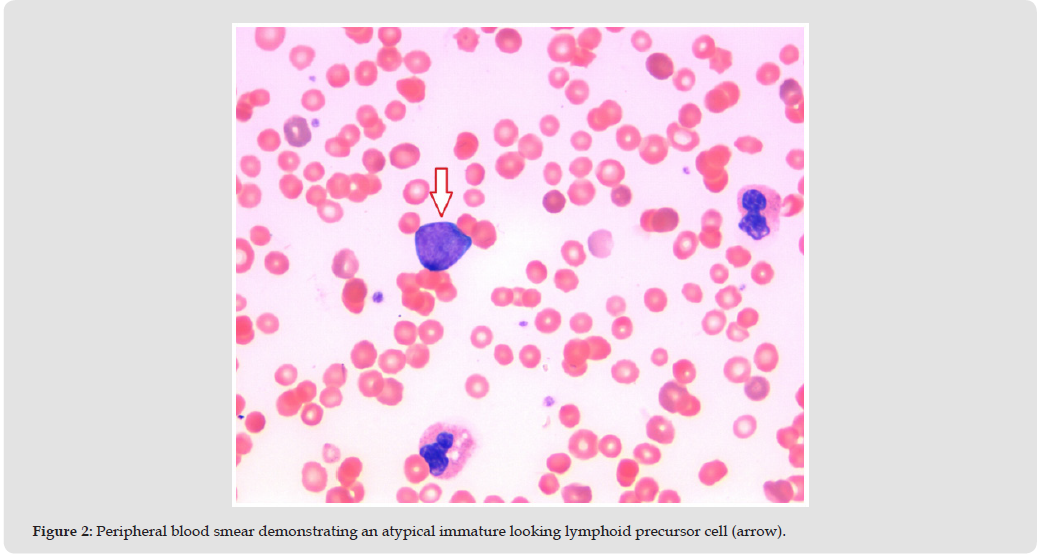
In the emergency department, her vital signs were stable; however, she was noted to have a low-grade fever of 101.1°F. Laboratory studies were notable for new-onset anemia with a hemoglobin level of 8.0 g/dL. Her reticulocyte count was elevated at 22.4%, with low haptoglobin (<30 mg/dL), elevated lactate dehydrogenase (LDH) of 706 U/L, and total bilirubin of 6.1 mg/dL, findings consistent with hemolysis. A computed tomography (CT) scan of the abdomen and pelvis revealed marked splenomegaly with a small splenic infarct. Overall, her clinical presentation was concerning for new-onset hemolytic anemia. She was treated with analgesics and admitted for further evaluation and management. The patient also reported a significant family history, noting that both her mother and aunt were diagnosed with hereditary spherocytosis (HS) during childhood and subsequently underwent splenectomy. Her peripheral blood smear, upon review, revealed characteristic features of hereditary spherocytosis (HS) (see Figure 1). In addition, a small number of atypical immature looking lymphoid precursor cells were identified (see Figure 2), raising suspicion for a possible associated lymphoid malignancy and prompting the request for flow cytometric studies. Flow cytometry analysis revealed circulating CD34-positive events with an ambiguous phenotype. Consequently, a bone marrow examination was recommended for definitive evaluation of a potential hematologic disorder, which was subsequently performed.
Figure 1
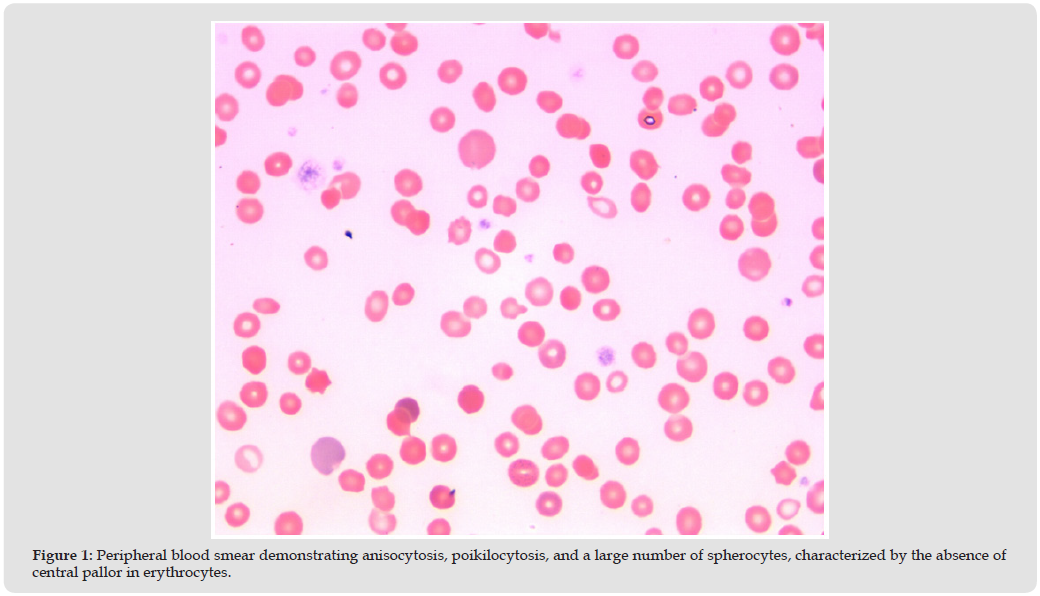
Figure 2
Fortunately, bone marrow aspiration and biopsy studies were negative for any hematologic malignancy. No diagnostic immunophenotypic aberrancies were detected on bone marrow aspirate by flow cytometry. Cytogenetic analysis of a 48-hour unstimulated bone marrow culture demonstrated a normal female karyotype. Furthermore, no reportable genomic alterations were identified on molecular studies, including next-generation sequencing.
Hereditary spherocytosis (HS) is an inherited disorder characterized by an intrinsic defect of the red blood cell membrane, resulting in the formation of spherical red blood cells (spherocytes) and their sequestration and destruction in the spleen [1]. HS was first described in 1871 [2] and is the most common inherited hemolytic anemia among Caucasians, with an incidence of approximately 1 in 2,500 to 5,000 individuals [3,4]. It also occurs in individuals of African and Mediterranean descent, with an estimated incidence of approximately 1 in 2,000 individuals in these populations [3]. Although HS is considered relatively uncommon worldwide, it is usually diagnosed in early childhood. During the first few postnatal months, anemia may develop in infants who fail to mount an adequate reticulocyte response [4]. Later in childhood, HS commonly presents with anemia, jaundice, and splenomegaly [4-6]. Affected patients may have mild, moderate, or severe anemia.
Children with moderate to severe anemia may experience poor exercise tolerance, impaired growth, and academic difficulties. However, it is not uncommon for the diagnosis to be delayed until adulthood, as in the case presented. The classic triad of anemia, jaundice, and splenomegaly, together with the characteristic morphologic finding of spherocytes on peripheral blood smear, represents the hallmark of the diagnosis of HS and was present in this case. In addition, a positive family history of HS further supported the diagnosis. Although the presence of atypical lymphoid precursors on the peripheral blood smear and ambiguous findings on flow cytometry initially raised concern for acute lymphoblastic leukemia—an association that has been reported in the literature [1]—a comprehensive bone marrow evaluation in this patient was negative for any concomitant hematologic malignancy. The patient was managed conservatively with nutritional supplementation consisting of folic acid and ascorbic acid and has been doing well since her diagnosis approximately six months ago.

International Association of Landscape Archaeology, Czech Glass Society, Czech Republic

Department of Chemistry, Semenov Institute of Chemical Physics, USSR Academy of Sciences, Moscow, Russia

Associate Professor at Department of Breast and Thyorid Surgey, Chongqing General Hospital, China

Professor of Nuclear Medicine, Faculty of Medicine and Surgery, University of Milan, Milan, Italy

Department of Pharmaceutical Sciences, South University School of Pharmacy, USA





 Abstract
 PDF
PDF



























