info@biomedres.us
+1 (502) 904-2126
One Westbrook Corporate Center, Suite 300, Westchester, IL 60154, USA
Site Map
 ISSN: 2574 -1241
ISSN: 2574 -1241
ISSN: 2574 -1241
Received: April 01, 2026; Published: April 20, 2026
*Corresponding author: Nourhane Omara, Department of Oral Medicine, Periodontology and Oral Diagnosis, Faculty of Dentistry, Ain- Shams University, 20 Organization of African Union St., Cairo, 1156, Egypt
DOI: 10.26717/BJSTR.2026.65.010179
Oral potentially malignant lesions (OPMLs) are conditions with a high tendency for malignant transformation. Thus, early recognition and prompt management are key to optimal outcomes for these lesions. Zinc Oxide nanoparticles (ZnO NPs) showed relatively high biocompatibility and selective cytotoxicity against cancerous cells. Furthermore, the magnetite-zinc-oxide composite nanoparticles (ZnO-Fe₃O₄) could provide topical therapeutic benefits for these lesions due to better penetration. This case report evaluated the therapeutic potential of a topical ZnO-Fe₃O₄ nanoparticle–based gel over 6 weeks in a 35-year-old patient with oral leukoplakia and mild epithelial dysplasia. The treatment showed a favorable clinical response, no reported adverse effects, and a histopathological conversion from mild to no dysplasia. These findings highlighted the potential of ZnO-Fe₃O₄ nanoparticles as a novel, non-invasive therapeutic approach for managing early-stage dysplastic OPMLs. Further studies are recommended to validate these outcomes.
Keywords: Cancer therapy; Drug Delivery; Leukoplakia; Metal Oxides; Nanomedicine
Oral Potentially Malignant Lesions (OPMLs) are described as mucosal lesions that have the potential to develop into oral cancer. Most commonly includes oral leukoplakia, oral lichen planus, and oral erythroplakia [1]. According to the World Health Organization (WHO), low-risk lesions are graded as non-dysplastic or showing mild dysplasia, and moderate-risk lesions are those demonstrating three or less architectural criteria of dysplasia or four or less cytological dysplasia criteria. On the other hand, the high-risk category includes all lesions graded as severe dysplasia or carcinoma in situ and moderate epithelial dysplasia with four or more architectural criteria or five or more cytological criteria [2]. One of the novel methods of synthesis of nanoparticles is magnetite-zinc-oxide composite conjugated nanoparticles [(ZnO-Fe₃O₄) NPs]. This composite was synthesized by ex situ conjugation of synthesized ZnO nanoparticles (ZnO NPs) and Fe3O4 NPs using trisodium citrate as a linker to retain key properties of both NPs. This provides more therapeutic benefits besides specificity and specific localization, multidrug conjugation, easy tuning of release kinetics, selective localization, and bypass of the multidrug resistance mechanism [3]. Magnetite-zinc-oxide composite conjugated nanoparticles [(ZnO-Fe₃O₄) NPs] showed preferential cytotoxicity towards cancer cells, with no significant cytotoxicity towards noncancerous cells [3]. These NPs can be applied to treat cancer by either passive or active processes. A passive process uses enhanced permeability and retention effect, while an active process includes the induction of apoptosis and the generation of reactive oxygen species selectively in cancerous cells [4]. The current case report explored the potential therapeutic effect of topical [(ZnO-Fe₃O₄) NPs] in the management of oral leukoplakia with mild dysplasia as one of the OPMLs.
A 35-year-old female patient attended the oral medicine outpatient clinic complaining of a non-painful rough area in the buccal mucosa that had lasted for a year. Intraoral examination of the white lesion showed a 1 cm wide rough keratotic plaque extending along the buccal mucosa from the oral commissures to the first molar area that couldn’t be wiped off with a slight loss of pliability and flexibility, and no tenderness without any sign of rough dentition adjacent to the lesion. The patient had a history of smoking for 5 years and stopped 6 months ago. She did not report any trauma or biting habit and denied any illnesses or allergies, as well as taking any medications. An excisional biopsy with histopathological evaluation of H&E-stained sections confirmed the diagnosis of oral leukoplakia with mild epithelial dysplasia. After obtaining informed consent and providing a thorough explanation of the procedure, the patient was prescribed a 5% topical (ZnO-Fe₃O₄) gel to be applied three times daily for a duration of 6 weeks. The patient was subsequently monitored for an additional 12 weeks of treatment-free observation period.
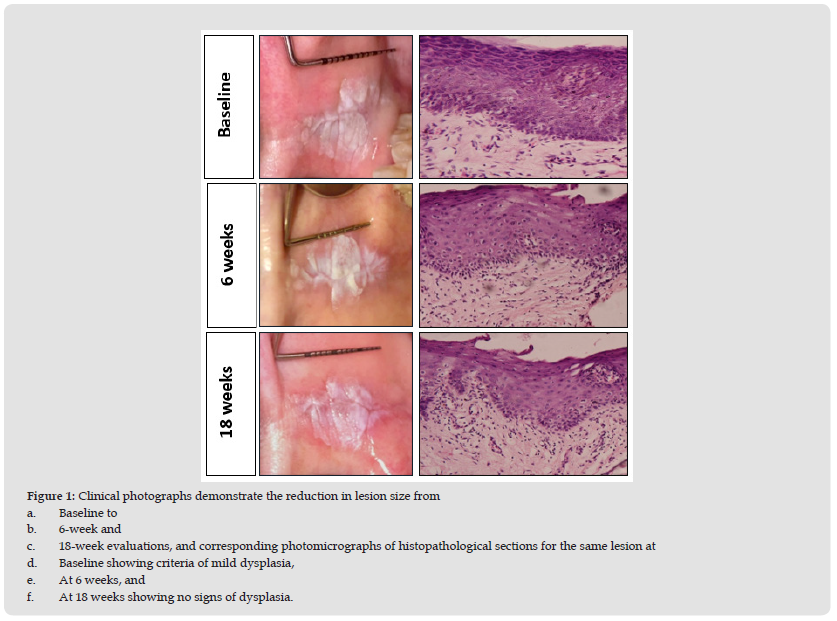
Clinical changes in lesion size, along with histopathological grading of dysplasia, were reassessed by biopsy at both 6 and 18 weeks. The patient retained the right to withdraw from the study at any time, and discontinuation was permitted in the event of any complications related to the intervention or the patient’s general health. Additionally, if histopathological evaluation at either follow-up interval revealed progression to severe dysplasia, surgical excision of the lesion was indicated. At the 6-week follow-up, clinical examination demonstrated a reduction in lesion size, with no reported adverse effects or patient complaints. Histopathological assessment at this stage revealed epithelial hyperplasia without evidence of dysplasia. Following the 12-week treatment-free period (18-week evaluation), the lesion remained histologically stable, with no recurrence or progression of dysplastic changes. Figure 1 shows clinical photographs demonstrating the changes in lesion size from baseline to 6-week and 18-week evaluations, together with corresponding photomicrographs of histopathological sections for the same lesion.
Figure 1
Oral potentially malignant disorders represent a significant clinical challenge due to their unpredictable risk of malignant transformation. Early intervention strategies that are both effective and minimally invasive remain an area of ongoing research. Previous research documented that cancerous cells are characterized by a decrease or alteration in zinc concentration, suggesting that a deficiency in zinc can make cells unstable, and it is an important factor in the development and progression of malignancy. Therefore, zinc can be valuable in the prevention and treatment of several cancers [5-8]. The (ZnOFe₃O₄) are now being widely researched for their anticancer properties. They showed relatively high biocompatibility [9]. They also show selective cytotoxicity against cancerous cells in vitro compared with other nanoparticles. They can be further surface engineered to show increased selective cytotoxicity [10]. The synthesis process of ZnO NPs is easy, with a wide variety of methods. Owing to these different methods of synthesis, their size and size distribution can be easily controlled [11]. ZnO NPs nanoparticles were also used to promote wound healing on post-cesarean wounds [12], diabetic foot ulcers [13], and pediatric perineal burns treatment [14].
Previous studies have demonstrated the anticancer potential of zinc oxide nanoparticles through the generation of reactive oxygen species (ROS), leading to oxidative stress, DNA damage, and induction of apoptosis [15,16]. In the present case, the observed reduction in lesion size, along with histological regression of dysplasia, suggests a potential therapeutic effect of the ZnO-Fe₃O₄ gel. This may be attributed to its anti-proliferative and pro-apoptotic properties, as well as its ability to modulate oxidative stress within dysplastic epithelial cells.
From a clinical perspective, the current case demonstrated that the use of a topical ZnO-Fe₃O₄ gel offered a non-invasive and well-tolerated alternative for managing early dysplastic lesions, potentially reducing the need for surgical intervention in selected cases. However, Further studies with larger sample sizes, longer follow-up periods, and controlled clinical designs are necessary to validate the efficacy and safety of ZnO-Fe₃O₄ NPs-based gel in the management of OPMDs.
The authors report no conflict of interest.

International Association of Landscape Archaeology, Czech Glass Society, Czech Republic

Department of Chemistry, Semenov Institute of Chemical Physics, USSR Academy of Sciences, Moscow, Russia

Department of Educational Sciences, Research Centre Qualities of Teachers, School of Education – HAN, Nijmegen, Netherlands

Associate Professor at Department of Breast and Thyorid Surgey, Chongqing General Hospital, China

Neurology, LA BioMed Research Institute, USA





 Abstract
 PDF
PDF



























