info@biomedres.us
+1 (502) 904-2126
One Westbrook Corporate Center, Suite 300, Westchester, IL 60154, USA
Site Map
 ISSN: 2574 -1241
ISSN: 2574 -1241
ISSN: 2574 -1241
Received: March 31, 2026; Published: April 09, 2026
*Corresponding author: Shoshi Inooka, Japan Association of Science Specialists, Japan
DOI: 10.26717/BJSTR.2026.65.010169
Synthetic DNA crown cells can be produced using sphingosine (Sph)-DNA-adenosine-monolaurin compounds and egg white. Previous experiments have demonstrated that both antibiotic compounds and antibiotic-producing cells can be produced using various combinations of DNA crown cells with partners, such as microorganisms, other cells, extracts, and peptides. In another study, both cell proliferation and various objects (“crown cells nema”) were observed in cultures of partner-stimulated antibiotic-producing cells (antibiotic crown cells). The present experiments examined whether crown Bovine meat kaiware-seed-ex cells nema prepared in cultures of egg white powder enclosing DNA (Bovine meat) crown cells with Kaiware-seed extract and stimulated Kaiware- seed extract could be serially cultivated. The results showed that crown Bovine meat kaiware-seeds ex cells nema could be serially cultivated.
Keywords: DNA (Bovine Meat) Crown Cells; Sphingosine-DNA; Antibiotic Crown Bovine Meat Kaiware-Seed-Ex Cells; Kaiware-Seed Extract; Crown Cells Nema; Serial Cultures
Self-replicating artificial cells were first reported in 2012 [1] and the principal methods for preparing these artificial cells were described in 2016 [2]. As the exterior consists of DNA, these cells were referred to as DNA crown cells in 2016 by the present author [3]. Synthetic DNA crown cells were produced using four common commercial compounds: sphingosine (Sph), DNA, adenosine, and monolaurin. The cells developed into fully self-replicating DNA crown cells when incubated in egg white. Previous studies have demonstrated that antibiotic and antibiotic-producing cells were produced by combining various DNA crown cells with different partners, such as microorganisms, other cells, extracts, and peptides [4-11]. Moreover, antibiotic-producing cells were cultured on agar plates and a partner was added. As a result, cell proliferation and objects that varied in shape and size were observed. These cells are referred to as crown cells nema [12-14]. Crown cells nema are multicellular or filamentous, and grow from antibiotic crown cells in response to the partner. The present experiments examined whether such crown cells nema could be serially cultivated using crown cells nema prepared from the combination of crown Bovine meat kaiware-seed-ex cells with Kaiware seed extract.
Antibiotic crown cells, crown cells nema and the resulting cultures were prepared using the following five steps. Steps 1-3 were carried out as described in previous methods and the powder used in previous experiments was again used in these experiments [11]. The methods are again described here.
• Step 1 Preparation of DNA crown cells.
• Step 2 Preparation of powder.
• Step 3 Culture of powder (antibiotic crown cells).
• Step 4 Preparation of crown cells nema.
• Step 5 Serial passage of crown cells nema.
Materials for these Experiments
Sph (Tokyo Kasei, Tokyo, Japan), DNA (from bovine meat), adenosine (Wako, Tokyo, Japan), monolaurin (Tokyo Kasei, Tokyo, Japan), and adenosine-monolaurin (A-M) compound were used in this study [15]. Monolaurin solutions were prepared to a final concentration of 0.1 M in distilled water. Agar plates were prepared using standard agar medium (SMA; AS ONE, Japan). Kaiware seeds were obtained from a local market.
Step 1: Preparation of DNA (Bovine Meat) Crown Cells (11–13)
Briefly, 180 L of Sph (10 mM) and 90 L of DNA (1.7 μg/L) were combined, then the mixture was heated and cooled twice. A-M solution was added and the mixture was incubated for 15 min at 370C. Following the addition of monolaurin solution, the mixture was incubated for 5 min at 370C to produce synthetic DNA crown cells. These cells were then added to egg white and incubated for 7 days at 370C. The egg white was then recovered and used as DNA (Bovine meat) crown cells.
Step 2: Preparation of Powder-Enclosed DNA Crown Cells with Kaiware-Seed Extract
1. First, 3 mL of Kaiware-seed extract was mixed with 3 mL of
egg white. To prepare Kaiware-seed extract, approximately
50 seeds were ground in a mortar and suspended in 3 mL of
distilled water. The solution was prepared for each experiment.
2. The mixture was then incubated for 5 h at 370C.
3. Approximately 20 mL of fresh egg white was then added to
the mixture.
4. The mixture was plated onto two Petri dishes and dried for
1-2 days at 370C.
5. The dried material was then collected and ground to a powder
using a mortar and pestle.
6. The powder, termed crown Bovine meat kaiware-seed-ex.
P was stored at room temperature and used as necessary
(Figure 1).
Figure 1

Step 3: Cultivation of Powder (Preparation of Antibiotic- Producing Cells)
Approximately 50 mg of crown Bovine meat kaiware-seed-ex. P was added to an agar plate and incubated for 2 days at 370C. Approximately 1.5 mL of 0.1 M monolaurin solution was poured onto each plate, which was then incubated for 2 days at 370C. About 6.0 mL of distilled water was then added to the plate and dispersed on the plate surface. Objects on the plate were then recovered and suspended objects were used as antibiotic-producing cells. To culture antibiotic- producing cells, 200 L of sample was placed onto an agar plate and incubated for 1 day at 370C.
Step 4: Preparation of Crown Bovine Meat Kaiware-Seed- Ex Cells Nema
After 3 days of culturing antibiotic-producing cells, approximately 1.5 mL of Kaiware-seed extract solution was added to an agar plate. After 3 days of culturing Kaiware-seed extract solution, objects (crown cells nema) that grew on the plate (Figure 2, within the frame) were collected, transplanted into a new plate and incubated for 1 day at 370C. Objects that grew on the plate were crown cells nema in primary culture.
Figure 2

Step 5 Serial Culture of Crown Cells Nema (to 5 Generations)
After 3 days of primary culture, about 1.5 mL of Kaiware-seed extract was added to the objects (crown cells nema) that grew in culture and were incubated at 370C for 3 days. The objects grown were then collected and transplanted into a new plate and incubated for 1 day at 370C. Objects that grew on the plate were considered to be 2nd-passage crown cells nema. After 3 days of culture, objects grown in plate were collected and were incubated at 370C for 1 day. Objects that appeared in culture were 3rd-passage crown cells nema.
These cells were then collected, transplanted into a new plate and incubated for 1 day at 370C. About 1.5 mL of Kaiware-seed extract was added to the plate and objects that grew on the plate were 4th-passage crown cells nema. The objects that grew in 4 passages were collected, placed into a new plate and incubated for 1 day at 370C. The objects that grew on the plate were 5th-passage crown cells nema. Two passages and 5 passages were carried out without the addition of Kaiware-seed extract. Here, antibiotic crown Bovine kaiware seed ex cells were used in the culture experiments. The antibiotic crown cells were selected as one example that supports serial culture, it’s use does not imply a particular significance.
Figure 3 shows an agar plate at the beginning of culture using the powder (i.e., crown Bovine meat kaiware-seed-ex P). Powder particles of various sizes were observed throughout the Petri dish. Figure 3 shows an agar plate 2 days after adding monolaurin. Large, round, brown objects were observed on the plate. Objects within the frame were collected and cultured as antibiotic-producing cells. Figure 4 shows an agar plate at 1 day of culture with the objects shown in Figure 5. Objects similar to microorganisms were observable by the naked eye across the entire plate. These objects were antibiotic-producing cells. Figure 5 shows an agar plate 3 days after adding Kaiware- seed extract. The objects were crown cells nema. Objects within the frame were collected and cultured. Figure 6 shows the culture of objects indicated by the frame in Figure 5 grown on the agar plate. Microorganism- like objects were observed over the entire plate. These objects were crown cells nema in primary culture. Figure 7 shows an agar plate at 3 days after addition of Kaiware-seed-extract to the objects from the plate in Figure 6. Objects within the frame were collected and cultured. Figure 8 shows the cultures of objects (as indicated by the frame in Figure 7 grown on the agar plate. Objects similar to those seen in Figure 6 were observed. These objects were 2nd-passage crown cells Nema. Figure 9 shows the microscopic appearance of objects at 3 days after 2 passages Figure 8. Round objects were observed Figure 9a, along with an object like a single cell Figure 9b. The approximate size of the objects in Figure 9a was 200 μm. Figure 10 shows an agar plate after 3 days of culturing the objects grown in the plate from Figure 8. These objects were collected and cultured. Figure 11 shows the culture (indicated by the frame in Figure 10 grown on the agar plate. Microorganism-like objects were observed throughout the whole plate. These were 3rd-passage crown cells nema. Figure 12 shows the microscopic appearance of objects at 7 h after adding Kaiware- seed extract in 3 passages. A round object was observed Figure 12a. An object with some structure within object was also observed Figure 12b. The approximate size of the object in Figure 12a was 150 μm.
Figure 3

Figure 4

Figure 5

Figure 6
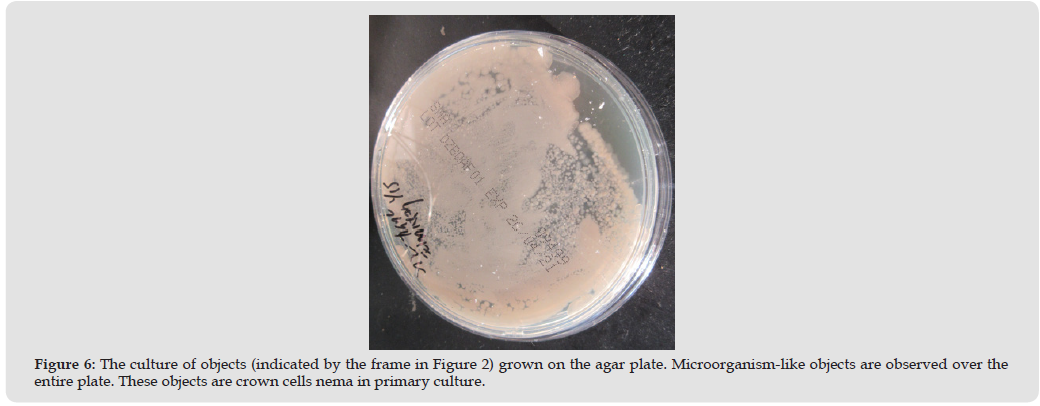
Figure 7
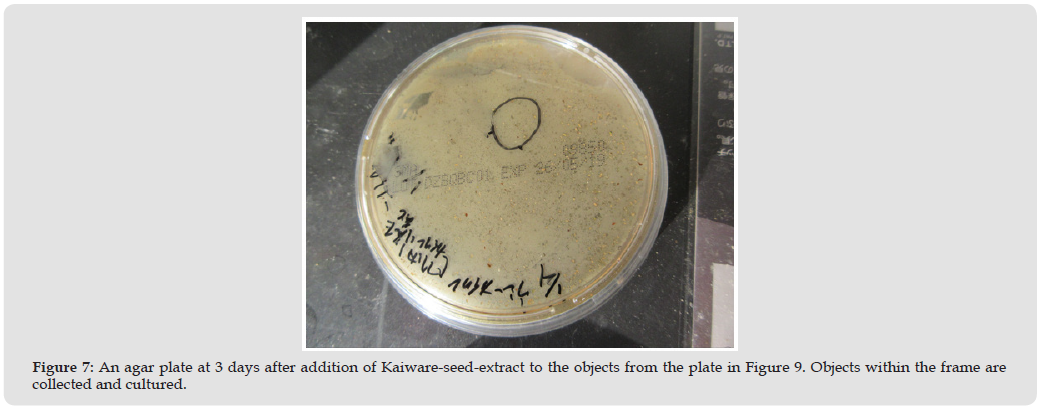
Figure 8

Figure 9
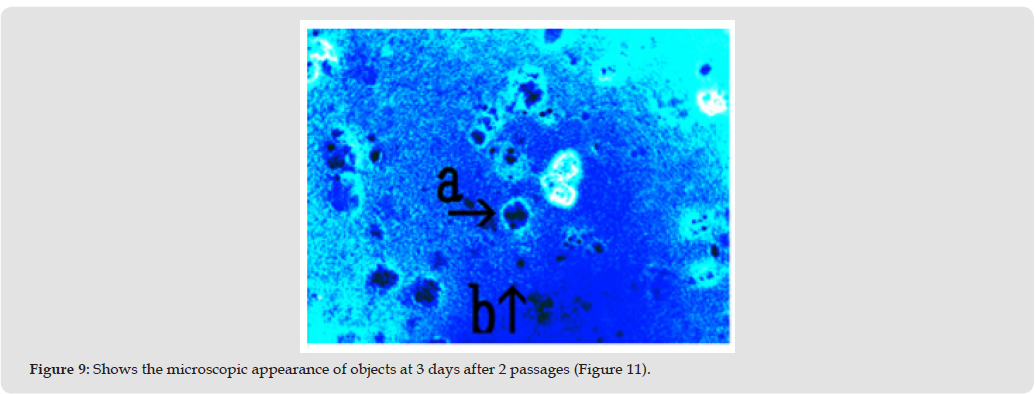
Figure 10
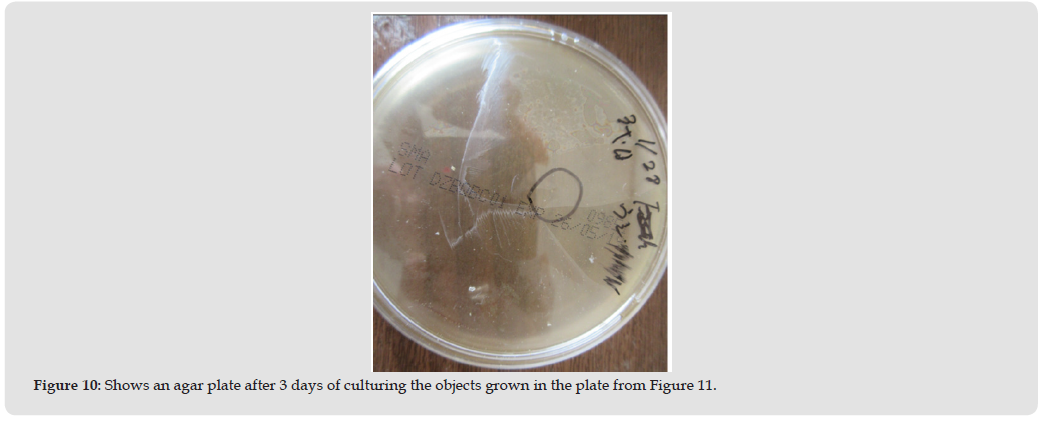
Figure 11

Figure 12
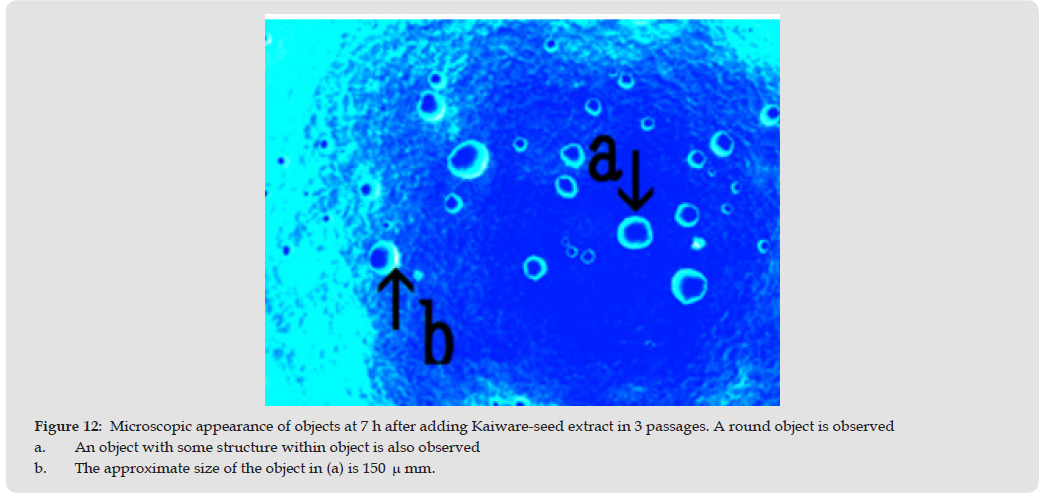
Figure 13
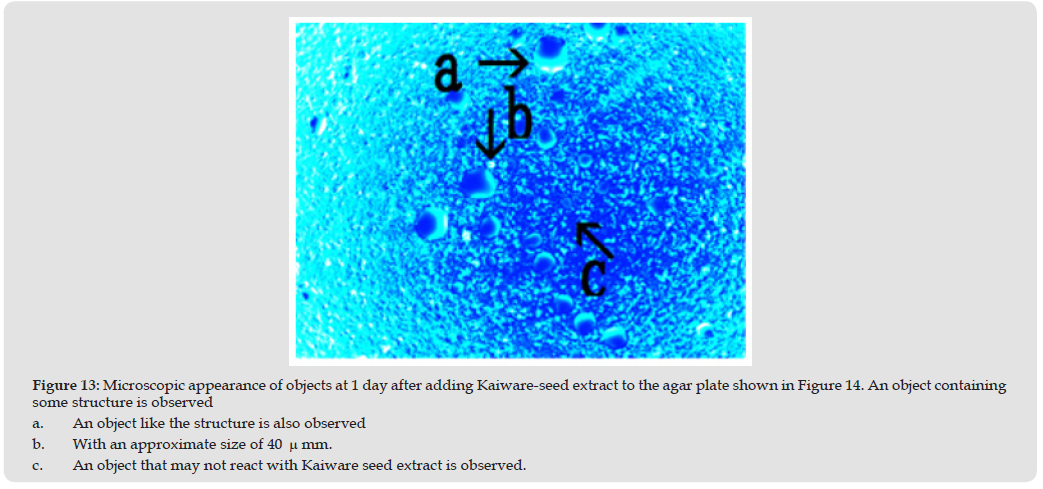
Figure 13 shows the microscopic appearance of objects at 1 day after adding Kaiware-seed extract to the agar plate shown in Figure 11. An object containing some structure was observed Figure 13a. An object like the structure was also observed Figure 13b. An object that may not react with the Kaiware seed extract was observed Figure 13c. The approximate size of the object in Figure 13b was 40 μm. Figure 14 shows an agar plate at 3 days after adding Kaiware-seed extract. Objects within the frame were collected and cultured. Figure 15 shows the culture of objects (indicated by the frame in Figure 14) grown on the agar plate at 3 days after Kaiware-seed extract addition. Microorganism- like objects were observed throughout the whole plate. These were 4th-passage crown cells Nema. Figure 16 shows the microscopic appearance of the culture at 5 h after adding Kaiware-seed extract to the agar plate shown in Figure 15. Objects that may produce some fibers were observed Figure 16a, as well as fiber-like assemblies Figure 16b. The approximate size of objects in Figure 16a was 500 μm. Figure 17 shows the microscopic appearance of culture at 1 day after adding Kaiware-seed extract to the plate shown in Figure 15. An object with some structure was observed Figure 17a. A structure was also observed Figure 17b. A round object that may have been derived from the structure was observed Figure 17c. The approximate size of object Figure 17c was 90 μm.
Figure 14
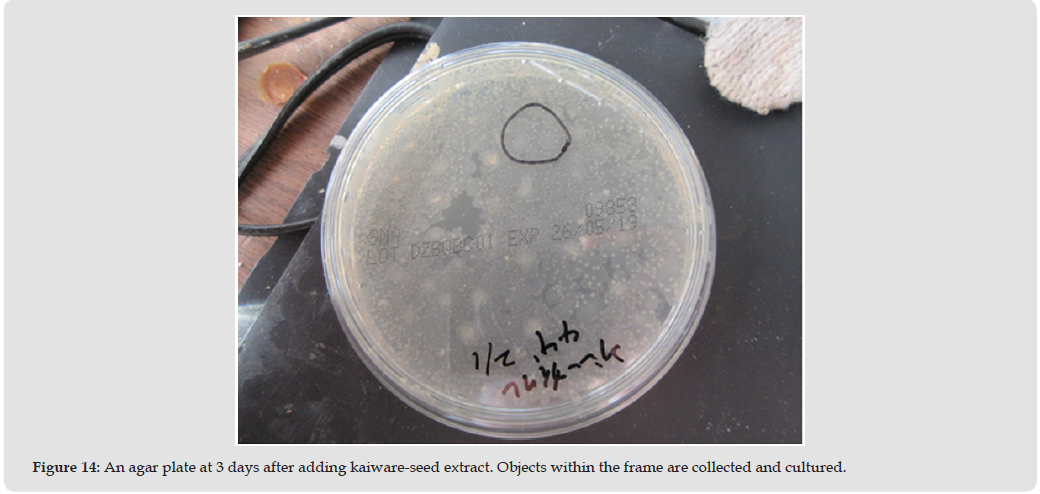
Figure 15

Figure 16
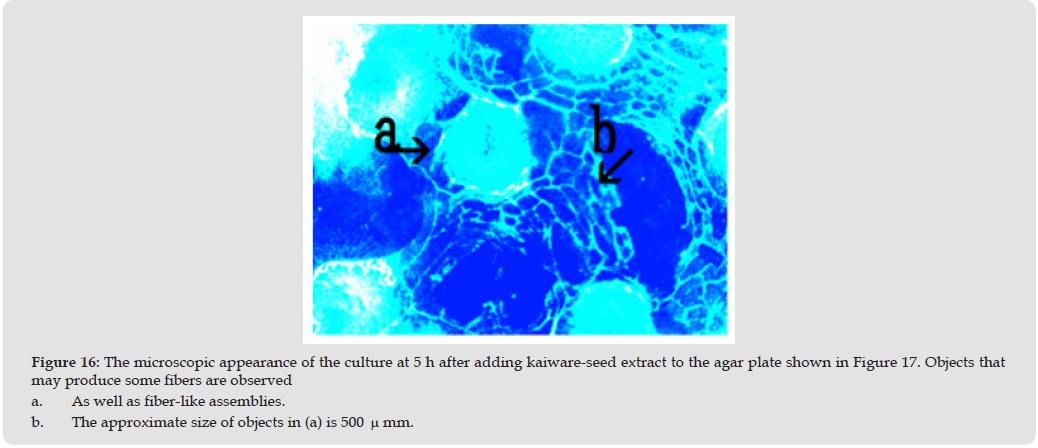
Figure 17

Figure 18 shows the microscopic appearance of the objects shown in Figure 15 at 3 days after adding Kaiware-seed extract. A round object with some structure was observed Figure 18a. A structure was also observed Figure 18b. The approximate size of the object in Figure 18a was 100 μm. Figure 19 shows the microscopic appearance of the objects shown in Figure 15 at 4 days after addition of Kaiware-seed extract. Many round objects with some structures were observed Figure 19a. Objects which may not react with the Kiware- seed extract were observed Figure 19b. The approximate size of the round objects in Figure 19a was 50 μm. Figure 20 shows an agar plate culture of the objects shown in Figure 15. Microorganism-like objects were observed throughout the entire plate. These were 5th-passage crown cells Nema. In previous studies, antibiotic-producing cells (antibiotic crown cells) were produced in combination with various DNA crown cells and partners (e.g., microorganisms such as yeast, Bacillus subtilis, cells such as salmon roe, extracts such as those from bovine meat, and chemical compounds such as peptides) [4–11]. Moreover, previous experiments [12] showed that various unique objects appeared when antibiotic crown cells produced with DNA (Ascidian) crown cells with Glu-Glu as a partner were cultivated on agar plates and Glu- Glu was added. Also, previous studies have demonstrated that antibiotic crown E. coli glu-glu cells and E. coli amino acids form crown cells nema with the addition of Glu-Glu and Amino acids, respectively [13,14]. The present experiments examined whether unique objects (crown Bovine meat kaiware seed ex cells nema) were created by the combination of antibiotic crown (Bovine meat kaiware-seed-ex cells) with Kaiware seed extract and could be serially cultivated. Cultivation of crown cells nema, which appear with the addition of a partner to antibiotic-producing cells, was carried out for 5 passages, and the original crown cells nema were successfully cultivated until 5 passages. Because these objects emerged as a response to the partner, they are classified as cells nema.
Figure 18
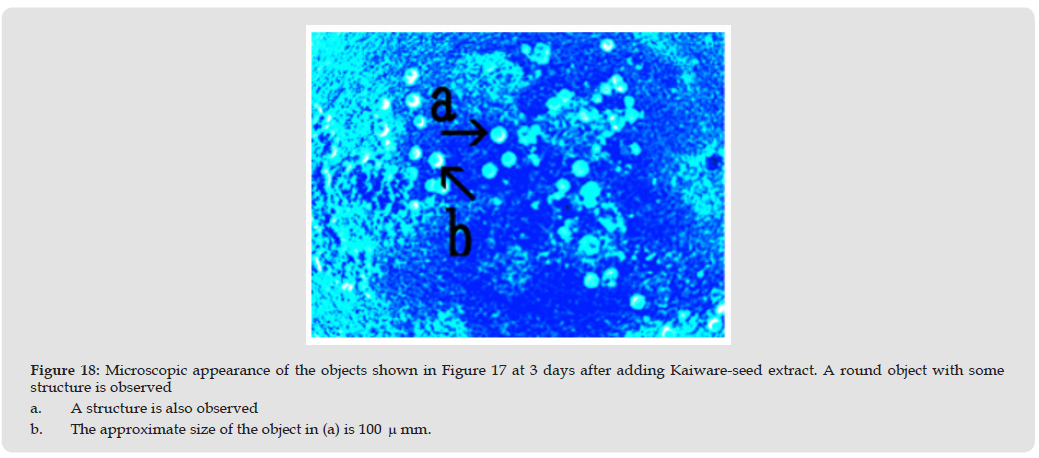
Figure 19

Figure 20

As shown in Figures 16-19 with 4 passages, culture cells seen after the addition of a partner (Kaiware-seed extract) were not evident before the addition of a partner. This implies the cultivated cells represented crown cells nema. Regarding the proliferation of crown cells nema, such cells nema may arise from some structures within the object shown in Figure 17. However, the mechanism underlying the generation of cells nema was not be discussed here, because the subject of the present studies was to clarify whether crown cells nema can be serially cultivated. Crown cells nema were also found to be maintained without the addition of a partner, because serial passages 2–5 were successfully carried out without the addition of a partner. As described previously [12], crown cells nema consist of regenerated DNA crown cells. Thus, the present findings demonstrate that antibiotic crown cells form crown cells nema, and were formed from DNA crown cells prepared with Sph, DNA (Bovine meat), adenosine, and monolaurin. These cells nema that could be a response to partner could be maintained for a long time.
These findings also demonstrate that antibiotic crown cells precede the formation of crown cells nema. Thus, the origin of crown cells nema is DNA crown cells and antibiotic crown cells have the ability to behave as proto-cells for crown cells in addition to the characteristics of anti-Bacillus. Moreover, such crown cells could continue to live. A previous report [12] described on the crown Asci glu-glu cells nema forming with a complex structure and grouping of cells nema based on size and shape may therefore be difficult. On the other hand, in the cases of both crown E. coli glu-glu cells nema and crown E. coli amino acid cells nema, most may be formed with simple round or rod shapes [13,14]. Such phenomena may result from differences in the source DNA (derived from the biology of the single-celled E. coli or multicellular Ascidian). Crown cells nema may consist of several crown cells and comprise a mass of crown cells that may form with regenerated DNA crown cells.The present findings suggest that complex objects may form with the use of DNA (Bovine meat), as a multicellular source organism. That is, the proliferation of crown cells nema may have implications for the appearance of complex objects. On the other hand, microorganisms on Earth are estimated to number 415-6151028, with wide diversity and over 99.9% of these species remain unidentified. Unidentified microorganisms existing on Earth are considered potentially beneficial to human welfare, because cells nema are capable of living a long time, such cells nema may evolve into a unique form of life. However, it may be more likely that these cultivated cells nema degenerate to a kind of crown cell and differentiate again into a microorganism-like form. Anyway, despite the complexity of the underlying processes, unidentified terrestrial microorganism appears to be associated with the formation of cells nema both single and complexes biological systems.
On the other hand, such objects (crown cells nema or crown cells) may represent as-yet unidentified microorganisms exiting on Earth fully recognize that demonstrating the hypothesis would be extremely challenging Here, a hypothesis regarding the origin of as-yet unidentified microorganisms on Earth is stated.
Biological loads involve proliferation of various types of cells. For example, this includes lymphocyte proliferation during immune responses or cancer cell proliferation. Studying crown cells nema may provide insights into the mechanisms of proliferation at work in cancer cells or lymphocytes. On the other hand, the role of the partner (molecules involved as partners) in crown cells nema remains unclear. The partner may, for example, contribute to the appearance of environmental microorganisms or act as an antigenic stimulus for immune responses. In summary, crown cells nema promote cell proliferation in response to stimulation. Therefore, this research may be applicable to understanding proliferation behaviors such as cancer cell growth and lymphocytes expression during immune response. Consequently, it could also contribute to the development of therapeutic strategies for these conditions. This study designed antibiotic crown Bovine kaiware-seed-ex cells. In addition, objects derived from antibiotic crown Bovine kaiware-seed-ex cells after stimulation with a partner (Kaiware-seed extract) were named crown Bovine meat kaiware- seed-ex cells nema. The objects consisting of crown cells nema are named crown cells.

International Association of Landscape Archaeology, Czech Glass Society, Czech Republic

Department of Chemistry, Semenov Institute of Chemical Physics, USSR Academy of Sciences, Moscow, Russia

Department of Educational Sciences, Research Centre Qualities of Teachers, School of Education – HAN, Nijmegen, Netherlands

Associate Professor at Department of Breast and Thyorid Surgey, Chongqing General Hospital, China

Neurology, LA BioMed Research Institute, USA





 Abstract
 PDF
PDF