info@biomedres.us
+1 (502) 904-2126
One Westbrook Corporate Center, Suite 300, Westchester, IL 60154, USA
Site Map
 ISSN: 2574 -1241
ISSN: 2574 -1241
ISSN: 2574 -1241
Received: April 02, 2026; Published: April 08, 2026
*Corresponding author: Chen Yang, School of Electronic Engineering, Beijing University of Posts and Telecommunications, Beijing, P.R. China
DOI: 10.26717/BJSTR.2026.65.010168
Brain-computer interface (BCI) spelling systems based on rapid serial visual presentation (RSVP) can provide communication means for users with motor dysfunctions, but their performance has long been limited by the trade-off between recognition accuracy and information transfer speed. Traditional information transfer rate (ITR) metrics are usually based on the assumption of fixed decision duration, which is difficult to apply to sequential stopping mechanisms. To address this problem, this paper proposes a channel capacity analysis method for dynamic decision-making BCIs, which formulates the character selection process as a multi-hypothesis decision process under sequential evidence accumulation, and treats the transmission duration as a random variable determined by decision thresholds. On this basis, a dynamic channel capacity model is constructed, and simulation analyses of recognition accuracy, average decision time, and channel capacity under different threshold conditions are carried out combined with RSVP spelling tasks. The results show that there exists an optimal threshold for channel capacity under the dynamic decision-making mechanism. Compared with the fixed-length decision strategy, this method can more effectively coordinate the relationship between speed and accuracy, thereby improving the information transfer efficiency of the system. This research can provide a reference for the performance evaluation and parameter optimization of dynamic BCI systems.
Keywords: Electroencephalogram (EEG); Dynamic Time-Division Coding; Channel Capacity
Abbreviations: BCI: Brain-Computer Interface; ITR: Information Transfer Rate; RSVP: Rapid Serial Visual Presentation; EEG: Electroencephalogram
Brain-Computer Interface (BCI) is a type of technology that realizes intention recognition and human-computer interaction by decoding users’ electroencephalogram (EEG) or other neural signals, which has been widely concerned in the fields of communication assistance, neural rehabilitation, and peripheral control [1]. The core indicators for measuring the performance of BCI systems usually include accuracy and transfer rate (e.g., information transfer rate, ITR) [2], and there is an obvious trade-off between them: improving accuracy often requires increasing observation or stimulation duration, thus reducing the information output per unit time; conversely, pursuing a higher rate may lead to an increase in error rate and affect system usability. In practical applications, especially interactive tasks such as spellers, each symbol (character) transmission requires both high accuracy and low latency and high throughput. Therefore, how to effectively balance speed and accuracy is one of the core issues in BCI research and engineering implementation [3]. In the implementation paradigm of BCIs, time-division coding is a commonly used and efficient stimulation/acquisition strategy [4].
Its basic idea is to realize the distinction of multiple candidate targets by organizing stimulation sequences or time slots on the time axis. According to implementation details, it can be divided into several typical paradigms: one is the RSVP-based speller [5], which realizes selection by sequentially presenting candidate characters in a short time and recognizing target-related EEG responses. Another is the time-slot allocation or segmented flashing scheme, where each time slot corresponds to several candidates and provides distinguishable information in the time domain for the decoder [6]. There is also a hybrid coding method based on multi-channel time multiplexing, which jointly encodes spatial and temporal information to improve distinguishability [7]. The above paradigms can adopt different stimulation rhythms, repetition times, and sequence length designs in specific implementations. Traditional performance evaluation often calculates ITR or other capacity metrics based on the premise of a fixed number of sequences or a fixed trial duration. For real-time applications, in addition to stimulation/time-division design, the selection of online decision-making strategies is also critical to system efficiency. Common online strategies include fixed-length strategies (forced decision-making after a preset number of sequences), majority voting or average posterior fusion (accumulating evidence for each candidate within a fixed number of samples before decision-making), and threshold-triggered sequential stopping rules [8].
Among them, the sequential stopping rule judges whether sufficient evidence is reached to stop acquisition and output a decision based on real-time accumulated confidence or log-likelihood ratio, thus allowing different trials to use different numbers of sequences to achieve “on-demand acquisition” [9]. This dynamic decision-making mechanism can stop early to save time when the single-trial signal is clear enough, and continue sampling to improve accuracy when uncertain, thereby improving the speed-accuracy trade-off on average. Although several studies have adopted dynamic stopping or adaptive sampling in engineering, existing channel capacity or ITR metrics are mostly based on the fixed-duration assumption, lacking a systematic analysis method that incorporates variable transmission duration into the information theory framework [10]. To solve the above problems, this paper proposes and systematically studies a channel capacity analysis framework for dynamic time-division coding BCIs based on evidence accumulation. We abstract each character selection as a “symbol” transmission carrying information, couple the information amount of the symbol with its accuracy, treat the transmission duration as a random quantity dependent on the sequential stopping rule, define a dynamic channel capacity metric dependent on decision thresholds, scan thresholds under different classifier performance and time-division coding settings, compare dynamic strategies with several fixed-length baselines, and analyze under what conditions an optimal threshold exists and the potential benefits of dynamic strategies. Finally, we discuss the impact of model assumptions, key points for threshold estimation and deployment in real EEG systems, and propose future expansion directions.
EEG Channel Capacity
This study abstracts each character selection as a “symbol” transmission. The information amount of the symbol depends on the system accuracy under a given decision strategy, and the symbol transmission duration is determined by the sequential evidence accumulation process. We define the dynamic channel capacity as:
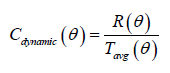
For the entire system, the symbol accuracy under threshold θ is P (θ ) , and the symbol information amount adopts the classical form [2]:

where N is the number of candidate symbols.
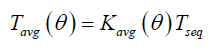
The time consumption of a single stimulation sequence is defined
as Tseq . If the average number of stimulation sequences required to
reach the threshold is Kavg (θ) , the average transmission duration is:
Dynamic Decision Strategy
Taking the RSVP speller paradigm with Q characters in the character set as an example, the differences between different targets are reflected in different time coding, i.e., the positions of target stimulation occurrence moments. For the data to be tested X, we can establish multiple hypothesis testing [11]:
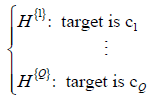
H{1} ~ H{Q} represent hypotheses that EEG signals come from different stimulation targets, and c1 ~ cQ represent characters in the character set. When any hypothesis is accepted, the system outputs the decision result of the current trial and stops stimulation. We define the decision statistic function as:
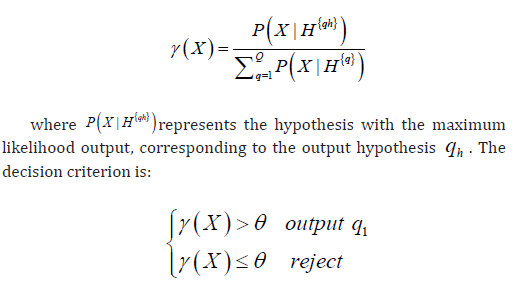
That is, decision-making is only made when the difference between the maximum likelihood probability and the second maximum likelihood probability is large enough, and qh corresponding to the maximum posterior probability is selected as the decision result. θ is the decision threshold, which is usually obtained by parameter scanning of experimental data.
Statistical Model
For the normalized score of a single stimulation sequence, the scores of target stimulation and non-target stimulation can be regarded as random variables, which are used to simulate the decoding performance of the classifier in real EEG data. This is because real EEG has state fluctuations in actual experiments, and changes in signalto- noise ratio affect the decoding performance of single trials. Two random variables are defined to follow Gaussian distribution:
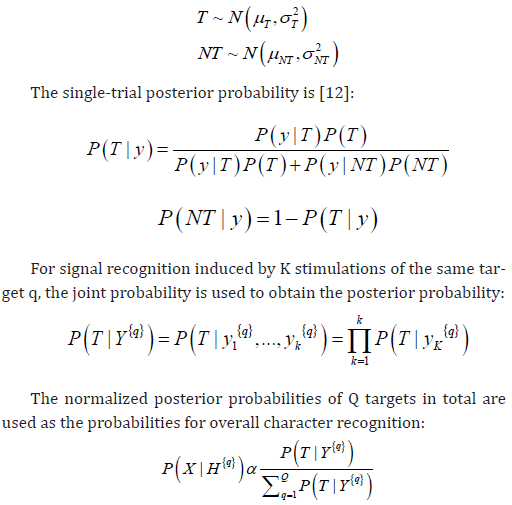
Simulation Experiment Setup This study takes the RSVP speller as an application example because it has typical characteristics of time-division coding. The character set size is set to 26 characters (A to Z). The stimulation is presented in groups, each group contains 26 randomly arranged characters, and the duration of a single group stimulation is 2.6 s. After each group, sequential evidence accumulation dynamic decision- making is performed using all current data to determine whether to output. If not, data accumulation continues until output. The threshold θ is a scanning parameter with a range of 0.1 to 0.9 and a step size of 0.1. The input probability of sequential evidence accumulation dynamic decision-making is obtained from the classifier. The mean score of target stimulation is set to 4.4, μT = the mean score of non-target stimulation is set to 0.26, NT μ = − and the variance of both is σ2 =σ2T =σ2NT =6.0. The classifier performance is related to the difference between μT and μNT ; the larger the difference, the better the performance. The simulation is carried out by the Monte Carlo method to simulate the whole process of character recognition and dynamic decision-making. To obtain stable statistical results, 5000 characters are spelled in each experiment. The simulation objectives are to obtain the spelling accuracy P (θ) and average recognition duration Tavg (θ) , so as to calculate the channel capacity Cdynamic (θ) . Meanwhile, the traditional fixed-length decision-making method is set as a comparison method, using the same single-trial classifier output parameters. The window length is set to 1 to 10 with a step size of 1. The calculation results of the comparison method are compared with those of dynamic decision-making.
(Figure 1) Simulation results show that the dynamic decision- making method can effectively balance recognition accuracy and decision time by adjusting the decision threshold, and outperforms the fixed 5 group decision method in overall performance. Specifically, as the threshold gradually increases, the system accumulates more evidence before outputting a result, so recognition accuracy keeps rising and the amount of information per selection also increases. Meanwhile, however, the average decision time keeps lengthening, indicating that higher accuracy is achieved at the cost of longer waiting time. Precisely because these two trends coexist, channel capacity does not increase indefinitely with the threshold, but first rises and then falls, meaning there exists an optimal threshold interval for the system. In this simulation, the channel capacity of dynamic decision- making reaches its maximum when the threshold takes a moderate level, approximately from 0.3 to 0.4, which is significantly higher than that of the fixed 5 group method. This suggests that although fixed length decision-making is simple to implement, it lacks the ability to flexibly adjust the decision timing according to the strength of current evidence. In contrast, dynamic decision-making can output early when evidence is sufficient and continue accumulation when evidence is insufficient, thereby balancing speed and accuracy more effectively. Overall, the results verify the effectiveness of the dynamic decision-making strategy in time division coding brain computer interface systems, showing that it can significantly improve the information transmission efficiency of the system and has good practical application value.
Figure 1
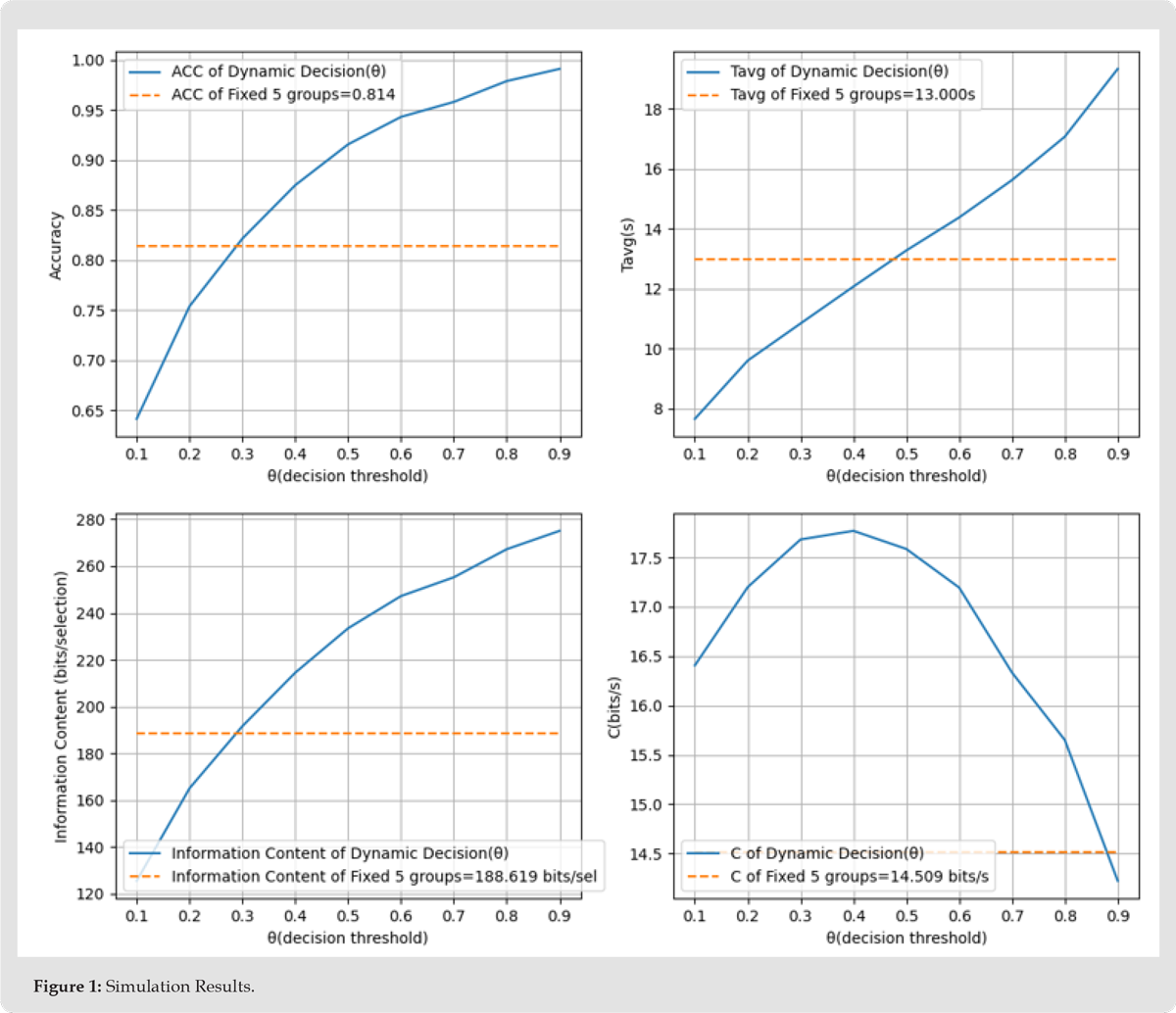
This study proposed a dynamic decision-based channel capacity analysis framework for time-division coded brain-computer interface systems and verified its effectiveness through simulation. The results show that, compared with the conventional fixed-length decision strategy, the proposed method can adaptively determine the decision time according to the accumulated evidence, thereby achieving a better trade-off between accuracy and speed. As the decision threshold increases, the system obtains higher accuracy and greater information content per selection, but this improvement is accompanied by a longer average decision time. Owing to this trade-off, the channel capacity first increases and then decreases with the threshold, indicating the existence of an optimal operating region rather than a monotonic trend. Under the simulation setting, the dynamic decision strategy reaches its best performance at a moderate threshold and achieves a higher channel capacity than the fixed 5-group method. These findings demonstrate that dynamic sequential evidence accumulation can effectively improve information transmission efficiency in BCI spelling systems. Overall, the proposed framework provides a more realistic and flexible way to evaluate and optimize time-varying BCI communication performance, and it has promising potential for practical brain-computer interface applications.

International Association of Landscape Archaeology, Czech Glass Society, Czech Republic

Department of Chemistry, Semenov Institute of Chemical Physics, USSR Academy of Sciences, Moscow, Russia

Department of Educational Sciences, Research Centre Qualities of Teachers, School of Education – HAN, Nijmegen, Netherlands

Associate Professor at Department of Breast and Thyorid Surgey, Chongqing General Hospital, China

Neurology, LA BioMed Research Institute, USA





 Abstract
 PDF
PDF



























