info@biomedres.us
+1 (502) 904-2126
One Westbrook Corporate Center, Suite 300, Westchester, IL 60154, USA
Site Map
 ISSN: 2574 -1241
ISSN: 2574 -1241
ISSN: 2574 -1241
Received: March 12, 2026; Published: April 06, 2026
*Corresponding author: Elnaz Abedini, Faculty of Engineering, Department of Biomedical Engineering, Karabuk University, Karabuk, Turkey
DOI: 10.26717/BJSTR.2026.65.010162
Trauma bone defects, resection of tumors, or developmental malformations are a considerable clinical problem, and advanced regenerative approaches are required. The conventional bone scaffold design platforms, mainly based on parametric CAD and Finite Element Analysis (FEA), are normally constrained in the solution of the complex multi-objective optimization problems involved in meeting mechanical integrity, mass transport, and biological cues. These techniques are typically computationally expensive and fail to resolve the complex hierarchical characteristics of natural bone and its interaction with implanted biomaterials in its entirety. This review presents the idea of the Deep Healing paradigm, in which advanced Deep Learning (DL) models are used to transform the design and optimization of bone tissue engineering scaffolds. We critically examine structural analysis and prediction of properties using Convolutional Neural Networks (CNNs), inverse design using Generative Adversarial Networks (GANs) of complex and bio-inspired geometries (Triply Periodic Minimal Surfaces) (TPMS), time-dependent phenomena (such as degradation kinetics and drug release) using Recurrent Neural Networks (RNNs) and Long Short-Term Memory (LSTMs), and the study of non-Euclidean connectivity in trabecular bone structures using Graph Moreover, we discuss the integration of DL with advanced life-cycle applications, such as, topology optimization, composite scaffold material hybridization, and the creation of Digital Twins to smart 3D bioprinting.
Lastly, we talk about future critical views, including the issue of data scarcity, the problem of black box interpretability in clinical translation, and the evolutionary route in the FDA regulation of AI-generated medical devices, highlighting the transformative opportunity of AI in bone regeneration.
Keywords: Deep Learning; Bone Scaffolds; Tissue Engineering; Multi-objective Optimization; AI; Regenerative Medicine; 3D Bioprinting’ Digital Twin
Abbreviations: FEA: Finite Element Analysis; DL: Deep Learning; CNNs: Convolutional Neural Networks; GANs: Generative Adversarial Networks; TPMS: Triply Periodic Minimal Surfaces; RNNs: Recurrent Neural Networks; LSTMs: Long Short-Term Memory; CAD: Computer-Aided Design; AI: Artificial Intelligence; TO: Topology Optimization
Bone is a dynamic and multifactorial tissue that has amazing regenerative capabilities, but on a large scale or critically sized defects can usually surpass its own inherent healing ability [1]. These defects may be a result of trauma, oncological resections, or congenital abnormalities and contain a high clinical and socioeconomic cost. Existing clinical methods, such as autografts, allografts, etc., have been hampered by donor site morbidity, short supply, and immune rejection [1]. This highlights the need for new approaches in bone tissue engineering, in which biomaterial scaffolds are key transitory assemblies to enable cellular infiltration, proliferation, and differentiation, which will eventually lead to the regeneration of functional bone tissue [2]. Designing an ideal bone scaffold is a multi-objective optimization problem that needs a balanced approach that is delicate between the requirements that are often conflicting [2-6]. Mechanically, the scaffold should be stable enough in terms of stiffness and strength to support physiological loads and eliminate such stress shielding as may result in bone resorption [1,7]. On a biological level, it needs to have a very well-linked porous structure to support the movement of nutrients, waste, and vascularization, as well as cell migration [8-11]. This complex balance can be achieved using the standard design techniques, including Computer-Aided Design (CAD) along with Finite Element Analysis (FEA), which is highly computationally-demanding, and usually based on an empirical trial and error or on a simplified model [3,5,12].
Even though these tools have given some fundamental foothold, their very shortcomings in search over large design spaces, non-linear material behavior, and concomitant optimization over contrasting goals have become more and more explicit. The design process is mostly disintegrated, where mechanical and biological issues are dealt with in a sequential manner rather than in a synergistic manner [2]. The introduction of Artificial Intelligence (AI) and Deep Learning (DL) is an innovative revolution in materials science and biomedical engineering. The unprecedented capability of the DL algorithms in learning complex, non-linear relationships on large data sets provides a powerful paradigm in accelerating the discovery, design, and optimization in bone tissue engineering [13,14]. This new area is called Deep Healing, which proposes a future in which the wise use of intelligent computational models, guided by the insights of biology, will lead to the rational formation of clear bone scaffolds for a patient with unsurpassed accuracy and effectiveness. In contrast to conventional methods, DL is able to study unprocessed data (e.g., medical images, mechanical test results, biological assays) to discover latent patterns and predictive results and go beyond explicit programming and simplified assumptions [15,16]. This ability allows the scaffolds to be inverted, designed such that the functional attributes required to be achieved are the guiding factors to the generative nature of the architectural characteristics, as opposed to sequentially experimenting with a fixed set of geometries [17-19].
This review will set out to critically examine the nature of the deployment of particular DL architectures to maximize the performance of bone scaffolds throughout their entire life cycle. We will explore how Convolutional Neural Networks (CNNs) can be used to accurately analyze structural features and predict properties, Generative Adversarial Networks (GANs) can be used to discover complex, bio-inspired geometries, including Triply Periodic Minimal Surfaces (TPMS), Recurrent Neural Networks (RNNs) and Long Short-Term Memory (LSTMs) can be used to predict time-varying biological and material phenomena such as degradation kinetics, and Graph Neural Networks (GNNs After this technical background, we shall address the ways of how these DL developments are applied into practice, such as topology optimization, high-tech design of hybrid material systems (e.g., polymer-ceramic composites), and creation of “Digital Twins” of intelligent 3D bioprinting and performance prediction in silico. Lastly, we are going to discuss the major issues and opportunities of this rapidly changing field such as the lack of data, the urgent necessity to achieve more interpretability of models (so-called black box problem) and an opportunity to find the way to navigate the complicated regulatory landscape of AI-powered bone regenerative therapies, thus, tracking the path towards really personalized and effective bone regenerative therapies [20].
The aim is to point out the enormous potential of DL so that it makes it possible to achieve Deep Healing, which is to design scaffolds, not only to imitate native bone, but to actively stimulate and expedite its regeneration.
The effective repair of large bone defects requires the use of scaffolds that carefully recapitulate the bone microenvironment in its natural state, both biologically and mechanically [2]. Natural bone is a hierarchical complex material, which is designed to support the mechanical load and enable vital biological processes such as housing of cells, vascularization, and exchange of nutrients [2]. The main issue of bone tissue engineering is the multi-objective optimization problem: developing scaffolds that would meet the high mechanical requirements and offer an optimal biochemical and structural environment to osteogenesis [3,4,6]. Physiologically, bone scaffolds should be mechanically sufficient in terms of their stiffness and strength to support physiological loads without early failure. One of the crucial considerations is the avoidance of stress shielding, and in this case, a significantly stiffer implant absorbs excessive load, causing the surrounding bone to resorb [1]. As such, the mechanical characteristics especially the elastic modulus of the scaffold, must preferably be similar to those of the host bone, which is between 10-30 GPa in cortical bone and 0.1-5 GPa in trabecular bone [7]. Although high porosity is essential to biological processes, it tends to reduce the mechanical strength and stiffness of the scaffold [8,11,21].
On the other hand, excessive stiffness may hamper the transfer of appropriate load to regenerating bone and, thus, impede the maturation of the tissues. High-strength-to-weight ratio and biocompatible materials such as Ti6Al4V are frequently used, though their bulk moduli are much greater than those of the bones, requiring engineering porous structures to bring about the desired matching of mechanics [7]. In addition to mechanical scaffolds, bone scaffolds are essentially biological scaffolds. Their porous structure is the most important in cellular functions. A pore network is needed to be interconnected so that cells can enter and adhere, grow, and differentiate [8,9]. The ideal pore size that is usually between 100 and 500 μm in diameter is important to facilitate angiogenesis (blood vessel formation) and osteogenesis (bone formation) [2]. Poor interconnectivity of pores might result in necrotic cores because of a lack of nutrients in them and an inability to get rid of wastes to promote successful tissue regeneration. One more important parameter is the fluid movement in the scaffold, which is often measured in terms of permeability [4- 22]. Permeability determines how swiftly nutrients and oxygen can reach the cells that are located deep in the scaffold, and the speed with which the metabolic waste products are eliminated. Reduced permeability may cause nutrient loss and cell death, which impairs regeneration [3,23,24]. The high permeability is reported to be crucial in improving the cell viability and the growth of the tissues in several studies [8,25,26].
The complex interplay was demonstrated by Foroughi and Razavi, who proved the possibility of improving mechanical properties and permeability with the help of multi-objective shape optimization [3]. The permeability directly depends on parameters of pore size, interconnectivity, and tortuosity [8,10]. To provide some examples, raising tortuosity, a character of fluid pathways convoluteness, may reduce permeability in spite of high porosity [10]. To improve the mass transport properties without much impact on the mechanical strength, hollow strut designs have been suggested [27]. Likewise, the pore architecture has also been demonstrated to be tuned in Ti6Al4V scaffolds in order to tune both permeability and mechanical performance [26]. Another important biological factor that is critical is the surface area of the scaffold, which defines where the cells attach and allows the adsorption of proteins and growth factors [4]. The surface area tends to be larger and therefore facilitates more cell-biomaterial interaction, which is advantageous to osteoinduction. Nevertheless, when the surface area is too large, the rate of material degradation or unfavorable pore geometries may occur. Therefore, the concomitant adjustment of stiffness, permeability, and surface area would pose a massive design problem [4].
Conventional design approaches tend to have problems with these conflicting goals. Although parametric CAD models admit to geometric control, they need to undergo extensive computational loops (e.g., based on FEA) to assess the effects of any change in the design on various properties [3,5,12]. It is time-consuming and usually restricts the search of the huge design space, and it can produce solutions that are less than optimal. As an example, with multi-objective optimization methods, like in the case of Ferguson et al., the goal is to find a balance in mechanobiological stimulation and biotransportation, but these approaches can remain computationally demanding with more geometries and design variables [5]. The development of state-of-the-art scaffold geometries, such as Triply Periodic Minimal Surfaces (TPMS) and functionally graded scaffolds, is a major milestone in such a multi-objective challenge [6,12,23,28]. TPMS materials like gyroids, diamond, and Schwarz P have high surface volume ratios, high interconnectivity, and isotropic mechanical properties, and are very appealing in bone tissue engineering [12,22,23,]. It has been demonstrated that they are more permeable than traditional lattice structures [22-24]. Functionally graded scaffolds, in which porosity or material composition is spatially varied, seek to recapitulate the heterogeneity of natural bone, to better distribute stress and facilitate region-specific tissue regeneration [21,28,29].
Cheong et al. studied porosity gradients to provide higher mechanical stimuli, whereas Zhang et al. discussed the porosity variation approaches in Ti-6Al-4V scaffolds [21,28]. These intricate geometries, although promising, increase the burden on computer computations to design and optimize them using conventional methods.
Experimental and numerical analysis is continuously being carried out to develop novel equations of permeability and elastic modulus of TPMS scaffolds to gain a deeper insight into their behavior [22]. The microstructure is still a fertile field of study that can affect morphological, mechanical, and permeability characteristics [8]. Voronoi tessellation has been considered as a way to produce porous scaffolds with desired mechanical and permeability characteristics, too [9]. The sensitive trade-off between a brittle and permeable system with mechanical strength, which is typically inversely proportional, is the most important challenge [3,4,8,11]. This requires a switch to more intelligent and efficient design paradigms like deep learning, to traverse such complex trade-offs and open up new scaffold designs [30].
DL Architectures (The Technical Core)
Deep Learning (DL) has become a radical computational paradigm, which provides remarkable potential to process complex data, learn complex patterns, and conduct predictive or generative activities [13,14,31]. DL architectures used to optimize bone scaffolds can overcome the shortcomings of traditional analytical and numerical optimization models by making direct predictions of the relationship between structure, properties, and biological outcomes based on large-scale data sets, allowing more efficient and intelligent design processes.
Convolutional Neural Networks (CNNs)
CNNs are a type of DL algorithm that is particularly developed to handle grid data, which includes images; thus, they are highly efficient in analyzing intricate 3D microarchitectures of bone scaffolds [13,14,31]. Their main advantage is that they can automatically extract hierarchical characteristics by use of convolutional layers that apply filters to input information to extract patterns, edges, and textures, and are then followed by pooling layers that decrease the number of dimensions without loss of important data [32]. Structural analysis and property prediction CNNs are mostly applied in the optimization of bone scaffolds. CNNs may be trained on a dataset of scaffold geometries (e.g., micro-CT scans or CAD models) and properties of the scaffolds calculated experimentally or numerically (e.g., elastic modulus, compressive strength, permeability, stress distribution) to learn complex and non-linear relationships that predict scaffold behaviour [15,16]. An example is a CNN can quickly predict the mechanical behaviour, e.g., stress fields under certain loading configurations, directly based on an image representation of a scaffold structure, much faster than repeated FEA simulations [15]. This is also true in predicting the properties of fluid flows, for which CNNs can predict permeability by looking at the morphology of the pore networks [16]. D’souza et al. presented the study of CNNs at the structural analysis and optimization level, with small samples, which reflects their strength [13].
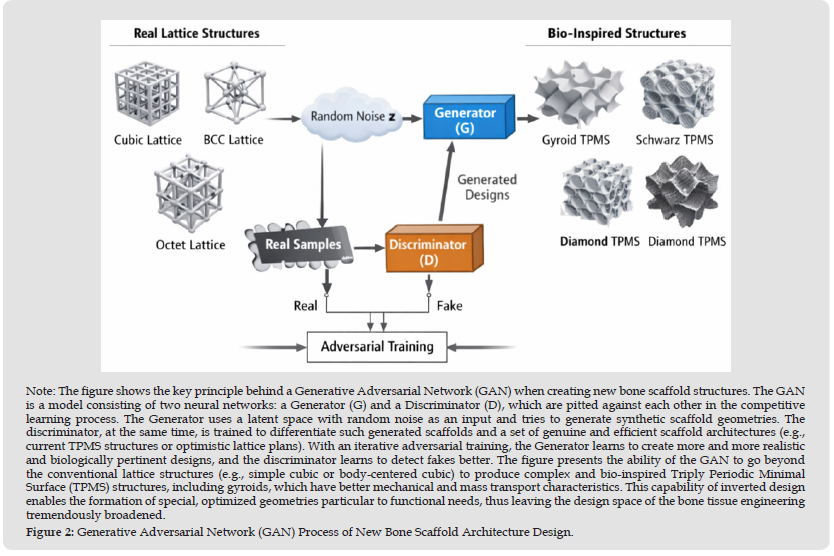
Moreover, the CNNs may be used in the quality control in additive manufacturing to detect defects or departures from the perfect geometry of 3D printed scaffolds by comparing the scanned manufactured object with the required design. The capability of CNNs to draw valuable information out of the spatial information renders them important in comprehending and forecasting the functionality of complex scaffold designs. Generative Adversarial Networks (GANs) are generative AI models that generate images by utilizing adversarial networks and neural networks. <|human|>Generative Adversarial Networks Generative AI models that create images through the use of adversarial networks and neural networks are called Generative Adversarial Networks (GANs). One of the most effective types of DL models that can be used to implement generative design and inverse materials engineering is called Generative Adversarial Networks (GANs) [33,34]. A GAN is made up of two rival neural networks, a generator (G) and a discriminator (D). The Generator is trained to generate new data examples that are similar to the training data, and the discriminator is trained to differentiate between real and generated data. The networks derive benefit through this adversarial interaction, whereby the Generator will eventually generate highly life-like, novel information [33,34]. GANs, especially when used to generate bone scaffolds, can in particular invert design complex geometries based on bio-inspiration, including Triply Periodic Minimal Surfaces (TPMS) and functional grading [17-19].
Conventional techniques used to construct TPMS structures usually entail explicit mathematical equations and therefore restrict the variety and flexibility of the designs produced. GANs are capable of training the underlying distribution of designs with desirable architecture based on a given set of designs with a high level of performance, and subsequently produce all new geometries that meet desired specifications (e.g., desired porosity, desired specific surface area, anisotropic mechanical properties) without explicit parametric guidance [17,18]. This makes new design spaces to be explored, which could not be reached using more traditional parametric or optimization algorithms. To take one as an example, Wang et al. described the inverted design of TPMS structures with the help of the point cloud generation network, which is another application of GANs that is rather similar [17]. Li et al. also examined generative AI algorithms for the inverse design of TPMS geometries of cells as well as performance- based inverse structural design of complex gradient TPMS structures [18,19]. GANs can also be used to design scaffolds that are functionally graded in size and porosity, and with dense struts to form scaffolds in nature that optimize stress distributions and biological responses throughout the implant [21,28,29]. With the help of GANs, engineers can no longer rely on a trial-and-error design but instead abide by a more effective design by performance design, quickly creating scaffolds that are specifically designed to fit clinical needs.
Recurrent Neural Networks (RNNs) / Long Short-Term Memory (LSTMs)
Recurrent Neural Networks (RNNs), and in particular, their more complex case, Long Short-Term Memory (LSTM) networks, are created to work with sequential data and characterize temporal dependencies [35,36]. In comparison with feedforward networks, RNNs possess memory, and they may store the data of some steps in a sequence. This is further improved by LSTMs by creating so-called gates that regulate the flow of information, effectively overcoming the vanishing gradient issue and allowing them to learn long-range dependencies [37,38]. RNNs/LSTMs are indispensable in bone tissue engineering as they can be used to model phenomena over time. The prediction of scaffold degradation kinetics in physiological conditions is one of the most important applications [37]. The rate of degradation of a bio-degradable scaffold should be highly balanced with the rate of growth of new bone to give mechanical support during the healing duration and to prevent early failure or retention of a non-degradable material. When trained on time-series data of mass loss of scaffolds, mechanical property variations, and environmental conditions (e.g., pH, enzyme activity, etc.), such networks can be used to predict the degradation profile of new materials or designs with good accuracy [36,37]. On the same note, it is possible to model and predict drug release patterns of drug-eluting scaffolds using LSTMs to optimize the time-dependent delivery of growth factors, antibiotics, or other anti-inflammatory agents to improve tissue regeneration and avoid complications.
Just as with the applications of LSTMs to predicting remaining useful life in batteries [35,38,39], the LSTMs can also be used to predict the functional lifespan of a scaffold in vivo, which is crucial in clinical planning and personalized medicine. Moreover, they are able to monitor and forecast cell proliferation and differentiation dynamics in relation to the changes in biochemical and biophysical stimuli with time, which can contribute to a better understanding of the biological reaction within the scaffold.
Graph Neural Networks (GNNs)
Graph Neural Networks (GNNs) are a modern form of DL models that can process graph-structured data, which is represented by nodes (entities) and edges (relationships) [40,41]. Non-Euclidean data are also efficiently analyzed using GNNs; in contrast to traditional CNNs, which operate on Euclidean grids (and therefore ideally analyze regular networks, such as the microarchitecture in biological tissues and design of complex scaffolds), non-Euclidean networks are best analyzed using GNNs [41,42]. Optimization of bone scaffold using GNNs is mainly based on the model of non-Euclidean connectivity and structure-property correlations in irregular shapes. The most common example of a graph-structured biological material is natural trabecular bone, and its complex and disordered network of struts. GNNs can incorporate such a complicated structure by computing each bone trabecula or scaffold strut as a node, and their relations as an edge [43,44]. This enables GNNs to learn and examine the natural structural hierarchy and connectivity structures that play a vital role in mechanical integrity as well as fluid transport. Specifically, analyzing the load distribution over the scaffold can predict its mechanical behavior, thereby revealing information about concentrations of stress and possible failure locations that would be unnoticed by traditional image-based CNNs because of the irregularity of the network [41].
They also find application in pore network modeling, where nodes are the pores and the interconnections are the edges, and allow a complex analysis of the transport efficiency and the pathways of fluid flow in pores [41]. This can be especially pertinent to the development of scaffolds that recreate the complexity of the vascular network or fluid dynamics of native bone, which optimize the supply of nutrients and removal of waste [44]. GNNs can provide a potent means of creating biomimetic structures to enhance the best biological integration and long-term functionality because of their ability to capture the non-Euclidean character of trabecular bone and sophisticated scaffold design. Overall, these various DL designs offer a highly effective toolkit to handle the complex problems in bone scaffold design. DL is accelerating the field of regenerative engineering, making complex geometries solvable, creating new structures and predicting time-dependent behaviors, as well as making solutions smart, personalized, and effective.
The introduction of Deep Learning (DL) at every stage of the design and life cycle of bone scaffold development, starting with the formation of its conception and the choice of its material and continuing with its production and further predictions of its performance after implantation, opens the door to a new era of “Deep Healing” development. Here, this section describes pertinent life-cycle applications in which DL has a significant influence.
Optimisation of Topologies and Deep Learning
Topology Optimization (TO) is a computational design approach that allocates material to a defined design space to optimize a performance goal (e.g., stiffness) under certain constraints (e.g., volume, load) [45,46]. Thirdly, traditionally, TO is based on iterative Finite Element Analysis (FEA) solvers that are demanding in computation, particularly complex 3D structures and multi-objective problems [29,47]. DL greatly boosts and hastens TO processes. Instead of solving FEA every time a new design is tested, DL models, especially CNNs, can be trained to predict the optimal material allocation or structural response based upon input parameters or simplified geometries alone [48]. As an example, CNNs may be used as surrogate models and quickly predict mechanical properties of proposed topologies, which saves on the expensive FEA simulations [16]. GANs can also be used to solve generative topology optimization: the networks are trained to produce new high-performance topologies, and they are effectively utilized in the field of inverse design [29,47]. Kouhi-Lakeh et al. presented bio-inspired topology optimization of 3D printed radially graded meta-structures, and showed the promise of such hybrid strategies [29]. Additionally, TO can also help in designing functionally graded scaffolds with DL that will not only guarantee that mechanical properties change strategically throughout the implant in response to physiological load distributions but also reduce the prevalence of stress shielding [47,48].
TO plus DL synergy makes it possible to quickly search large design spaces and arrive at mechanically efficient and biologically relevant scaffold structures that are, in practice, manufacturable through additive methods.
Hybridization (Polymer/Ceramic) of Materials
The biological environment that the human body is complex can require materials with a wide variety of characteristics that can not be found in a single material. The concept of material hybridization and especially the integration of polymers and ceramics has a promising future of scaffold composite development that can capitalize on the advantages of each constituent [49-51]. Polymers are flexible, tough, and tunable biodegradable, and ceramics are osteoconductive, osteoinductive, and stiffer [49,50]. DL is very critical in streamlining the design and composition of such hybrid materials. An example is that the DL algorithms are able to forecast the optimum ratios, distribution regimes, and interfacial attributes of polymer-ceramic composites necessary to obtain a desired combination of mechanical characteristics, degradation, and biological reactions [50]. Through the training on a dataset based on experimental characterization of different composite formulations and performance, non-intuitive synergistic effects can be identified by the DL models. It is especially applicable to 3D printed polymer-infiltrated ceramic networks, with the infiltration strategy and the interface properties of the materials playing a decisive role [49]. Nanomaterial-integrated 3D printing to be used in biomedical applications can also be designed with the help of DL to determine the effect of nanoparticle dispersion and interaction in a polymer-ceramic matrix on the overall performance of the scaffold [52].
Multi-material systems, such as adhesion problems, phase segregation, and byproducts of degradation, can be effectively steered by DL, and customized hybrid scaffolds with advanced mechanical and biological properties can be created [50,51].
3D Bioprinting Digital Twins
The Digital Twin (DT) concept implies that a physical product, process, or system is modeled as a virtual replica and constantly receives new data (in real-time) related to the physical system [53,54]. During the 3D bioprinting and bone tissue engineering, DTs provide a new milestone of control, closed-loop design, manufacturing, and prediction of performance [55,56]. A digital twin of 3D bioprinting typically combines sensor signals of the bioprinter (e.g., nozzle temperature, print speed, bio-ink viscosity, deposition accuracy) with computational models (including DL) to generate a high-fidelity virtual model of the scaffold being printed [55,57,58]. This will allow optimization of processes and quality in real time. The DT can use the DL algorithms to examine the scaffold parameters and predetermine the possible deviation of the desired scaffold structure, which can then be corrected in real-time with minimal defects and guarantees structural integrity [58,59]. This is specifically critical in patient-specific implants where accuracy plays the most important role. In addition to the production, patient-specific scaffold designs with the use of DTs powered by DL can be developed, integrating patient-specific information (e.g., CT/MRI scans of bone defects, biomechanical loading profiles, cellular characteristics) [56,60]. This individualized DT can, in turn, be modeled to be able to simulate different scaffold designs in vivo to predict their mechanical behavior, degradation dynamics, and their biological behavior in the unique physiological environment of the patient [60,61].
As an example, the BioDT architecture is an intelligent biomanufacturing system combining a DT and AI [56]. This predictive potential greatly decreases the use of large amounts of in vitro and in vivo experiments, hastening the field of translation research and improving the clinical risk. Vu et al. emphasize the way of eliminating uncertainty in the biodesign by biofabrication with mycelium, and the scope of their use is impressive [60]. Moreover, DTs can be projected to track the bone scaffold performance that has already been implemented. The DT can forecast long-term osseointegration, scaffold degradation, and bone regression by matching patient-specific data (e.g., follow-up imaging, patient activity) with the virtual model, which provides information to optimize the clinical management [62]. This establishes a closed-loop system in which not only is the scaffold designed and optimized, but the system also constantly tracks performance and provides feedback on its performance to enhance future design, which is the real meaning of “Deep Healing” [54,55]. The design of in vivo evaluation is a big step forward in achieving the full potential of personalized regenerative medicine using a holistic approach.
Although Deep Learning (DL) provides an unprecedented chance to transform the design of bone scaffolds and speed up the paradigm of what can be referred to as Deep Healing, there are key issues that should be addressed to fully achieve the clinical translational potential of Deep Learning (DL). The destiny of AI in the field of regenerative medicine in the next ten years will be determined by its navigation. Data scarcity and quality can be viewed as one of the greatest obstacles in the broad use of DL in optimizing bone scaffolds [13,63]. DL models are also data-intensive models, which can only be trained effectively with massive amounts of various and high-quality data. Relevant datasets in the field of bone tissue engineering, such as detailed 3D scaffold geometries, matching mechanical properties, in vitro cellular responses, in vivo degradation kinetics, and long-term regeneration outcomes, are frequently limited, heterogeneous, and proprietary. It is data-consuming and time-consuming to develop such extensive data sets. Moreover, in many cases, different sources provide such data with different experimental procedures, and it becomes quite difficult to standardize the data. Future directions should aim at creating standardized data collection guidelines, developing data sharing programs between research institutions and industry, and investigating methods of synthetic data creation (e.g., with GANs) in order to supplement existing datasets [13,63]. CNN structural analysis is prone to problems with small sample sizes, which explains why it is important to have robust datasets [13].
The other supreme obstacle is the black box interpretability of the complex DL models [20]. Contrary to the traditional physics-based models, where one can see the mechanism driving them, the DL algorithms, in particular, deep neural networks, tend to issue opaque decisions that cannot be understood by humans. This is a massive hindrance to clinical acceptance and regulatory approval. The regulatory authorities and the clinicians would have to know why they chose a particular scaffold design, the way in which the particular qualities have been simplified, and the risks that might be associated with an AI-generated implant. Devoid of interpretability, the safety and efficacy of AI-designed machines will be difficult to validate. The strategies of Explainable AI (XAI) have to be developed and incorporated. The aim of XAI is to make the AI models more understandable and agreeable since it attempts to provide information on how the decision is made by the model [20]. As an example, XAI might indicate the geometric characteristics or material parameters that played the biggest role in predicting the behavior of a scaffold. Drakoulas et al. started investigating explainable machine learning to scaffold design, which is a promising direction [20]. Another major issue is the changing regulatory frameworks of the FDA regarding AI-generated implants. The emerging AI technology has a tendency to move at a faster pace than regulatory laws.
Regulatory organizations such as the FDA must have clear rules on how AI-driven medical devices should be validated, their performance, cybersecurity, and continuous learning systems [64]. The other critical questions include how to ensure the reproducibility and generalizability of AI models, how post-market monitoring of the device developed by adaptive AI would be organized, and to what degree human control of the decisions made by AI on design is required. Researchers, industry, and regulatory agencies should collaborate in coming up with robust and flexible tracts that ensure safety to the patients and encourage innovation. The process of bringing an AI-generated idea of design to clinically tested implants would be associated with a high level of validation that is above the standard [64]. In the future, the area of optimization of bone scaffolds can be predicted to have a number of trends. There will be an increased use of integration and multi-modal AI, where various DL architectures are integrated into a single framework. An example would be that a system may analyse patient-specific bone defect geometry using CNNs, create optimal scaffold designs using GANs, predict the long-term degradation and biological integration of the scaffold using RNNs, and optimise load transfer through biomimetic pore networks using GNNs. This multi-modal practice will facilitate the holistic design strategy by taking into account mechanical, biological, and time-related factors at the same time (Figures 1 & 2).
Figure 1
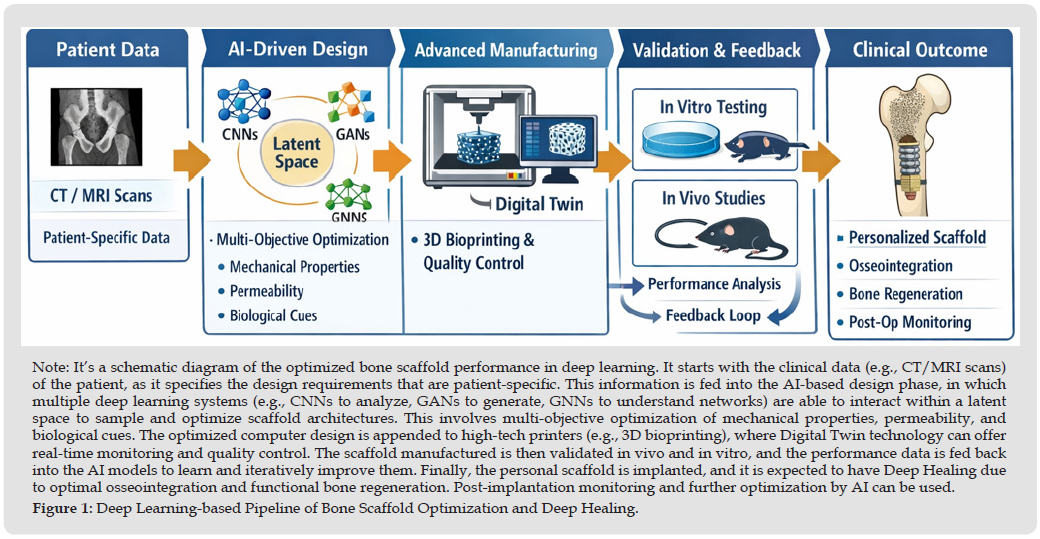
Figure 2
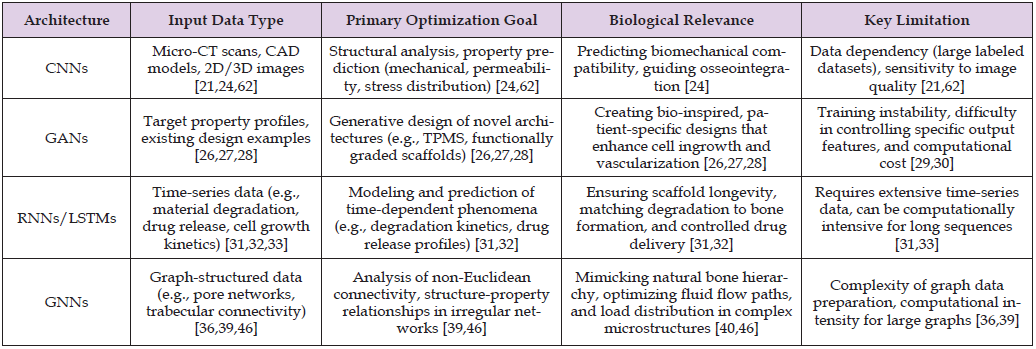
In addition, we expect the transition to closed-loop design and autonomous optimization. It is a combination of real-time sensor data of bioprinting processes and in situ monitoring systems with AI models to develop constantly learning and self-improving design-to-manufacture pipelines [56]. These autonomous structures were not only capable of designing and generating scaffolds but also reacting to unexpected manufacturing variations or even reacting to initial signs of inefficient in vivo operation and continually developing the following generation of implants. The focus of this autonomous future will be the Digital Twin technology that will deliver the physical simulator of constant optimization and predictive analytics to the entire life cycle of bone scaffolds [54,55] (Table 1). Finally, the combination of highly developed AI and high-tech materials and production processes is likely to deliver a level of functionality never seen in bone tissue engineering, as it will stop being an act of fixing a flaw and instead initiate Deep Healing and individualized regenerative medicine [30,65,66].
Table 1: Comparison of Deep Learning Architectures in Bone Scaffold Optimization.

International Association of Landscape Archaeology, Czech Glass Society, Czech Republic

Department of Chemistry, Semenov Institute of Chemical Physics, USSR Academy of Sciences, Moscow, Russia

Department of Educational Sciences, Research Centre Qualities of Teachers, School of Education – HAN, Nijmegen, Netherlands

Associate Professor at Department of Breast and Thyorid Surgey, Chongqing General Hospital, China

Neurology, LA BioMed Research Institute, USA





 Abstract
 PDF
PDF



























