info@biomedres.us
+1 (502) 904-2126
One Westbrook Corporate Center, Suite 300, Westchester, IL 60154, USA
Site Map
 ISSN: 2574 -1241
ISSN: 2574 -1241
ISSN: 2574 -1241
Received: March 16, 2026; Published: March 25, 2026
*Corresponding author: Masayuki Nagasawa, Ohbayashi Medical Clinic, 656-1 Sendano, Shiraoka-city, Saitama 349-0215, Japan. E-mail: mnagasawa.ped@tmd.ac.jp
DOI: 10.26717/BJSTR.2026.65.010149
In recent years, the increase in macrolide-refractory Mycoplasma pneumoniae (MP) infection, which presents failure to achieve fever resolution within 2–3 days after macrolide administration and is highly related with 23SrRNA mutations, has become a problem. We retrospectively reviewed the treatment details in pediatric out-patients with PCR determined MP infection and found that short-term combination therapy with prednisolone (0.4–0.8 mg/kg/day) for three days is useful as treatment for azithromycin-refractory MP infection.
Keywords: Mycoplasma Pneumoniae, Macrolide-Refractory, Corticosteroid
Abbreviations: MP: Mycoplasma pneumoniae; RO: Reproduction Number; AZM: Azithromycin; CAM: Clarithromycin; MINO: Minocycline; TFLX: Tosufloxacin; PSL: Prednisolone
Mycoplasma pneumoniae (MP) is the most common causative pathogen of community-acquired pneumonia in children aged 5 years and older and young adults. Prior to the COVID-19 pandemic, a cyclical epidemic pattern appeared approximately every 1-4 years [1]. The incubation period is relatively long at two to three weeks, and the basic reproduction number (R0), an indicator of infectiousness, is R0 = 1.7 (95% CI: 1.6-1.9). This leads to outbreaks within relatively small groups such as families and schools [2]. This suggests that unlike respiratory viral infections with short incubation periods and high infectivity, it tends to begin as localized regional outbreaks. Since they lack cell walls and are intracellular parasites, bacteriostatic antibiotics such as macrolides, tetracyclines, and fluoroquinolones are used for treatment. The rate of proliferation within cells is slow, taking approximately 6 hours—a very slow pace compared to the typical 20 to 30 minutes for most bacteria. Therefore, in the pathogenesis, the direct damage caused by pathogen proliferation is considered to be a minor factor, while the host’s immune response plays a major role. Regarding the immune response in MP pneumonia, an interesting report comes from a group at the University Children’s Hospital (Zurich) [3,4].
They examined the number of MP-specific IgM-producing B cells (IgM-ASC) as a humoral immune response and the number of MP-specific IFN-γ-producing CD4+ T cells (IFN-γ-CD4+) as a cellular immune response using spot-ELISA. IgM-ASC levels surge sharply in the early disease phase and decline rapidly, whereas IFN-γ-CD4+ T cells increase during the acute phase, persist, and correlate with disease severity. As a result, complications can include a wide variety of conditions such as otitis media, aseptic meningitis, encephalitis, hepatitis, pancreatitis, hemolytic anemia, myocarditis, arthritis, Guillain- Barré syndrome, and Stevens-Johnson syndrome [5]. Inactivated and attenuated vaccines have been attempted, but reports indicate that vaccination can exacerbate symptoms after infection (so-called vaccine-enhanced disease: VED) [6]. To date, no effective vaccine is available. MP infections are generally mild and considered self-limiting. In recent years, the increase in macrolide-resistant Mycoplasma pneumoniae has become a problem, particularly in Asia. In China especially, nearly all Mycoplasma pneumoniae detected in clinical specimens are reported to be macrolide-resistant, and severe MP infections have become a significant concern [7,8]. Resistance is mediated predominantly via point mutation within domain V of the 23SrRNA at position 2063 or 2064, preventing drug binding. It has been reported that failure to achieve fever resolution within 2–3 days after macrolide administration correlates with macrolide resistance with 23SrRNA mutations [9].
Most reports on the treatment of macrolide-resistant MP have focused on hospitalized patients. Numerous reports indicate the effectiveness of corticosteroid treatment for severe cases [10,11]. From May to October 2025, there were 141 pediatric patients (7.84 ± 3.19 years old) diagnosed as MP infection through PCR testing at our medical clinic. All cases improved with outpatient treatment without hospitalization. We retrospectively reviewed the treatment details and their clinical efficacy (summarized in Table 1). Initial treatment failure is defined as “no fever resolution by the third day of treatment initiation and no improvement in the patient’s clinical symptoms.” As initial treatment, azithromycin (AZM) was selected for 69 patients (48.9%), clarithromycin (CAM) for 25 patients (17.0%), minocycline (MINO) for 39 patients (27.7%), and tosufloxacin (TFLX) for 8 patients (5.7%). Twenty-three patients (16.3%) failed to respond to initial treatment and required secondary treatment. Regarding the initial treatment efficacy with monotherapy, MINO was effective in all cases. Secondary treatment was required in half of cases (16/32) with AZM monotherapy. CAM tended to be selected for mild cases. In the initial treatment AZM group, patients receiving prednisolone (PSL) had a significantly longer pre-treatment fever (>38.0℃) duration (3.32 vs 5.57 days) and tended to be more severe compared to those not receiving PSL.
Table 1:
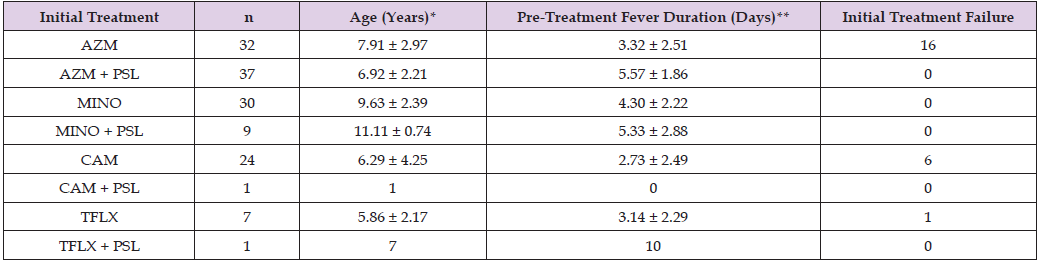
Note: AZM: Azithromycin, MINO: Minocycline, CAM: Clarithromycin, TFLX: Tosufloxacin, PSL: Prednisolone
*: mean ± SD, **: mean ± SD
However, no cases of initial treatment failure were observed in the AZM group receiving PSL. All 10 patients with initial treatment failure in AZM monotherapy group who received secondary treatment with PSL alone also showed prompt improvement. There were no significant differences in age (8.00 vs 7.81 years-old) or pre-treatment fever duration (3.38 vs 3.25 days) between the responders and non-responders in the AZM monotherapy initial treatment group. PSL was administered at 0.4–0.8 mg/kg/day (maximum: 30 mg/day) for 3 days in all cases. Although genetic examination of the presence or absence of 23SrRNA mutations for azithromycin-refractory MP could not been performed in this study, our findings indicate that short-term combination therapy with PSL is useful as treatment for out-patients with AZM-refractory MP infection and warrants further investigation
The authors confirm contribution to the paper as follows: Conception, design, literature review, draft manuscript, preparation and approval: MN, preparation and approval: HO. The authors reviewed the results and approved the final version of the manuscript.
This paper’s content is approved by the institutional review board (2025/11/1, 2025-1101).
The authors declare that there is no conflict of interest to disclose.
The authors declare that the study received no funding.
The datasets analyzed during the current study are available from the corresponding author on reasonable request.

International Association of Landscape Archaeology, Czech Glass Society, Czech Republic

Department of Chemistry, Semenov Institute of Chemical Physics, USSR Academy of Sciences, Moscow, Russia

Neurology, LA BioMed Research Institute, USA

Associate Professor at Department of Breast and Thyorid Surgey, Chongqing General Hospital, China

Professor of Nuclear Medicine, Faculty of Medicine and Surgery, University of Milan, Milan, Italy





 Abstract
 PDF
PDF



























