info@biomedres.us
+1 (502) 904-2126
One Westbrook Corporate Center, Suite 300, Westchester, IL 60154, USA
Site Map
 ISSN: 2574 -1241
ISSN: 2574 -1241
ISSN: 2574 -1241
Received: February 24, 2026; Published: March 18, 2026
*Corresponding author: Atsushi Imai, Department of Obstetrics and Gynecology, Matsunami General Hospital, 185-1 Dendai, Kasamatsu, Gifu 501-6062, Japan
DOI: 10.26717/BJSTR.2026.65.010140
Mucinous cystadenomas may enlarge progressively into substantial masses and frequently remain clinically silent until they attain giant proportions, often being incidentally identified during routine physical examinations or imaging studies. In postmenopausal women or in cases with suspected malignancy, total hysterectomy with bilateral salpingo-oophorectomy constitutes the preferred surgical approach. The management of massive ovarian tumors is associated with considerable risks, including profound hypotension, increased venous return, cardiac decompensation, respiratory compromise, and intestinal distention. Postoperative complications frequently result from abrupt hemodynamic alterations, notably the development of pulmonary edema. The management of these high-risk cases necessitates a multidisciplinary strategy, with rigorous intraoperative and postoperative surveillance to prevent adverse outcomes.
Giant ovarian tumors have become increasingly uncommon owing to the early detection of adnexal pathology facilitated by the widespread use of advanced imaging modalities in contemporary clinical practice [1,2]. In the literature, large or giant ovarian cysts are typically defined as lesions exceeding 20 cm in diameter or extending above the level of the umbilicus. Ovarian cystadenomas are frequently discovered incidentally, often in the absence of specific clinical manifestations, though complicated presentations may include abdominal pain. Among these, mucinous cystadenomas are more prevalent and possess the capacity to enlarge substantially while remaining undiagnosed until reaching considerable dimensions, commonly detected incidentally during routine physical examinations or radiologic imaging [3-5]. If left untreated, they may attain remarkable size and give rise to serious complications such as abdominal compartment syndrome [6] and cyst rupture [7], both of which necessitate urgent surgical intervention. The objective of this mini-review is to underscore such presentations in surgically high-risk postmenopausal women and to expand the existing literature pertaining to this age group, including our cases (see Figure 1).
Figure 1
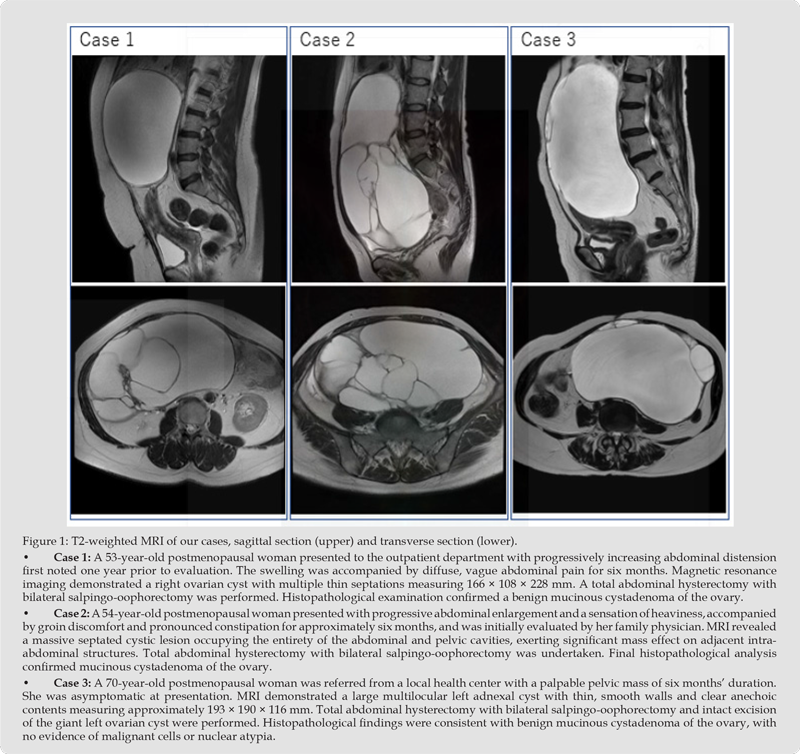
Mucinous cystadenomas can progressively enlarge into massive lesions and frequently remain undetected until they achieve giant dimensions, typically being identified incidentally during routine clinical examinations or ultrasonography. The most commonly reported symptoms include abdominal bloating, progressive distension, fatigue, urinary disturbances, and pelvic or abdominal discomfort. Gastrointestinal manifestations-such as abdominal pain, pressure sensation, flatulence, constipation, or diarrhea-are also frequently documented, in addition to dyspnea, particularly in the supine position or during ambulation. Physical and pelvic examination may initially raise suspicion when a sizable adnexal mass is palpable; however, definitive characterization requires imaging studies. Magnetic resonance imaging (MRI) is recommended as a complementary modality for comprehensive preoperative assessment [8,9]. MRI provides superior soft-tissue contrast resolution, facilitating the identification of subtle intracystic nodules and papillary projections that may suggest borderline pathology.
In postmenopausal women or when malignancy is suspected, total hysterectomy with bilateral salpingo-oophorectomy is generally advocated. Although laparoscopy represents a first-line approach for many adnexal cysts, its applicability in the management of giant cysts remains limited. Technical constraints, particularly restricted operative space, render laparoscopic excision of extremely large ovarian cysts feasible only in highly selected cases and in the hands of experienced surgeons. Although cystadenomas are benign epithelial neoplasms, rare cases of coexistence with anaplastic carcinoma or malignant ovarian Brenner tumors have been reported [10]. According to available literature, mucinous tumors are typically unilateral, as observed in our cases (Figure 1), and are classified as benign (75%), borderline (15%), or malignant (10%). If untreated, these neoplasms may progress to invasive mucinous carcinoma [3-5,11]. Benign ovarian mucinous cystadenomas constitute the majority of mucinous tumors [3-5,11]. They are capable of attaining extraordinary dimensions and rank among the largest tumors recorded in the human body, as exemplified by our patients. In postmenopausal women, the incidence of borderline ovarian tumors declines significantly and is therefore relatively uncommon. Mucinous tumors most frequently arise during the fifth and sixth decades of life; however, their true incidence in postmenopausal women may be underestimated due to earlier detection. Our patients were 53, 54, and 70 years of age and postmenopausal at the time of diagnosis.
In addition to serious complications such as torsion [6], rupture [7], and ascites, prior reports emphasize the potential for life-threatening events in patients with giant ovarian tumors, including pulmonary and cardiac failure, pulmonary embolism, and sepsis [1,12,13]. These risks are amplified by the physiological challenges inherent in managing massive tumors, which may precipitate severe hypotension, increased venous return, cardiac dysfunction, respiratory compromise, and intestinal distention. Postoperative complications often stem from rapid circulatory shifts, particularly the development of pulmonary edema [1,12,13]. One notable concern is supine hypotensive syndrome, resulting from compression of major blood vessels in the supine position; this may provoke abrupt reductions in intrathoracic and intracavitary pressures, leading to significant hemodynamic instability. Accordingly, the management of these high-risk cases mandates a multidisciplinary approach and meticulous intraoperative and postoperative monitoring to mitigate potential complications.
Although rare in postmenopausal women, giant mucinous ovarian cystadenomas may pose substantial risks if not promptly diagnosed and appropriately managed, with a potential for malignant transformation. Heightened clinical awareness may facilitate earlier detection and more comprehensive documentation of such cases.
The authors declare no conflict of interest.

International Association of Landscape Archaeology, Czech Glass Society, Czech Republic

Department of Chemistry, Semenov Institute of Chemical Physics, USSR Academy of Sciences, Moscow, Russia

Neurology, LA BioMed Research Institute, USA

Associate Professor at Department of Breast and Thyorid Surgey, Chongqing General Hospital, China

Professor of Nuclear Medicine, Faculty of Medicine and Surgery, University of Milan, Milan, Italy





 Abstract
 PDF
PDF



























