info@biomedres.us
+1 (502) 904-2126
One Westbrook Corporate Center, Suite 300, Westchester, IL 60154, USA
Site Map
 ISSN: 2574 -1241
ISSN: 2574 -1241
ISSN: 2574 -1241
Received: March 03, 2026; Published: March 18, 2026
*Corresponding author: Muhammad Amir, Virology Lab, Centre of Agricultural Biochemistry and Biotechnology (CABB), University of Agriculture Faisalabad, Pakistan
DOI: 10.26717/BJSTR.2026.65.010136
Geminiviruses are almost exclusively transmitted by the whitefly Bemisia tabaci, which regularly causes 30-100 % yield loss in cassava, maize, tomato, cotton and grain legumes. These diseases already cause billions of dollars in losses annually and contribute to food insecurity in smallholder farming systems that support hundreds of millions of the world’s poorest households. The ongoing climate change that is marked by a 2-4°C warming, high CO2 concentration, extended droughts, heavy rainfalls and increased frequency of extreme weather events is significantly altering the triad of vectors, viruses and hosts accelerating the development of the whitefly and the prevalence of invasive biotypes, promoting viral replication and recombination, inhibiting plant antiviral defense, and expanding into unsuitable altitude and latitude areas. This review brings together the existing evidence that climate change is exacerbating geminivirus epidemics, undermining the usefulness of the existing host resistance, cultural control, and chemical control and increasing socio-economic susceptibility in the region’s most prone to climate change. We examine new proposal to climate resiliency, such as stacked and biotechnology-based resistance, temperature stable biopesticides, landscape scale management of vectors and digital early warning.
This work highlights important knowledge gaps including the lack of multi-factor field experiments, long-term studies of evolution and gender-disaggregated adoption studies the immediate requirement of integrated, prospective methods. The review gives a scientific and policy roadmap to safeguard tropical and subtropical food production through increasing threats of geminiviruses in a warming world.
Keywords: Geminivirus; Bemisia Tabaci; Climate Change; Tropical Agriculture; Host-Plant Resistance; Smallholder Food Security
Abbreviations: CMD: Cassava Mosaic Disease; TYLCD: Tomato Yellow Leaf Curl Disease; CLCuD: Cotton Leaf Curl Disease; ACMV: African Cassava Mosaic Virus; EACMV: East African Cassava Mosaic Virus; RDR6: RNA-Dependent RNA Polymerase 6; EACMV-UG: East African Cassava Mosaic Virus -Uganda; FACE: Free-Air CO2 Enrichment; BGYMV: Bean Golden Yellow Mosaic Virus; PTGS: Post-Transcriptional Gene Silencing; SLCMV: Sri Lankan Cassava Mosaic Virus; MSV: Maize Streak Virus; TYLCV: Tomato Yellow Leaf Curl Virus; MYMIV: Mungbean Yellow Mosaic India Virus
Geminiviruses (family; Geminiviridae) are some of the most destructive pathogens of crop production in tropical and subtropical agriculture, the causes of cassava mosaic disease (CMD), maize streak disease, tomato yellow leaf curl disease (TYLCD), cotton leaf curl disease (CLCuD) and an expanding repertoire of begomoviruses in grain legumes and vegetables (Cohen, et al. [1-3]). These single-stranded DNA viruses are routinely transmitted with a 30-100% loss in yield in resource-poor agriculture where cassava, maize, tomato, common bean and cotton are used as a dietary staple as well as the main source of income (Gbashi, et al. [4,5]). The economic losses already run into the billions of US dollars per year in sub-Saharan Africa and South Asia alone, and they have had ripple effects on food security, rural livelihoods, and regional stability (Rasul, et al. [6,7]). By the middle of the century, under conditions of RCP4.5-8.5, it is projected that 2-4°C of warming will occur in the tropical and subtropical belt, the CO2 concentration will be 550-700 ppm, there will be more drought periods, increased rainfall, and more frequent cyclones (Mulla, et al. [8,9]).
These shifts are radically transforming the geminivirus-vector- host triad: increasing temperatures hasten the growth of vectors and viruses, increased CO2 suppresses the defences of plants and improves the quality of food given to whiteflies, and abiotic stresses impair both natural and implemented genetic protection (Prasad, et al. [10,11]). As a result, geminiviruses are spreading up the mountains and further southward, new recombinant viruses are rising and the old methods of control that were previously effective are failing at an incredible rate. Though increasing awareness, there are several significant gaps in knowledge to alleviate our inability to predict and counteract future epidemics, with very few field experiments yet evaluating combined elevated temperature, CO2 plus drought impacts on geminivirus resistance durability in natural tropical conditions- most evidence remains obtained using controlled-environment chambers, no long-term evolutionary studies of recombination rates and virulence changes under projected climate conditions exist (Yusuf, et al. [12]); the performance of novel biotechnological resistances (RNAi, CRISPR) outside three field seasons, This review is thus urgently necessary to synthesise the fast-growing yet disjointed evidence, to determine the mechanisms driving the emergence of ever-deepening and geographically spreading geminivirus disease epidemics during climate change, to determine the climate-resilience of existing and emerging management procedures, and to clearly identify the research priorities that are required to protect the food security and livelihoods of hundreds of millions of smallholder farmers in the most climate-vulnerable regions of the world.
Few long-term, multi-factorial field experiments at the interface of elevated temperature, CO₂, drought, and rainfall variability, and the corresponding interactions on geminivirus–whitefly–host systems in realistic tropical and subtropical settings, are available. Very few evolutionary and phylodynamic studies that focus on geminivirus mutation, recombination, and emergence of new recombinant strains are available in the context of projected climate warming, altered seasonality, and phylodynamics. Gender-disaggregated and vulnerability- focused field socio-economic studies are severely limited, thus the differential impacts and adoption of management practices by women and other marginalized groups are poorly documented. Integrated modelling approaches combining climate variables, whitefly population dynamics, geminivirus epidemiology, and socio-economic variables in operational systems to anticipate and inform policymakers are still lacking.
Temperature Rise and Heat Waves
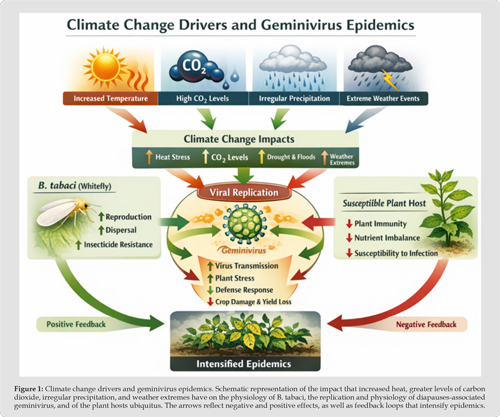
The average temperature in tropical and subtropical areas is already increasing at a rate of 0.8-1.2°C per year above the pre-industrial levels and the heatwaves are extending and becoming more severe (Dar, et al. [13]). Each 1°C change in temperature increases the growth rate of B. tabaci by 10-15 % reducing the generation time and enabling an extra 3-5 generations per season in most areas (LAVANYA, et al. [14,15]). Increase in temperature also shortens the latency of begomoviruses within the vector and in the plant to induce epidemics (Regassa [16]). Controlled experimental studies reveal that virus titre in tomato and cassava plants infected with the virus grows exponentially with temperature exceeding 30°C, with virus viral DNA replication and host RNA silencing inhibited (Malavika, et al. [17]). Extreme heat events also compromise the basal defences of plant, down-regulation of pathogenesis-related proteins makes plants that are otherwise moderately resistant cultivars vulnerable (Chaves [18]).
Elevated CO₂ and Plant Physiological Changes
The free-air CO2 enrichment experiments all indicate that CO2 concentration of 550-600 ppm enhances growth of leaf area and carbohydrates as well as reduces nitrogen and defensive secondary metabolites in cassava, tomatoes and common bean (Ahammed, et al. [19]). Lower levels of phenolic and glucosinolates lower induced resistance to geminiviruses and decrease the quality of phloem sap to B. tabaci, which raises fecundity of the vectors with 20-40 % more (Tanda [20]). At the same time, high levels of CO2 result in the closure of stomata and a decrease in transpiration, which indirectly supports the survival of whiteflies in dry seasons (Manzari, et al. [21]). It is observed that the experiment of heightened combined performance of vectors and diluted plant defences has augmented TYLCV severity indices with 45-80 % in the combined elevated CO2 and temperature conditions (Guo, et al. [22]).
Erratic Rainfall, Drought, and Flooding Events
Drought stress disturbs the salicylic acid and jasmonic acid signalling and reduces both RNA silencing and R-gene-mediated geminivirus resistance (Rahman, et al. [11]). East Africa In East Africa, two outbreaks of severe CMD in 2015-2020 were accompanied by a longterm drought that decreased cassava resistance to African cassava mosaic virus (ACMV) and East African cassava mosaic virus (EACMV) (Elegba [23]). In contrast, excessive waterfall and flood promotes the distribution of whiteflies and forms water-wet tissues, which become pathways of opportunistic co-infections by bacteria and worsen the manifestation of begomoviruses (Regassa [16]).
Increased Frequency and Intensity of Tropical Storms
Physical wounding and defoliation are due to cyclones and hurricanes which provide infection courts and cause whitefly migration in hundreds of kilometers (Sarojini [24]). Surveys following post-cyclone Hurricane Irma and Maria (2017) in the Caribbean showed the highest TYLCV incidence (>90) in low-disease regions ever because of the great influx of vectors (Talbot [25]) (Figure 1).
Figure 1
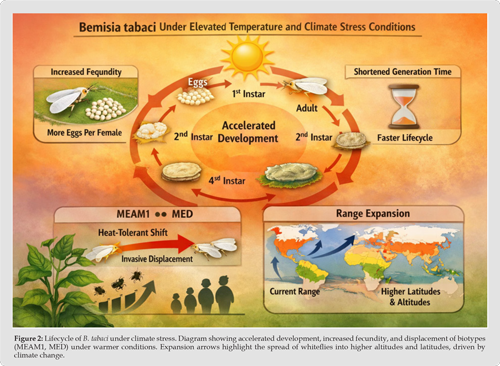
B. tabaci is an agricultural pest which is one of the most thermally plastic and the ongoing climate change is altering the population dynamics, geographic ranges and competitive advantages in a manner that is highly favorable to transmission of geminiviruses (Varma, et al. [26]). The direct influence on B. tabaci life-history characteristics is the strongest in relation to temperature. Constant temperature experiments and fluctuating temperature experiments have produced a parabolic shape of the thermal performance curves, with development rate, fecundity, and survival maximized at between 28-32°C and upper lethal limits nearing 40-42°C when in constant exposure conditions (Chandi, et al. [27,28]). Importantly, with the projected 2-4°C means of increasing by mid-century under RCP4.5-8.5, many sections of the tropics and subtropics will be placed in or near this thermal optimum throughout the year and will thus have a generation time of 16-18 days at 32°C and may have 2-4 generations annually (Compagnoni, et al. [29]). Although acute mortality is caused in adults by extreme heatwaves (>40°C), the overall impact in most of the lowland tropical areas is pronounced escalation in the voltage of the year and population carrying capacity (Matthews, et al. [30]). Using CMIP6 ensembles, species-distribution and bioclimatic envelope models predict that the highly invasive MEAM1 (B biotype) and MED (Q biotype) cryptic species will grow in 15-40 % of their current total climatologically suitable habitat by 2050-2070 (Moyer, et al. [31]).
This has extended into poleward migrations in southern Europe, eastern China, southern Brazil, and the southern United States, and altitudinal migration of 300-800 m in the Andes, East African highlands, and Himalayan foothills, which used to be too cool to undergo overwintering (Masters, et al. [32]). These projections are already realised: The real range shifts have been colonised by MED above 40°N in Europe and 35S latitude Australia in the past 15 years (Hudson [33]). The rapid displacement of biotypes is also caused by warming. Less polyphagous endemic populations of B. tabaci are being replaced by MEAM1 and mostly MED which are more fecund, wider-range, and more efficient transmitters of most begomoviruses (Naranjo, et al. [34]). On the Mediterranean basin, MED has replaced endemic biotypes nearly entirely over a decade, which is closely linked to a 23C increase in mean winter temperatures, which prefers MED to survive the winter. Similar displacements are currently being reported in southern China, eastern India and East Africa where MED and MEAM1 are now dominant in agroecosystems that were formerly inhabited by Asia II or SSA bias (Vyskocilova, et al. [35,36]).
Growth of CO2 (550-700 ppm) offers another, indirectly, performance- enhancing effect to vectors, namely, it raises the phloem amino- acid concentration and depresses plant defensive chemistry, which raises whitefly nymphal survival and adults fecundity by 20-50, even at heat stress. Thereby, climate change is not simply lengthening the geographical and seasonal range of B. tabaci, but is actively favoring the most invasive and virus-competent cryptic species, establishing the perfect environment of geminivirus outbreak and proliferation in the world tropics and warming subtropics (Walls [37]) (Figure 2).
Figure 2
Temperature is one of the key regulators of host-virus interactions and kinetics of geminivirus replication. Both in vitro and in planta experiments show that the multifunctional replication-associated protein (Rep, also known as AC1/C1) has an optimum at 30-35°C, and enzymatic rates are 3-8 times faster at 30°C than at 25°C (Kim, et al. [38]). As a result, accumulation of viral DNA in tissues in systemic infections is 515-fold higher at 33°C than at lower temperatures, which is accompanied by faster cell-to-cell and long-range migrations. Increased temperature also inhibits the post-transcriptional gene silencing (PTGS), which is the most dominant form of antiviral defence among plants. Production of virus-derived siRNAs and the activity of RNA-dependent RNA polymerase 6 (RDR6) all decrease rapidly above 30°C, allowing rapid systemic invasion which is normally limited at lower temperatures (Jauvion, et al. [39,40]). Heat stress also enhances the evolution rate of geminiviruses by augmenting the mutation and recombination rates. Blistering temperatures help increase the rate of template switching by Rep during rolling-circle replication and facilitate pseudo-recombination between different begomovirus species that infect the same cell concurrently (Diamos, et al. [41]). Laboratory and field experiments indicate that there is an increase in recombination events 412-fold during periods when plants are held at 3°C compared to periods during which plants are held at 25°C especially with mixed infections.
The prototypical case is East African cassava mosaic virus -Uganda (EACMV-UG), a recombinant of the African cassava mosaic virus (ACMV) and East African cassava mosaic virus (EACMV) that occurred in the mid-1990s and precipitated the disastrous CMD pandemic in East and Central Africa (Elegba, et al. [2,23]). The evidence of genomic analyses and phylodynamic reconstructions has shown that its explosive diffusion was enhanced by the presence of a long-term, 0.8-1.2°C regional warming trend that started in the late 1980s, which not only contributed to an increase in vectors competence but also to host silencing defenses being loosened (Chellappan, et al. [42]). Synergistically enhancement of viral load (up to 20-fold) and symptom severity are obtained with combined exposure to 33-35°C and 650-700 ppm CO2, which is much larger than due to these factors individually (Krishna [43]). In addition, extended warm seasons also increase the temporal opening of overlapping infections with numerous begomovirus species, and increase the likelihood of new recombinant emergence (Jabłońska-Sabuka, et al. [43,44]). The existing (considerable) evidence thus indicates very clearly that climate warming is not only enhancing the severity of already existing epidemics, but also playing an active role in generating new, more aggressive geminivirus strains a definite evolutionary intensification of the threat in tropical and subtropical agro ecosystems (Potnis, et al. [45,46]) (Table 1).
Table 1: Climate stressors and their impacts on the geminivirus-whitefly-host system.
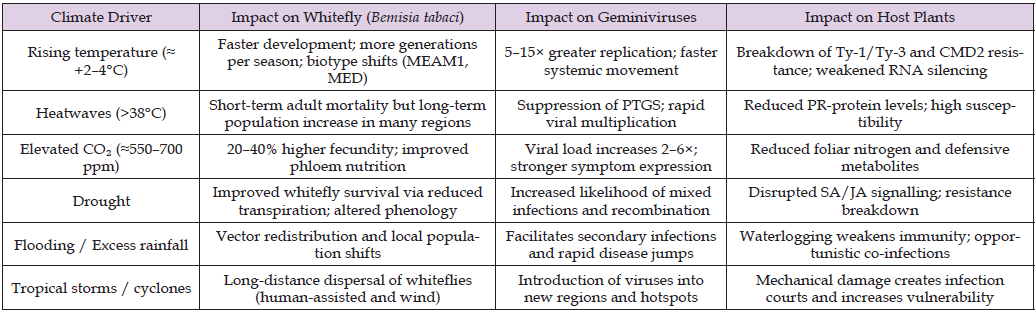
Climate change changes the physiology and biochemistry of plants in a systematic favoritism to the geminivirus infection and replication, regardless of the actual influence on the virus or its vectors. High levels of atmospheric CO2, which will rise to 550-700 ppm by the mid-century under RCP 4.5-8.5, leads to a significant reallocation of carbon- nitrogen in C3 crops that dominate the tropical agriculture (cassava, tomato, common bean, cotton, grain legumes, etc.). According to the free-air CO2 enrichment (FACE), and controlled-environment studies, the effect of 15 to 35 % increments in leaf non-structural carbohydrates is accompanied by 10 to 30 % decreases in foliar nitrogen and protein content (Godara, et al. [47-49]). This dilution of nitrogen, combined with transcriptional repression of phenylproanoid, lignin, and polyphenol biosynthesis, sharply reduces the levels of defensive secondary metabolites (phenolics, tyrosine decarboxylase, trypsin inhibitors), as well as pathogenesis-associated (PR) proteins. Consequently, viral loads become astronomical: TYLCV DNA titres in tomato and ACMV titres in cassava are 2-6 times higher at 700 ppm CO2 than in the atmosphere, and the severity of symptoms increases by 50-80 % at the same inoculation pressure (Bahar, et al. [50,51]). The further undermining of antiviral defences by convergent molecular mechanisms is provided by drought and heat stress which become co-occurring on future climate situations.
Water deficit inhibits the signaling of the salicylic acid (SA) and jasmonic acid (JA), disrupts post-transcriptional gene silencing (major antiviral route in plants), and suppresses essential resistance loci (Ray, et al. [52]). The temperature-sensitive Ty-1 and Ty-3 alleles (RNA-dependent RNA polymerases) of tomato become inactive at temperatures exceeding 32-35°C which allows systemic movement of TYLCV that would be limited. Likewise, CMD2-type resistance in cassava, which is based upon a combination of slowed viral replication and limited cell-to-cell movement, fails at altitudes of combined heat and drought, and field trials in East Africa reported 60 to 95 % incidence of the resistance in formerly resistant varieties under extended dry-hot conditions (Shen, et al. [53]). All these effects are not simply additive: concomitant exposure to high CO2, heating, and moderate drought may completely annul resistance, resulting in viral titres and expression of symptoms that are equivalent to that of susceptible genotypes (Jeger [54]). More importantly, these physiological alterations also increase good host quality towards B. tabaci. Enhanced phloem amino-acid provision and decreased secondary metabolites enhance whitefly fecundity and longevity and form a positive feedback mechanism enhancing transmission efficacy (Li, et al. [55]).
Therefore, plant-mediated indirect interactions are a highly effective yet underestimated way in which climate change is undermining both natural and implemented resistance, making the existing control measures more ineffective in the same environment where geminiviruses have caused the most severe threat to food security (Srivastava, et al. [56]). The integrated high CO2, warming and drought because synergies which tend to lead to near-total breakdown of resistance and the drastic increase in the level of whitefly performance owing to the quality of phloem becomes better. These are indirect, plant-mediated effects that are a highly important, yet often ignored cause of future intensification of geminiviruses (González-Klenner, et al. [57]).
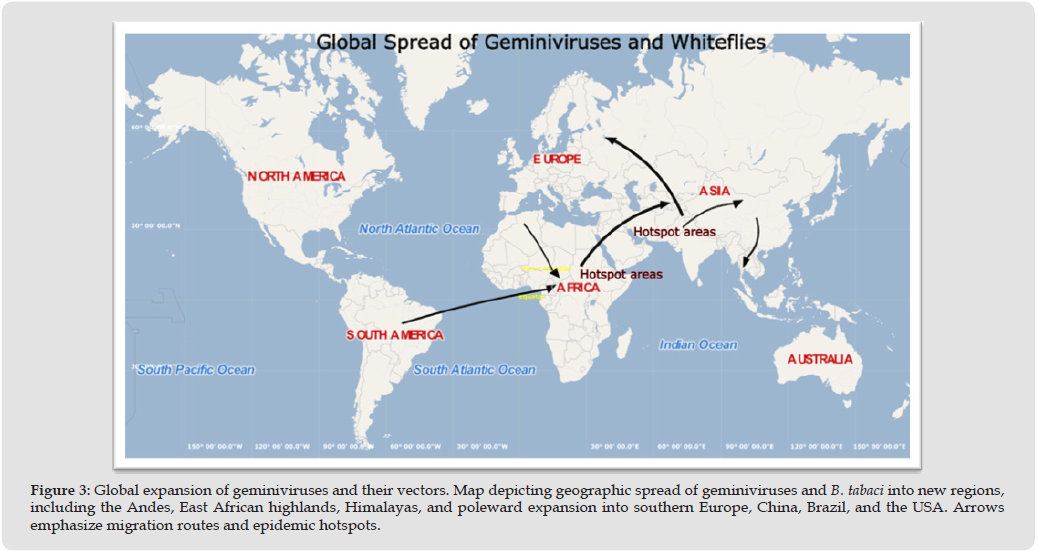
As a result of climate changes, the footprint of geminiviruses is growing fast outside of traditional lowland tropical regions. The MEAM1 and MED biotypes of B. tabaci along with their corresponding begomoviruses have colonized altitudes above 1800-2200 m in Andes, East African highlands and Himalayan foothills areas previously thought too cool to support consistent transmission. Coexistences of tomato leaf curl and cassava mosaic diseases are currently threatening the highland potato-tomato and enset systems that had previously never experienced the diseases (Shakir, et al. [58]). Cassava mosaic disease (CMD) was first described in Cambodia (2015) and Vietnam (2017), spreading with epidemiological veracity over the past 5 years, covering more than 500,000 ha - concomitant with a 1.5°C increase in regional temperature and the introduction of invasive B. tabaci populations. Poleward and altitude growths of the same type are reported of cotton leaf curl viruses in northern India and Pakistan, and bean golden yellow mosaic virus (BGYMV) in Central America. These intrusions highlight the fact that a warming world requires new epidemic frontiers (Sastry, et al. [59,60]) (Figure 3).
Figure 3
Cassava and Cassava Mosaic Geminiviruses
The annual losses of African cassava mosaic disease (ACMV) and East African cassava mosaic disease (EACMV) complexes are estimated to be over US1 -2.3 billion in sub-Saharan Africa alone. In the recent past (since 2015), a virus named Sri Lankan cassava mosaic virus (SLCMV) spread across Southeast Asia has effected over half a million hectares and potentially causing one-quarter of the global cassava starch production (Minato, et al. [61]).
Maize
The Maize streak virus (MSV) has expressed steep outbreaks in southern and eastern Africa whereby the long warm seasons have expanded the vectors (leafhoppers) working hours and supported the wingless infection cycles through the year (Mushayi, et al. [62]).
Tomato and Pepper
Tomato yellow leaf curl virus (TYLCV) has no longer remained seasonal but has become a perennial throughout Mediterranean Europe and temperate Asia and outbreaks of the virus have become common in regions that were previously marginal because of cooler winters (Lefeuvre, et al. [63]).
Cotton
Since 2015, cotton leaf curl disease (CLCuD) has returned violently in India and Pakistan due to temperature-tolerant recombinant begomoviruses and the high population of the B. tabaci MED (Saleem, et al. [64]).
Grain Legumes
The begomoviruses which include mungbean yellow mosaic India virus (MYMIV) and its allied virus are spreading northwards in India at a rate of 10-15 km/year with up to 70 % losses in mungbean, black gram and soybean (Dhobale, et al. [65]) (Figure 4).
Figure 4
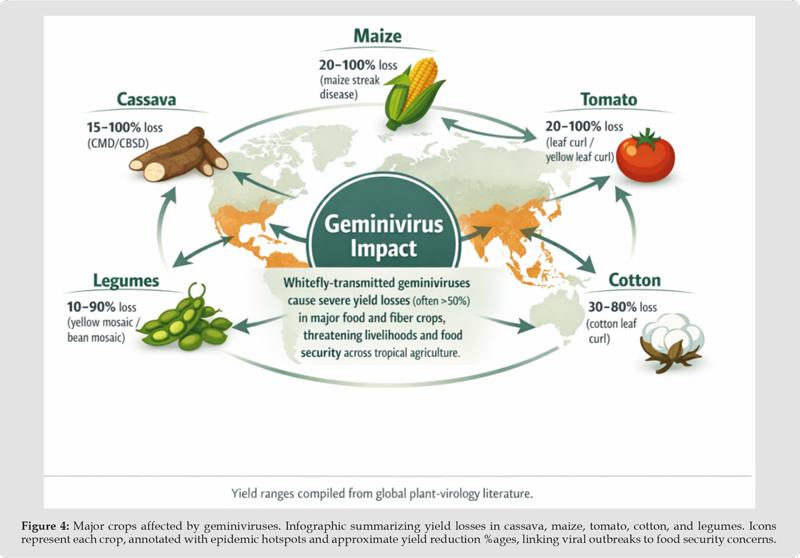
Geminivirus epidemics have the highest socio-economic effects on smallholder agricultural systems that permeate the tropical and subtropical agriculture (Sastry, et al. [66]). In sub-Saharan Africa, South and Southeast Asia, and the areas of Latin America, the affected households produce less than 2 ha of mostly susceptible staples (cassava, maize, tomato, common bean, and cotton) that yield 60-90 % of the caloric and cash income (Vanderschuren, et al. [67]). The losses incurred by the farmers of 40-100 % in case of an extreme outbreak directly translate to acute food insecurity, forced sale of assets, malnutrition of children and migration with women and children, who are the main food producers and primary caregivers, carrying a disproportionate burden. Pandemic CMD in East Africa has been causatively associated with higher rates of stunting and school dropout, continuing a cycle of poverty by the generations (Legg, et al. [68]). Economic losses are already overwhelming. Sub-Saharan Africa alone, which is the region worst affected by cassava mosaic and brown streak viruses, conservatively estimates annual losses to be US 1.2-2.3 billion and the indirect multiplier effect (lack of labour productivity, increased food prices, and emergency aid) is estimated to approach US 4-6 billion (Rey, et al. [69]). Similar losses are realized in tomato and cotton by begomovirus complexes in South Asia, and protein security to >500 million people is now threatened by emerging threats to grain legumes (mungbean, black gram, soybean) (Sattar, et al. [70]).
Under RCP8.5, these amounts are projected to rise by 3060% by 2050 due to climate-related intensification and geographic expansion, but East and Central Africa, the Indo-Gangetic Plain, and the mainland Southeast Asian regions have been identified as the hottest spots (Riahi, et al. [71]). The increase in the pressure of vectors has led to an expensive insecticide treadmill that overloads the poor farmers. The resistance of whitefly to over 60 active compounds such as neonicotinoids, spiromesifen, cyantraniliprole, and pyriproxyfen is now nearing fixation in most areas compelling spray frequencies up to 15-30 applications in tomato and cotton systems at cost of over US 800-1500 $ per ha. Such spending usually surpasses smallholder gross margins of less than 1 ha, which cause indebtedness and land abandonment (Abubakar, et al. [72]). Sex-disaggregated data shows that women farmers who operate most of vegetable and legume lands have special problems with obtaining credit, protective gear, and safer options, leading to increased pesticide exposure and adverse risks to their health (Black, et al. [73]). In addition to farm-gate economics, more chemical containment is leading to externalities in the environment and public health. Reduced population of pollinators (bees, butterflies) due to neonicotinoids drift have limited yields of insect- reliant crops by 10-25 % in watersheds with neonicotinoid contamination, and have resulted in chronic risks of surface and groundwater contamination in tropical river basins with high populations (Vanbergen, et al. [74]).
These external expenses, which are hardly internalized in estimates of losses, also contribute to the weakness of downstream populations. Together, the socio-economic impact of climate-enhanced geminivirus epidemics is much greater than direct loss of yield, posing a threat to the realization of several Sustainable Development Goals (SDG 1: No Poverty, SDG 2: Zero Hunger, SDG 5: Gender Equality, SDG 6: Clean Water) in the regions of the world that are most vulnerable to climate change (Bose, et al. [75,76]) (Table 2).
Table 2: Socio-economic vulnerabilities linked to climate-driven geminivirus epidemics.

Host-Plant Resistance
The host-plant resistance has been the pillar of the management of geminiviruses within the tropical systems that are resource constrained (Patil, et al. [77]). Historical incidence of cassava cassava has been controlled by polygenic CMD2-type resistance and marker-mediated introgression of dominant monogenic resistance in TME 14, TME 204, NAROCASS 1–5, and the vitamin A series cassava to less than 10 % under historical climatic conditions (Tokunaga, et al. [78]). The Ty-1/Ty-3 complex (which encode RNA-dependent RNA polymerases) of tomato has given strong protection against TYLCV and other begomoviruses in the Mediterranean, Middle East and South Asia (Verlaan, et al. [79]). But several sources of evidence now show that these resistances are extremely temperature-dependent. Temperatures higher than 35°C during the day and higher than 28°C at night inhibit Ty-1/Ty-3-mediated RNA silencing and systemic viral movement has been shown to allow severe expression of symptoms and hypersensitive responses. In Uganda and Tanzania (2020-2024) field surveillance documented complete CMD2 resistance breakdown in extended heatwaves (>38°C over 10 days continuous) with, depending on the cultivar, CMD2 incidence increasing to less than five % (prev pre-surveillance) to 60-95 % (prev post-surveillance) (Sett, et al. [80]). The same collapse of minor-gene background resistance has been noticed in heat + drought and this implies that contemporary breeding products might collapse at the time and place they are most required the most (Gadag, et al. [81]).
Cultivation and Phytosanitary Measures
Inoculum pressure has been reduced and epidemics postponed using cultural controls, including rogueing of infected plants, early synchronised planting, reflective mulches, and polyculture, historically. But warmer winters and longer growing seasons currently keep whitefly populations alive all year round, removing the years when whiteflies were traditionally not present, and thus made such practices effective (Kruidhof, et al. [82]). The effect of extreme rainfall, which is likely to rise in frequency and intensity, is that it flushes away the mulch shields and submerges physical traps, and a long cloud cover makes UV-reflective surfaces less effective (Díaz Desani, et al. [83]). In India, farmer member surveys indicate that farmer intercrops that used to be protective against begomovirus spread, such as maizebean- cowpea, are no longer effective where B. tabaci overwintering survival is increasing with warmer winters (Singh [84]). Such changes make most of the less expensive cultural strategies unreliable in future climatic conditions, especially to smallholders who are not able to change planting schedules, or even invest in climate-adaptive planting.
Chemical Control
The whitefly control using insecticides is still common irrespective of sustainability issues. The basis of vector management in the tomato, cotton and vegetable systems has been comprised of neonicotinoids (imidacloprid, thiamethoxam), spiromesifen, cyantraniliprole, and pyriproxyfen. Nonetheless, high temperatures (>32°C) greatly decrease residual activity, cuticular penetration and translocation of systemic compounds through phloem, frequently halving effective field persistence (Atia, et al. [85]). At the same time, the metabolic resistance that is mediated by overexpressed cytochrome P450 monooxygenases (especially in CYP6CM1 and its orthologues) has rapidly disseminated throughout Asia and Africa and has resistance factors more than 1,000-fold to spiromesifen and cyantraniliprole in MEAM1 populations in India, Pakistan, and Burkina Faso (Wang, et al. [86]). Opposition to neonicotinoids has now become almost obsessive in numerous areas and now demands farmers to resort to costly and hazardous cocktails of these substances that only serve to worsen the pollinator crisis and environmental contamination. With anticipated warming, the combined effect of declining insecticide efficacy and increasing resistance will pose a threat to make chemical control not only economically unsustainable but ecologically unsustainable to most smallholder systems in the coming decade (Wells [87]). Combined, these shortcomings indicate that the three prophecies of modern integrated management - genetic resistance, cultural practices and chemical control - are all crumbling together under climate change and there is an urgent need to develop next-generation climate- resilient strategies.
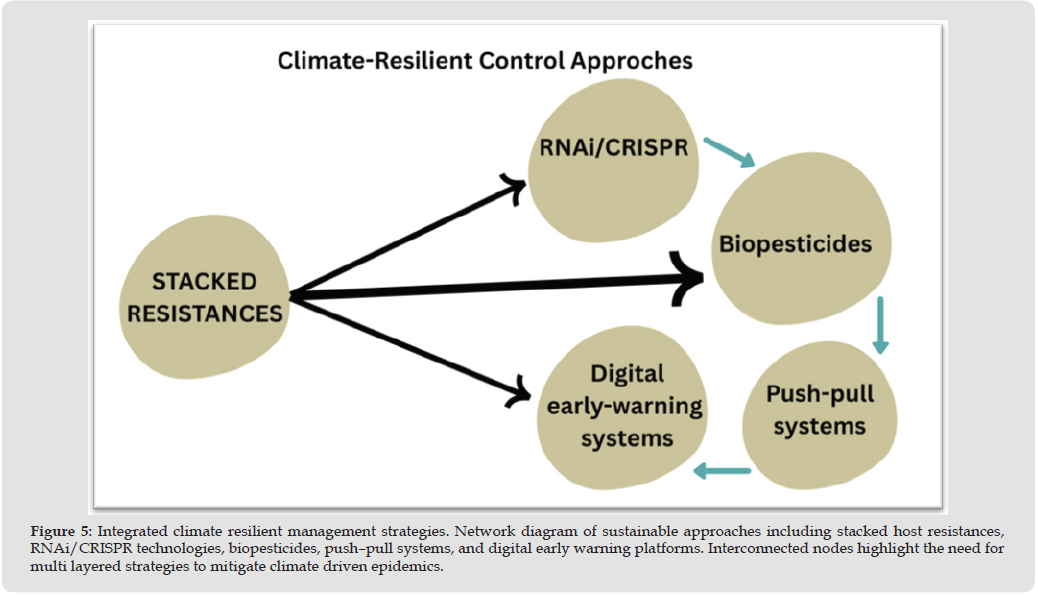
Breeding and Biotechnological Resistance Traditional resistance relying on individual large genes (e.g. Ty-1/ Ty-3 in tomato, CMD2 in cassava) is becoming susceptible to breakdown at high temperatures. Recent developments thus aim at building up resistance mechanisms. Hearth stabilized QTLs Pyramid of Ty-1/Ty-3 with tomato lines with increased resistance of more than 90 % during daytime (38°C) and night (above 30°C) field experiments in the Mediterranean and South Asia have resulted in heat stable tomato lines (Khan, et al. [88]). On the same note, RNAi vectors expressing conserved begomovirus replication-associated protein (Rep) and coat protein (CP) transcripts protect tomato and cassava against at least five seasons of broad-spectrum resistance against temperature fluctuations [78,112]. CRISPR-Cas9 editing of eukaryotic translation initiation factor (eIF4E/ eIF(iso)4E) and replication-related protein- interacting host factors currently provides close-immune responses to a variety of begomoviruses in common bean, cassava, and cotton (Jasrotia, et al. [89]). Multi-site genome editing, which is done in conjunction with marker-assisted backcrossing has reduced breeding periods to 23 years, making it possible to deploy even in orphan drugs (Garcia-Oliveira, et al. [90]).
Vector Management Innovation
The effect of chemical control is crumbling because of resistance of over 60 active ingredients. A long-term substitute is in the form of biopesticides. Beauveria bassiana and Isaria fumosorosea are used in oil-based formulations that stabilize up to 40°C to provide adult whitefly mortality and nymphal populations of 60-85 and 70-90 % in West Africa and India respectively without impacting the natural enemies (Shaili, et al. [91]). Lecanicillium lecanii and Metarhizium anisopliae are currently being incorporated into the already existing spray program at the same level of efficacy under high moisture levels. The push-pull systems that were initially designed to target stemborers are being re-used: Desmodium intercrops repell B. tabaci and Napier grass and Brachiara attack adults. These systems with repellents derived by neem reduce the incidence of TYLCV and CMD by 55 to 75 % in smallholder tomato-cassava polycultures in Kenya and Tanzania when applied alone or in combination with repellents derived with neem (Sain, et al. [92]).
Landscape and Computer-Based Methodologies
Early-warning systems, the early-warning systems are now actionable and are remotely-sensed and machine learning-based. In East Africa (e.g., Pest Risk Information Service funded by the USAID), and Southeast Asia, satellite NDVI anomalies, weather forecasts, and crowd-sourced whitefly counts are combined to provide 2 weeks to 4 weeks advance warning of CMD and TYLCV outbreaks with 82-91% accuracy (Aziz, et al. [93]). The spectral signatures of begomovirus-induced damage are detected by the drone-based hyperspectral imaging 7-10 days prior to symptom development, which allows targeted rogueing. In Uganda and Vietnam, community-based digital networks based on smartphone applications have helped shorten response times by several months to days (Abbas, et al. [94]).
Policy and Enabling Environments
The most cost effective intervention is rapid introduction of resistant varieties in the case of the presence of institutional structures. The efficacy of pre-emptive breeding pipelines and streamlined regulatory approval is demonstrated by Thailand being able to contain the 2016-2018 SLCMV invasion by emergency release of RNAi cassava varieties in 18 months (Ozimati, et al. [95]). Similarly successful in Nigeria (2019-2023) with NAROCASS 15 varieties of material, puts into perspective the role of harmonized regional seed systems and prepositioned clean planting material (Sikirou, et al. [96]). The main bottlenecks now are the long biosafety approval of genome-edited crops (5-10 years in most countries in Africa) and the disjointed seed certification. Such rapid blueprints that are based on the COVID-19 vaccine emergency-use rule and include public-business coalitions to multiply and distribute them are currently being promoted by the FAO and the Gates Foundation to expedite the next generation resistances (Louwaars, et al. [97]). These four pillars should be brought together in a location-based, participatory framework through an effective climate-resilient strategy that acknowledges women and marginal farmers as co-designers and beneficiaries, which entails stacked genetic resistance, temperature-stable biological control, digital surveillance, and enabling policy (Figure 5).
Figure 5
Geminiviruses are changing fast to be region-specifically useful pathogens to become systemic hazards to food security in tropics and subtropics due to climate change. The combination of increasing temperatures, the changed physiology of plants and the widening of the B. tabaci range is converging to sabotage any current control efforts and hasten the development of new and even more virulent strains. These changes are reversing decades of advancement in cassava, tomato, maize, cotton, and grain legumes management, and yield losses are expected to increases in specific areas where hunger and poverty are already hardships. The confluence of the climate stressors with the evolvement of viruses and adaptation of vectors defines the frailty of the modern strategies and the necessity of reconsidering the management principles. As a preventive measure, urgent investment should be made on heat-resistant resistance genes, broad-spectrum management of vectors, and real-time surveillance networks that can identify and control an outbreak before it rose to the level of an epidemic. However, solutions to technology will not be enough. The paradigm shift is needed on proactive and transdisciplinary, and equitable approaches. This will entail the application of state-of-the-art biotechnology like RNAi and CRISPR in line with agroecological principles, enhancing seed-system control, and guaranteeing that innovations are made available to the smallholder farmers that constitute the bulk of the tropical agriculture.
Control of climate-resilient geminiviruses management should be positioned to be scientifically and socially urgent. Food security in a warming world needs urgent action at a global scale, and it should be coordinated across disciplines and borders to preserve the lifelihood of hundreds of millions of farmers. It is the collective effort of this type that can help reduce the systemic danger of geminiviruses and construct resilience that will be sustainable to future generations.
Funding Source
N/A.
Acknowledgment
Authors are thankful to virology lab members for critical review of the manuscript.
Conflict of Interests
The authors declare that there is no conflict of interests.
Data Availability
All the data is available in the article.
Author Contributions
MYM, SN, MUR, MU, QAQ, and MA contributed equally to the study conception, design, data analysis, and writing of the manuscript.
Ethics Statements
N/A
Generative AI Statements
The authors declare that no Gen AI/Deep Seek was used in the writing/creation of this manuscript.

International Association of Landscape Archaeology, Czech Glass Society, Czech Republic

Department of Chemistry, Semenov Institute of Chemical Physics, USSR Academy of Sciences, Moscow, Russia

Neurology, LA BioMed Research Institute, USA

Associate Professor at Department of Breast and Thyorid Surgey, Chongqing General Hospital, China

Professor of Nuclear Medicine, Faculty of Medicine and Surgery, University of Milan, Milan, Italy





 Abstract
 PDF
PDF



























