info@biomedres.us
+1 (502) 904-2126
One Westbrook Corporate Center, Suite 300, Westchester, IL 60154, USA
Site Map
 ISSN: 2574 -1241
ISSN: 2574 -1241
ISSN: 2574 -1241
Received: February 19, 2026; Published: March 03, 2026
*Corresponding author: Anwarul Islam, MD, PhD, FRCPath. FACP, Clinical Associate Professor of Medicine, Division of Hematology/ Oncology, Department of Medicine, Buffalo General Hospital, Room E 428, Buffalo, New York 14203, USA
DOI: 10.26717/BJSTR.2026.65.010123
Chest wall hematoma is a rare but potentially life-threatening manifestation of antiphospholipid syndrome (APS). Due to its rarity, standardized treatment guidelines have yet to be established. We present the case of a patient with APS who developed a massive left chest wall hematoma and was successfully managed with low-molecular- weight heparin (LMWH) therapy
Antiphospholipid syndrome (APS) is a rare autoimmune disorder characterized by the presence of antiphospholipid antibodies (aPLs) that increase the risk of both arterial and venous thrombosis and pregnancy complications [1]. While relatively rare in the general population with an incidence of approximately 5 per 100,000 individuals [2] it remains a complex disorder that paradoxically increases the risk of both thrombosis and hemorrhage. In clinical practice, large or expanding hematomas within the upper chest may manifest as acute dyspnea or chest pain; these presentations demand immediate medical evaluation and often necessitate urgent surgical intervention.
The patient is a 67-year-old male with a significant medical history including antiphospholipid antibody syndrome (on chronic warfarin for prior DVT/PE), CHF, paroxysmal atrial fibrillation, type 2 diabetes, Parkinson’s disease, and morbid obesity. He presented to the Emergency Department with worsening left chest wall swelling, associated pain, and ecchymosis. The patient was recently hospitalized for severe sepsis secondary to Streptococcus bacteremia, likely originating from a left lower extremity ulcer. Following discharge to subacute rehab, he developed acute pain, swelling, and bruising of the left chest wall. Subsequent CT imaging revealed active extravasation, along with bilateral pulmonary infiltrates concerning for pneumonia. General Surgery evaluated the patient and recommended no acute surgical intervention. To address his anemia, he was transfused 4 units of packed RBCs. Although Gastroenterology was consulted, they deferred endoscopic evaluation. An IVC filter was successfully placed by Interventional Radiology. During his course, he developed C. difficile colitis and was started on oral vancomycin. The initial working diagnosis was a hematoma, possibly related to a ruptured vessel or a possible coagulopathy. The patient’s laboratory workup revealed a WBC of 4.5, hemoglobin of 7.1, and platelets of 105. Renal function showed a mildly elevated BUN (29) and creatinine (1.42). Glucose was elevated at 171.
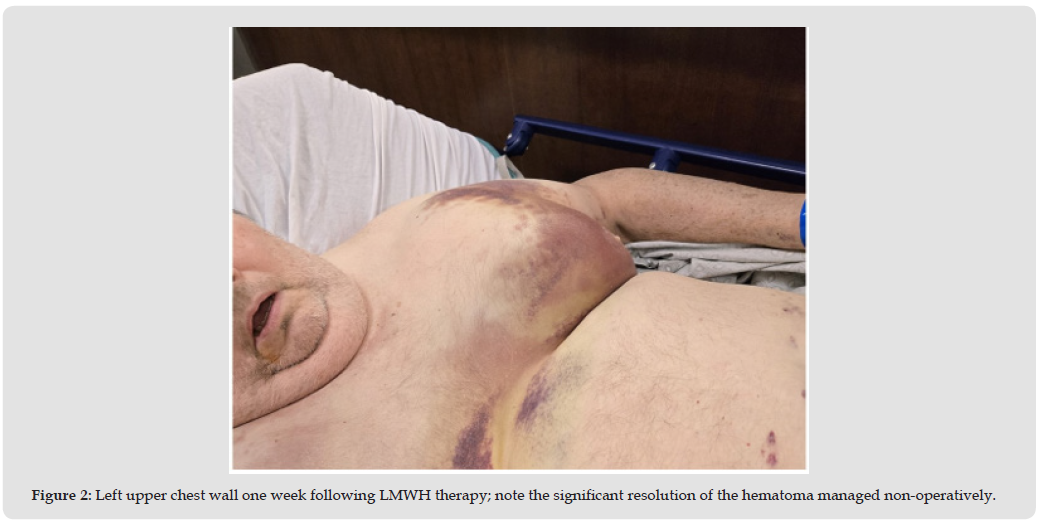
Coagulation studies were within normal limits (PT 12.2, INR 1.0, aPTT 34.7). His D Dimer was high at 2645. Further testing for the presence of a lupus anticoagulant, anti-cardiolipin antibodies, and anti- beta-2 glycoprotein I antibodies, were not done as the patient had a confirmed diagnosis of APS. Imaging studies, including a chest X-ray and CT scan, confirmed the presence of a large hematoma on the left chest wall (Figure 1), with no evidence of significant underlying vascular injury. Given the patient’s presentation with a massive hematoma in the absence of trauma and the confirmed diagnosis of antiphospholipid antibodies, APS was diagnosed as the underlying etiology. The patient was treated with anticoagulation therapy low-molecular- weight heparin (LMWH)), and the hematoma was monitored with serial imaging. There was no recurrence of bleeding, and the patient’s hematoma and symptoms gradually improved (Figure 2). Further workup revealed no other thrombotic events, and the patient was managed on long-term oral anticoagulation with warfarin.
Figure 1
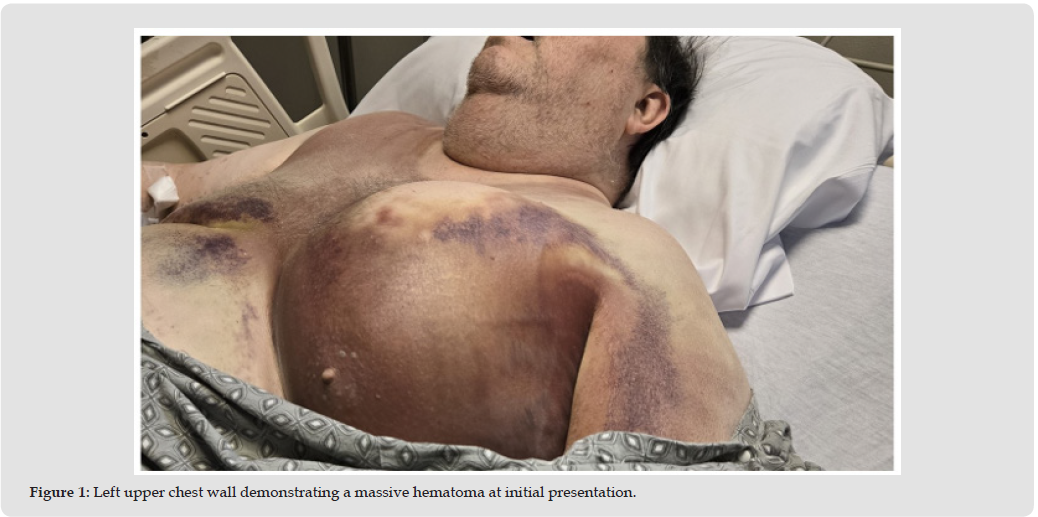
Figure 2
APS is well known for its thrombotic complications, including deep vein thrombosis, pulmonary embolism, and strokes [3,4]. However, the condition can also manifest with hematologic abnormalities such as thrombocytopenia, which can sometimes lead to spontaneous bleeding or hematoma formation [5,6]. This case is unique because of the massive chest wall hematoma as an initial presentation, which could easily be mistaken for a traumatic injury or another vascular disorder. APS should be considered in the differential diagnosis of spontaneous hematomas, especially in patients with unexplained vascular events or those with a history of other thrombotic phenomena. Diagnosis is typically made by detecting antiphospholipid antibodies in the blood, along with clinical signs of thrombosis or pregnancy- related complications. Treatment primarily involves anticoagulation, with the goal of preventing further thrombotic events, although bleeding complications, should be carefully managed.
Anti-phospholipid antibody syndrome can present with a variety of manifestations beyond its typical thrombotic complications, including spontaneous hematoma formation. This case report emphasizes the need to consider APS in the differential diagnosis of unexplained hematomas and the importance of prompt diagnosis and management to prevent further complications. Given the potential for APS to cause both thrombotic and bleeding events, careful monitoring and appropriate treatment are essential to managing these patients effectively.
Key Takeaways
1. APS can present with unusual symptoms, including spontaneous hematomas, and should be considered in patients with unexplained bleeding or vascular events.
2. The diagnosis is confirmed by detecting antiphospholipid antibodies and assessing for associated clinical features.
3. Early recognition and anticoagulation therapy are essential in managing APS-related hematomas and preventing further thrombotic events.
This case serves as a reminder that APS can present in a variety of ways, and clinicians should be vigilant when evaluating patients with unexplained bleeding or vascular phenomena.

International Association of Landscape Archaeology, Czech Glass Society, Czech Republic

Department of Chemistry, Semenov Institute of Chemical Physics, USSR Academy of Sciences, Moscow, Russia

Neurology, LA BioMed Research Institute, USA

Associate Professor at Department of Breast and Thyorid Surgey, Chongqing General Hospital, China

Professor of Nuclear Medicine, Faculty of Medicine and Surgery, University of Milan, Milan, Italy





 Abstract
 PDF
PDF



























