info@biomedres.us
+1 (502) 904-2126
One Westbrook Corporate Center, Suite 300, Westchester, IL 60154, USA
Site Map
 ISSN: 2574 -1241
ISSN: 2574 -1241
ISSN: 2574 -1241
Received: February 16, 2026; Published: March 02, 2026
*Corresponding author: Luca Martini, Azienda Ospedaliera Universitaria Senese, Clinical- Surgical Cardiology, italy
DOI: 10.26717/BJSTR.2026.64.010118
Introduction: Spontaneous coronary artery dissection (SCAD) is an infrequent but increasingly recognized cause of acute coronary syndromes (ACS), particularly in young women. The coronary tortuosity index (TI) has been associated with SCAD recurrence, but its prognostic utility in plaque-related ACS remains unclear.
Materials and Methods: We retrospectively analyzed 102 patients with ACS admitted between 2015 and 2023 to a tertiary referral center. Patients were divided into two groups: SCAD (Group A, n=52) and plaque-related ACS (Group B, n=50). Demographic, clinical, echocardiographic, and angiographic data were collected. The primary outcome was the incidence of major adverse cardiovascular events (MACEs) at 2-year follow-up. TI was calculated from coronary angiograms using a validated method.
Results: Group A patients were predominantly female (71% vs. 26%, p<0.001) and younger (median age 55 vs. 57 years). Group A had a significantly higher TI (2.3 [IQR 1.6–3.0] vs. 1.0 [IQR 0.3–1.7], p<0.001). MACEs occurred in 8 patients in Group A (15%) and 13 in Group B (26%) (p=0.048). TI >2 was independently associated with MACEs in both groups. However, the ROC curve showed a lower predictive value for TI (AUC 0.383) compared to EF (AUC 0.510), EDD (AUC 0.657), and ESD (AUC 0.622).
Conclusions: TI is associated with adverse outcomes in both SCAD and plaque-related ACS. While promising, its limited discriminatory power compared to conventional echocardiographic markers highlights the need for further validation before clinical implementation.
Keywords: Acute Coronary Syndrome; Spontaneous Coronary Artery Dissection; Echocardiography; Tortuosity Index
Abbreviations: SCAD: Spontaneous Coronary Artery Dissection; ACS: Acute Coronary Syndromes; TI: Tortuosity Index; IVUS: Intravascular Ultrasound; OCT: Optical Coherence Tomography; MACEs: Major Adverse Cardiovascular Events; ROC: Receiver Operating Characteristic; ESD: End-Systolic Diameter
Acute coronary syndromes (ACS) encompass a spectrum of clinical presentations resulting from myocardial ischemia, most commonly caused by atherosclerotic plaque rupture and thrombosis. [1,2] However, a growing body of literature has drawn attention to non-atherosclerotic causes, particularly spontaneous coronary artery dissection (SCAD), as important contributors to ACS, especially in younger women without conventional cardiovascular risk factors. SCAD is characterized by the formation of an intramural hematoma or intimal tear that compresses the true lumen of the coronary artery, leading to impaired myocardial perfusion [3]. Unlike typical atherosclerotic processes, SCAD often presents in the absence of significant coronary artery disease and may be underdiagnosed unless a high index of suspicion is maintained [3]. Epidemiologically, SCAD accounts for up to 4% of all ACS and approximately 25–35% of myocardial infarctions in women under 50 years of age [3,4]. It is frequently associated with connective tissue disorders such as fibromuscular dysplasia, peripartum status, and hormonal fluctuations, and can also be precipitated by intense emotional or physical stress [3,4]. Diagnostic confirmation typically relies on coronary angiography, although intravascular imaging techniques such as intravascular ultrasound (IVUS) or optical coherence tomography (OCT) may be necessary to delineate the dissection plane or intramural hematoma in ambiguous cases [3,4]. Management strategies for SCAD diverge from those of plaque rupture-related ACS.
Conservative medical therapy is often preferred, as percutaneous coronary intervention may be technically challenging and associated with worse outcomes. Therefore, risk stratification tools and prognostic indicators tailored to this unique patient population are needed [5]. This study aimed to investigate the clinical and prognostic significance of TI in a mixed population of SCAD and plaque-related ACS patients. Specifically, we sought to determine whether TI is independently associated with adverse outcomes and to compare its predictive performance with conventional echocardiographic parameters.
Study Population
This retrospective, single-center observational study included patients with ACS admitted to the Azienda Ospedaliera Universitaria Senese between January 2015 and December 2023. ACS was defined per ESC guidelines. Inclusion criteria were: confirmed ACS diagnosis, available coronary angiography, and complete echocardiographic evaluation at baseline and 2-year follow-up. Exclusion criteria included age <18 years, incomplete clinical or imaging data, or loss to follow-up. The study was performed according to the Declaration of Helsinki.
Data Collection
In this single-center observational retrospective study, clinical, demographic, and laboratory data were collected from the Siena Heart Center’s electronic records. All echocardiographic examinations were performed by experienced operators using a GE Vivid E80/E95 (GE Medical Systems, Northern Ireland) equipped with a 1.5–4.3 MHz phased-array transducer, following the recommendations of the American Society of Echocardiography and the European Association of Cardiovascular Imaging [6,7]. Conventional echocardiographic measurements were made complying with the European and American Guidelines [8]. Patients have been evaluated via TTE at basal and 2-years after the event. CA were performed by experienced operators in AOUS Interventional cardiology catheter laboratories, using appropriated materials, contrast, and ionized radiation, as stated by Italian Interventional Cardiology guidelines [9]. The primary endpoint was the occurrence of major adverse cardiovascular events (MACEs), defined as a composite of all-cause death, cardiovascular hospitalization, myocardial infarction, stroke, and heart failure during 2-year follow-up.
Statistical Analysis
Normality of continuous variables was tested using Shapiro-Wilk test. Continuous variables were expressed as mean ± SD or median (IQR) as appropriate. Categorical variables were presented as frequencies and percentages. Comparisons were made using Student’s t-test or Mann-Whitney U test, and chi-square test for categorical variables. Logistic regression was performed to identify predictors of MACEs. ROC curve analysis compared the discriminatory performance of TI, EF, EDD, and ESD. A p-value <0.05 was considered statistically significant. Analyses were performed using Jamovi (version 2.6.44).
Of 132 patients initially screened, 102 met all inclusion criteria and were included in the final analysis: 52 patients with SCAD (Group A) and 50 with plaque-related ACS (Group B). Demographic characteristics differed significantly between the groups. Group A included 71% females and had a younger median age (55 years [IQR 48–62]) compared to Group B, which had 26% females and a median age of 57 years (IQR 47–67) (p=0.041).
STEMI presentation was more common in Group B (78%) than Group A (60%, p=0.042), while NSTEMI accounted for 40% of SCAD cases. Regarding comorbidities, hypertension and diabetes were more frequent in Group B, whereas smoking was more prevalent in Group A. Angiographic findings revealed that the left anterior descending artery was the most commonly involved vessel in both groups. However, percutaneous coronary intervention (PCI) was performed significantly less in Group A (27%) compared to Group B (88%, p<0.001), reflecting the more conservative management typically adopted in SCAD patients. Echocardiographic evaluation at baseline showed no significant difference in ejection fraction (Group A: 52% [IQR 45–59]; Group B: 51% [IQR 44–58], p=0.600), although Group B had larger left ventricular diameters (EDD: 50 mm vs. 47 mm, p<0.001; ESD: 33 mm vs. 30 mm, p=0.009). At 2-year follow-up, EF remained stable in both groups (p=0.336), with no statistically significant differences Graphical abstract Scad.
Graphical Abstract
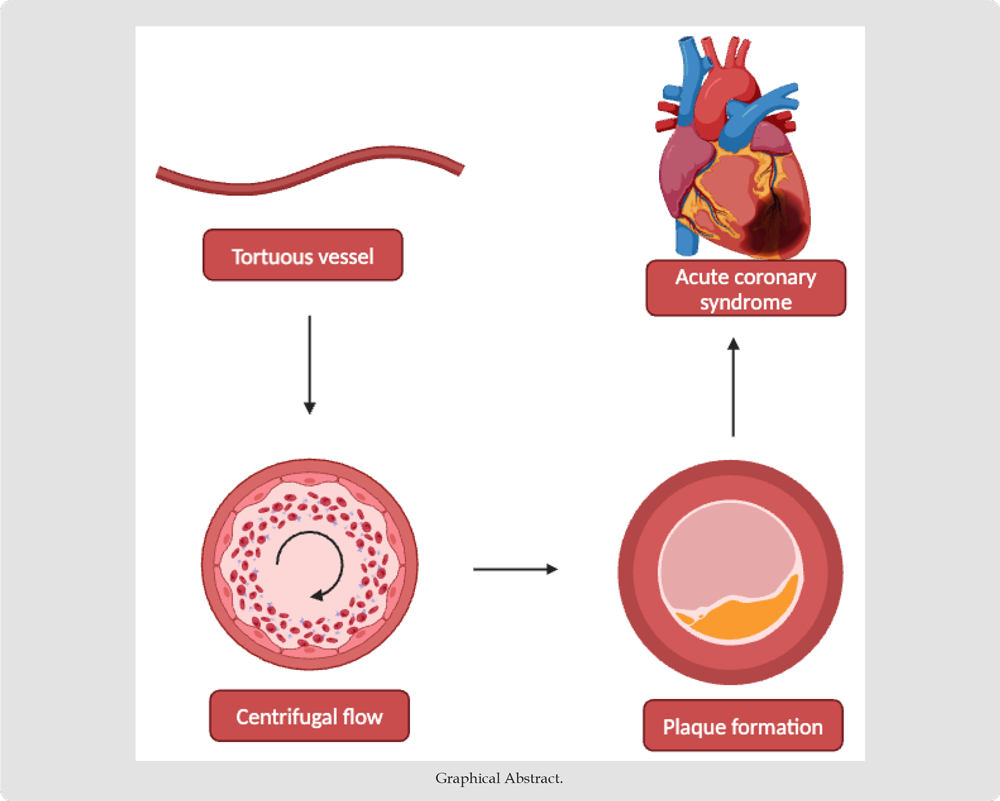
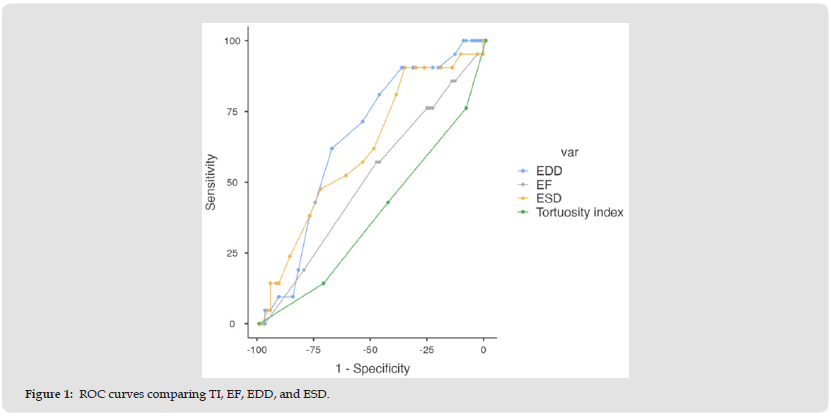
The tortuosity index (TI) was markedly higher in Group A (median 2.3 [IQR 1.6–3.0]) than in Group B (median 1.0 [IQR 0.3–1.7], p<0.001). A TI >2 was present in 65% of SCAD patients versus 18% of plaque-related ACS patients. TI >2 was significantly associated with the incidence of MACEs in both groups (Group A: p=0.008; Group B: p=0.019). Table 1 describes clinical, echocardiographic, and angiographic characteristics.in details. During the 2-year follow-up, 21 total MACEs occurred: 8 in Group A (15%) and 13 in Group B (26%) (p=0.048). These included recurrent myocardial infarction, stroke, and cardiovascular hospitalizations. Kaplan-Meier estimates showed a higher median survival in SCAD patients (21 months [IQR 19–23]) than in non-SCAD patients (13 months [IQR 11–13], p=0.045). Linear regression analysis revealed a significant correlation between TI and both baseline and follow-up left ventricular diameters (EDD and ESD) in both groups. TI was positively correlated with baseline EDD (Group A: p<0.001, Group B: p=0.003) and ESD (Group A: p=0.043, Group B: p=0.049), as well as follow-up EDD (Group A: p<0.001, Group B: p=0.009) and ESD (Group A: p=0.002, Group B: p=0.010). Receiver operating characteristic (ROC) curve analysis demonstrated that TI had lower predictive accuracy for MACEs (AUC 0.383) compared to EDD (0.657), ESD (0.622), and EF (0.510), highlighting the need to further investigate the clinical utility of TI as a prognostic marker (Figure 1).
Table 1: Clinical, echocardiographic, and angiographic patients’ characteristics.
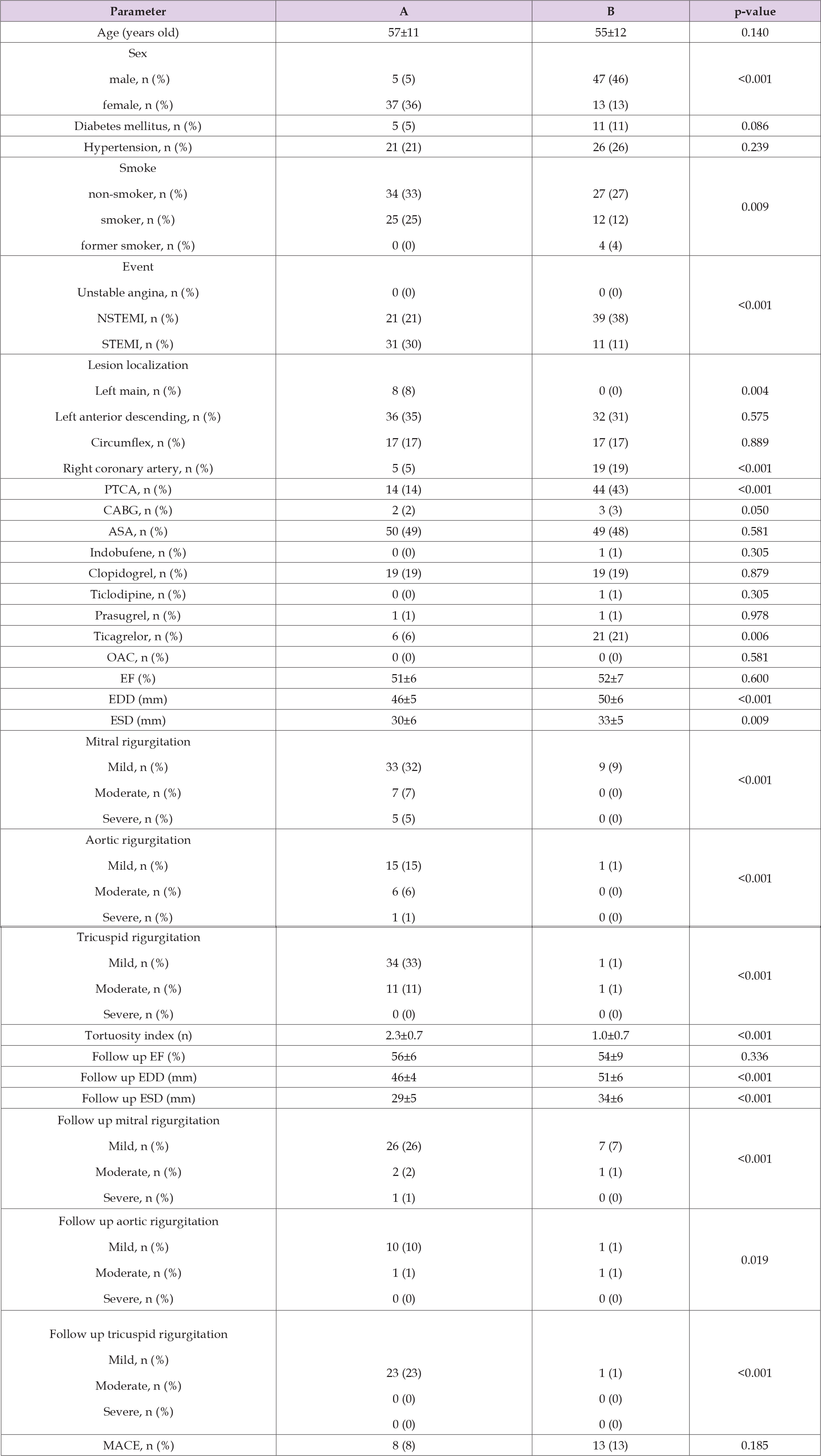
Figure 1
This study confirms the association between elevated coronary tortuosity and SCAD, consistent with prior findings linking female sex and smaller ventricular size to increased vessel curvature [6,9]. These anatomical differences likely contribute to higher TI values observed in the SCAD group. Our results corroborate earlier reports indicating that coronary tortuosity is more common in women, potentially due to structural and hormonal influences on arterial wall elasticity. The observed correlation between TI and major adverse cardiovascular events (MACEs) in both SCAD and plaque-related ACS groups suggests a broader role for tortuosity as a prognostic marker. From a hemodynamic perspective, tortuous vessels are associated with disturbed laminar flow and increased endothelial shear stress, both of which can promote endothelial dysfunction, inflammation, and atherogenesis. Moreover, high TI may reflect underlying vascular fragility, increasing susceptibility to dissection, plaque erosion, or rupture. Despite these associations, our findings indicate that TI has limited discriminatory power when compared to traditional echocardiographic markers such as left ventricular EF, EDD, and end-systolic diameter ESD. The relatively low area under the curve (AUC) for TI on ROC analysis underscores the need for caution in adopting this marker for routine clinical use. Nevertheless, TI offers several potential advantages. It is easily derived from standard coronary angiograms and does not require advanced imaging modalities.
In settings where intravascular imaging is unavailable, TI may provide a non-invasive adjunct to risk stratification. Furthermore, its association with both SCAD and atherosclerotic disease broadens its applicability across diverse ACS populations. The disparity in intervention rates between groups further highlights the clinical importance of accurate risk assessment. SCAD patients, who were less likely to undergo percutaneous coronary intervention, may benefit from alternative monitoring strategies if TI is validated as a prognostic tool. Additionally, sex-specific reference values and thresholds for TI should be explored in future studies. In summary, the study supports the hypothesis that increased coronary tortuosity is not only a marker of SCAD but also a potential contributor to worse outcomes in ACS more broadly. While TI alone may not outperform established parameters, it could enhance current models when integrated into multimodal risk assessment approaches. This study has some limitations that should be considered. The retrospective, single-center design introduces potential selection bias and limits generalizability. The small sample size, although appropriate for a rare condition like SCAD, reduces statistical power. SCAD diagnosis was based on angiography without systematic use of intravascular imaging, possibly leading to underdiagnosis. The TI was measured manually without assessing interobserver variability. The 24-month follow-up, while useful for mid-term evaluation, may not capture long-term outcomes. Additionally, no multivariate prognostic model was applied, limiting assessment of TI’s incremental value.
Future prospective, multicenter studies using standardized imaging and multivariable analyses are needed to validate the role of TI in ACS risk stratification.
TI is associated with adverse outcomes in both SCAD and plaque-related ACS. While promising, its limited discriminatory power compared to conventional echocardiographic markers highlights the need for further validation before clinical implementation.
Ethical Approval
Not appliable.
Competing Interests
None declared by all authors.
Authors’ Contributions
LM and AC wrote the paper, MMG, AP, MF, and MC revised it critically.
Funding
The authors have not received any funding.
Availability of Data and Materials
The publications can be read using the Pubmed platform, the journals and the books mentioned in the references.

International Association of Landscape Archaeology, Czech Glass Society, Czech Republic

Department of Chemistry, Semenov Institute of Chemical Physics, USSR Academy of Sciences, Moscow, Russia

Associate Professor at Department of Breast and Thyorid Surgey, Chongqing General Hospital, China

Professor of Nuclear Medicine, Faculty of Medicine and Surgery, University of Milan, Milan, Italy

Department of Pharmaceutical Sciences, South University School of Pharmacy, USA





 Abstract
 PDF
PDF