info@biomedres.us
+1 (502) 904-2126
One Westbrook Corporate Center, Suite 300, Westchester, IL 60154, USA
Site Map
 ISSN: 2574 -1241
ISSN: 2574 -1241
ISSN: 2574 -1241
Received: February 04, 2026; Published: February 24, 2026
*Corresponding author: Wolfgang Lederer, Medical University of Innsbruck, Fritz-Pregl-Str. 3, 6020 Innsbruck, Austria
DOI: 10.26717/BJSTR.2026.64.010109
Basic awareness has been important for the development of living organisms from the very beginning of evolution. It enables responsiveness that is considered one of the requirements for the emergence of life. In its earliest stages, awareness embodies membrane-bound being. According to the hydrozoic theory of conscious perception the liquid crystal-like structure made of a phospholipid bilayer and adhesive water molecules can store, release and propagate energy. Intermittent mechanic forces acting on the water - membrane formation generate electric and perpendicular magnetic fields from which membrane-bound awareness emanates. In early multi-cellular organisms, the fluid-filled three-dimensional water-membrane formation of the interstitial space may function like an antenna by transmitting electromagnetic waves as electrical signals. Conscious perception, as the self-centred attention to a selected thought and its associated feelings developed in advanced nervous systems. While basic awareness corresponds to the general being of “the is”, conscious perception represents the ego-centred view of “myself”. Externalized consciousness can experience its existence in the moment. This experience is both bodily and mentally. It establishes the necessary connection between central processing and the environment. Ultimately, consciousness is the self that creates reality.
Keywords: Awareness; Cell membrane; Consciousness; Hydrozoic Theory; Magnetic fields; Marine hydrobiology; Memory; Perception; Self Concept
Scientific postulates are based on fundamental assumptions predetermined as axioms (derived from the Greek word axioma (ἀξίωμα) in the meaning of principle). These basic assumptions are deliberately accepted but neither proven nor deductively derived. Axioms are taken as given. However, by their very nature axioms are ambivalent. They provide firm support and simultaneously become a prison for reflection. Wittgenstein did not see axioms as absolute and eternally true foundations, but rather as basic rules that we establish in order to deduct theorems and from them theories. He postulated: “Something is not an axiom simply because we recognize it as extremely probable, indeed as certain, but because we ascribe a specific function to it, and one that contradicts that of empirical proposition. However, Wittgenstein stated that if experience led us to abandon an axiom, its opposite would not thereby become an axiom” [1]. John Locke (British philosopher, 1632-1704) believed that all knowledge was based solely on experience [2]. In his view, experience results from both observations of external objects (perception) and observations of the internal operation of the mind (reflection). In philosophy, reflection makes perception meaningful.
In science, however, calculated and predicted outcome of experiments based on measurements that are not actually made in large samples (corresponding to counterfactual definiteness) have limited meaning. It’s a short step from empiricism to serendipity. According to Locke, two events are not necessarily linked in a way they can be observed. This somehow corresponds with the principle of complementarity of quantum mechanics in the meaning that certain pairs of complementary properties cannot all be observed or measured simultaneously [3]. Although mathematical formalism can facilitate the transition from potentiality to actuality, in a superposition of opposing states the observation has a lasting impact on the measured result. Does the observer influence the observed object similar to how consciousness influences its conscious experience? Stuart Hameroff hypothesized that neural microtubules enable quantum processes in the brain that give rise to consciousness [4]. In his quantum theory of consciousness, he speculates that each time a quantum wave function collapses a moment of conscious experience occurs. He does not distinguish whether consciousness is viewed transitively, when it refers to a direct object, or intransitively, when it refers to a fact. Gathering and applying information is an important characteristic of life [5].
However, considering the nervous system as the primary concept in the emergence of consciousness, then the neuronal component seems overestimated and the non-neuronal component seems ignored. Apparently, the development of a high-performance processing system required prior awareness to build upon. The hydrozoic theory [from hydrozoikos (ὑδροζωικός), a compound term referring to the dependency between water and life in natural philosophy] supports the hypothesis that basic awareness already existed before cell development [6]. This theory is based on the theorem, that water is regarded a basic requirement for biochemical, biophysical and biological evolution. And this theorem is based on the postulate of Thales of Miletus (ancient Greek philosopher, 624-547 BC), who considered water to be the origin of everything [7]. Water has many unique chemical and physical properties that potentially contributed to the origin of life. These include its polarity (H2O acts as a bipolar molecule by donating one electron from the H atom to the O atom), its amphoteric nature (H2O acts as an acid or a base by donating or accepting protons), its bonding readiness (H2O can stick to other molecules by cohesion and adhesion), its multi-phase appearance (gaseous, liquid, solid, crystalline) and its property as an universal solvent [8]. Not at least, water shelters the chemistry of life by providing protection from molecule-destroying cosmic radiation, such as ultraviolet light [9].
The hydrozoic theory of conscious perception links unique hydro- properties and membrane characteristics to the emergence of awareness and memory during early evolution [6]. It is based on the observation that liquid crystals are sensitive to electromagnetic fields and can maintain their polarization [10]. The theory proposes that phospholipid bilayers and adhesive water molecules can store and release information [6]. This way, water is also closely linked to the glimmer of basic awareness in the primeval sea.
In this essay, I distinguish between basic awareness as a general concept and transitive and intransitive consciousness as a specific concept. To investigate the question of how awareness arose and initially functioned I used deductive reasoning and applied the “rule of mandatory sequence”. It is obvious that the stimulus precedes the triggered electrical signal, and the signal occurs before its magnetic storage. A logically compelling conclusion goes from the general to the particular. It is necessarily or deductively valid if it follows logically from the premises [11]. A deductive proof includes the “rule of definition” that is usually applied to two assertions (premises) and the “rule of substitution” that is applied to one of the objects from the assertions in order to infer the final assertion (conclusion) from it. A conclusion is regarded true, when the two premises are well-founded. According to Alfred Tarski, logical consequence has three essential characteristics, namely: the consequence is necessary, formal, and a priori recognizable [11]. To draw logically compelling conclusions, it is not absolutely necessary to conduct any form of empirical investigation. For analysis I used two classical methods, the modus ponens (composed of the Latin words modus for method and ponens for spotting) and the modus tollens (referring to the Latin word tollens for eliminating) in a modified version. The modus ponens in the used application states that if A implies B and B implies C, then A also implies C (1). The conclusion in this version is transitive and based on conjunction and implication.

For instance, if awareness (A) is a basic precondition for biological life (B), and biological life (B) originated in the sea (C) then from this it follows that awareness (A) also originated in the sea (C). In contrast, the modus tollens shows the falsification of an assumption under certain conditions based on subjunction and negation. The modus tollens in the following application states that if A is equivalent to B and B is not true in C, then A is not true in C either (2). This conclusion is primarily based on equivalence and negative implication.

For instance, if awareness (A) is equivalent to the presence of specific electrical activity in the brain (B) of mammals, and a mammal (C) lacks electrical activity in the brain (B), then this mammal (C) also lacks awareness (A). Actually, consciousness is a vital function. This conclusion based on subjunction and negation supports the finding that lack of specific electrical activity in the brain of a mammal also suggests its lifelessness. Presumably, Rene Descartes applied these modes in his famous conclusion: cogito ergo sum in the meaning of “I think, therefore I am” [12]. However, in his noted finding a subfunction of consciousness (I think) is equated with a specific conscious experience (I am). In fact, thinking is a basic function of consciousness, but feeling is of similar importance. “I feel, therefore I am” (sentio ergo sum) and even more common, “I suffer, therefore I am” (patior ergo sum) are equally true. Negative premises would not allow for correct conclusions, since thinking, feeling and suffering are only subfunctions of consciousness and not consciousness itself. The inability to feel signifies a lack of conscious function, but not a lack of consciousness itself. This considerably limits the conclusion. Wittgenstein added a caveat on the drawing of logically compelling conclusions specifying: “One must remember that the propositions of logic are constructed in such a way that they have no practical application as information” [1].
Life as defined in the Encyclopedia Brittanica is attributed to living matter that shows responsiveness, growth, metabolism, energy transformation and reproduction. As a dynamic process life is characterized by the capacity for self-organization, information processing, and evolution, and manifested in a diversity of biological systems [13]. Paul Nurse determined five fundamental principles of life, namely the idea of the cell, the idea of the gene, the idea of the biological evolution by natural selection, the idea of life as chemistry, and the idea of life in terms of information [5]. In this concept, cells are considered the smallest living units and single-celled organisms are the smallest living things. Since the definition of life is tied to the simultaneous presence of certain properties, it can be assumed that individual properties were already developed in pre-cellular stages. This corresponds to the self-organizing, self-referential nature of life [14]. Life and awareness are inextricably linked. Considering consciousness as a function of living matter, then basic awareness most likely appeared early in biological evolution. Ultimately, bodily states provide the fundamental basis upon which complex mental states can arise.
There is a long way from basic awareness to the convoluted consciousness of humans. In humans, processing emotions and bodily reactions and transforming them into conscious feelings and experiences by the brain is a reciprocal process. John Locke defined consciousness as “perception of what passes in a man’s own mind” [2]. It surmounts the perception of one’s own existence and environment. Fittingly, in human medicine consciousness is the totality of mental states supported by neurophysiological processes. Memory is the crucial link in the effort to make unaware objects become aware. The constant need to search for food takes up mobility and basic spatial orientation, perception at a distance with receptors for locating and the ability to recognize object permanence (the knowledge that objects continue to exist even if they cannot currently be detected). However, if recognizing the environment and reacting appropriately are sufficient for being conscious, robots supplied with artificial intelligence software already fulfil these criteria. Apparently, the capability to perform complex reactions and retain memories is not necessarily tied to a brain. Basic awareness is present in every living being. The human-focused view tends to overlook the numerous gradients of awareness as they have evolved from less complex life forms.
The moss piglet from the phylum tardigrada for instance, is characterized by extremely high resilience and longevity and even has survived exposure to outer space [15]. From a human perspective a rope ladder nervous system may be considered unpretentious but doesn’t the moss piglet’s competence to survive in natural selection for over hundred million years point to exceptional qualifications? Obviously, thinking in animals differs considerably from human thinking. Animals can think despite lack of conceptualization. Since only a limited number of consciousness functions are accessible to human observation there is still a marked reluctance to attribute different degrees of conscious experience to animals. Charles Darwin observed that individuals within a species vary in their genetic traits [16]. In addition to genetic inheritance, organisms also adapt to environmental influences through active assimilation and habituation. Changes in genes and selective gene activation through epigenetic markers have effects that are advantageous in certain environments and disadvantageous in others. Apparently, unstable environmental conditions provoke natural selection of modifications and adaptations. Thus, close environment controls evolution and directly governs awareness.
The Origin of Water and Membrane-Bound Awareness
Life most likely originated in the primeval sea [17]. Presumably, chemical evolution of organic molecules (abiogenesis) occurred in the vicinity of alkaline hydrothermal vents that wind across the deep ocean. The spontaneous formation of fatty acid membranes in sea water is a critical component of abiogenesis. According to the hydrozoic theory awareness emerges on phospholipid bilayer and adhesive water molecules when mechanic energy is transformed into electric energy [6]. Good theories tell a story. It is conceivable that awareness emerged in the swaying of the waves in shallow waters. Waves are caused by the gravitational pull of the moon and the sun and created by the friction between water and wind blowing across the surface. When waves move across the surface of water, the primary motion of water is up and down. A floating phospholipid bilayer undergoes an upward movement by the unbalanced force of a passing wave (Figure 1). In this way, mechanical strain in prebiotic membranes creates flexoelectricity by converting mechanical deformation into electrical signals. Khandagale et al. reported that even membrane fluctuations due to molecular motion and activity are sufficient to produce electricity [18].
Figure 1
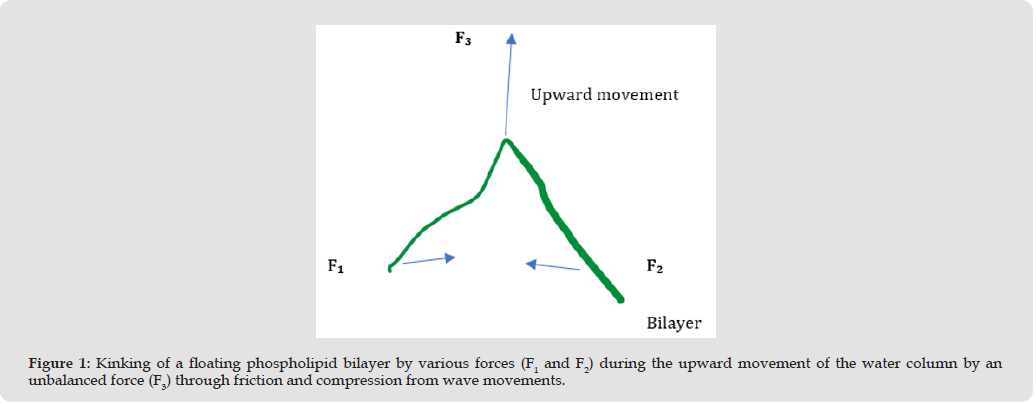
One of the forces acting on the phospholipid bilayer depends on the natural tendency of an object to resist to acceleration. Following Newton’s law of inertia, the force equals the product of mass and acceleration [19]. The brief stimulus from mechanical kinking leads to an electrical signal. Consequently, the induced current creates a momentary magnetic field. When electric current flows through a magnetic field energy is stored in it. Hypothetically, the rhythmic generation of electric and magnetic fields provides the origin of basic awareness. The rate at which current changes over time (dI / dt ) is proportional to the induced voltage that creates and modifies a magnetic field [20]. According to Faraday’s Law of Induction the rate of change of the magnetic flux (dΦ / dt )corresponds to the induced voltage (U) (3).

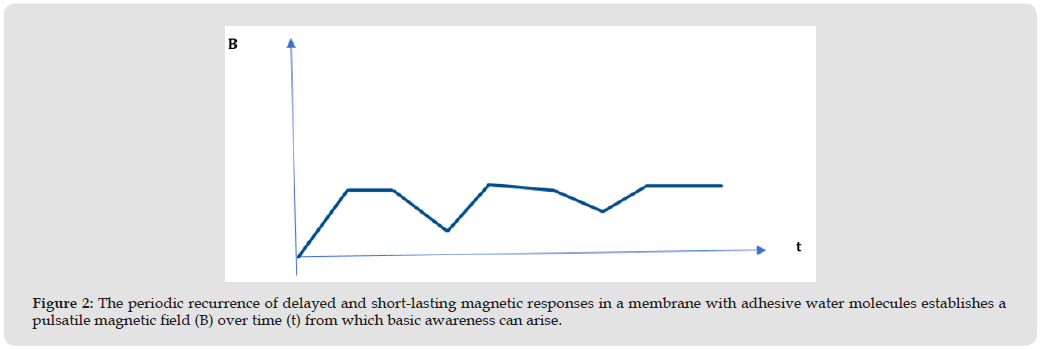
The regular impact of mechanic energy can generate an electromagnetic field. In this concept, the periodic recurrence of changing electric and magnetic fields creates an image (electrical flash) followed by an afterimage (magnetic echo), that lasts for a few seconds [6]. Presumably with each cycle within an interval of a few seconds, the magnetic field lasts slightly longer and finally exhibits a pulsatile appearance (Figure 2). From this follows that awareness emerged from a pulsatile electromagnetic field as the remembered being within the present. Hypothetically, in the rhythmic movements of the waves a continuous network of mechanic stimuli and electromagnetic responses is created, that links an experienced “is” to a remembered “the is “(4).

Figure 2
Depending on membrane properties and environmental conditions, a certain threshold must be exceeded by the stimulus to trigger an electrical signal. Differences in the intensity of electrical signals correspond to differences in the areas of the magnetic field. This juxtaposition allows for a contrast based on intensity and regularity. In a simple dichotomous system of intensity and regularity additional stimuli can be identified as a deviation from the basic rhythm of awareness. Different signals have contrasting effects while similar signals have an enhancing effect. Patterns that match allow the recognition of a specific stimulus. Electrical responses to mechanical stimulation of membranes were observed to be depolarizing or hyperpolarizing [21]. The rhythmic impact of small stimulations causes hyperpolarization and increases membrane conductance. According to the hydrozoic theory of conscious perception, membrane-bound awareness in early multi-cellular organisms can be communicated via the interstitial space that connects all cells in a multicellular organism [6].
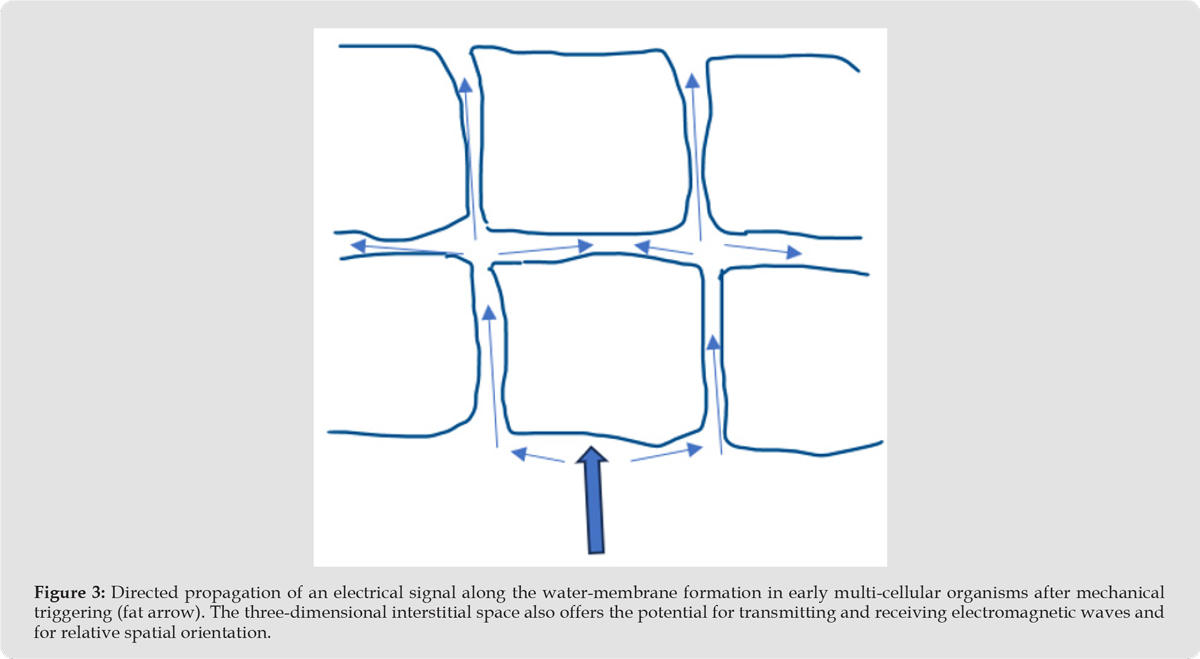
The fluid-filled space between cell membranes provides structural support and plays a vital role in body-wide communication. Dissolved ions like salt and minerals conduct electricity in the water-membrane formation [22]. Constructive and destructive interferences affect the propagation of electric signals and enhance contrasts (Figure 3). Hypothetically, the dipole property of water in this three-dimensional framework also works like an antenna by transmitting and receiving low-frequency electromagnetic waves as electrical signals. It may even have the potential for relative spatial orientation. Cenaj et al. reported that the interstitial space acts as a conduit for electrical and molecular signalling [23]. In more advanced cell membranes mechanosensitive ion channels convert mechanical stimuli into electrical signals by changing the membrane potential [21]. The later development of special receptors in the membrane and the formation of sensory organs from conjoined receptors further improved stimulus detection.
Figure 3
Dichotomy as Concept of Perception and Externalized Self-Centred Awareness
Heraclitus of Ephesus (520-460 BC), a pre-Socratic philosopher from the ancient Greek, observed that everything is in a constant and flowing process of thriving. He stated: “Those who descend in the same rivers will always find different water flowing towards them”. In his concept of change seemingly opposing elements form a higher- level unity. Thriving is a necessary condition for constancy and stability arises from movement [7]. Distinction of contrasting properties from a flow of stimuli is a principle of perception. The spherically closed membrane creates the inner environment and the cell-bound self. According to the hydrozoic theory, basic awareness enables differentiation between single-celled organisms and their environment, thus allowing untargeted responsiveness. A simple escape reaction after direct contact has already been observed in amoeba. In an unfamiliar environment the early stage of awareness allows to distinguish between “me” (cell membrane) and “not me” (environment) [6,24]. Living in a community, the social interactions within a species also provoke an out-side view of the “me”. This influences and enhances awareness of the self. Furthermore, externalization of the “me” as an abstracted thought generates awareness that is aware of itself (“myself”). Presumably, this identity creation accelerates during early childhood when the infant starts to accept the given name as part of his identity. In this concept, externalization (giving an abstracted thought its own entity) facilitates the conscious awareness of a self that is aware of its own existence [25]. The object-like imagination is further reinforced by the simultaneous continuous perception of the physical presence of the “me” (Figure 4).
Figure 4
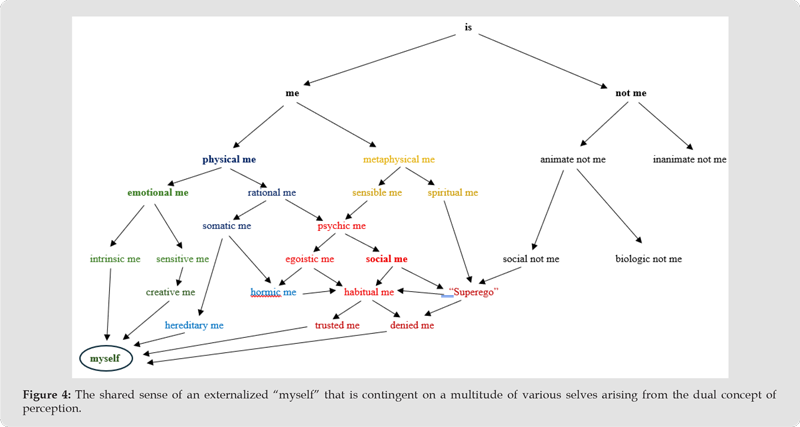
Transitive consciousness enables the self to be seen as an object. The focus is on what it is, not what it does. In contrast, intransitive consciousness emphasizes the self as a fact. The two systems do not compete. Transitive consciousness encourages motivity in space, while intransitive consciousness encourages motivity in time. Conscious experience is self-centred. The wide range of alternate selves are either combinations of physical aspects (e.g. somatic me, emotional me, …) and qualities (e.g. sensitive me, creative me, …) or expectations (e.g. trusted me, denied me, …). Ultimately, the fragmented nature of “myself” appears as a separate entity that is composed of many different, even bizarre properties of the self (Figure 4). With each new invocation of this entity, the composition and weighting of properties slightly change. The distinct traits of the externalized “myself” are in a constant state of flux. Conscious experience is more complex compared to basic awareness. It can be considered on a higher level built upon basic awareness. In humans, conscious perception occurs knowingly and unknowingly. Knowing perception depends on the cortical brain but unknowing perception is also possible on subcortical levels and the thalamus (e.g. if the blanket is pulled away during sleep, the sleeping person can grasp and pull back the blanket with a coordinated movement without waking up).
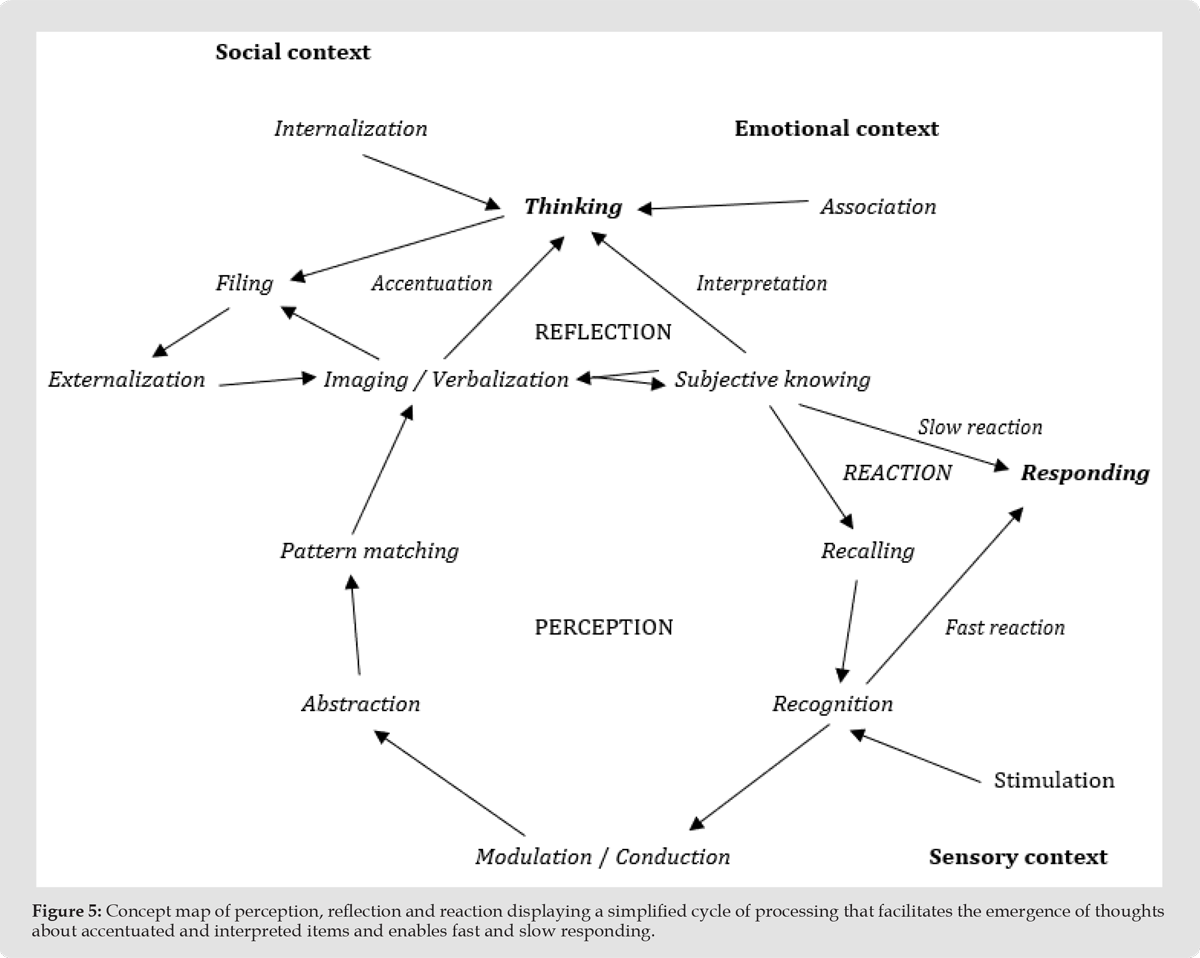
Consciousness is a multifaceted term for physical and mental states. It primarily serves the identification of the self. Ultimately, it is all about the self-centred attention to conscious perception and its associated feelings within a selected context of abstract ideation and imagination in the present. While transitive consciousness refers to a direct object (e.g. the seeing of objects), intransitive consciousness is factual and does not need a direct object (e.g. the experience of seeing). Consciousness encompasses feeling, thinking, imaging, perceiving, and acting in varying states of wakefulness, clarity, and certainty. Due to the presence and primacy of awareness, intentional thoughts depend on current beliefs, feelings and well-known habits. Contemplating “myself” recalls a combination of self-related impressions. The self can be intensely experienced due to its externalized self-creation and its physically tangible and memorable identity. Through externalization of personal experience bodily-self-perception and adaptation to internalized content within a social and emotional context, awareness of the self emerges as an ultimately self-organizing system (Figure 5). Externalized transitive consciousness exists only in and to itself. To pay particular attention to thoughts and sensations is part of the very nature of consciousness itself. It allows the formulation of concepts, and the linking of abstract concepts in thoughts, images and feelings. Consciousness is the self, experiencing its existence in the moment. It depends on attention of the mind and correlates to mental alertness and bodily tension.
Figure 5
Conscious Experience in a Pulsatile Electromagnetic Field
The development from membrane-bound awareness in single- celled organisms, via the paired ganglion system in multicellular organisms and ultimately, the peripheral and central nervous system in vertebrates is as old as life itself. In parallel, the communication skills developed from the primitive communication between single- celled organisms via messenger substances, to the synchronized coordination in multicellular organisms and finally, to the body and sign language and the linguistic expression between humans. In vertebrates the well protected and shielded brain has lost direct access to the environment. The central nervous system relies almost completely on external signals. From incoming signals, it builds a representation onto the rugged surface of the brain, which is continuously synchronized with ongoing external stimulation. In humans, the anatomical representation of the motor and sensory functions extends as a distorted homunculus (Latin for “little man”) across the folded surface of both hemispheres in the precentral and postcentral region [26]. Sensations are specifically categorized, reinforced through associations and selectively projected by the brain. The world as we experience it is created by our brain [27]. Cognitive control is integration, interpretation and censorship. By giving meaning to the perceived environment, consciousness designs reality. According to Susan Pockett consciousness is identical with certain spatiotemporal patterns in the electromagnetic field. In her electromagnetic field theory human consciousness is a local, brain-generated, configuration of, or pattern in, the electromagnetic field [28].
In medical science specific patterns of electromagnetic oscillation correlate with certain mental states. Characteristic individual patterns in brain activity, as shown on functional magnetic resonance imaging scans, can be attributed to specific associations. Electrical activity that primarily originates from the somatodendritic department in the cerebral cortex can be recorded via sensors from the scalp. High activity is indicated by beta-waves characterized by high frequency and low amplitude. With declining mental state frequencies diminish and amplitudes increase [26]. According to the hydrozoic theory of conscious perception an electrical signal that propagates along the unmyelinated dendritic spine changes the surrounding magnetic field [6]. The time-varying magnetic field on the cell membrane and the adhesive water molecules creates a current that opposes the incoming current (Lenz’s law). This may have a selective inhibiting effect on the signals to the neuron. The liquid crystal-like structure made of a phospholipid bilayer and adhesive water molecules modulates the intensities of electrical signals that correspond to specific magnetic fields. The propagation of signals also affects the ion channel activity of membranes [21]. From a socio-hydrological perspective, the pulsating electrical activity of the brain, upon which conscious perception is built, corresponds to the pulsatile magnetic field in the primeval sea from which basic awareness arose. In this way, the development proceeded via membrane-bound basic awareness through cell-bound primary perception and receptor-bound sensory perception to complex brain-bound conscious perception Consciousness of the individual is not independent of the consciousness of a community, which is essential for the individual’s survival. The ways of thinking we acquire are strongly influenced by our social and emotional context (e.g. upbringing, education, friends, …). Even corvids have the ability to empathize with others in their community and essentially read their thoughts. The alignment of a collective consciousness exists in cohorts of highly developed living beings, including humans. Living in the human society provides access to accumulated knowledge, which is passed on from generation to generation and allows learning without trial and error of the individual. For this, humans benefit from their distinct episodic memory and their ability to abstractly design complex mental scenarios (Figure 5). The intransitive cohort consciousness corresponds to the “we”. It develops from interhuman relationships, cultural heritage, ethical virtues, conscience, social rules and laws, literature and art. This further enhances the development of a dominant, language-based social consciousness. Gustave Le Bon asked: “Can anything be more intricate, logical, or wondrous than spoken language? And doesn’t this well-ordered structure spring from the unconscious mass spirit?” [29].
The social context shapes the way we experience ourselves and report on our own inner experiences. In a caring community, the behaviour of the individual is assessed and judged more accurately than the individual can do. On specific occasions cohort consciousness can manifest itself as psychological mass phenomena. Under certain circumstances, a mass phenomenon can even develop in which a large number of individuals behave like a single entity, with a synchronized, uniform way of feeling, thinking, and acting. Within this psychological mass, feelings and actions are transmitted. The influences can be so strong that general character traits become communitarian within the mass, and the individual’s sense of responsibility disappears completely [29]. This is all the more surprising since no specific electroreceptors were identified in humans that are sensitive to electric and magnetic fields over short distances. According to the hydrozoic theory of conscious perception, the interstitial space could fulfil this function [6].
In humans thinking occurs in images and in words from invoking. It is predominately a silent form of talking and listening to oneself. Thinking is what enables to move within consciousness, to compare, and to question. Wittgenstein refers to language and the activities with which it is interwoven: language games, that determine our understanding of the world. He postulated that the thought is a logical image of the sentence and thus also a kind of sentence [30]. According to Daniel Kahneman, human judgements and decisions are shaped by a dual system of thinking [31]. The fast system of thinking operates automatically without voluntary control. It appears to be intuitive and emotional. Contrarily, the slow system is associated with greater insight and knowledge. It appears more deliberative and logical. It directs attention and searches the memory for answers. The subjective experience of agency and choice is associated with the slow system [31]. Kahneman observed that humans think associatively, metaphorically and causally, but usually they do not think heuristically. The perceived reality departs from the physical reality. What constitutes happiness in life is often determined by a small sample of highly available ideas rather than a careful weighting of the domains [31].
The much-vaunted gift of free will can play a role only within given possibilities. Free will appears to be largely limited to vetoing a specific item and often it is merely a forced decision between two options. Wittgenstein was succinctly stating that the wish precedes the event and the will accompanies it. He specified: “The act of will is not the cause of the action, but the action itself” [30]. But how can there be a free will when our intuitive beliefs and preferences are guided by impressions and feelings? In any case, a fundamental will to make a decision must be distinguished from the verbalized free will, the free decision that was actually made, and the initiation of its execution. Reflection, as a verbalized weighing of options, often precedes a verbalized decision. Amazingly, most conscious activities occur unknowingly without being particularly noticed. This encompasses the realms of the un-conscious, the sub-conscious, the co-conscious and the pre-conscious. Emotions are the initial and often subconscious response to a stimulus. They influence thought processes, decision- making, motivation and behaviour [32]. Consequently, feelings result from the subjective interpretation of emotions and are experienced consciously. Feelings are crucial factors in conscious being and significantly influence how reality is experienced.
They guide conscious choices and decisions and affect awareness of the self. In their central role feelings modify situational awareness, deploy attention, evaluate thoughts, induce reappraisal and modulate responses [32]. Recognition of familiar patterns influences our perceptions and our feelings combine different perceptions into a single entity. In mutual dependency feelings are shaped by thoughts and past experiences. Ultimately, feelings enhance memory by stapling emotional impact to conscious experience. Consciousness as a phenomenon is holistic, affecting both the physical body and its external and internal environment in the perception of one’s own existence. It developed from electromagnetic membrane-bound awareness that is the commonality in the great diversity of living organisms and the base for advanced and convoluted human consciousness. From a socio- hydrological perspective, there is a shared overarching consciousness of all living beings.
Water is a basic requirement for biochemical, biophysical and biological evolution. According to the hydrozoic theory of conscious perception membrane-bound awareness was generated from intermittent mechanical energy that was transformed into pulsatile electromagnetic energy. From this consciousness as the self-centred attention to a selected thought and its associated feelings developed within a selected context of abstract ideation and imagination in the present. In this theory awareness appeared to be a basic prerequisite for life. Considering the relation of awareness and life, then thinking resulted from the tension between perception and memory. Communication followed information processing, developed image and word language and expressed the zest for life. Polarity matched the flow between birth and death. Apparently, the primeval sea provided the ideal cradle for the emergence of basic awareness.

International Association of Landscape Archaeology, Czech Glass Society, Czech Republic

Department of Chemistry, Semenov Institute of Chemical Physics, USSR Academy of Sciences, Moscow, Russia

Associate Professor at Department of Breast and Thyorid Surgey, Chongqing General Hospital, China

Professor of Nuclear Medicine, Faculty of Medicine and Surgery, University of Milan, Milan, Italy

Department of Pharmaceutical Sciences, South University School of Pharmacy, USA





 Abstract
 PDF
PDF



























