info@biomedres.us
+1 (502) 904-2126
One Westbrook Corporate Center, Suite 300, Westchester, IL 60154, USA
Site Map
 ISSN: 2574 -1241
ISSN: 2574 -1241
ISSN: 2574 -1241
Received: February 09, 2026; Published: February 23, 2026
*Corresponding author: Alexander Harrison, FRSN, Fmr. Professor of Engineering, Newcastle University, NSW, Founder, Berkeley Computational Research, Berkeley Vale, NSW 2261 Australia
DOI: 10.26717/BJSTR.2026.64.010105
Background: There are few reports on the diagnosis and treatment of rare Fusarium infection in early chemotherapy of early T-cell precursor acute lymphoblastic leukemia (ETP-ALL) with HOX11 gene positivity.
Physical 4-dimensional (4D) spacetime is extended to 5-dimensions (5D) with an additional coordinate τ, representing an informational phase or cognitive dimension. A model proposes that conscious individuals in 4D are embedded within 5D space. A new 5D scalar field Q which includes τ is defined that permits interactions between individuals via 5D without any causality conflicts in 4D spacetime. The model considers that individuals can experience mental activity and connection, enabled by a localized projection of a 5D source J on the individual’s 4D hypersurface. The function of J is to inject information into the Q field. The Q field propagates causally through 5D space controlled by a retarded Green’s function to ensure causality and to pin the local projection of J in the 4D reality by use of a Dirac delta function. Action of the retarded Green’s function causes the 5D wavefront to intersect another individuals 4D spacetime, thereby information reenters that individuals 4D experience. Since τ motion resides only in 5D space it is unobservable in 4D. As a result, these interactions appear as instantaneous nonlocal cognitive information (NCI) in 4D while remaining fully causal in 5D space. The model mathematically shows that consciousness and nonlocal telepathic effects are allowed in 4D spacetime when causality criteria apply in 5D.
Keywords: Nonlocal Information; Cognition; Premonitions; Telepathy; 4D and 5D Consciousness; Fifth Dimension; Field Theory; Causality; Spacetime; 5D Field Dynamic Equations
Numerous instances exit in popular magazines, newsprint and other annals of human records where telepathic thoughts and suggestions are documented. In a telepathic state, information or knowledge is commonly shared between two or more people without any direct link such as audio or visual cues. Since people are biological entities, we do not generate or transmit electromagnetic radiation and so radio transmission is not a source of telepathic thought. There are no biomedical conditions known that can generate an instant or even delayed thought transfer between people, even though telepathic effects are believed to be real and, in some cases, verifiable. Lack of a physical process or mechanism to describe telepathy results in its classification as pseudoscience and is generally researched as part of the field of parapsychology. A plethora of magazines and books discuss telepathy. In practice, there are too many to reference in this paper and their voracity is considered dubious at a scientific level. However, a few publications do exist that discuss telepathy and some are noteworthy due to their widespread acceptance and review processes. Telepathy articles can be found in the Journal of Scientific Exploration, the Journal of Science and Healing, the Psychological Bulletin, the Journal of Consciousness Studies, the International Journal of Yoga and the Journal of Parapsychology. A number of studies on telepathy are worth referencing as an introduction to the topic.
For example, in the Ganzfeld experiment by Bem [1], a controlled sensory deprivation study claimed positive results though its value is debatable [1]. A study by biologist Sheldrake, et al. [2] discusses telepathy studies involving telephone calling where participants would guess the caller with above-chance correlation or with statistical significance [2]. In a 2025 meta-analysis by Sheldrake, Stedall, & Tressoldi, published results described the outcome of an analysis of 26 telecommunication studies, with claims of a statistically significant result in telephone, email, and SMS tests showing telepathic occurrences [3]. Notwithstanding, the view of the broader academic and scientific community is that the publications on telepathy are conjectural, lack a basis in science and show no path forward to quantify the field into a legitimate area of science. In a scientific attempt to understand telepathy, a technical study published and indexed on PubMed/PMC investigated a “mentalist” using functional MRI (fMRI) and reported distinct brain activation (right Para hippocampal gyrus) during successful telepathic tasks [4]. A paper published by Jiang, et al. [5] describes a brain-to brain interface using EEG for collaborative problem solving [5]. At present, telepathy research has a weak academic basis regarding its mechanism of operation. More recently, research on nonlocal entanglement in physics has examined the fundamental nature of premonitions and precognition, based on causal adherence in a fifth dimension (5D), with instantaneous information consciousness in to our fourth dimension (4D) [6,7].
Telepathy could involve multiple people. This paper describes a fundamental mechanism of telepathy based on a mathematical description of causal information transfer between 4D and 5D worlds. The physics-based theory of telepathy shows how 4D information exists simultaneously as nonlocal and causal information in a fifth dimension.
Developing a model describing the flow of nonlocal information between cognitive bodies, including people, requires an understanding of a mechanism that could lead to such information flow. At first, the mathematical infrastructure of the model needs to be established. Telepathy itself should operate without cues, radio waves or other light-speed dependent technologies. An additional constraint is that spatial separation of bodies in our 4th-dimensional world (4D) does not affect the mechanism. The operation of a field capable of information transfer as telepathy between people P1 and P2 is required. Human beings routinely use technology based on electromagnetic field radiation in 4D spacetime. From basic geometry, physical 3D space is described by a coordinate vector r = (x, y, z) . A 3D world projects to a 2D world with r = (x, y) easily if z = 0 (e.g. a 3D camera output to a 2D flat screen television). Continuing, 3D space exists in time which is the 4D world, known as spacetimes. A 4D coordinate is defined by X = (r,t) . For a two-person 4D model, the worldlines for Persons P1 and P2 will have coordinates X1 = (r1,t) and X2 = (r2,t) . Suppose beings in a 4D world somehow connect with a 5th dimension τ , i.e., the 5D world. By extension, a 5D coordinate is defined as X = (r,t,τ ) . These 5D coordinates exist as points in a 5D field Q. With regard to telepathic transmission and reception, let a 5D field Q = Q(r,t,τ ) . A field is required to carry or propagate causal information along the 5D axis τ. In other words, X = (r,t,τ ) is a 5D “Field Point” of field Q where the field Q to sensed, evaluated or measured.
A signal “Source Point” can define the origin of a disturbance that enters 5D, termed X ' = (r ',t ',τ ') , Both X and X ' are different points in 5D space. A field point at P1 has coordinates X1' = (r1',t 'τ 1(t)) . A source point at P2 would have coordinates X 2' = (r2',t 'τ 2(t))which is a point where a disturbance is created in the 5D field Q. For P2, τ ' =τ 2(t ') . If P1 were a source, the τ coordinate for P1 becomes τ ' =τ 1(t) . Field Q has a value at a field point X or at the source point X ', defined by as Q(X ) or Q(X ') . Both P1 and P2’s worldlines are embedded in 5D. A 5D Q wave travels in τ , spreads in X and moves forward in t, all invisible to 4D. Source points in 5D can “live” in 4D as long as its Q value is non-zero only on the 4D hypersurface. A new 5D function J is used to pin X or X ' to 4D by enlisting the help of a Dirac delta function [8]. By this procedure, J (X ) or J (X ') represents where and how “information” is injected into or extracted from the 5D field Q. Function J is therefore forced to exists on a 4D hypersurface inside 5D.
The coordinate systems that describe 4D and 5D space have been elucidated. To address nonlocal cognitive interaction (NCI, or colloquially telepathy), fields and propagation functions are required. Clearly, an NCI signal cannot be of 4D origin because information transfer from P1 to P2 could be instant or faster than light speed, which would break laws of causality in physics. As a hypothesis, information can exist in 5D and be causal there, while being immediately available in 4D spacetime by a suitable mechanism involving 5D fields. The concept is the basis of a new NCI theory using a field Q in 5D space. A causal event depends on inputs from the past or present to form an event outcome in real time, at a time sequence where a cause exists before the effect. In other words, knowing a future event from a future time is forbidden since its cause has not yet occurred. An event could occur outside of real time t and contain information about a future event in 5D where it is causal if the event travels along a 5D τ line. A being’s cognitive capacity is assumed receptive to a connection through a causal 5D space, knowing that Persons P1 and P2 exist not only on a 4D worldline but also on the 5D trajectory.
A 5D Causality Test
In order to test if a signal felt by P1 or P2 shows a causal telepathic connection, mathematical principals of space and time by Minkowski [9] may be applied to 5D space coordinates [9]. One causality criterion in 5D involves determining the value of a “small interval” dσ of 5D geometry. Adding a τ -element dτ in the Minkowski’s interval gives by symmetryd σ 2= c 2dt 2−dx 2−dy 2−dz 2−α dτwhere α > 0 is a coupling constant to 5D that sets the weighting or coefficient value of τ . Ifd σ 2= 0then the interval is null in 5D, but if dσ 2> 0 then causal tests would show a physical process in 4D are satisfied. If dσ 2< 0 then there no causal influence. The test means that position X and X ' are causally connected when dσ 2≥ 0 , a constraint would require a real physical process from 4D, even if two events are spacelike separated in 4D (no causal connection via c), they may be time like or null in 5D when τ is included. In that case, telepathic transfer is not acausal; it is causal in 5D, but appears acausal when projected back to 4D. As a result, no violation of causality occurs in 5D and only an apparent violation when we ignore τ.
5D Information-Carrying Field
A 5D field Q is required to carry a telepathic signal along dimension τ [6]. To model Q in general, a 5D wave-like equation needs to be formulated so that its action has potential to propagate a 5D wave along τ containing information that not causal in 4D spacetime. Generating a 5D wave and its equivalent wave equation involves derivation of a differential operator D that encodes the dynamics of a field Q in 5D. When D acts on Q, the product has to be equated to a source term J , which can be defined by the 5D equation D.Q = J (X ') where J (X ')is an event source function. A 5D wave operator Dcan be extended from the general d’Alembertian operator in field theory [10]; with its application to D Q = J as follows;
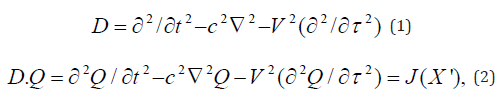
where ∇2 is the Laplacian in r = (x, y, z) and c is the speed of light, V is a characteristic “propagation speed” along the τ axis. Source function J (X ')injects the 5D field equation into Q with an “informational input” from 4D containing P1 or P2. Within 5D, information can propagate along τ with any speed V , which is not constrained by 4D light cones, and so is causal because the propagation V 2∂ 2Q / ∂τ 2 is not a function of t . Boguña et. al (2025) discusses modern use of the d’Alembert operator for causal nonlocal research [11].
From 4D to 5D with a Source Field J(X′)
Recall that J (X ') is a 5D function where X ' is the 5D coordinate. J (X ') is zero only in a 4D sheet or hypersurface. Function J encodes where, how and when information is injected into the 5D field. Nonlocal cognitive interaction (NCI) is enabled through a 5D source field labeled as J . Mental activity acts as a source J in the model. The value of the function J (X ') has to be non-zero only on the 4D hypersurface. Information reality and consciousness exist at P1 and P2 in a 4D worldline. Source J represents “informational inputs” into the 5D field Q emanating from P1 and P2. Note that X1' = (r1',t 'τ 1(t)) and X1' = (r1',t 'τ 1(t)) , and a total source field could be;

which is the sum of the contributions from P1 and P2: Each of these is a 5D function, but each is nonzero only on its own 4D spacetime or hypersurface. Ideally the function J (X ') should only be non-zero when τ matches the τ trajectory of the person. A way to force that requirement is to use a Dirac delt function δ (τ ) in 5D space [8]. For analytical ease, assume that an explicit form of J1 and J 2 uses general 3D space geometry by letting y and z coordinates exist but are not written. P1 has a worldline (or worldtube) centered at position x1(t '), y1(t '), z1(t ')) , while P2 has a worldline centered at x2(t '), y2(t '), z2(t ')) . Then;
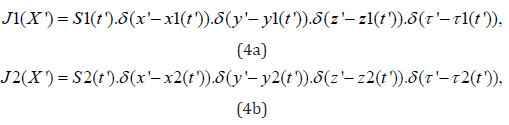
where X ' = (x ', y ', z ',t ',τ ') is the integration variable (source point). Source strength or intensity S1(t ') and S2(t ') are used to show how strongly P1 and P2 excite Q at time t ' . The Dirac delta functions “pin” the source to the actual worldlines in both space and τ . For visualization simplicity and NCI graphing, its common to only use coordinates x and t. In this case P1 at X = X1(t ') and P2 at X = X 2(t ') , and then;
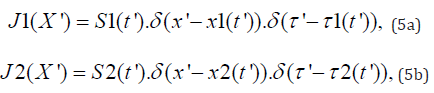
where J1(X ') and J 2(X ') shows there is a source at P1 and P2’s position in x ' (and y ' , z ' if used), at time t ' . In the 5D world, P1 and P2’s embedded trajectories are τ ' =τ 1(t) and τ ' =τ 2(t ') respectively. To recap, field J was specifically developed as a function to move information from 4D to 5D. The source term J in Equation (2) is placed there to excite the hypothetical 5D Qfield, because Q does nothing by itself. Field Q is the 5D field that exist everywhere in (x, y, z,t,τ ) space. However, P1 and P2 are 4D cognitive beings and they exist in (x, y, z,t) spacetime, while their mental or informational activity is modeled as J1 and J2, written as 5D functions J (X') , but with delta functions that pin them to 4D hypersurfaces (their τ -trajectories). Function J is a bridge because it takes a 4D process (what P1 or P2 are doing in time), and injects it into the 5D field Q. The function is an impulse kick to the 5D field, from a 4D location, time and τ . In summary, a person’s internal state generates the source term J that injects the information into the 5D field Q. However, the field J1 for person P1 is restricted to the persons 4D worldline via δ (τ '−τ 1(t ')) , or for person P2 by δ (τ '−τ 2(t')) .
From 5D to 4D with a Green’s Function Gret (X, X’)
The J field is essential for placing information about events in 4D into the 5D field Q, however bringing causal information from 5D back to 4D may also be possible with another function and the use of delta functions. A retarding Green’s function can specifically operate to collapse information from one plane to another [12]. Mathematically, Green’s function can bring 5D information to 4D worldlines. Green’s functions are a tool from wave theory that can allow manipulation of a disturbance at the source point X' travels to the field point X . There are constraints. The function can only allow propagation forward in time, and only inside the 5D light cone or space. In other words, no backwards in time influence, no faster than light action (superluminal) and no other acausal behavior. For these constraints to hold, everything the function does is strictly causal in 5D. Such a requirement has a specific solution of Green’s function known as a retarded Green’s function Gret (X , X ') = 0 for t < t' . The Green’s function Gret (X , X') is defined as the solution of;
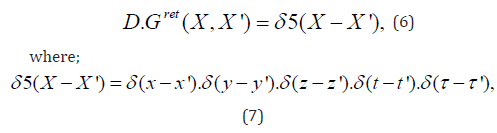
and D is the 5D wave operator (the differential operator that Q obeys), δ 5(X − X ') is the 5D Dirac delta function, and the superscript “ret” just means “retarding” (only future-directed operation). Terms δ 5(X − X ') is a product of five 1-Dimension delta functions, one for each coordinate. It enforces X = X ' , i.e., x = x ', y = y ' , z = z ' , t = t ', τ =τ ' . The action of the Dirac delta function is a key to the model mathematically being viable. The δ function pins the 5D source to a 4D spacetime hypersurface by its action, meaning the person lives in 4D, not 5D. Their influence enters the 5D field only along their worldline so for P1, the source exists only where τ =τ 1(t) . Similarly, for P2, the source exists only where τ =τ 2(t) . This means that the δ function injects 4D information into the 5D field Q at the correct τ location, like poking a 5D membrane from a 4D surface. Finally, integrating the product of the terms in a Green’s function will yield return information held in Q to 4D persons P1 or P2. A Green’s function solution for Q is:

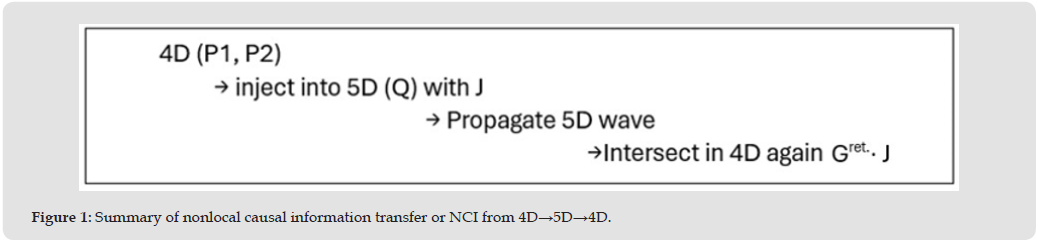
with d5X' the 5D integration measure, d5X' = dx' dy' dz' dτ' . Green’s function is under an integral so the field Q(X) at 5D point X is the sum over all possible source points X '. At each X ', the source J (X ') creates a disturbance and Gret (X , X ') measures how much of that disturbance reaches X , while d5X’ sums contributions from all x ' , y ' , z ' , t ' , τ ' . Because J (X') contains a delta function that pins it to P1 or P2’s 4D hypersurfaces, the integral effectively reduces to integrating along their 4D worldlines; that’s the precise way the model describes nonlocal cognitive interaction (NCI) or telepathy between two people in 4D spacetime. The process is summarized as shown in the simplified diagram in Figure 1.
Figure 1
Diagrams of 5D Nonlocal Interactions
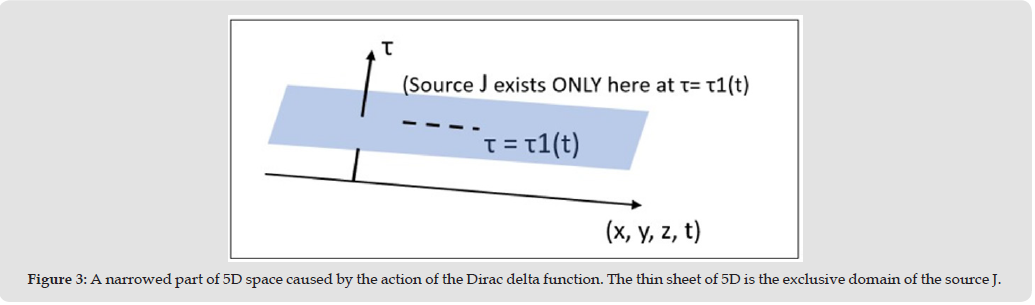
Diagrammatic representation of 5D space geometry is simplified by collapsing the three spatial dimensions r = (x, y, z) into a single axis r. In describing the location of P1 and P2, it is sufficient to use the x coordinate x1 and x2 respectively for tractability. Figure 2 shows a depiction of a 4D hypersurface. A hypersurface is simply the set of all points where τ takes a specific value. On the figure, τ is the vertical 5D axis on the page while a sheet shown by the dotted line is a out of the plane of the diagram to indicate a 4D hypersurface at a nominal τ =τ 0 . The 4D sheet floats inside 5D space and is called a hypersurface. Figure 3 illustrates the narrowing function of the Dirac delta function component δ (t −τ 1(t)) , generalized from Equation (5a), which forces the source J (X) to only exist on the hypersurface where τ =τ 1(t) in this case. The delt function “cuts out” a small 4D sheet inside the 5D space so instead of filling all of 5D space the source becomes narrowed to a thin sheet. Source J only exists on this narrowed sheet where P1 and P2 each have their own sheets at τ =τ 1(t) and τ =τ 2(t) respectively. A point to note is that the retarding Green’s function Q(X) = ∫Gret (X , X').J (X')d5X' in the above Equation (8) contains the delta function embedded in the source field J(X′). As stated above in Figure 3, the source term J only exists on a narrow sheet in 4D. While the Green function propagates a Q signal forward in 5D, its integral collapses to a 4D one because J (X ') contains δ (τ −τ 1(t ')) as shown in Equation (5). Green’s function is evaluated as a collapsed 4D version Q(X ) = ∫Gret (X , X').J 4(X')d 4X' .
Figure 2
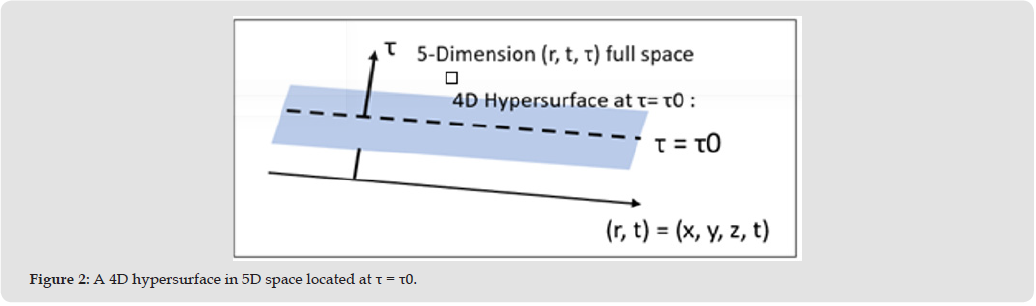
Figure 3
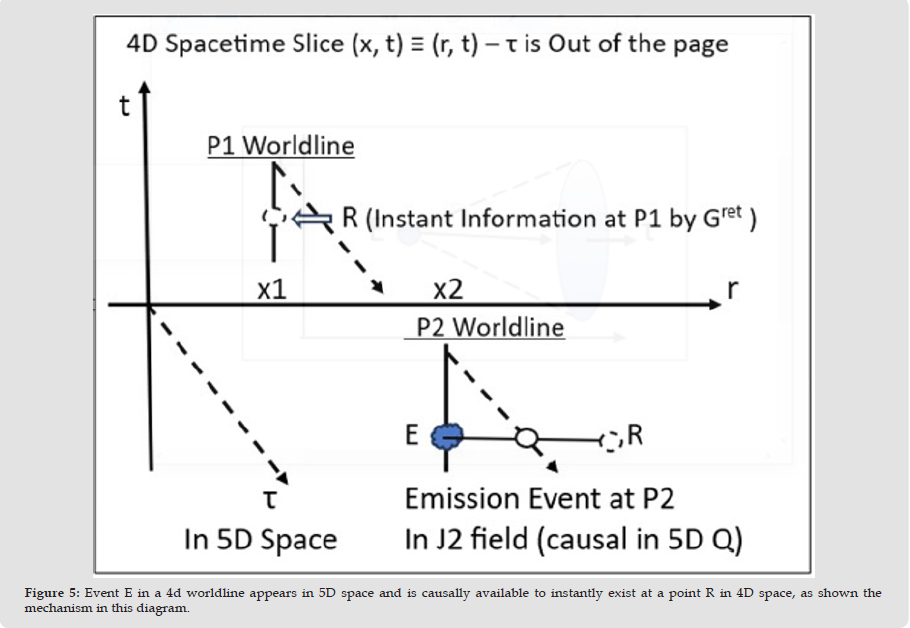
Causality is critical in all analysis of 4D space. Activity along τ in 5D space is causal because events don’t cross into time t. Figure 4 shows an emission point E in 5D space. By drawing a 5D light-cone in the (t,τ ) plane, all points are accessible causally in 5D as the signal spreads in both t and τ . The 5D light cone guarantees causality even when 4D sees an instant telepathy. Figure 5 shows the complete diagram of a nonlocal cognitive interaction (or telepathic event). An emission point E occurs at P2. The information travels in a 5D light cone as a physically real causal connection. When conditions in τ are aligned via Greens function, the τ -motion collapses to a 4D point R , the reception in P1’s reality. This is why E from P2 at x2 can appear instantly at R at P1’s location x1.
Figure 4
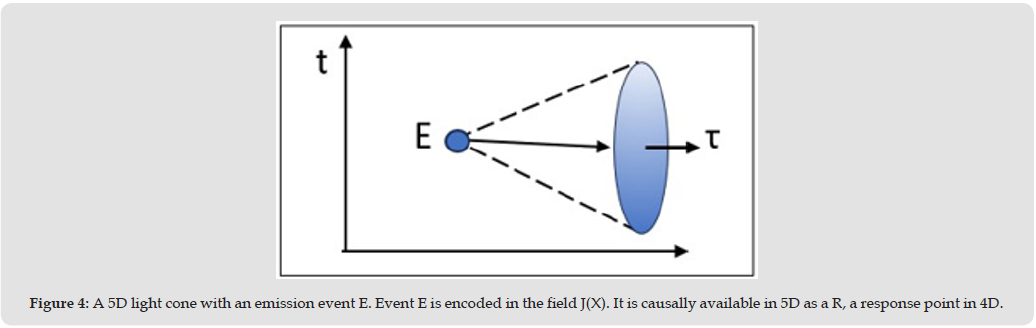
Figure 5
Nonlocal information, defined as that which does not originate in spacetime, can be causal in 5D space. A similar effect has been discovered in physics in which two particles can be spatially separated and exhibit exactly the same states, known as quantum entanglement. The question was posed, what if nonlocal cognitive interaction (known as telepathy) could be explained by a mechanism that allows signal transfers from 4D space to and from 5D space? A mathematical physics approach was used in this paper to analyze and understand nonlocal cognitive interactions (NCI) while respecting causality. A simplified chain of events that describes this process is provided in a Figure 1. A more detailed summary of Figure 1 serves as a discussion on the entire paper. The entire subject of mathematically justifying nonlocal cognitive interaction has been provided. Model setup first required two individuals P1 and P2 in 4D spacetime. Person P1 has a field location coordinate X in 5D space while Person P2 creates a source disturbance at location X' in 5D space. In theory, P2’s conscious activity itself creates the disturbance in a 5D field Q. A Dirac δ function was used to pin this disturbance to P2’s 4D hypersurface in x, where x = x2 , t = t 'and τ =τ 2(t ') , i.e., the δ function pinned the source to P2’s 4D worldline inside 5D, thus defining the “injection” point for 4D information into 5D. A wavefront from the 5D source signal J (X ') propagates in Q from P2, expands outward as it moves through 5D space. It rises in τ , it spreads in x and it moves forward in t.
This is the part 4D cannot see because it only exists in 5D space.
With respect to P2’s disturbance signals, they spread forward in 5D
space and time causally, described by the action of the retarding
Green’s function defined as Gret (X , X') = 0 for t < t' . A Green’s
function was adopted because it ensures the disturbance propagates
forward in time, and stays inside the 5D light cone of x , t , and τ
(and not just in spacetime x and t ). As such, the disturbance is a
fully causal 5D wavefront because is not constrained by light speed
and future information. Next in the process, the 5D wavefront intersects
P1’s 4D hypersurface and this is a key moment. Recall that P1’s
worldline is also embedded in 5D via τ =τ 1(t) and that P1 only
samples Q along its own 4D worldline x = x1, t = t , τ =τ 1(t)
. In other words, the 5D signal collapses into a 4D experience. To P1,
it looks like no travel time and no spatial propagation, just a sudden
mental event; the essence of nonlocal cognitive interaction or telepathy.
Viewing Figure 5, point R on P1’s worldline shows how an event
E at P2 arrives at P1 instantly. When the 5D wavefront reaches a point
where x = x1, t = tR , τ =τ 1(tR) , the signal form X' becomes “visible”
to P1, as the telepathic reception event. The idea that R is point
needs clarification, so that Figure 5 makes sense. In the figures, X'
is always a source (like P2) and X is always a field evaluation point
(like P1). They are never the same object. However, R is a specific
field point X on P1’s worldline where the 5D wavefront arrives. So
mathematically  and R is simply a particular
value of X .
and R is simply a particular
value of X .
The point R is not a source point, nor is it X ' or where the disturbance originates (on P2), but rather where the disturbance is felt (on P1). They are connected by the retarding Green’s function Q(X ) = ∫Gret (X , X').J (X')d5X' and as a result X ' is integrated over P2’s worldline while X is the point where the field is evaluated. Finally, R is the particular X where the wavefront intersects P1’s τ trajectory, i.e., X' → causal propagation in 5D → R . In a final overview of the process, the δ function injects 4D information into 5D, the retarded Green’s function carries it causally through 5D, and the intersection of the 5D wavefront with another 4D hypersurface makes the signal appear instant in 4D even though it is fully causal in 5D. A final comment about the setup for the model is worthwhile. Analysis has only considered two persons involved in a nonlocal cognitive exchange of information. More persons could be added to the model as required. In the research, analysis of the 5D space (r, t, τ) was made mathematically tractable by collapsing the 3D positions of P1 and P2 into only the x-axis positions x1 and x2 respectively. Testing for an NCI event in the future might require some laboratory measurements, including use of ordinary statistical correlation between two random quantities. A future laboratory tests would consider an experiment to evaluate the values of Q along the 5D structure, such as Q(X1) and Q(X2) as random variables (or stochastic processes) indexed by t. The covariance and correlation coefficient between them would be a measure of how well the R signal and E signal align based on P1 and P2 statements.
Methods and theoretical treatments that explain nonlocal cognitive interactions (NCI) between spatially separated individuals have been considered. Connections cannot be electromagnetic in nature. A theory is introduced to show that cognitive information coupling between separated people is valid through a 5D space in which our 4D spacetime exists. Information transfer from a person through a distant connection that begins with an event which is immediately sensed at some other location by a person would break laws of physics related to faster-than-light travel. Such action would be acausal, unless contained in a causal space such as 5D. A model was proposed that describes an information signal source, a transmission process and a return of information to another location. Further, transmission of information from one conscious person to a space where causality is preserved, acted on instantly, and returned to a recipient person at another part of spacetime, is conceptual in physics. A short summary of the way a nonlocal cognitive interaction operates is instructive to conclude the paper. In the model. A person P2 in 4D acts as a source of signal J2 at event E. P2’s conscious activity creates a disturbance in the 5D field Q. Use of a Dirac delta function pins the disturbance to P2’s 4D hypersurface at X 2 , t ' and τ =τ 2(t ') . This is the injection of information from 4D into 5D. A retarding Green’s function spreads the disturbance forward in time inside the 5D light cone in x, t, τ and is fully causal. This is the part the 4D cannot see.
The wavefront in Q intersects a person’s P1 τ -trajectory noting that P1’s worldline is embedded in 5D space. P1 coordinates are x1 , t and τ =τ 1(t) . When the wavefront reaches location R the signal becomes instantly visible to P1. This is a sudden mental event, a nonlocal cognitive interaction or telepathic event.

International Association of Landscape Archaeology, Czech Glass Society, Czech Republic

Department of Chemistry, Semenov Institute of Chemical Physics, USSR Academy of Sciences, Moscow, Russia

Associate Professor at Department of Breast and Thyorid Surgey, Chongqing General Hospital, China

Professor of Nuclear Medicine, Faculty of Medicine and Surgery, University of Milan, Milan, Italy

Department of Pharmaceutical Sciences, South University School of Pharmacy, USA





 Abstract
 PDF
PDF



























