info@biomedres.us
+1 (502) 904-2126
One Westbrook Corporate Center, Suite 300, Westchester, IL 60154, USA
Site Map
 ISSN: 2574 -1241
ISSN: 2574 -1241
ISSN: 2574 -1241
Received: February 03, 2026; Published: February 20, 2026
*Corresponding author: Huihong Dou, Department of Hematology and Oncology, Maternity and Child Health Hospital, Guangxi Zhuang Autonomous Region, Nanning, Guangxi, China; Guangxi Clinical Research Center for Pediatric Diseases
DOI: 10.26717/BJSTR.2026.64.010102
Background: There are few reports on the diagnosis and treatment of rare Fusarium infection in early chemotherapy of early T-cell precursor acute lymphoblastic leukemia (ETP-ALL) with HOX11 gene positivity.
Case Presentation: To explore the clinical characteristics and treatment of childhood leukemia complicated with Fusarium infection. A 7-year-old female child with ETP-ALL (HOX11 positive) complicated with Fusarium infection in the early stage of chemotherapy. Repeated fever occurred in the early stage of induction chemotherapy. Chest CT scan showed multiple patchy and nodular hyperdense shadows in both lungs, purplish red hard nodules on the skin of the whole body with central necrosis, and then multiple subcutaneous liquid masses on the limbs. Fusarium was detected in sputum culture, stool culture, skin biopsy tissue culture and skin pus culture. The fungal culture of skin biopsy tissue was sequenced and verified to be F. pseudensiforme. Amphotericin B liposome combined with voriconazole and posaconazole was given to treat Fusarium infection. After 1 month of antifungal treatment, the treatment effect was not good, and the fever in child continued. Chest computed tomography showed multiple patchy shadows with increased nodular density in both lungs. The pulmonary infection progressed, and skin lesions did not resolve significantly.
Conclusion: Once characteristic skin lesions are found during chemotherapy in children with acute leukemia, biopsy of skin lesions should be carried out as soon as possible; Once multiple subcutaneous fluid masses are found, smear and culture the puncture fluid of the masses as soon as possible to clarify the types of pathogens and guide the next treatment plan. For the comprehensive treatment of children with invasive Fusarium disease, sufficient antifungal drugs should be given early and timely. Amphotericin B liposome + voriconazole is one of the treatment schemes of anti Fusarium disease.
Keywords: Leukemia; Fusarium; Fungal Infection; Skin Lesions
The first strain of Fusarium was discovered on Malvaceae plants in 1809. So far, more than 100 species of Fusarium have been found, but only some species can cause human infection [1]. Fusarium solani is the most common species causing invasive disease (accounting for more than half of cases), followed by F. oxysporum [2]. Fusarium spores are widely distributed in nature and are opportunistic pathogens that can cause invasive or localized infections. Invasive Fusarium disease in children is a rare, severe fungal infection commonly seen in patients with immunosuppression, neutropenia, hematological malignancies undergoing chemotherapy, or bone marrow transplants.
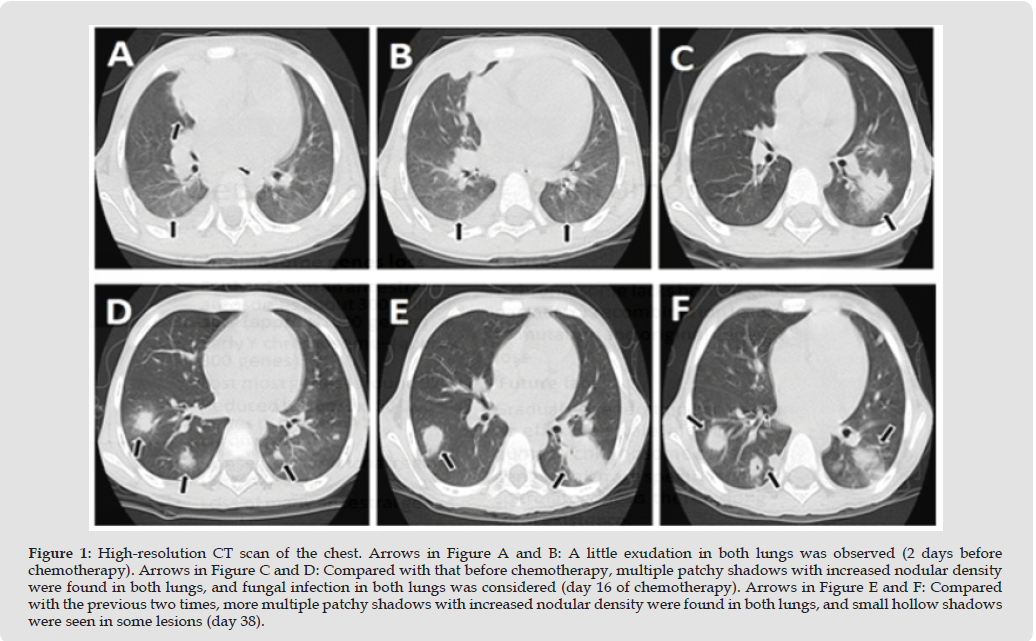
A 7-year-old female child was admitted to our department due to “fatigue and pale face”. The patient’s blood routine examination was initially performed at the local hospital: the white blood cell count was 215 × 109/L (4–10 ×109/L), the hemoglobin level was 29 g/L (110–150 g /L), and the platelet count was 22 × 109/L (100–300 × 109/L). After admission to our department, the bone marrow was extracted and sent for morphological, immunological, cellular, and molecular genetics (MICM) typing of bone marrow cells. The diagnosis was ETP-ALL (HOX11 positive). The chest CT scan showed a little exudation in both lungs (Figures 1A & 1B). Relevant organ function was evaluated, revealing no contraindications. The chemotherapy was started according to the remission induction regimen of ALL (dexamethasone + vincristine + daunorubicin + pegaspargase). Agranulocytosis in the child was observed on day 8 of chemotherapy. On day 13, the child had a fever, with a peak temperature of 39.0°C. The lesion location was not clear. The monitored CRP was between 89 mg/L and >200 mg/L (0–10 mg /L), and the GM test was 1.141– 4.467 (positive). On day 16, a chest CT scan showed multiple patchy shadows with increased nodular density in both lungs, and fungal infection in both lungs was considered (Figures 1C & 1D).
Figure 1
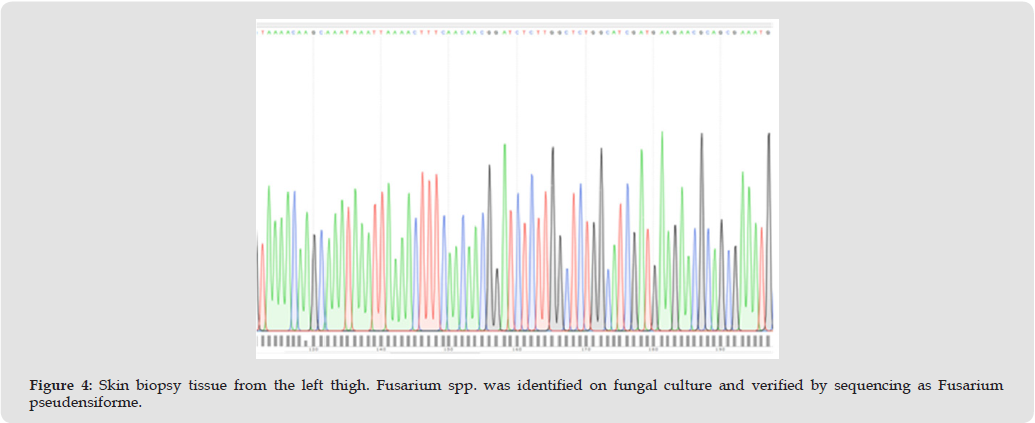
On day 17, voriconazole was given for antifungal treatment. On day 18, yellow-green scattered stools were passed, 4–6 times/day, without mucus, pus, and blood. On day 19, the bone marrow morphology was reviewed. The primitive naive lymphocytes accounted for 37.5% and the bone marrow MRD revealed about 70% of abnormal cells. On day 20 of chemotherapy, induration appeared on the face of the child, accompanied by tenderness, which further increased, enlarged, and deepened (Figures 2A-2C), with rapid progression. Subsequently, multiple bruising and induration appeared on the trunk, limbs, nasal cavity, and other parts of the body, accompanied by tenderness, which gradually enlarged and increased. Also, some ulceration occurred without an oral mucosal ulcer. On day 22, a skin biopsy was performed on the rash on the left thigh. The fungal smear showed septate fungal hyphae (Figure 3). Fusarium was detected in fungal culture and verified by sequencing as F. pseudensiforme (Figure 4). During the course of the disease, the child still had a recurrent fever, with the temperature increased to 39.5°C. The skin lesions increased, ulcerated, and became necrotic, showing crater-like changes (Figure 2D, right index finger).
Figure 2
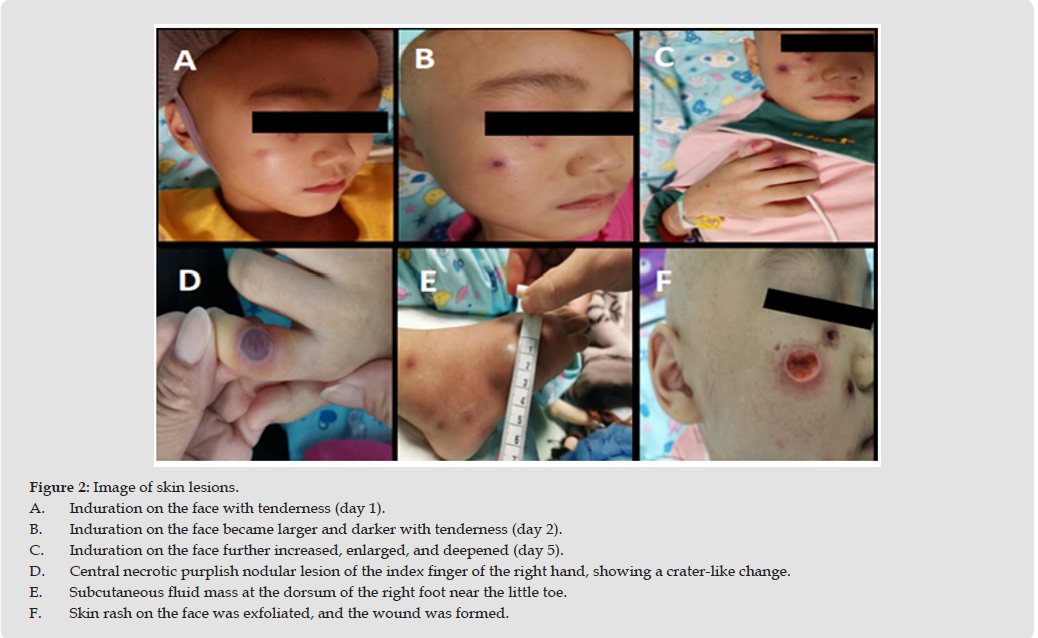
Figure 3
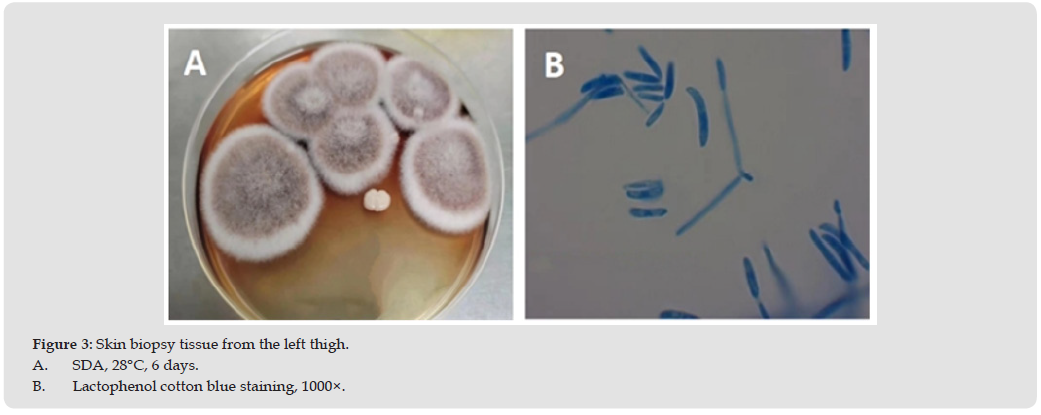
Figure 4
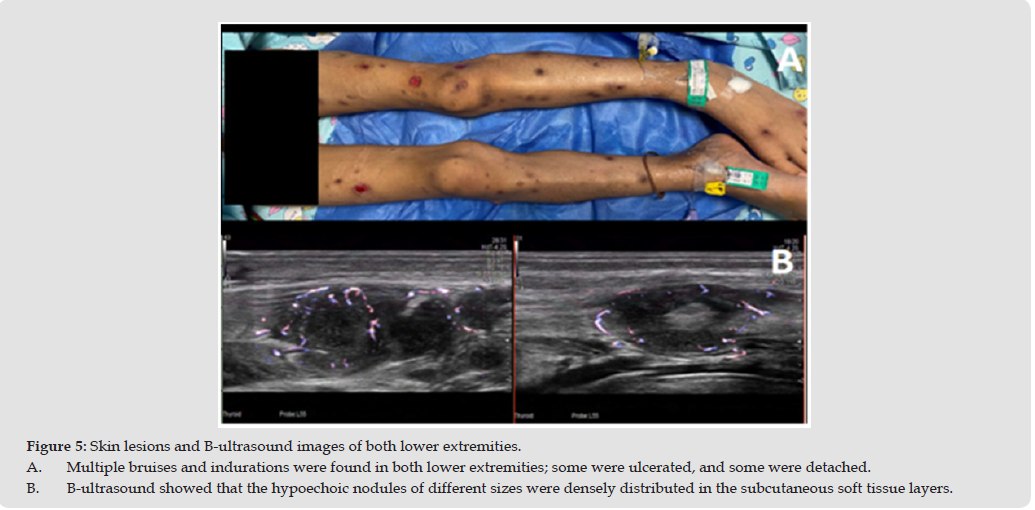
Multiple blood cultures were negative for bacteria and fungi. On day 31, the dorsum of the right foot near the little toe was swollen with tenderness, without fluctuation, which gradually increased (Figure 2E). On day 34, the dorsum of the right foot was swollen obviously with tenderness, and the skin temperature increased, with a sense of fluctuation. The mass on the dorsum of the right foot was treated with incision and drainage, septate fungal hyphae were found in the pus smear, and Fusarium spp. was cultured. On day 40, new subcutaneous fluid masses of size 4.5 × 5 cm2 and 3 × 4 cm2 were found on the left calf and left thigh of the child. The skin color did not change, no tenderness was found, and the skin temperature was not high. The B-ultrasound examination of both lower limbs was performed (Figure 5). Hypoechoic nodules of different sizes were densely distributed in the subcutaneous soft tissue layers of both lower limbs, with the largest being 2.7 × 1.4 cm2. Part of the nodules protruded from the skin surface with unclear boundaries, and some adhered to surrounding tissues. After chemotherapy, the child had obvious bone marrow suppression. Fusarium was detected in stool culture, sputum culture, skin biopsy tissue culture, and skin pus culture. At the same time, the skin biopsy tissue drug susceptibility test was performed.
Figure 5
The minimum inhibitory concentration (MIC, μg/mL) was as follows: amphotericin B, 4; voriconazole, 4; itraconazole, 8; 5-flucytosine, 8; caspofungin, 16; and fluconazole, 16. The chemotherapy was stopped on day 27 due to severe bone marrow suppression after chemotherapy combined with severe systemic diffuse invasive Fusarium infection (lung, skin, and digestive tract). The child had agranulocytosis with fever for a long time. Combined with pathogenic microorganisms and a drug sensitivity test, the child was treated with sufficient courses of potent antibacterial and antifungal treatments (amphotericin B liposome combined with voriconazole and posaconazole successively). At the same time, the intravenous infusion of gamma globulin, albumin, red blood cells, platelets, and plasma support was performed. The recombinant human granulocyte stimulating factor was used to promote the growth of granulocytes, and terbinafine was used for the external application. After sufficient analgesia, the induration and superficial mature liquid mass were removed for debridement. After debridement, the wound was treated with iodophor disinfection, physiological saline irrigation, silver ion alginate dressing, and sterile gauze covering. The dressing change was performed daily to record the wound condition, and attention was paid to strengthen supportive treatment.
After the aforementioned positive systemic and local treatment, the digestive tract symptoms and anemia of the child improved and diarrhea stopped, but the fever continued for more than a month and the daily heat peak fluctuated between 37.0 and 39.6℃. The number of systemic skin lesions increased. Some skin lesions gradually collapsed and appeared crater-like, and a small part of the skin lesions fell off and tended to heal (Figure 2F). The skin rash on the face was exfoliated, and the wound was formed. However, the newly added soft tissue mass spread to the deep part of the limbs in the later period. The re-examination of bone marrow (day 36) showed active bone marrow hyperplasia, with prolymphocytes accounting for 1.5%. The re-examination of chest CT (day 38, as shown in Figure 1E & 1F) indicated an increased number of lesions and small voids in some lesions. The blood routine examination before discharge revealed the following: The white blood cell count was 7.3 × 10⁹/L, the hemoglobin level was 86 g/L, the platelet count was 139 × 109/L, the absolute lymphocyte count was 0.67 × 10⁹/L, the absolute neutrophil count was 6.23 × 10⁹/L, and the CRP level was 114.1 mg/L. The family could not pay the long-term medical expenses.
Therefore, the child was discharged to the local hospital for conservative treatment after 7 weeks of treatment. After discharge, the child was followed up telephonically; the child had a fever almost every day, mainly moderate-to-high fever. A few superficial skin lesions fell off and healed, but the soft tissue mass of the limbs did not shrink significantly and no new skin lesions were found. Oral posaconazole suspension and Chinese herbal medicine treatment were continued. The skin lesions of the child almost completely subsided, and the body temperature was normal 3 months after discharge. However, the white blood cell count in the blood routine monitoring increased to more than 100 × 109/L again, and the recurrence of leukemia was considered, without further chemotherapy. The child died about 4 months after discharge.
Since Cho et al. reported the first case of leukemia combined with invasive Fusarium disease in 1973, invasive Fusarium disease was still extremely rare in clinic. In patients with leukemia complicated with invasive fungal infections, Fusarium was the second most important pathogen after Aspergillus. Its transmission route was similar to that of Aspergillus because Fusarium infection was usually not recognized and easily overlooked. The clinical manifestations of Fusarium infection were mainly determined by the immune status of the host and the entry of infection. It was rare in people with normal immune function and generally caused local infections, such as onychomycosis, keratitis, sinusitis, osteomyelitis, brain abscess, and so forth [3]. Fusarium could often cause systemic disseminated or invasive infections in patients with severe immune dysfunction, especially malignant hematological diseases, severe neutropenia, hematopoietic stem cell transplantation, and so forth [4]. In 2014, the European Society of Clinical Microbiology and Infectious Diseases (ESCMID) and the European Confederation of Medical Mycology (ECMM) guidelines on the diagnosis and treatment of Fusarium disease pointed out that early chest high-resolution CT examination (evidence-based medical evidence classification: AII) and mycolic examination (evidence-based medical evidence classification: BIII) were important means to detect pulmonary Fusarium infection in children with hematological diseases complicated with severe immune dysfunction [5].
The imaging manifestations of pulmonary Fusarium infection included vascular infiltration. Nodules or masses found by chest CT were the most common, and 80% of patients had no halo sign [6]. Sassi et al. showed that invasive Fusarium infection was suspected if chest CT showed lung infiltration with low-density signs but no halo sign or signs of occluded vessels [7]. In the present case, severe systemic diffuse invasive Fusarium infection occurred in the bone marrow suppression stage after chemotherapy, involving the lung, skin, and digestive tract. The clinical manifestations of the child were recurrent moderate and high fever, with mild respiratory manifestations, accompanied by a little cough, mainly wet cough. A total of three chest high-resolution CT examinations were performed, and multiple patchy shadows with increased nodular density appeared in the last 2 times, indicating fungal infection. Later, bronchoscopy alveolar lavage, smear, culture, and metagenomic examination of the alveolar lavage fluid did not detect fungi, which might be related to the use of antifungal drugs for a long time.
In the present case, two main manifestations of skin lesions were found: one was the early appearance of diffuse purple-red induration throughout the body, accompanied by tenderness, and gradual rupture, necrosis, and crater-like changes after necrosis; another type of skin lesion was the late appearance of multiple subcutaneous fluid masses, which had a sense of fluctuation when touched, mostly in the limbs. The B-ultrasound examination found that the deep skin was involved, and yellow and white pus flowed out after puncture or incision. Yu-fang Yao [8], Sevestre [9] and other domestic and foreign scholars reported cases of Fusarium infection in patients with malignant hematological diseases after chemotherapy, all of which showed fever and rash as the main clinical manifestations; the biopsy at the nodules of skin lesions confirmed Fusarium infection. The rash subsided after antifungal treatment. The characteristics of the rash were consistent with the early appearance of skin lesions in this case. The skin biopsy tissue, puncture incision and drainage of mass abscess, and fungal culture in this case suggested Fusarium infection. Fusarium spp. can form biofilms and reduce the permeability of antifungal drugs, leading to high drug resistance to most antifungal drugs [10], with a mortality rate greater than 75% [11].
A combination of antifungal therapy had been shown to be a potential method to improve antifungal ability and efficacy [12], and is an essential means to combat multidrug resistance [13]. ECMM et al. recommended improving the patient’s immunosuppressive status, surgical debridement, and systemic antifungal therapy, and strongly recommended the use of voriconazole or voriconazole combined with liposome amphotericin B preparation for the first-line treatment of invasive Fusarium disease [14]. Although most scholars recommended the combination of voriconazole and amphotericin B liposome for antifungal therapy, the literature included mostly case reports or retrospective analysis, and the optimal treatment strategy and efficacy were not clear. The case reports showed that despite aggressive antifungal therapy, these patients had a poor prognosis [15], and they even died [16]. However, successful cases were also reported. Jieni [17], Verbeke [18] and other scholars reported that patients with acute leukemia complicated with Fusarium infection after chemotherapy were treated with voriconazole combined with amphotericin B liposome for antifungal therapy, and the skin lesions of the patients basically healed and the patients survived. Although the child in the present case was actively treated with combined antifungal infection in the early stage, the clinical manifestations were still progressive, including recurrent fever, increased skin lesions, lung lesion progression, and uncontrollable Fusarium infection.
The reasons were considered to be related to the fact that the child had ETP-ALL combined with positive HOX11 gene, with poor response to chemotherapy. Compared with other subtypes of T-ALL, children with ETP-ALL had the lowest 10-year disease-free survival rate of 32.1% ± 11.7%, with poor treatment response and a high recurrence rate [19]. The tumor burden was still high on day 19 of induction chemotherapy, and the chemotherapy effect was not satisfactory. The underlying diseases could not be effectively controlled, and the patient was in immunosuppression state after chemotherapy. However, further research was needed for clarification. Although Fusarium infection was rare in clinical practice, once it occurred and if it was not controlled in a timely and effective manner, it could easily turn into a systemic disseminated and invasive infection, with poor prognosis and high mortality. In clinical practice, if typical lesions are found, clinicians should examine the lesions as soon as possible to make a correct diagnosis, provide effective antifungal treatment, and improve the immune state in time, which is the key to improving the survival rate of patients with Fusarium infection.
The following experiences were gained from the diagnosis and treatment of this case and the review of literature:
1) For children with agranulocytosis secondary to chemotherapy for hematological malignancies, active fungal infection and chest CT examination should be actively performed to detect signs of pulmonary fungal infection and achieve the purpose of timely antifungal treatment.
2) Once abnormal skin lesions were found, skin biopsy should be performed as soon as possible. Once multiple subcutaneous fluid masses were found, smear and culture of the mass puncture fluid should be performed as soon as possible to identify the pathogen species and guide the next treatment plan.
3) Children with invasive Fusarium disease should be given a sufficient amount and a full course of antifungal drugs. Amphotericin B liposome + voriconazole is one of the treatment options for Fusarium disease.
4) Attention should be paid to timely promote the recovery and maintenance of hematopoietic function in children, repeatedly give G-CSF, restore the children’s autoimmunity, and actively take supportive measures such as transfusion of red blood cells and platelets.
This work was supported by the Guangxi Clinical Research Center for Pediatric Diseases (Grant/Award Number: Guike AD22035121).
The authors declare no conflicts of interest.
Informed consent was obtained from the patient’s guardian.

International Association of Landscape Archaeology, Czech Glass Society, Czech Republic

Department of Chemistry, Semenov Institute of Chemical Physics, USSR Academy of Sciences, Moscow, Russia

Associate Professor at Department of Breast and Thyorid Surgey, Chongqing General Hospital, China

Professor of Nuclear Medicine, Faculty of Medicine and Surgery, University of Milan, Milan, Italy

Department of Pharmaceutical Sciences, South University School of Pharmacy, USA





 Abstract
 PDF
PDF



























