info@biomedres.us
+1 (502) 904-2126
One Westbrook Corporate Center, Suite 300, Westchester, IL 60154, USA
Site Map
 ISSN: 2574 -1241
ISSN: 2574 -1241
ISSN: 2574 -1241
Received: February 09, 2026; Published: February 19, 2026
*Corresponding author: Ronaldo André Castelo dos Santos de Almeida, Department of Physiological Sciences, Laboratory of Cardiovascular Physiology and Pharmacology, Federal Rural University of Rio de Janeiro (UFRRJ), Brazil
DOI: 10.26717/BJSTR.2026.64.010100
Environmental heat is emerging as a major determinant of cardiovascular stress in the context of climate change and increasing environmental extremes. Heat exposure activates thermoregulatory mechanisms, which lead to dehydration, reduced plasma volume, and elevated heart rate. These changes increase cardiac workload and may precipitate acute cardiovascular events, particularly in older adults and individuals with preexisting cardiovascular disease. Epidemiological evidence consistently links temperature rise and heatwaves to increased cardiovascular morbidity and mortality, supported by mechanisms such as inflammation, autonomic dysfunction, haemoconcentration, and prothrombotic states. Thermal stress requires coordinated hemodynamic and autonomic adjustments. Increased cardiac output, mediated by heart rate and stroke volume, is essential to sustain heat dissipation through skin blood flow. This integrated response defines cardiac thermal economy, a state in which cardiovascular regulation maintains thermal balance efficiently. However, this adaptation carries physiological costs.
Aging attenuates cardiac output reserve and shifts reliance toward increased heart rate and contractility, elevating ventricular workload. Myocardial blood flow and systolic function also rise during heat exposure, reflecting active yet potentially taxing compensatory mechanisms. When cardiac resilience is exceeded, compensatory mechanisms may become sources of cardiovascular stress. Despite strong physiological evidence, controlled heat exposure remains outside standard preventive practice, highlighting a translational gap. Cardiac thermal economy offers a framework linking environmental exposure to preventive cardiology, suggesting that individualized, monitored thermal conditioning may enhance cardiovascular efficiency and resilience. In a warming world, integrating environmental physiology into cardiovascular science is essential for risk prediction and prevention.
Abbreviations: CVD: Cardiovascular Disease; CO: Cardiac Output; BP: Blood Pressure; HR: Heart Rate; SV: Stroke Volume
Environmental stressors associated with human activities (eg, air and noise pollution, light disturbance at night) and climate change (eg, heat, wildfires, extreme weather events) are increasingly recognized as contributing to cardiovascular morbidity and mortality (Blaustein, et al. [1]). Heat-waves are associated with increased cardiovascular mortality and incidence rates [2]. High ambient temperatures trigger thermoregulatory responses such as peripheral vasodilation and increased sweating, which in turn lead to dehydration, reduced plasma volume, and elevated heart rate. These changes increase cardiac workload and may precipitate acute events in vulnerable individuals (Tran, et al. [3]). At rest, heat stress causes vasodilation, decreased vascular resistance, increased cardiac output, and changes in heart rate and stroke volume (Tran, et al. [3]). The ability to increase cardiac output is imperative to allow for and sustain thermoregulatory effector responses (i.e., skin blood flow and sweating) to elevated body temperatures. As such, thermoregulatory demands during heat stress can place considerable strain on a compromised cardiovascular system in older adults (Cottle, et al. [4]).
Most of the hospitalizations and deaths in this population are attributed to heat-induced cardiovascular sequelae (Cottle, et al. [4]). Extreme heat particularly exacerbates cardiovascular complications in adults with pre-existing cardiovascular disease (CVD) (Cottle, et al. [4,5]). The meta-analysis of 266 studies that met our inclusion criteria revealed that a 1°C rise in temperature was associated with a 2.1% increase in cardiovascular disease-related mortality and 0.5% increase in cardiovascular disease-related morbidity (Liu, et al. [6]). Heatwaves were also associated with negative cardiovascular disease health outcomes. The risk of heatwaves on cardiovascular disease-related mortality increased significantly by 11.7%, with an increased effect as heatwave intensity increased (Liu, et al. [6]). Key mechanisms include thermoregulatory stress, inflammation, autonomic nervous system dysfunction, prothrombotic state, and psychosocial stress (Siqi Zhang, et al. [5]). Heat stress is associated with haemoconcentration and a prothrombotic condition due to decreased plasma volume as a result of sweating, and increases in circulating levels of platelets, red blood cells, and blood viscosity (Stewart [7]).
Thermal stress represents a fundamental physiological challenge that demands coordinated cardiovascular adjustments. Thermal stress can be classified as passive or exercise-related thermal stress (Tran, et al. [3]). During passive exposure, the cardiovascular system becomes a central component of heat dissipation mechanisms. When the body is subjected to continued passive heat stress, cutaneous blood vessels dilate, reducing peripheral vascular resistance. This, in turn, promotes cardiac output (CO) to maintain blood pressure (BP). CO is mediated by the increased heart rate (HR) and stroke volume (SV) (Tran, et al. [3]). Accordingly, at rest, heat stress causes vasodilation, decreased vascular resistance, increased cardiac output, and changes in heart rate and stroke volume. (Foster, et al. [3,8]). These hemodynamic responses are not auxiliary, but essential to thermoregulation. The ability to increase cardiac output is imperative to allow for and sustain thermoregulatory effector responses (i.e., skin blood flow and sweating) to elevated body temperatures (Cottle, et al. [4]).
However, this thermoregulatory demand comes at a physiological cost, particularly in vulnerable populations. As such, thermoregulatory demands during heat stress can place considerable strain on a compromised cardiovascular system in older adults (Cottle, et al. [4]). Underlying these adjustments is a complex autonomic integration that modulates cardiac function dynamically. Multiple interactions between the two systems result in the nonlinear transmission of neural information to the target organ, exemplified in the autonomic outflow to the heart (Tran, et al. [3]). Their continuous dynamic interaction modulates cardiovascular function through bidirectional augmentation, where a tonic vagal signal enhances the gain of sympathetic stimulation to the heart during sympathetic dominance, and vice versa (Berntson, et al. [9,10]). Despite central volume challenges during heat exposure, compensatory cardiac mechanisms are engaged. Despite a reduction in central blood volume and cardiac filling pressures, SV is still maintained or slightly increased by improving systolic and diastolic functions (Tran, et al. [3]). Age modifies the efficiency of these cardiovascular responses, reshaping the concept of cardiac thermal economy.
While the findings remain equivocal on maintenance of stroke volume in older adults, it is clear that (1) the magnitude of the rise in cardiac output during heat stress is attenuated in older compared to young adults, and (2) increases in cardiac output in older individuals are primarily driven by increases in HR and contractility, increasing the work of the left ventricle (Cottle, et al. [4]). This altered strategy also affects myocardial perfusion. Myocardial blood flow increases in proportion to increases in core temperature (González Alonso [11]). Simultaneously, intrinsic cardiac adjustments are evident. Heat exposure increased s′ in almost all participants, indicating an elevated systolic contractility in the heat (Foster, et al. [8]). Together, these findings describe adaptive yet potentially taxing mechanisms. These findings demonstrate the compensatory mechanisms that older adults use to maintain adequate cardiac output during heat stress (Glenn Armstrong, et al. [12]).
Cardiovascular resilience in the context of thermal stress refers to the capacity of the cardiovascular system to maintain functional stability despite sustained environmental strain. When this compensatory requirement is prolonged, physiological reserve becomes a key determinant of tolerance, since thermoregulatory demands during heat stress can place considerable strain on a compromised cardiovascular system in older adults (Cottle, et al. [4]). Resilience is therefore expressed through the dynamic capacity of autonomic and hemodynamic systems to adapt under load. Neural control plays a central role, as multiple interactions between the two systems result in the nonlinear transmission of neural information to the target organ, exemplified in the autonomic outflow to the heart (Horowitz, et al. [13]). Moreover, their continuous dynamic interaction modulates cardiovascular function through bidirectional augmentation, where a tonic vagal signal enhances the gain of sympathetic stimulation to the heart during sympathetic dominance, and vice versa (Tran, et al. [3]). These mechanisms allow the heart to adjust output and vascular distribution in response to thermal stress.
However, resilience is not uniform across the lifespan. Age-related differences reveal limits in adaptive capacity, where the magnitude of the rise in cardiac output during heat stress is attenuated in older compared to young adults, and increases in cardiac output in older individuals are primarily driven by increases in HR and contractility, increasing the work of the left ventricle (Cottle, et al. [4]). This altered strategy indicates greater myocardial effort for equivalent thermoregulatory demands. Supporting this, myocardial blood flow increased in proportion to increases in core temperature (Cottle, et al. [4]), demonstrating that myocardial perfusion must rise to match metabolic needs during heat exposure. Cardiac functional adjustments further illustrate the concept of resilience under thermal strain. Heat exposure increased s′ in almost all participants, indicating an elevated systolic contractility in the heat (Foster, et al. [8]). These responses are not passive but represent active compensatory adaptations, as these findings demonstrate the compensatory mechanisms that older adults use to maintain adequate cardiac output during heat stress (Foster, et al. [8]). Thus, cardiovascular resilience reflects the integrated ability of autonomic control, myocardial performance, and vascular responses to sustain function when exposed to environmental heat. When this adaptive capacity is exceeded, the same mechanisms that preserve homeostasis may transition into sources of cardiovascular strain.
Despite the clear physiological relevance of heat exposure, translation into clinical application remains limited. Heat stress represents a powerful cardiovascular stimulus, as the ability to increase cardiac output is imperative to allow for, and sustain, thermoregulatory effector responses (i.e., skin blood flow and sweating) to elevated body temperatures (Cottle, et al. [4]). At the same time, the same mechanisms that enable thermoregulation can impose cardiovascular load, since thermoregulatory demands during heat stress can place considerable strain on a compromised cardiovascular system in older adults (Cottle, et al. [4]). This duality helps explain caution in clinical translation. Cardiovascular adjustments during heat exposure are extensive: When the body is subjected to continued passive heat stress, cutaneous blood vessels dilate, reducing peripheral vascular resistance. This, in turn, promotes cardiac output (CO) to maintain blood pressure (BP). CO is mediated by the increased heart rate (HR) and stroke volume (SV) (Tran, et al. [3]). In parallel, at rest, heat stress causes vasodilation, decreased vascular resistance, increased cardiac output, and changes in heart rate and stroke volume (Tran, et al. [3]). Such responses resemble hemodynamic stress tests rather than passive environmental effects.
The autonomic component further complicates therapeutic integration. Multiple interactions between the two systems result in the nonlinear transmission of neural information to the target organ, exemplified in the autonomic outflow to the heart (Tran, et al. [3]). Additionally, their continuous dynamic interaction modulates cardiovascular function through bidirectional augmentation, where a tonic vagal signal enhances the gain of sympathetic stimulation to the heart during sympathetic dominance, and vice versa (Tran, et al. [3]). These complex control dynamics make the cardiovascular response to heat highly individualized. Age (Roth, et al. [14]) and disease (Roth, et al. [14,15]) modify the response further, creating uncertainty in risk stratification. The magnitude of the rise in cardiac output during heat stress is attenuated in older compared to young adults, and increases in cardiac output in older individuals are primarily driven by increases in HR and contractility, increasing the work of the left ventricle (Cottle, et al. [4]). Moreover, myocardial blood flow increased in proportion to increases in core temperature (Cottle, et al. [4]), indicating increased myocardial metabolic demand. Functional markers also shift under thermal load: Heat exposure increased in almost all participants, indicating an elevated systolic contractility in the heat (Foster, et al. [8]).
These findings highlight the adaptive nature of the response but also its potential limits, since these findings demonstrate the compensatory mechanisms that older adults use to maintain adequate cardiac output during heat stress (Foster, et al. [8]). The reliance on compensatory mechanisms, rather than baseline reserve, underscores why controlled heat exposure remains outside standard cardiovascular guidelines, despite mechanistic evidence of adaptive potential.
The concept of cardiac thermal economy offers a physiological bridge between environmental exposure and preventive cardiology. Heat exposure engages fundamental cardiovascular control mechanisms because the ability to increase cardiac output is imperative to allow for, and sustain, thermoregulatory effector responses (i.e., skin blood flow and sweating) to elevated body temperatures (Cottle, et al. [4]). When these responses occur efficiently, they reflect a state in which cardiovascular regulation supports thermal balance without excessive strain (Almeida, et al. [16]) (Figure 1). This efficiency depends on coordinated autonomic integration. Multiple interactions between the two systems result in the nonlinear transmission of neural information to the target organ, exemplified in the autonomic outflow to the heart (Tran, et al. [3]). Furthermore, their continuous dynamic interaction modulates cardiovascular function through bidirectional augmentation, where a tonic vagal signal enhances the gain of sympathetic stimulation to the heart during sympathetic dominance, and vice versa (Tran, et al. [3]). Such dynamic control suggests that repeated exposure to heat could influence autonomic balance — a core determinant of cardiovascular risk. Peripheral and central hemodynamics are also central to this framework. When the body is subjected to continued passive heat stress, cutaneous blood v
Figure 1
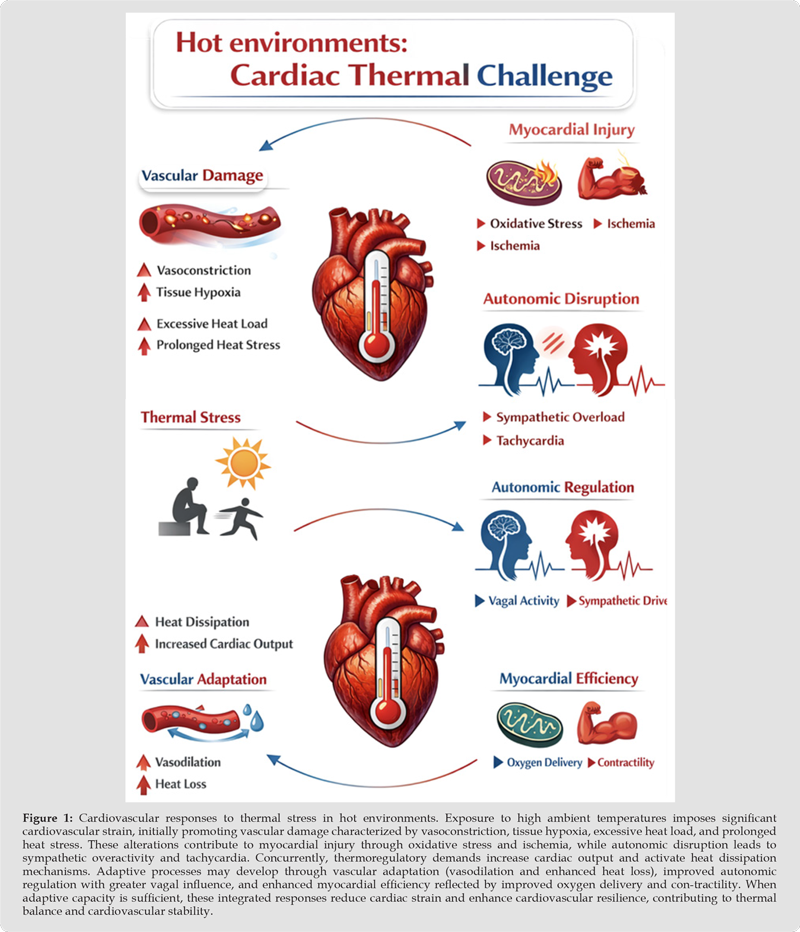
This, in turn, promotes cardiac output (CO) to maintain blood pressure (BP). CO is mediated by the increased heart rate (HR) and stroke volume (SV) (Tran, et al. [3]). Meanwhile, myocardial support of these adjustments is evident since myocardial blood flow increased in proportion to increases in core temperature (Cottle, et al. [4]). These responses reflect the heart’s active participation in thermoregulation. However, preventive strategies must consider biological limits (Almeida, et al. [16]). The magnitude of the rise in cardiac output during heat stress is attenuated in older compared to young adults, and increases in cardiac output in older individuals are primarily driven by increases in HR and contractility, increasing the work of the left ventricle (Cottle, et al. [4]). Functional adaptation may still occur, as heat exposure increased s′ in almost all participants, indicating an elevated systolic con-tractility in the heat (Foster, et al. [8]). Yet, these findings demonstrate the compensatory mechanisms that older adults use to maintain adequate cardiac output during heat stress (Foster, et al. [8]), highlighting reliance on reserve capacity rather than reduced demand. Thus, cardiac thermal economy frames heat adaptation not merely as tolerance, but as efficiency of cardiovascular operation under thermal load. In preventive cardiology, this framework suggests that controlled thermal exposure may act as a physiological conditioning stimulus (dos Santos de Almeida, et al. [17]) — provided that individual cardiovascular reserve and vulnerability are accounted for.
Environmental heat is no longer merely an external physical factor but a potent cardiovascular stressor that actively shapes cardiac workload, autonomic balance, and myocardial function. The evidence reviewed demonstrates that thermoregulation is inseparable from cardiovascular physiology, with cardiac output, vascular tone, and autonomic integration forming the core of the body’s response to elevated temperatures. Under heat stress, the heart transitions from a primarily circulatory organ to a thermoregulatory effector, operating under conditions that resemble sustained hemodynamic challenge. The concept of cardiac thermal economy provides a unifying framework to understand how the cardiovascular system may operate more efficiently under thermal load, reducing physiological cost through integrated autonomic and vascular adaptations. However, this adaptive capacity is not limitless. Aging, pre-existing cardiovascular disease, and reduced physiological reserve shift the balance from adaptive regulation toward increased myocardial work, autonomic strain, and potential instability. Thus, the same mechanisms that preserve thermal homeostasis may become pathways of cardiovascular vulnerability when exposure exceeds individual resilience.
The notion of cardiovascular resilience further emphasizes that tolerance to environmental heat depends on the dynamic capacity of neural, vascular, and myocardial systems to maintain function under stress. When resilience is exceeded, compensatory mechanisms transition into sources of strain, linking environmental heat directly to adverse cardiovascular outcomes observed at the population level. A major challenge remains translational. Despite mechanistic and physiological evidence, con-trolled thermal exposure has not yet been integrated into cardiovascular preventive strategies. This gap reflects the dual nature of heat as both a conditioning stimulus and a hemodynamic load. The framework of cardiac thermal economy suggests that, if properly individualized and monitored, thermal exposure could represent a non-pharmacological avenue for enhancing cardiovascular efficiency and resilience. However, defining safe doses, identifying vulnerable phenotypes, and establishing clinical guidelines are essential next steps. In a warming world, cardiovascular physiology must evolve into an environmentally integrated discipline. Understanding how the heart adapts — and fails to adapt — to heat will be central to predicting risk, guiding prevention, and redefining the role of environmental stress in cardiovascular health.
Our sincere thanks to the Department of Physiological Sciences and the Department of Physical Education of the Federal Rural University of Rio de Janeiro, both of which were decisive in carrying out this work.

International Association of Landscape Archaeology, Czech Glass Society, Czech Republic

Department of Chemistry, Semenov Institute of Chemical Physics, USSR Academy of Sciences, Moscow, Russia

Associate Professor at Department of Breast and Thyorid Surgey, Chongqing General Hospital, China

Professor of Nuclear Medicine, Faculty of Medicine and Surgery, University of Milan, Milan, Italy

Department of Pharmaceutical Sciences, South University School of Pharmacy, USA





 Abstract
 PDF
PDF



























