info@biomedres.us
+1 (502) 904-2126
One Westbrook Corporate Center, Suite 300, Westchester, IL 60154, USA
Site Map
 ISSN: 2574 -1241
ISSN: 2574 -1241
ISSN: 2574 -1241
Received: February 02, 2026; Published: March 02, 2026
*Corresponding author: Amadou NDIADE, Histology, Embryology and cytogenetic laboratory, Alioune DIOP University, Senegal
DOI: 10.26717/BJSTR.2026.64.010082
Background: Disorders of sex development (DSD) are congenital conditions in which the development of chromosomal,
gonadal, or anatomical sex is atypical. Early and accurate diagnosis is critical for appropriate management,
gender assignment, and prevention of complications. In Senegal, data on DSD remain limited.
Objective: To describe the demographic, cytogenetic, and molecular characteristics of patients diagnosed with
DSD at the Human Genetics Department of Cheikh Anta Diop University (UCAD) in Dakar between 2020 and
2024.
Methods: A retrospective study was conducted on 115 patients referred for karyotyping and/or SRY gene analysis.
Demographic data, cytogenetic findings, and molecular results were collected from medical records. Karyotyping
was performed using conventional G-banding, and the presence of the SRY gene was assessed by PCR.
Results: The mean age at diagnosis was 10.52 years (range: 1 day–44 years). Among the 115 patients, 47 were
assigned male at birth, 31 were females, and 37 had an undetermined sex. The most frequent age group was 0–1
year (34%). Karyotype analysis revealed 46, XY in 52% of cases, 46, XX in 37%, and sex chromosome DSD in
10%. Discordance between chromosomal and reported sex was observed in 10% of cases. SRY was detected in
55% of tested patients and in 85% of chromosomally male individuals. Comparative analysis with other African
studies indicated that 46, XY DSD is the most prevalent category on the continent.
Conclusion: DSD represents a complex medical challenge in Senegal, with delayed diagnosis being frequent.
The implementation of cytogenetic and molecular analyses, including SRY testing, has improved etiological diagnosis,
facilitated informed gender assignment, and enhanced accessibility to DSD care. Early diagnosis remains
crucial for optimal management and patient outcomes.
Keywords: Disorders of Sex Development; DSD; Karyotype; SRY Gene; Senegal; Cytogenetics; Molecular diagnosis
Disorders of sex development (DSD) are a group of rare conditions defined as congenital anomalies in which the development of chromosomal, gonadal, or anatomical sex is atypical [1]. The incidence is estimated at 1 in 4,500 live births [1]. Diagnosis is typically made during the neonatal period or, more rarely, at puberty in cases presenting with delayed sexual development, amenorrhea, infertility, or discordant secondary sexual characteristics. Since the Chicago Consensus Conference in 2006 [1], a new karyotype-based classification has been adopted, dividing DSD into three major categories:
1. 46, XY DSD, resulting from insufficient masculinization of a genetically male embryo;
2. 46, XX DSD, caused by excessive virilization of a genetically female embryo;
3. Sex chromosome DSD, encompassing conditions characterized by atypical arrangements of sex chromosomes.
Recent advances in molecular biology and genetics have improved our understanding of the pathophysiology, clinical presentation, and etiology of DSD. Management primarily aims to assign a social sex compatible with the patient’s life and well-being. Cytogenetic analyses play a crucial role in establishing the diagnosis of DSD. Sex assignment depends on a definitive etiological diagnosis, including genetic confirmation, the functional capacity of external genitalia, and the feasibility of surgical interventions.
In this study, we report cases of DSD diagnosed by cytogenetics and/or molecular biology between 2020 and 2024 at the Human Genetics Department of the Faculty of Medicine, Pharmacy, and Dentistry, Cheikh Anta Diop University, Dakar.
Study Population
A retrospective study was conducted using medical records of patients referred to the Human Genetics Department of Cheikh Anta Diop University (UCAD) for karyotyping and/or SRY gene analysis over four years (2020–2024). All patients with records indicating a diagnosis of DSD-including cases of infertility, primary amenorrhea, Turner syndrome, or Klinefelter syndrome-were included after signing an informed consent. Demographic information, cytogenetic findings, and molecular biology results were extracted from these records for analysis.
Methods
Demographic Data: For each patient, age at presentation and self-reported sex were recorded.
Conventional Cytogenetics: Peripheral blood samples were collected in heparinized tubes and cultured at 37°C for 72 hours in Lympho medium supplemented with phytohemagglutinin. Cells were then treated with a hypotonic potassium chloride solution (0.075 M for 20 minutes), fixed in methanol: acetic acid (3:1, twice for 20 minutes), and spread onto slides. Chromosome preparations were analyzed by G-banding following the International System for Human Cytogenetic Nomenclature (ISCN).
PCR Amplification of the SRY Gene: Genomic DNA was extracted from EDTA-anticoagulated blood using the Qiagen kit according to the manufacturer’s instructions. The SRY gene, essential for male sex determination, was amplified by polymerase chain reaction (PCR) using primers designed from the reference sequence. PCR products were separated by electrophoresis on 1.5% agarose gels. The presence of a 420 bp fragment was interpreted as a positive result for the SRY gene.
A total of 115 patient records presenting with various features of DSD were collected over four years at the Human Genetics Department of Cheikh Anta Diop University (Figure 1).
Figure 1

Demographic Data
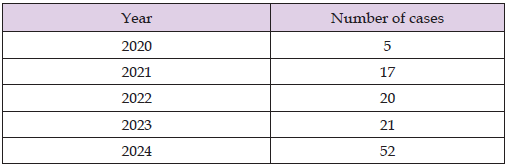
The mean age of the patients was 10.52 years, ranging from 1 day to 44 years. Among the 115 patients, 47 were assigned male at birth, 31 were assigned female, and 37 had an undetermined sex. The most represented age group was 0–1 year, accounting for 34% of the study population (Table I).
Table I Number of DSD Cases Diagnosed per Year.
Age Distribution
The distribution of patients by age group is presented in Figure 1. The 0–1 year age group was the most represented (34%), followed by 1–5 years (15%), 5–12 years (13%), 12–18 years (14%), 18–25 years (7%), and over 25 years (16%).
Cytogenetic Analysis
Karyotyping was performed on all 115 patients, revealing the following chromosomal constitutions: 46, XY (60/115), 46, XX (43/115), 47, XXY (3/115), 45, X (6/115), and 45, X/46, XX (3/115). The 46, XY DSD category was the most frequent, representing 52% of the study population, followed by 46, XX DSD at 37%, and sex chromosome DSD at 10%.
SRY Gene PCR Analysis
PCR analysis of the SRY gene was performed on 40 patients, with the gene detected in 22 individuals, representing 55% of the tested population. Among chromosomally male patients, SRY was present in 85% of cases. Notably, four chromosomally male patients lacked the SRY gene, two of whom exhibited a female phenotype.
This study collected a total of 115 cases over four years, corresponding to an average of 28 cases per year. During the entire study period, the Human Genetics Laboratory of FMPO at UCAD was the only public facility in Senegal capable of performing DSD diagnoses. Notably, awareness of this diagnostic service was not uniform among clinicians in public hospitals, which likely contributed to the relatively modest prevalence observed. Nevertheless, the prevalence in our cohort remains higher than that reported in other low-income countries. For example, prevalence rates in Côte d’Ivoire [2] and Kenya [3] were comparatively low, whereas South Africa reported considerably higher rates [4]. A summary of DSD prevalence by country is presented in Table IV [2-5]. In addition, the cost of these diagnostic analyses posed a significant barrier, given the average purchasing power in Senegal. Limited clinician awareness combined with financial constraints likely explains why the observed prevalence of DSD remained below anticipated levels. These findings highlight the need to improve access to diagnostic services and raise awareness among healthcare providers to ensure timely and accurate identification of DSD cases.
Table IV: Single-center Studies of DSD in Africa.

We used the Chicago Consensus, which is currently the most widely adopted medical classification system for grouping and naming Disorders/Differences of Sex Development (DSD). This consensus was established during a multidisciplinary expert meeting-including endocrinologists, geneticists, surgeons, psychologists, and representatives of support groups-in Chicago in 2005 and published in 2006, replacing older terms such as intersex, hermaphroditism, and pseudohermaphrodites. The classification is based on karyotype and categorizes our study population into three groups: 46, XY DSD; 46, XX DSD; and sex chromosome DSD. In addition, the presence of the SRY gene was investigated to enable a more precise diagnosis. The mean age of our cohort was 10.52 years, reflecting a delayed diagnosis of DSD in Senegal. In several African countries, DSDs are often diagnosed late: the mean age at diagnosis is 7 years in Côte d’Ivoire [2], 20 months in Nigeria [6], and 10 months in South Africa [4]. Ideally, DSD should be diagnosed promptly after birth, preferably before hospital discharge, so that an appropriate gender assignment can be made and treatment planned. In our study, only 18% (21/115) of cases were newborns. This diagnostic delay may be explained by socio- cultural factors, including taboos surrounding sex and a lack of public awareness regarding this still poorly understood condition. Furthermore, the limited availability of diagnostic facilities, particularly for populations living outside the capital, contributes to delayed diagnosis, as most patients originate from rural areas where access to specialized services is often challenging.
Analysis of the karyotype results showed that the 46, XY DSD category was the most represented, accounting for 52% of our cohort. These findings are consistent with most studies conducted in Africa and globally, where 46, XY DSD is reported as the most frequent category. Large-scale single-center studies in Africa and worldwide have reported similar results (Table IV). The high frequency of 46, XY DSD may be explained by the fact that it is the only profile in which both sex chromosomes are active and expressed simultaneously, unlike the 46, XX profile, where one X chromosome is inactivated. Furthermore, given that the Y chromosome contains a limited number of genes, any structural rearrangement may render it non-functional, exposing the fetus to maternal hormonal influences and often resulting in a DSD. Karyotype results were concordant with reported sex in 57% of cases. Only 12 patients (10%) exhibited discordance between chromosomal sex and reported sex: 5 individuals with a male karyotype were reported as female, and 7 individuals with a female karyotype were reported as male. A previous Senegalese study reported discordance between chromosomal sex and reported sex in 50% of cases [7], with a higher prevalence observed among individuals with a male karyotype. In that study [7], one out of two individuals with discordance was reported as female despite having a male karyotype. Supporting this observation, a large-scale English study by Sarah F. Ackley, which included 487,600 individuals who underwent genotyping, identified 200 individuals with discordance between chromosomal sex and reported sex [8]. This study confirmed the predominance of male chromosomal sex among discordant cases, accounting for 73% of the individuals.
Among individuals with unknown reported sex, 18 were chromosomally male and 19 were chromosomally female (Tables II & III). It is important to note that a female rearing sex with a 46, XY karyotype is not uncommon. In a one-year study of 55 patients in Algeria, 4 individuals were raised as female despite having a 46, XY karyotype [9]. Similarly, in Cameroon, 6 cases of individuals raised as female with a 46, XY karyotype were reported by Felicien, et al. [10]. In addition, Ganie et al., in their study on ovotesticular DSD, reported that 36 out of 64 patients had a male rearing sex despite a 46, XX karyotype [11], and 4 out of 15 cases in Nigeria presented a similar discrepancy [6]. The analysis of the SRY gene revealed its presence in 55% of our patients. Among chromosomally male individuals, the gene was detected in 85% of cases. SRY is rarely mutated; in fact, 80% of individuals with 46, XY DSD do not harbor mutations in this gene [12]. Only four chromosomally male patients lacked the SRY gene, two of whom exhibited a female phenotype. Several types of SRY abnormalities have been described, including complete absence, deleterious mutations leading to loss of function, or ectopic translocations, particularly to the X chromosome. In genetically male individuals, the absence or inactivation of SRY results in a female phenotype [13]. These mutations in “XY females” confirm that SRY is essential for normal testis formation and male sex determination. Other genes, such as SOX9, NR5A1 (SF1), WT1, DMRT1, and FGF9, are necessary for sex determination, but they cannot activate themselves in the absence of SRY under physiological conditions. Without SRY, the gonad defaults to the ovarian pathway (regulated by WNT4, RSPO1, FOXL2). Testing for SRY is particularly important in our cultural and religious context, where the child’s name is assigned seven days after birth. Therefore, SRY analysis could serve as a first-line diagnostic test for DSD, offering shorter turnaround times and lower costs compared to karyotyping.
Table II: Distribution of Individuals According to Reported Sex and Chromosomal Sex.

Table III: Distribution of Individuals According to Chromosomal Sex and Presence of the SRY Gene.

Disorders of sex development (DSD) represent a complex medical reality in developing countries, particularly in Senegal. Early diagnosis, essential for the prevention of complications, remains a significant challenge. This study reported DSD cases diagnosed using cytogenetics and molecular biology over four years at the Human Genetics Service of UCAD. Thanks to the growing expertise in genetics, the management of DSD is becoming increasingly feasible for both patients and their families, particularly regarding informed decisions on rearing sex. The implementation of karyotyping and SRY gene analysis by PCR at the UCAD Human Genetics Service has further improved the etiological diagnosis of DSD and enhanced accessibility at affordable costs.
The authors declare that there are no commercial or financial relationships that could be construed as a potential conflict of interest in relation to this study.
AAmadou NDIADE1*, Cheikh AT LY2*, Jean PD DIOP2, Seydi Abdoul BA2, Andrea R G SENE, Farma BA, Souleymane DIALLO, Ndeye Seynabou NIANE, Ndiaga DIOP3, Mame V GUEYE2, Rokhaya N DIALLO2
*all the authors equally contributed to this work

International Association of Landscape Archaeology, Czech Glass Society, Czech Republic

Department of Chemistry, Semenov Institute of Chemical Physics, USSR Academy of Sciences, Moscow, Russia

Associate Professor at Department of Breast and Thyorid Surgey, Chongqing General Hospital, China
Professor of Nuclear Medicine, Faculty of Medicine and Surgery, University of Milan, Milan, Italy

Department of Pharmaceutical Sciences, South University School of Pharmacy, USA





 Abstract
 PDF
PDF



























