info@biomedres.us
+1 (502) 904-2126
One Westbrook Corporate Center, Suite 300, Westchester, IL 60154, USA
Site Map
 ISSN: 2574 -1241
ISSN: 2574 -1241
ISSN: 2574 -1241
Received: January 19, 2026; Published: February 02, 2026
*Corresponding author: Wedian Al-Mowallad, King Abdullah Medical City, Makkah, Saudi Arabia
DOI: 10.26717/BJSTR.2026.64.010071
Competitive athletes are exposed to sustained physical and psychological demands that extend beyond routine exercise. In this review, the term ‘competitive athletes’ refers to individuals engaged in organized, high-performance sport, including elite, professional, and collegiate-level athletes for whom training and competition are closely linked to performance evaluation and career progression. Although exercise is widely recognized for its positive influence on mental health, the relationship becomes more complicated when training is tied to performance outcomes. This review summarizes current evidence on how exercise interacts with mental health in competitive athletes, outlines common psychological stressors in sport, and highlights emerging approaches aimed at supporting athlete wellbeing.
Keywords: Athlete Mental Health; Exercise Psychology; Overtraining; Burnout; Sports Psychiatry; Competitive Sports
In recent years, mental health in competitive sport has received growing attention, partly due to high profile athletes speaking publicly about their struggles. Exercise is generally associated with improved mood, reduced anxiety, and better cognitive functioning. However, when physical activity is embedded within a high stakes competitive setting, its psychological effects are not always straightforward. Athletes must navigate pressures that extend beyond training itself, including expectations from coaches, teammates, and the public. These factors can complicate the otherwise beneficial relationship between exercise and mental health.
A substantial body of research supports the idea that regular physical activity contributes to emotional stability and resilience. Neurobiological changes, such as increased endorphin and serotonin activity, are often cited as mechanisms underlying these benefits. Exercise also enhances executive functioning, which may help athletes manage stress more effectively [1-3]. Team based sports can provide additional social support, which is known to buffer psychological distress. When training loads are well regulated, athletes often report better mental health outcomes than non-athletes, suggesting that structured exercise can be protective under the right conditions.
Performance Pressure
Competitive sport is inherently evaluative. Athletes frequently face pressure to meet performance standards, secure team selection, or maintain sponsorships. These expectations can contribute to persistent anxiety and self-doubt, particularly during periods of poor performance.
Overtraining and Burnout
When training intensity exceeds an athlete’s capacity to recover, psychological symptoms often emerge alongside physical fatigue. Irritability, sleep disturbances, and reduced motivation are common early signs [4-7]. If unaddressed, these symptoms may progress to burnout, a condition characterized by emotional exhaustion and diminished sense of accomplishment.
Injury Related Psychological Impact
Injuries disrupt training routines and may threaten an athlete’s identity, especially for those who strongly define themselves through sport. Feelings of isolation, frustration, and fear of re injury are frequently reported. The psychological impact of injury can persist long after physical recovery.
Stigma and Underreporting
Despite increasing awareness, many athletes remain reluctant to disclose mental health concerns. Worries about being perceived as weak or losing competitive opportunities often discourage help seeking. This reluctance contributes to underdiagnoses and delays in receiving appropriate support.
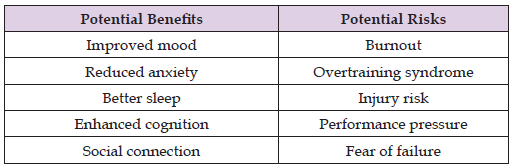
Exercise can simultaneously promote and challenge mental health. While moderate, well-structured training supports emotional wellbeing, excessive or poorly managed workloads may have the opposite effect. The table below illustrates this duality (Table 1).
Table 1: CT Exam Protocol.
Integrated Mental Health Screening
Routine psychological assessments are becoming more common in professional and collegiate sports programs. Early identification of distress allows for timely intervention.
Mindfulness and Cognitive Behavioral Strategies
Mindfulness based interventions and cognitive behavioral techniques have shown promise in helping athletes manage stress, maintain focus, and regulate emotions during competition.
Load Monitoring and Recovery Optimization
Advances in wearable technology and digital monitoring tools allow coaches to track training intensity, sleep patterns, and physiological markers. These tools can help prevent overtraining by identifying early signs of fatigue.
Supportive Sport Environments
Creating a culture in which mental health is openly discussed can reduce stigma and encourage athletes to seek help. Coaches and support staff play a central role in shaping these environments. Effective support is best delivered through multidisciplinary teams involving sports physicians, psychologists, and physiotherapists, allowing for coordinated management of physical load, injury, and psychological well-being.
Exercise remains a valuable component of mental health promotion, but its effects in competitive sport are shaped by a range of contextual factors. Athletes face unique pressures that can diminish the psychological benefits typically associated with physical activity. Integrating mental health support into training environments, monitoring workload, and fostering open communication are essential steps toward protecting athlete wellbeing. Continued research is needed to refine intervention strategies and better understand individual differences in response to competitive stress. These efforts are essential not only for performance optimization but also for the long-term health and sustainability of athletic careers.

International Association of Landscape Archaeology, Czech Glass Society, Czech Republic

Department of Chemistry, Semenov Institute of Chemical Physics, USSR Academy of Sciences, Moscow, Russia

Associate Professor at Department of Breast and Thyorid Surgey, Chongqing General Hospital, China

Professor of Nuclear Medicine, Faculty of Medicine and Surgery, University of Milan, Milan, Italy

Department of Pharmaceutical Sciences, South University School of Pharmacy, USA





 Abstract
 PDF
PDF



























