info@biomedres.us
+1 (502) 904-2126
One Westbrook Corporate Center, Suite 300, Westchester, IL 60154, USA
Site Map
 ISSN: 2574 -1241
ISSN: 2574 -1241
ISSN: 2574 -1241
Received: January 26, 2025; Published: February 02, 2026
*Corresponding author: ASM Sayem, The University of Oslo, Norway
DOI: 10.26717/BJSTR.2026.64.010068
Introduction: Bangladesh invested significantly in developing health management information systems in
2008. The country has reformed the collection and use of data in the health sector through digitalization. However,
many authors believe that defining health information system failure and success is complex. This study
aimed to assess the impact of digitalization on the use of data by health managers. It was focused on the information
culture through data for decision, analysis, and action.
Methods: This cross-sectional prospective study assessed health managers’ perceptions at district and upazila
health facilities in Bangladesh. Data were gathered through a voluntary online questionnaire, though the
collection period coincided with a major COVID-19 surge, resulting in a 17% response rate (n=92). Descriptive
statistics were generated to evaluate institutional information culture across three functional domains: decision-
making, analysis, and action.
Results: The results evidenced positive thoughts from the health manager and instigated further scope of research
in evaluating digitalization. A quantitative method was used to assess via an online survey questionnaire.
Ninety-two government health managers with an average age of 41 responded to express their agreement and
disagreement. The vast majority (94%) strongly preferred data- driven decisions, particularly in programs such
as immunization, maternal health, neonatal health, and adolescent health. Health managers frequently use data
for decisions. The study revealed that 96% of health managers effectively utilize data to take action, improving
health outcomes. The result shows that 86% of the health managers agreed that digitalization in health information
systems had improved their strength. However, among the health managers, 19% disagreed or strongly disagreed
that they had the right person for data analysis in the team. Most health managers were confident in analyzing
the data. However, most of them agreed (60%) that they need more skills in data analysis. Overall, health
managers felt strongly optimistic about this revolutionary change in the health sector after the digitalization.
Conclusion: While quantitative assessments suggest that digitalization has fundamentally transformed the
Bangladeshi health sector by enhancing data-driven decision-making among managers, these claims of success
warrant critical validation to ensure they are not overstated. Current research demonstrates that data utilization
can be rigorously measured via online surveys; however, significant opportunities remain to optimize the effectiveness
of Health Information Systems (HIS) and bridge the gap between digital infrastructure and actionable
health management.
Keywords: Health Manager; Data Use; Decision; Analysis and Action
Developing effective health information systems is crucial for making data-driven decisions, yet it can be challenging to ensure their sustainability. Often, pilot systems are abandoned after their initial launch [1]. However, unless health cadres use the data to inform local decisions and actions, the data will not help to enhance health services and outcomes. Following the political declaration to make Bangladesh a “Digital Bangladesh,” a new digital health management information system was introduced to all health facilities nationwide. The primary objective was to improve the management capacity of health managers. This problem of underused data, and indeed the absence of data use entirely, is widespread and has been evident for decades [2,3]. In many developing countries, health managers are drawn from the ranks of practicing clinicians, resulting in a duality of roles for health managers, the clinical managerial paradox [4]. Poor health outcomes often characterize health systems in low-income countries. While many reasons have been advanced to explain the persistently poor outcomes, management of the system has been found to play a key role [5]. The health workers put more effort into collecting data than focusing on health services. Low data quality and limited data use in health management are significant challenges to health information systems in developing countries [6].
The health workers at the facility level consider that the primary purpose of data collection is for reporting to a higher level rather than for local use to improve the quality of care [7]. In Bangladesh, the information sent from the community clinics, Upazila Health Complex’ and district-level health facilities to the divisional and central levels could took up to three months. By the time it arrived, it was no longer relevant, and there was little capacity for feedback to the decentralized levels [8]. Many health managers are not utilizing available tools for two reasons. Firstly, the information systems themselves are not comprehensive or readily accessible. Secondly, the structure of the health organization does not clearly define the roles and authority of managers. Other qualitative studies showed that managers lacked computer and data analysis skills. The results also highlighted low motivation as an obstacle to using health information [9]. Wickremasinghe et al. conducted a systematic literature review to explore how health managers and district administrators in LMICs utilize health data to make informed decisions. The review revealed that there is a limited range of documented processes for utilizing data for decision- making at the district level [10].
The behavior of using health information systems is constantly evolving and requires ongoing evaluation to assess its impact on health systems. How this phenomenon is experienced varies from country to country and context to context. The first author has been involved in Bangladesh’s digitalization process for over a decade and has witnessed its evolution. This study was intended to assess the health managers’ perspective of data used in decisions, analysis, and actions. The assessment was completed in 2022 after over a decade of digitalization implementation. Bangladesh has made impressive progress in the healthcare sector, making it one of the top performers in South Asia [11]. However, the country still faces various challenges hindering its further progress. One such challenge was the fragmented and unreliable health information system. Digitalization aims to improve the health management capacity among health workers. The comprehensive and collaborative approach to Health Information Systems Strengthening in Bangladesh has improved the data collection process. However, there was no large-scale evaluation to assess the use of data in this context. Moreover, the literature review suggests both positive and negative findings on the use of data after such development.
Digitalization has provided health managers a new way to visualize data and compare district performance. The government has also provided training to all managers and statisticians on health management information systems, focusing on interpreting data and using information for decision-making. This research aims to assess the effect of digitalization on health managers responsible for using data for decisions, analysis, and actions. It sheds light on the gap that is growing steadily between use and technology development. This study uses quantitative methods to describe the use of health management information systems for decisions, analysis, and actions after digitizing the government’s health management information system.
The Digitalization Context in Bangladesh
The Ministry of Health and Family Welfare (MOH&FW) implemented DHIS2, an open-source web- based package to manage integrated health information. The development of DHIS2 is coordinated by the Health Information Systems Program network established by the Department of Informatics at the University of Oslo, Norway [7]. This implementation promoted standardization and interoperability of eHealth software and databases, making it easier to collect comprehensive and reliable data about the coverage of health services and the population’s health status. The Ministry’s Management Information System created a guideline to achieve interoperability among existing and future database systems under MOHFW. Bangladesh boasts a strong health information infrastructure with over 16,000 government facilities reporting through DHIS2, and all community clinics and upazila facilities have internet and computer access with a high reporting rate. Human Resource Management software stores individual information of government staff in the health sector. It generates automated reports for administrative tasks such as transfer, posting, leave management, etc.
The government introduced biometric machines at the upazila level to collect information on staff attendance. Previously, attendance was recorded in a register, and no data was preserved. Each morning, staff members at every upazila health office must use a machine to record their attendance by touching their fingers. The machine automatically transmits the information to the national web portal every day. The dashboard shows the current attendance rate of government facilities and staff presence for health managers. The Ministry of Health and Family Welfare introduced a video conferencing system to meet all the upazila health managers once a month. All the Upazila Health Managers interact with the Director General about the priority issues and challenges of implementation. National execution plans for any health events were shared in video conferences. The Ministry of Health provided laptops, tablets, and the internet to connect all health managers with an official email account for better communication and monitoring at the field level. All the administrative letters were shared in email for action. The government launched a real-time health dashboard that consolidates data from various sources into a single platform.
The website has a wealth of valuable information that can benefit healthcare professionals and Bangladesh’s general public interested in health information. By accessing this data, anyone could better understand important health-related indicators in any geographical location or health facility. The health managers received training related to health programs, information systems (DHIS2), leadership skills, procurement, etc. The process of the above digitalization was initiated in 2008 in different phases, and the implementation was completed by 2016 through the nation. There was no official evaluation on the health managers’ perspective of data use after digitalization.
Study Design
This is a facility based cross-sectional prospective study conducted among the health managers of Bangladesh.
Study Period
The study was conducted over a span of 4 months, that is, from December 8, 2021, to April 6, 2022.
Study Population and Sampling
The survey questionnaire was sent through the ministry’s group email address to approximately 550 health managers at districts (64) and upazila (486) level. A voluntary response sampling technique was followed to collect the data from the health managers. In this study, the health managers refer to the Civil Surgeons, Upazila Health and Family Planning Officers, and the Hospital Superintendents. The study also included response from the medical officers in charge where the post is vacant in the district. A total of 92 health managers voluntarily participated in the study. Margin of Error is approximately ±9.32%. The managers were sent email reminders to fill out the survey forms. Among the health managers, 60 UH&FPOs, 10 Civil Surgeons, 8 Medical officers and 4 Hospital Superintendents participated in the study.
Study Tool
We utilized quantitative data measurement techniques in three dimensions: decision, action, and analytical skills. These dimensions were drawn from the six building blocks of WHO’s health system [12] and literature review to identify the use of data in the health sector. A well-functioning health information system ensures the production, analysis, dissemination, and use of reliable and timely health information by decision-makers at different health system levels [13]. An online questionnaire was developed which consisted of several questions with multiple options. Forms.app, an internet platform was used to create and share forms such as surveys [14]. One of the main advantages of the forms is that the app has a wide variety of customizable form templates, making the creation process quick and efficient. The questionnaire adopted psychometric responses in a 5-point Likert scale consisting of Strongly Agree, Agree, Neutral, Disagree, and Strongly Disagree options. This method was used to specify the respondent’s level of agreement or disagreement [15].
The questionnaire was tested in the field and translated into the local language to ensure the responders could better understand it. After the field test, minor corrections were made to the translation to make it more specific. Feedback was obtained from government officers working in the ministry. This online data collection method was chosen because of the pandemic, the health managers’ heavy engagement in the COVID protocol, and the movement restriction. The online questionnaire is attached as a supplementary material section.
Statistical Analysis
The data was analyzed using Microsoft Excel. The online questionnaire also had options for autogenerated graphs which were not used in the study. The raw data was downloaded, and graphs were created by the researcher in excel.
Ethical Implication
An official approval from the Director of the Management Information System of MOH&FW was obtained on November 30, 2021 (Memo no: DGHS/MIS/2021/706). The researcher sent a request letter about the study and sought permission to administer the questionnaire to the government officials. The questionnaire link was then sent to the health managers by the researcher using their official government email address. The approval letter of the study with an explanation of the study’s aim was attached in the email. The questionnaire had no confidential information about the responder or any patient data. All the responses were anonymous.
The response rate was 17%, and the probable reason for low response was the COVID-19 pandemic priorities. Because the Margin of Error is relatively high (close to 10%), the data is good for identifying general trends, but not for making highly precise claims. Most of the response was reported within the month of December 2021 when the email invitation was sent to participate in the study. The government COVID dashboard confirmed that the COVID case positivity rate sharply rose from the beginning of January 2022 and the response rate was very low during that time. While the study offers valuable insights as a first-of-its-kind report in Bangladesh, the low response rate strongly suggests the presence of non-response bias, which the we acknowledge as a major limitation of the study. The majority of respondents were from upazila level health facilities (65%), followed by district level organization (35%). The average age of the respondent was 41 years. Most respondents were male (89%), and only a few were female (11%).
The survey found that the respondents had an average of 13 years of experience in the health sector. This implies that they have a significant amount of knowledge and expertise in their field, which could have contributed to the accuracy and reliability of their responses. Additionally, the data shows that the respondents have been in their current positions for an average of four years. This information could help understand the stability of the health manager and the level of experience required to get unbiased answers.
Decisions based on Data
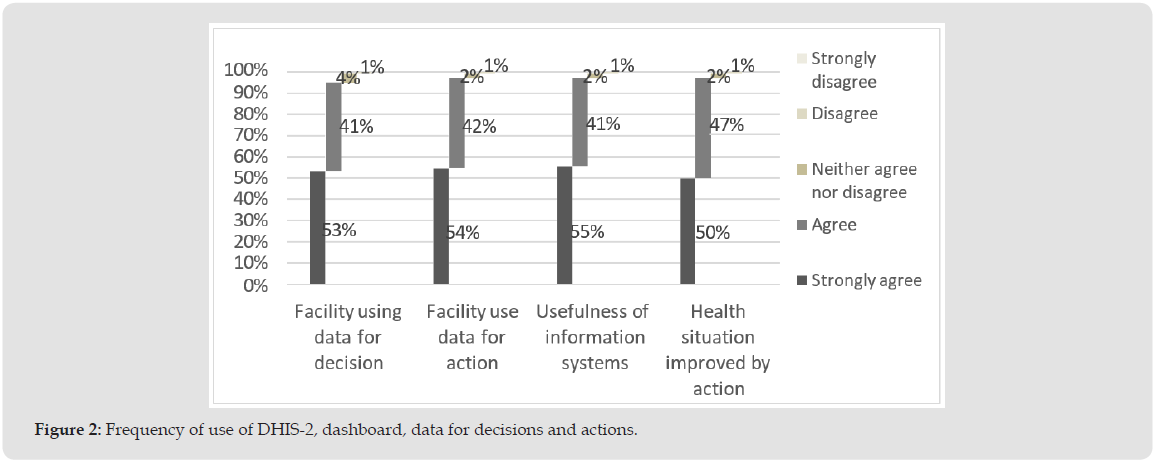
The respondents were asked whether the facility used data for decision-making. The majority (94%) strongly affirm data-driven decisions concerning immunization and maternal, neonatal, and adolescent health programs (Figure 1). The frequency of decisions made by managers was daily (40%) and weekly (35%) (Figure 2). Some decisions are also taken monthly (22%). During the COVID-19 pandemic, data was collected daily to get a real-time understanding of the situation. Decisions regarding COVID-19 vaccine requirements were crucial and had to be made daily. Among the significant dashboards, the most frequently used dashboard was COVID (58%), followed by Human Resource Management (13%), Reproductive health dashboard (11%), others (10%), and immunization, which was 9%. This answer could be biased as this question was administered during the COVID-19 pandemic, and the health managers were frequently asked to update information on the COVID-19 dashboard. Most health managers (96%) responded that the health management information system helps use the data for decisions (Figure 1). According to our survey, we inquired about the frequency of health managers utilizing District Health Information Software (DHIS-2). The responses indicated that the software is heavily used for analysis and decision-making. Specifically, 58% of respondents reported using the software daily, 25% reported using it every week, and 17% reported using it monthly (Figure 2).
Figure 1
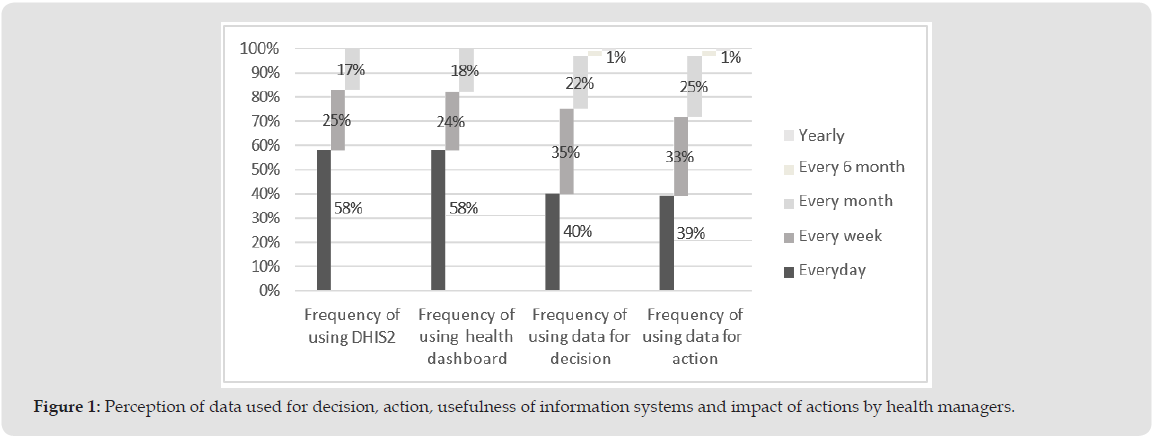
Figure 2
In the survey questionnaire, participants were asked to select who uses the collected data, statisticians were found to be the most frequent data user group (48%) that use the information systems for decision-making. On the other hand, health managers (Civil Surgeons, UH&FPOs, and Hospital Superintendents) accounted for 41% of the responses. It was worth noting that statisticians play a crucial role in data collection from the field and thus have a better understanding of the health database. Each health office has a statistical officer or assistant responsible for data entry and provides data to the health managers based on request. The statistician collects and manages data from field offices and receives training on new systems. Doctors and nurses (28%) also utilize data for decision- making in health facilities. Development partners such as UNICEF, WHO, UNFPA, and other international non-governmental organizations contributed 18% to using the data for the decision- making process.
To understand the depth of the data-driven decision, a question was designed to determine what the health managers do when they see any alarming figure in their data system. This was a multiple selection type question, and most health managers (47%) responded to that option where they would immediately discuss this with the expert and team. The second hit in the answer was that the health manager would visit the location to understand better the situation, which was 34%. This reflection indicated that health management information systems allow health managers to decide locally and find solutions. Some managers, accounting for 14% of the total, have preferred to report to a higher- level supervisor. The responses to this inquiry suggest that health managers make decisions collaboratively with their respective teams at the local level. The intention behind administering this question was to comprehend better the decision-making tendencies of these managers in the healthcare domain.
Actions based on Data
According to the study, 96% of health managers believe that data is effectively utilized to take action. The action leads to improvement of the health outcome, which is agreed by 97% of health managers (Figure 1). The health managers have also improved the local health situation through action for the existing information system. Most actions were taken within a month (every day 39%, every week 23%, and every month 25%) (Figure 2). The health managers were asked about their expertise in taking action using a 5-point Likert scale, and the response was highly positive (88%). However, some managers neither agreed nor disagreed, around 8%-this question aimed to assess local managers’ confidence and authority to take action. According to this study, 40% of health managers reported using data to make daily decisions, which is a positive sign. Real-time data is also having a significant impact on managers’ daily actions. 25% of the managers reported taking action weekly, while 33% did so monthly (Figure 2).
Analysis based on Data
During the survey’s design phase, we (1st and 2nd authors) faced challenges in assessing the participants’ analytical skills via the questionnaire. To assess their observation skills in detecting issues in data trends, a line graph was provided showcasing the health service trends of a particular year, depicting a decline in the services during a specific month. Interestingly, 77% of the health managers responded correctly to the question, indicating the required analytical skills for observation of data trends. Based on this study, when asked about the individuals involved in data analysis within their organization, 49% of the health managers indicated that they themselves were involved in the task. Additionally, statistical staff accounted for 40% of those involved in data analysis. It is worth noting that technical staff such as doctors, nurses, and other personnel carried out a mere 11% of data analysis. None of the respondents clicked on the option that stated “Data expert outside organization (development partners)” during the survey. This suggests that the government health team was entirely self-sufficient in analyzing their data without any external help from development partners.
About 75% of health managers reported feeling confident in their data analysis skills. The study also revealed that 15% of health managers have high confidence in data analysis, while 10% lack confidence in their abilities. However, the study did not provide further details on the respondents’ choice of answer. Although most health managers expressed confidence in the data analysis, a question about having the right person for the job revealed exciting results. Most health managers (74%) believe they have the right personnel for data analysis, although 19% disagreed. During the survey, a question was asked to gauge the opinion of the managers on whether there is a need to improve the data analysis skills of health managers. The response was unanimous, with all the managers agreeing or strongly agreeing (100%) on the need for more skills in this area. This highlights the importance of enhancing the analytical capabilities of health managers to ensure data analysis. According to the survey, most managers (86%) believe that digitalization has positively impacted the strength of health data systems. Specifically, 47% of managers strongly agreed, and 39% agreed that digitalization had improved the overall strength of health data systems. Only a small percentage of the respondents (8%) disagreed.
This survey is the first in Bangladesh to evaluate health managers’ performance utilizing the health management information system within the public healthcare system. The WHO recommended that three dimensions of responsive health information systems, decision, performance, and action, be used to summarize the study findings. A strong digital data culture was observed where more than 90% of our health managers mentioned that data collected at the local level are routinely being used for data-driven decision-making for health care service improvement. Though this statement sounds like overstated claims, that was one of the outcome of the survey which was difficult to measure. Though routine monitoring services are mostly focused on immunization, maternal, neonatal, and adolescent healthcare programs, efforts are underway to extend the service to other healthcare domains, such as workforce and finance management. The major limitation of this study was a relatively poor response rate (17%) due to the ongoing COVID pandemic, but the included sample was representative of the desired study outcomes. There is a potential for volunteer bias, where participants may have had stronger positive opinions about digitalization than non-responders, potentially skewing the results.
This was a major limitation during the COVID which affected the generalizability of the findings to the entire population of health managers in Bangladesh. The study revealed a positive data culture existence in Bangladesh’s current health-management information system. Although Bangladesh started to digitalize its HMIS in 2008, national-level data use evaluation was not done until we did this study. A scoping review done by Lemma et al. in 2020 has identified 16 such intervention studies that support positive data culture in LMIC settings, none of which were from Bangladesh [16]. However, the study results show that digitalization brought successful utilization of routine data in Bangladesh, which is similar to other LMICs. For example, Kenya has demonstrated an unprecedented potential to move from the era of an unreliable and fragmented HIS system to the ideal situation of availability and use of quality health information for rational decision-making. The combinations of capacity-building activities with enhanced technical tools and data quality assessment combined with feedback systems were also useful in LMICs. The data presented in the study indicates that 75% of health managers are confident in the utilization of data; however, there is a unanimous agreement (100%) regarding the necessity for enhanced skills.
Continuous training is essential to improve employee capabilities and to maintain this confidence, as there is no viable alternative [17]. It is important to approach this matter positively, as the training process is a critical requirement for fostering a sustained data culture within the organization. UNICEF report has highlighted the breakthrough initiatives supporting the successful implementation of digital HMIS in Bangladesh [8]. The paper notes an interesting finding: health managers were self-sufficient in data analysis, and no one selected the option for “Data expert outside organization”. Though the development partners are providing technical assistance in overall HMIS development in Bangladesh [18,19], this finding is positive toward sustainable HMIS development. Study shows that the ‘need for the data’ has been the driving force toward investment in the HMIS ecosystem. Partners with long relationship are powerful in influencing HMIS investment decision-making [20].
While high-quality data access is essential, more is needed to guarantee that the data will be utilized. For data to be useful, it must be collected, processed, and analyzed in a format that is easily accessible [21]. A recent scoping review where one of the countries was Bangladesh found that DHIS2 data are used primarily for planning and performance, decision-making, and action taken [3]. Based on the implementation of the HMIS in Malawi, it has been observed that health managers are keen to acquire more data but do not possess the relevant skills to utilize data in local-level healthcare planning [22]. This highlights the need for targeted capacity building and training programs to equip health managers with the skills to effectively utilize the vast amounts of available health data. Future routine health information system interventions should not only focus on technological solutions but also target multiple factors at a time [16]. Effective governance is vital for strengthening the healthcare system, as it involves decision-making at all system levels [23]. It significantly implements national policies and priorities, including equity goals and appropriate service delivery practices.
For people to use data in decision-making in a sustainable way, their organizations need to support them with transparent processes and systems that help them undertake data-use tasks [24]. This study has used a quantitively measuring tool to assess the perception of health managers on data use. The application of the tool is easy and can be used as a cost-effective method to evaluate on a large scale. On the other hand, the PRISM framework is comprehensive and requires more resources [24]. While reporting the performance of health managers on data analysis skills, our study identified a strong aptitude for observation of data trends. Around 77% of the health managers could correctly identify the trend in health care data. Health managers found it self-sufficient to handle their data without external support from donor agencies, which is promising on sustainability grounds. The availability of data dashboards under DHIS2 was a big win as program managers could see how quickly and easily their data could be pulled and how it could be visualized clearly. The dashboards also showed how the data would be accessible to the public. It was a selling factor for managers who wanted to be accountable and show their successes to a broader audience [8].
Like us, the action learning process with initial support from a skilled facilitator was mentioned as a successful process of developing health managers’ skills in the South African setting [25] Information used for action is one of the main motivations for building health information infrastructure [26]. Most of our health managers (96%) believe that data is effectively utilized to take action. Consequently, 97% of participating health managers perceived that the local health situation has improved through action for the existing information system. This resounding affirmation of their efforts is a testament to their expertise, dedication, and commitment to ensuring that the health needs of local communities are met with utmost care and professionalism. However, information and communications technology ICTs are not the sole way to improve health outcomes. They must be considered part of a more comprehensive set of approaches to tackle health problems. ICTs alone cannot produce motivated and knowledgeable health workers. They cannot produce an information culture that highly values using information for action [13]. Meaningful engagement between health services and clients is essential to enable health systems’ responsiveness, improve operational excellence and patient experience, and reduce costs. Developing knowledgeable societies is one of the significant strategies under the 2030 Agenda for Sustainable Development under ICTs to bridge the digital divide worldwide [27].
Digitalization has reformed Bangladesh’s health sector, transforming paper-based reporting into a web-based system. The implementation phases of digitalizing the health management information systems have significantly influenced the health managers’ data use perceptions. In this study, most respondents agreed that they use data to make informed decisions. Remarkably, most of them also reported using data on a daily or weekly basis, which is a promising trend. Additionally, the respondents expressed their satisfaction with the usefulness of the health information systems, indicating that the platform built for them was appropriate. It is worth noting that health information systems are often left unused and abandoned in many countries after their initial implementation. However, as per this study, the system installed in 2008 has remained in heavy use even in 2021. This highlights the importance of developing and implementing effective health information systems that can withstand the test of time and continue to serve their intended purpose.
According to the responses, the health workers were confident using the data and the digital system positively. There were only a few disagreements that required further investigation to understand why digitalization did not improve their strength. DHIS2 and dashboard platforms allow for autonomous data review and independent action for improvement based on the information gathered. The study’s results illustrate a successful application of digitalization and its connection to improved health management through data utilization. This phenomenon marks a significant shift in health managers’ decision- making, analysis, and action.
Online questionnaire: DOI: 10.13140/RG.2.2.19382.56642.
There is no funding commitment to this article.

International Association of Landscape Archaeology, Czech Glass Society, Czech Republic

Department of Chemistry, Semenov Institute of Chemical Physics, USSR Academy of Sciences, Moscow, Russia

Associate Professor at Department of Breast and Thyorid Surgey, Chongqing General Hospital, China

Professor of Nuclear Medicine, Faculty of Medicine and Surgery, University of Milan, Milan, Italy

Department of Pharmaceutical Sciences, South University School of Pharmacy, USA





 Abstract
 PDF
PDF



























