info@biomedres.us
+1 (502) 904-2126
One Westbrook Corporate Center, Suite 300, Westchester, IL 60154, USA
Site Map
 ISSN: 2574 -1241
ISSN: 2574 -1241
ISSN: 2574 -1241
Received: January 18, 2026; Published: January 28, 2026
*Corresponding author: Srwa Khalid, As. Professor & Consultant Obs & Gyn, University Kurdistan Hewler – School of Medicine, Iraq
DOI: 10.26717/BJSTR.2026.64.010060
Introduction: The effect of sleep pattern on academic performance has previously been studied, which included
the associations of sleep patterns with multiple measures of academic achievement of undergraduate university
students. Medical students are known to be among the highest achieving university students; thus, their sleeping
hours and pattern could be different compared to other students. Addition `ally, to our knowledge, no previous
studies assessed the effect of sleeping hours on academic performance of medical students, which prompted
us to consider this study, namely, the effect of number of sleeping hours at the night of exam on the students’
exam performance the following day. The objective of this prospective study is to assess the immediate effect
of the number of hours slept on the night on the following day exam performance in a large number of medical
students.
Material & Method: In this prospective study, 250 medical students were asked to report the number of hours
slept on the night of the exam when all data were collected at the time of the exam. These were later assessed in
conjunction of the same exam marks (score). This cohort included 127 female and 123 male students.
Results: There was a significant positive correlation between the number of sleeping hours and the exam score
(R = 0.9), meaning, the higher the number of sleeping hours the better was the score. We then categorised exam
scores into three groups, namely <60, 60-80 and >80 – out of 100. ANOVA test showed significantly higher exam
score with the higher number of sleeping hours (P < 0.0001). It was interesting to find out that female students
had significantly lower mean number of sleeping hours versus male students (2.64 vs 4.38, p < 0.01), which, not
unexpectedly, was also reflected in the significantly higher mean exam score in the male students (79.2 vs 59.8,
P <0.001).
Conclusion: Our prospective study clearly demonstrated a positive correlation between exam score and the
number of sleep hours on the night before the exam, regardless of the students’ gender. However, as female
students tended to have fewer sleeping hours, their exam scores were significantly lower than those of the male
counterparts. This study helps to advice students in general but, medical students in particular, about the importance
of decent pre-exam sleep as it is likely to impact their exam score.
There are numerous studies about sleep and cognitive function, but there is still a lack of quantitative data using objective measures to directly assess the association between sleep and academic performance. Sleep plays an important role in homeostasis, brain plasticity, clearance of neurotoxins, cognition, memory, concentration, performance, and the regulation of the temperature, endocrine and immunological systems [1].
Both sleep deprivation and poor sleep quality are prevailing, especially in university student population. Medical students, in particular are exposed to a significant level of pressure competitiveness due to academic demands. Their sleep pattern, not uncommonly, is characterized by insufficient sleep duration and delayed sleep onset. Previous studies showed that nearly 37% of medical students have abnormal sleeping habits, which were more prevalent in female students [2]. However, to our knowledge, the effect of immediate (night of the exam) sleeping pattern/sleep hours, has not been studied.
We aimed to examine the effect of sleep disorder, as manifested by number of pre-exams sleeping hours, among medical students and the relationship between reduced sleeping hours and academic performance, as objectively assessed by the following day exam scores.
This is a prospective self-administered questionnaire-based study. The participants were medical students of University Kurdistan Hewler. Erbil, Iraq. Two hundred and fifty students volunteered to participate in the study. It was a a single-blinded study; thus, the students were asked to fill a questionnaire form at the end of their exam session but they were not informed about the objective of the study. The questionnaire was simple; students were asked to answer one simple question about the number of hours of sleep they had the night before the exam.
Exam papers were marked electronically and the results (marks/ score) were tabulated against each student gender, number of sleep hours (as reported by each individual student). All exam marks were reported as absolute value out of 100 (minimum zero and maximum 100), i.e., academic performance as assessed by their exam marks. All data were added to an Excel sheet and analysed accordingly. Students’ exam marks followed normal distribution (by normal probability plot) and was analysed accordingly. Descriptive statistics, t-test and analysis of variance (ANOVA) were used to assess the effect and/ or relationship of sleeping hours on the following day exam performance. Microsoft Excel version 16.16 was used for statistical analysis.
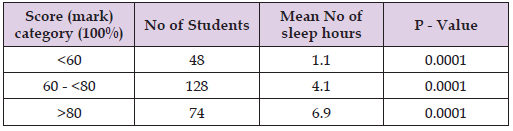
Two hundred and fifty students participated in the study, which consisted of 127 female and 123 males, respectively. There was strong positive correlation between the number of sleeping hour and exam score; meaning, the fewer the sleeping hours the poorer the exam score, regardless of students’ gender. Subsequently, we ranked the exam marks from the lowest to the highest and divided them into three categories, namely, < 60 (48 students), 60-80 (128 student) and >80 out of hundred (74 students). We used analysis of variance (ANOVA) to re-examine the effect of number of sleeping hours (categories) on the night of the exam with the same exam score (marks). This has also showed significant effect of the number of sleep hours on the exam scores, namely, the fewer the sleeping hours the lower was the exam score (Table 1).
Table 1: Effect of sleeping hours category on exam score.
We also examined the association of gender on the number of pre-exam sleeping hours, and, thus, exam score. We detected the following interesting findings (Table 2). Female students slept significantly fewer hours vs male students (Table 2).
Table 2: Comparison of average number of pre-exam sleeping hours between female and male students.
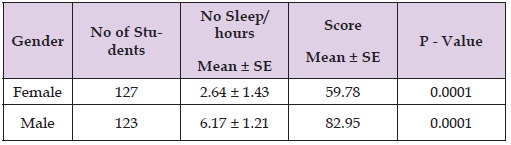
This study showed striking evidence that, fewer sleeping hours were associated with poor exam performance and this finding was much more prevalent in female students. Simply, it means the fewer the sleeping hours on the night of the exam, the more likely the poorer the exam performance.
Medical students are often deprived of sufficient sleep due to large amounts of clinical duties and curriculum load, which prompted us consider this study to help advise the students about sleeping pattern/habit before their exams because, these habits, we believe, could affect their exam performance. Furthermore, Lack of sleep is a predictor of a number of consequences, including issues at school such as sleepiness and tardiness [3].
Past studies focused on the negative influence of shorter sleep duration and poor sleep quality on academic performance, in general. Additionally, studies evaluated the association of academic performance and total sleep time were also published [4], however, to our knowledge, the effect of total sleep time/hours, just prior to the exam, on academic performance, e.g., exam results, of the medical students has not been assessed, thus, the objective of this study.
The question arises, whether poor pre-exam sleeping was an incidental incidence or represented a pattern of generally poor sleeping pattern. We believe it is the latter [5]. It is recognized that a number of factors lead to diminished total sleep time and, the foremost among these, are academic pressure and competitiveness, which are more prevalent among medical students [3]. Additionally, previous studies suggested a higher prevalence of poor sleep pattern in female students, which is also confirmed by our study. However, no studies tried assess why female students have poorer sleeping habits vs their male colleagues. We suggest to consider possible psychological and/ or endocrinological assessment to explore possible other factors that could affect female students sleeping pattern.
However, equally important to acknowledge, is the fact that, students sleep pattern on the night prior the exam could have reflected a long-term poor practice of irregular or inadequate sleep, which would be more impactful on the student overall academic performance, not only on the day of the exam. Our prospective study clearly shows strong correlation between reduced pre-exam number of sleep hours and exam performance, which was not suggested by other studies. This may be due to the fact that our study assessed specific group of university students (medical students) who are more prone to deprived sleep [6]. The other question which needs to be assessed in a further study is whether the reduced number of sleeping hours among us was an incidental finding or it was a representation of continuum of poor sleeping pattern.
Furthermore, our study revealed strong correlation between the number of sleep hours on the night preceding the exam and students’ exam score. Although relationship does not allow us to predict individual student’ mark (score) it is somehow a strong predictor of the exam score. However, this relationship should not be taken in isolation as, indeed, it could reflect individual student sleep pattern, which, overall, is reflected in a poor sleeping habit. it means poor sleeping pattern on the night before the exam could be a reflection an overall poor (abnormal) sleeping pattern, which should be screened for and corrected well before exams. This research carries important implications for both medical students and the broader academic community. The results emphasize the pivotal role of sufficient pre-exam sleep in enhancing academic achievement. Given the rigorous demands of medical education, it is essential for medical students to prioritize their sleep patterns. Educational institutions and medical programs may also consider incorporating discussions and resources on the significance of sleep hygiene and its impact on academic performance. Additionally, particular attention should be paid to female students’ sleeping patten and any underlying social, psychological or hormonal factors.

International Association of Landscape Archaeology, Czech Glass Society, Czech Republic

Department of Chemistry, Semenov Institute of Chemical Physics, USSR Academy of Sciences, Moscow, Russia

Associate Professor at Department of Breast and Thyorid Surgey, Chongqing General Hospital, China

Professor of Nuclear Medicine, Faculty of Medicine and Surgery, University of Milan, Milan, Italy

Department of Pharmaceutical Sciences, South University School of Pharmacy, USA





 Abstract
 PDF
PDF