info@biomedres.us
+1 (502) 904-2126
One Westbrook Corporate Center, Suite 300, Westchester, IL 60154, USA
Site Map
 ISSN: 2574 -1241
ISSN: 2574 -1241
ISSN: 2574 -1241
Received: January 11, 2025; Published: January 22, 2026
*Corresponding author: Sriharsha Kanuri, Merit Health Wesley Health Center, Hattiesburg, MS, USA
DOI: 10.26717/BJSTR.2026.64.010053
Keywords: Pheochromocytoma; Hypertension; Pulmonary Hypertension; Tachycardia; Adrenal Tumors; Alveolar Hemorrhage
Diffuse pulmonary hemorrhage (DAH) can be a sneaky presentation of pheochromocytoma, a rare adrenal tumor. The clinical presentation can be as vague as uncontrolled hypertension with shortness of breath and dry cough in young patient. DAH can be triggered by numerous causes including lung diseases, vasculitis and autoimmune diseases. Due to its vague clinical presentation, there is often in delay in diagnosis, thus amplifying the morbidity and mortality. Genetic syndromes can sometimes be associated with bilateral adrenal tumors, otherwise unilateral adrenal tumors are most commonly found. Conservative management including controlling hypertension only provides symptomatic relief. Most of these patients require surgical management followed by glucocorticoid supplementation. With this case we would like to highlight enigmatic clinical presentation of pheochromocytoma, thus underscoring its inclusion in the differential diagnosis otherwise unexplained hypertension in young patients almost always deemed necessary.
Patient is a 29 year old male known HTN on amlodipine, presented with chief complaints of headache, epigastric pain and vomiting for past 4 days. According to the patient, he had similar episode 2weeks ago, but the vomiting subsided by itself. This episode was progressing, with multiple episodes of non-bilious vomiting, not associated with diarrhea or fever. He states that he is not able to tolerate liquids or any food. On arrival patient’s BP is elevated, 225/174. Basic labs including troponin were sent. He was given Hydralazine 10mg IV push. Reassessment in the ED after 30min did not lower his BP so he was given labetolol 20mg IV push. As the patient’s BP was not lowering after an hour, he was placed on Nicardipine drip. His labs showed elevated WBC of 18, creatinine of 8.3 with a BUN of 53, troponin of 84. Nephrology opinion taken and on evaluation found to have AKI on CKD stage 3, and placed on medical management with a plan of dialysis if kidney function does not improve. CT abdomen showed thickening of small bowl loops. Surgeon on board, recommended NG tube placement and further monitoring. Renal artery ultrasound is unremarkable. CT scan of the chest showed ground glass opacities in both lung fields, signifying the presence of alveolar hemorrhage (Figure 1). 24-hour urine metanephrines are more than 2 times the normal value, which was suspecting of pheochromocytoma. Serum metanephrine were also positive confirms the diagnosis of pheochromocytoma. CT abdomen shows adrenal mass. The patient is referred for surgical management of pheochromocytoma.
Figure 1
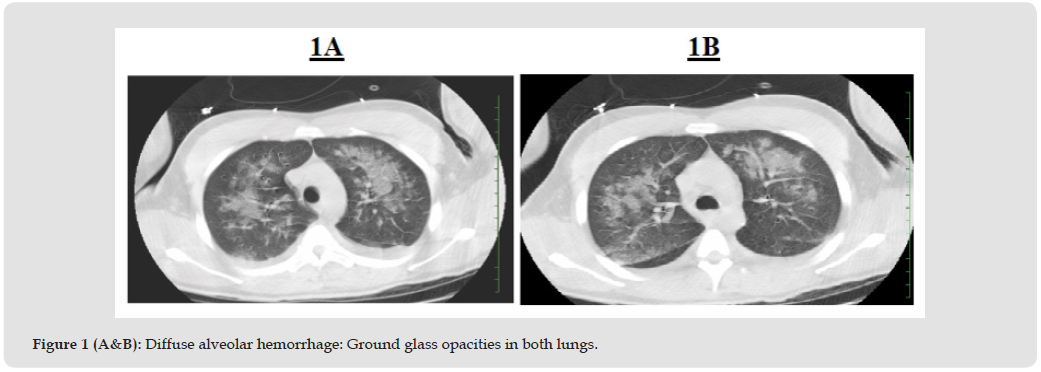
Pheochromocytoma is a neuroendocrine tumor that arises from the entero-chromaffin cells of the adrenal gland [1]. These tumors comprise of 85% of these adrenal tumors and majority of them are considered benign [2,3]. Etiological factors believed to be causative for pheochromocytoma include genetic mutations [RET, VHL & NF1], sporadic, emotional stress, trauma, surgery, childbirth and anesthesia [3]. The incidence of its occurrence can be as low as 0.5 cases per 100,000 person-years [4]. The cardinal function of the entero-chromaffin cells is to secrete key hormones ranging from epinephrine, norepinephrine and cortisol. It is not uncommon to fathom the fact that the tumors arising from these cells synthesize and squirt massive amount of these flight and fright hormones into the blood circulation. Excess hormones in the floating in the blood will act on the adrenergic receptors [alpha-1 and alpha-2, beta-1 and beta-2] of vasculature and instigate sudden and rapid spurts of hypertension, tachy-arrhythmias sweating and shortness of breath. Thus hypertension can be foundation for triggering various end-target fatalities, out of which diffuse alveolar hemorrhage blossoms. Diffuse alveolar hemorrhage (DAH) ensues whenever there is an abrupt and massive spike in the blood pressure, thus abetting increased left ventricular afterload and pulmonary congestion. These proceedings, can be the inciting events for increase in pulmonary venous pressure, elevation in pulmonary capillary pressure and spike in alveolar capillary permeability [5,6].
On top of these, excess catecholamine levels in the blood will trigger alveolar capillary endothelial dysfunction and coagulation abnormalities [7]. Endothelial injury and microvascular thrombosis can the penultimate events in connective tissue disorders [8]. These state of affairs will grease the wheels for the uncoupling and fragmentation of the alveolar capillaries. As alveolar capillaries are desecrated, there will be extravasation of the blood from the intravascular space into the interstitial space in the lung tissues. Pathological findings in DAH can include neutrophilic infiltration of alveolar membranes, endothelial edema, fibrinoid necrosis. intra-alveolar edema, capillary congestion, microthrombi, hyaline membrane formation and leaking of blood into alveoli [9]. Pulmonary capallaritis, which encompasses neutrophil infiltration along the alveolar septa is hallmark of anti-neutrophil cytoplasmic antibody associated vasculitis or glomerulonephritis [10]. DAH can be ultimate presentation of various disorders including various lung diseases, autoimmune disorders, connective tissue disorders, coagulation disorders, vasculitis, mitral stenosis, toxins, excessive antiplatelet therapy, pheochromocytoma, adrenal tumors and secondary cortisol secretion and malignancies [5,11,12]. Some of the presenting clinical symptoms of DAH can range from shortness of breath, cough, hemoptysis, fever, dilated cardiomyopathy, acute coronary syndrome and diffuse alveolar infiltrates [5,13].
As phechromocytoma is suspected, serum metanephrines, urinary metanephrines, bronchoscopy, abdominal CT or MRI can be helpful in diagnosis [1]. Bronchoalveolar lavage in these patients can yield bloody exudates and hemosiderin laden macrophages [10]. The radiological signs can range from ground glass appearance, consolidation, dark bronchus sign, interlobular septal thickening to crazy paving sign [12]. Presence of more than 2 times upper limit of normal serum or urine metanephrine levels confirms the diagnosis of pheochromocytoma, as they have 100% positive and negative predictive value in confirming the diagnosis of pheochromocytoma [14]. As diagnosis is suspected, conservative management with oxygenation, ventilator support, control of hypertension, correction of coagulation abnormalities, blood transfusion, corticosteroids, cyclophosphamide, rituximab and plasma exchange might be necessary in case-by-case basis [8,10]. Unilateral solitary tumors can be managed with unilateral adrenalectomy while bilateral tumors necessitates bilateral partial or cortical sparing adreneclectomy [1]. Unless promptly recognized and addressed, this clinical entity carries a high mortality rate of 20% [10].
Despite its treacherous clinical presentation, a hawk eyed clinical suspicion is a must for early identification of this rare adrenal tumor. This clinical image report is presented here to emphasize the fact that pheochromocytoma should be considered as a likely possibility in a young patient presenting with unexplained hypertension and hemoptysis. This can be pursued by assessing serum and urinary metanephrines. Prompt diagnosis and management will be life-saving which otherwise can lead to disastrous consequences and poor prognosis with severe morbidity and mortality.
Ethical Approval and Consent to Participate
Not Applicable.
Consent for Publication
Consent taken.
Availability of Data and Materials
Not Applicable.
Competing Interests
Not Applicable.
Funding
Not Applicable.
Acknowledgements
Not applicable.
Conceptualization, S.H.K& MTY; Methodology, S.H.K& MTY; Software, N.G.; Validation, N.A; Formal Analysis, N.A.; Investigation S.H.K, S.R.&S.B; Resources, N.A.; Data Curation, N.A.; Writing– Original Draft Preparation, S.H.K & MTY; Writing– Review & Editing, , S.H.K, MTY, RJ, SF, GG& ZC.; Visualization, S.H.K & MTY.; Supervision, GG.; Project Administration, G.G.

International Association of Landscape Archaeology, Czech Glass Society, Czech Republic

Department of Chemistry, Semenov Institute of Chemical Physics, USSR Academy of Sciences, Moscow, Russia

Associate Professor at Department of Breast and Thyorid Surgey, Chongqing General Hospital, China
Professor of Nuclear Medicine, Faculty of Medicine and Surgery, University of Milan, Milan, Italy

Department of Pharmaceutical Sciences, South University School of Pharmacy, USA





 Abstract
 PDF
PDF



























