info@biomedres.us
+1 (502) 904-2126
One Westbrook Corporate Center, Suite 300, Westchester, IL 60154, USA
Site Map
 ISSN: 2574 -1241
ISSN: 2574 -1241
ISSN: 2574 -1241
Received: December 12, 2025; Published: January 08, 2026
*Corresponding author: Stuart Taylor, Department of Oral Medicine at the University of Washington, USA
DOI: 10.26717/BJSTR.2026.64.010037
The x-ray output of a handheld dental x-ray tube unit (Aribex Nomad unit, KaVo Kerr) was measured in the presence of fixed magnetic fields of different strengths and orientations. X-ray photon output was increased (by 1.7%) when the magnetic field was in one orientation, when compared with identical measurements without a magnetic field.
Keywords: Magnetic Field; Dental X-Ray; Dental Radiology
Traditionally, x-ray photon beams have been modified by changing the x-ray production parameters (primarily tube current, voltage and exposure time), or with physical filtration and collimation techniques.
The purpose of this preliminary research was to extend previous research that explored the possibility of using external magnetic fields to alter the output of an x-ray production tube [1], with the goal of making dental x-ray tubes more efficient.
Using a Nomad handheld dental x-ray tube unit and an RTI piranha dosimeter, the tube output exposure was recorded in the absence of an external magnetic field (magnetic field - None). The Nomad unit’s tube voltage, current and exposure time were set to 60kV, 2.5mA and 0.3 secs for all the measured exposures. The position and orientation of the x-ray tube within the Nomad unit was determined from the unit’s focal spot markings and the manufacturer’s diagrams (Figure 1). Two neodymium cube magnets [2], with approximately 180 lbs of pull strength along the positive-negative pole axis (12,900- 13,200 Gauss ratings at their center), were used to generate the magnetic field. The magnets’ dimensions measured 25.4mm x 25.4mm x 38.1mm. When two magnets were used, they were aligned directly opposite from one another and centered on the x-ray tube at the external location “crosses” on the nomad unit. Magnets were thus positioned at either side of the focal spot of the x-ray tube, such that the magnetic field lines were oriented perpendicular to the anode-cathode axis. When magnets were removed from the Nomad unit, they were placed at least two meters away so that measurements of exposure output could be recorded without externally applied magnetic fields. In each of the following magnet orientations (including removal of the magnets/no magnetic field), three exposures and x-ray output measurements were made.
Figure 1
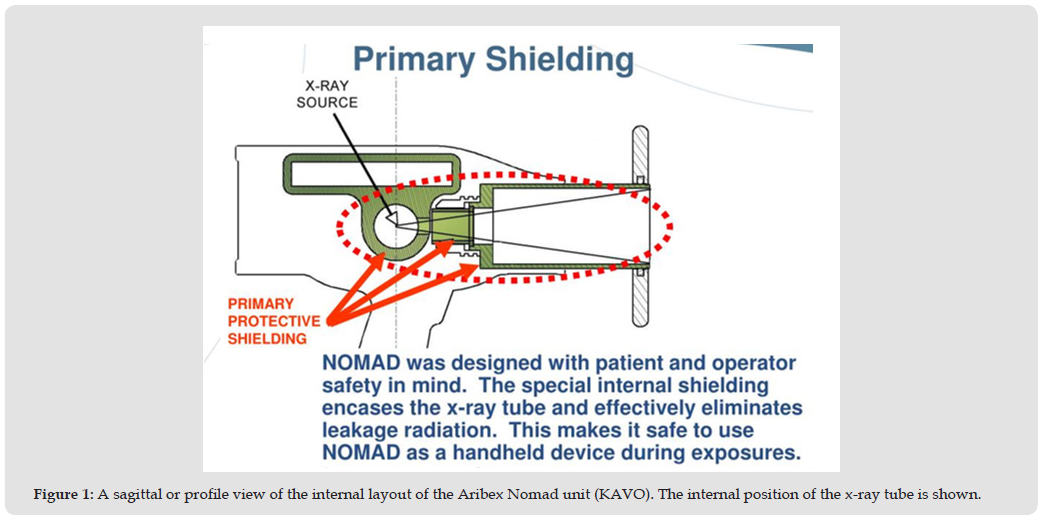
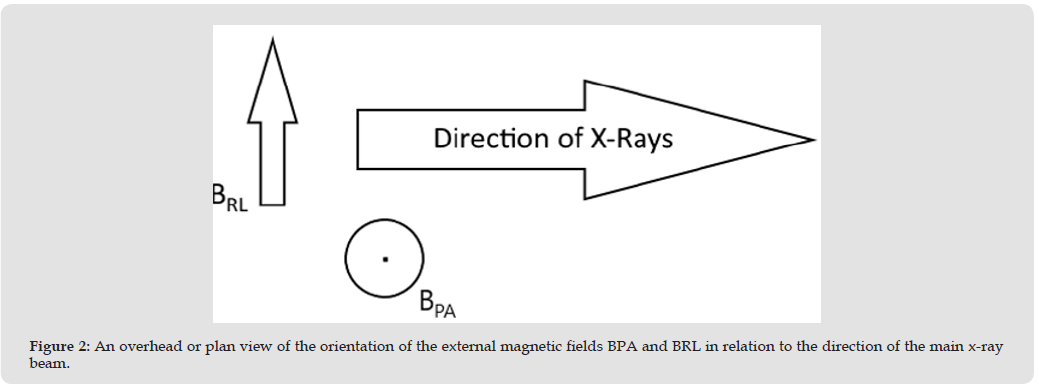
When the poles were aligned with one other and oriented with both of the “north” poles directed towards the west wall of the room and both of the “south” poles towards the east wall of the room, this was labelled as magnetic field BLR. When the poles were reversed in relationship with the “north” poles facing the east wall and the “south” poles facing the west wall, this was labelled as magnetic field BRL. It was determined that the x-ray tube within the Nomad unit is oriented in the same axis as BLR/BRL (Figures 1 & 2). When the poles were oriented with both of the “north” poles directed towards the room ceiling and both of the “south” poles towards the room floor, this was labelled as magnetic field BAP. When the poles were reversed in relationship with the “north” poles directed towards the floor and the “south” poles directed towards the ceiling, this was labelled as magnetic field BPA. The distance between the focal spot markings on the exterior of the nomad unit (and therefore the distance of separation for the magnets in the BLR and BRL orientations) was 133mm. The distance between the upper and lower surfaces of the nomad (and therefore the distance of separation of the magnets in the BAP and BPA orientations) was 108mm.
Figure 2
The difference in the distance of separation for the magnets in the BLR/BRL versus the BAP/BPA orientations was 25mm (18.79% of 133mm). According to Coulomb’s Law, the BLR/BRL magnet orientation will result in a magnetic force which is (108/133)2 = 0.659 (66%) of the magnetic force generated by the BAP/BPA orientation (Tables 1 & 2).
Table 1: Various tube voltage and exposure readings for the various orientations and absence of magnetic fields.
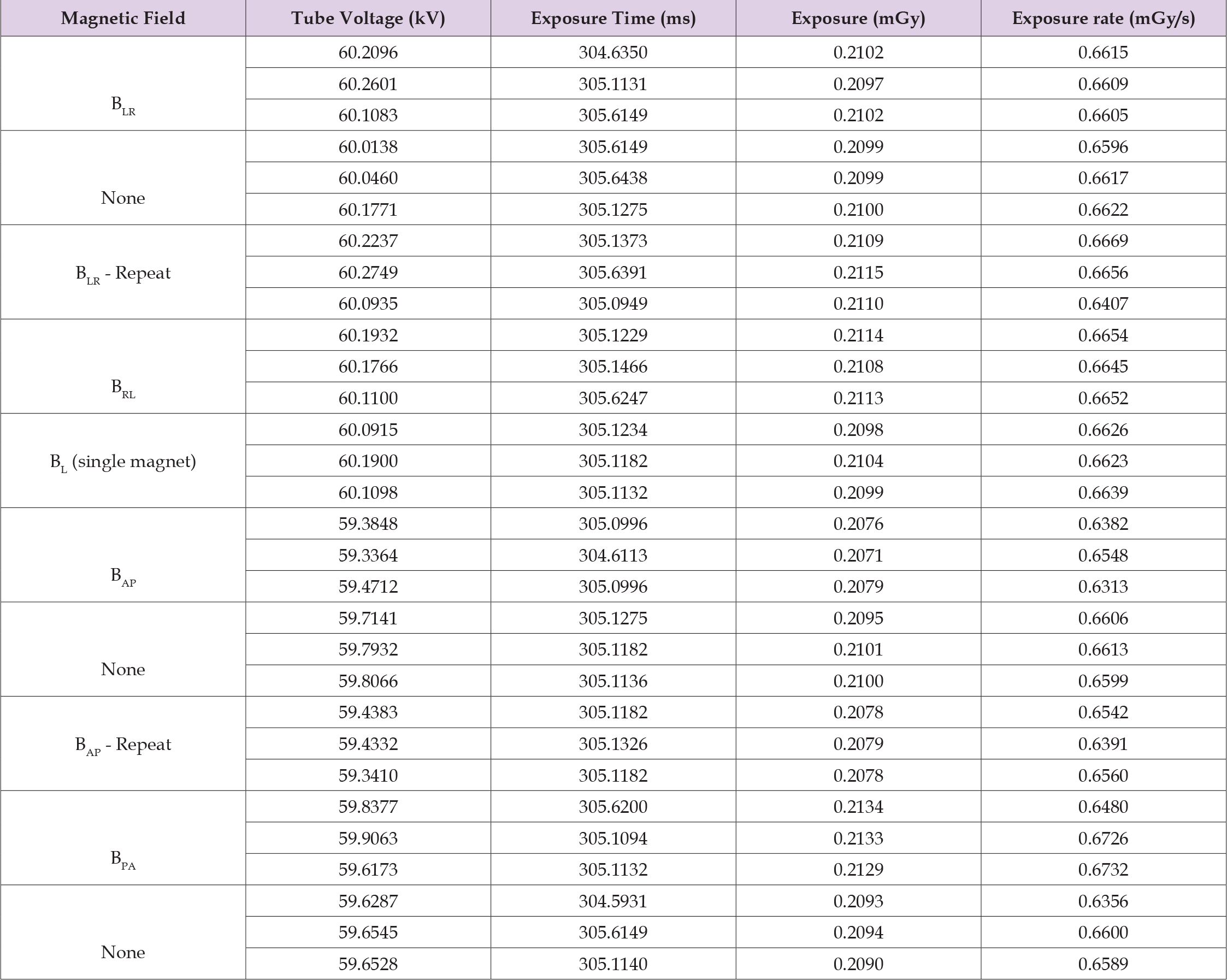
Table 2: Mean values (and standard deviations in parentheses) for the data in Table 1.
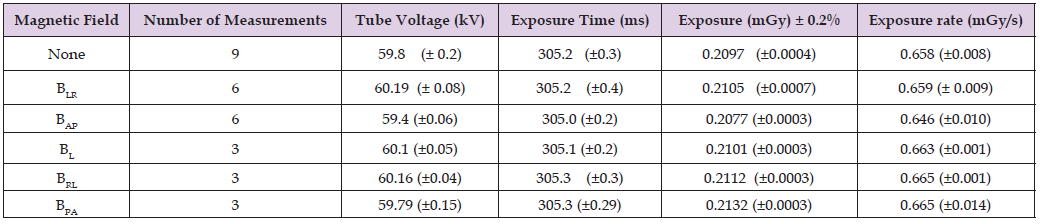
The mean total exposure for the BPA orientation was 0.2132mGy, with a standard deviation of +/-0.0003. The mean exposure without a magnetic field (None) was 0.2097mGy, with a standard deviation of +/-0.0004. This represents a 1.7% difference in mean exposure values, while the measurement error was consistently < 0.2%. The difference in mean exposure rate values was 1.06% between BPA (0.665mGy/s) and no magnetic field (0.658mGy/s). The difference in mean exposure rate values was 1.06% between BRL (0.665mGy/s) and no magnetic field (0.658mGy/s). The difference in mean exposure rate values was 2.9% between BAP (0.646mGy/s), and BPA (0.665mGy/s). There was no significant change in the dosimeter readings between orientations when the magnets were positioned in the BLR orientation.
Both the mean total exposure and exposure rates were increased when compared to no magnetic field when the magnets were placed in the BPA orientation. However, the mean exposure rate increase was within the margin of error. The mean total exposure and exposure rates were also increased when compared to no magnetic field when the magnets were placed in the BRL orientation. Again, the mean exposure rate was within the margin of error. The increase in the mean total exposure in the BPA orientation was much greater than the increase in the relatively perpendicular BRL orientation. Additionally, when magnets were placed in the orientation BAP, so that the North-South pole axis and thus the magnetic field, was at 90 degrees relative to the focal spot markings, there was a small but measurable decrease in the exposure readings from the dosimeter. The variations seen between exposure measurements made in the BPA/BAP orientation of the magnetic field, versus exposure measurements in the BLR/BRL orientation, may in part be due to changes in the magnetic field strength caused by variations in the distance between the magnets and the x-ray tube.
However, the variations in exposure readings observed between measurements in the BPA versus the BAP magnet orientations, and between the BRL and BLR orientations cannot be explained by variations in the magnetic field strength caused by variations in the distance of the magnets from the x-ray tube. It is hypothesized that these observed variations in x-ray tube output are due to the varied direction of the magnetic field lines between the bar magnets for the changed orientations. It has been previously hypothesized that the position and orientation of external magnets can affect the electron flow through the x-ray tube by increasing or decreasing the number of electrons hitting the tungsten target through beam focusing and deflection, respectively.
In conclusion, the use of relatively weak magnetic forces from bar magnets can modify the x-ray tube output in certain orientations, whilst not in others. More research is required to better describe the preliminary effects seen in this research.
Both authors declare that they have no conflict of interest.

International Association of Landscape Archaeology, Czech Glass Society, Czech Republic

Department of Chemistry, Semenov Institute of Chemical Physics, USSR Academy of Sciences, Moscow, Russia

Associate Professor at Department of Breast and Thyorid Surgey, Chongqing General Hospital, China

Professor of Nuclear Medicine, Faculty of Medicine and Surgery, University of Milan, Milan, Italy

Department of Pharmaceutical Sciences, South University School of Pharmacy, USA





 Abstract
 PDF
PDF



























