info@biomedres.us
+1 (502) 904-2126
One Westbrook Corporate Center, Suite 300, Westchester, IL 60154, USA
Site Map
 ISSN: 2574 -1241
ISSN: 2574 -1241
ISSN: 2574 -1241
Received: December 23, 2025; Published: January 07, 2026
*Corresponding author: H Hakemi, Plastic Liquid Crystal Technology Consultant, Italy
DOI: 10.26717/BJSTR.2026.64.010033
This study investigates the heat shielding performance of polymer dispersed liquid crystal (PDLC) films consisted of silver-based AgHT8 metallized infrared (IR)-reflective coatings. The AgHT8-PDLC films were compared against conventional ITO-PDLC films by measuring temperature differences between the front and back of the film surfaces under controlled exposure to a 150 W infrared lamp at 50-10 cm distance range. Significant reductions in transmitted infrared heat were observed in AgHT8-based PDLC structures due to their higher near-infrared (NIR) reflection. The AgHT8–AgHT8 configuration exhibited the highest ΔT values, confirming its suitability as an IR-reflective PDLC architecture. The results support the development of energy-efficient switchable glazing systems.
Keywords: PDLC; Liquid Crystal; Infrared Reflection; NIR; Heat Screening; AgHT8; ITO; Temperature Difference
Abbreviations: PDLC: Polymer Dispersed Liquid Crystal; IR: Infrared; NIR: Near Infrared; CLC: Chiral Liquid Crystal; SHGC: Solar Heat Gain Coefficient
The global demand for solar-energy–managing window technologies has increased sharply due to the need for energy efficiency, thermal comfort, and reduced cooling loads in modern buildings. Approximately half of incident solar energy lies in the infrared region, with the near‑infrared (NIR, 800–1100 nm) accounting for nearly 46–50% of the total solar spectrum. Controlling the NIR reflection is therefore a key strategy for reducing heat ingress through glazing. Out of NIR blocking materials, the reflection types are preferable to absorption types, since the heat dissipation of the latter is not very effective and allows heat to radiate into the indoor spaces. Many materials and methods are available for controlling NIR light passing through windows, as published review of infrared regulating “smart” windows based on organic materials [1,2]. Polymer dispersed liquid crystal (PDLC) films are widely used in switchable glazing systems. Their optical properties—high scattering in the off‑state and transparency in the on‑state make them attractive for privacy and daylight regulation. Several studies have reported their UV-blocking capabilities and modest NIR modulation; however, conventional PDLC structures typically exhibit low IR reflection, limiting their thermal performance [3-5]. The typical visible spectral transmissions of an indoor PDLC glazing are also studied to be around 71% at on-state and 27% at off-state, while the SHGC varied from 0.53 in the on-state (transparent) to 0.39 in the off-state [6]. The conventional PDLC films have shown excellent performance in blocking up to 98% of UV radiation and 12 and 38% modulation of NIR radiation [7]. Even it has been proposed that PDLC glass could reduce the energy consumption [8]. Also there has been attempt to utilize PDLC using chiral liquid crystal (CLC) reflector by electrical switching of a reflection band to generate visible coloration, but they are restricted to 50% reflection in a limited single layer bandwidth [9]. There is also a patent literature on solar heat rejection PDLC films that combines the static IR-reflecting coating with dynamic CLC mechanisms [10]. In general, the U-value and solar heat gain coefficient (SHGC) of a conventional PDLC glazing were studied under indoor conditions by utilizing a small scale test cell equipped with temperature sensors to measure the solar energy entering the PDLC cell [11]. The optical evaluation showed that the off-state PDLC glazing showed low UV (8%) and NIR (44%) transmissions, respectively. Also, it was observed that, due to low solar reflection and transmission, the SHGC was basically similar in both on-state (0.68) and off-state (0.63). In a similar report, the time variation of temperature difference (ΔT) between the internal PDLC cell temperature and external ambient at various radiation intensities were investigated, where the average ΔT increase were 18.8°C in the transparent state and 20.1°C in the translucent state. The result was that the overall heat flow through the PDLC glazing was relatively higher in the translucent state [12]. Despite extensive literature on PDLC optical properties, there remains limited quantitative evaluation of thermal performance under direct IR exposure. To address this limitation, incorporating IR-reflective transparent conductive layers, such as silver‑based metallized films has emerged as a promising approach. AgHT8, a transparent conductive silver-coated PET film, offers lower electrical resistance and substantially higher IR reflectivity compared to standard indium tin oxide (ITO) PET films. This work therefore investigates the heat shielding capability of AgHT8‑PDLC devices relative to ITO‑PDLC devices by measuring the temperature gradients generated during controlled IR lamp exposure through temperature differences (ΔT) between the front and back of corresponding translucent PDLC films. These results are described in the following sections.
The PDLC formulation was prepared using a commercial Qingdao liquid crystal mixture (QY142), Norland Optical Adhesive pre-polymer (NOA65), Ciba Irgacure 819 and 184 photo-initiators, BASF Tinuvin TV‑400 UV absorber, Suzhou 25 m NM micro-spacers and Kaitai acrylic acid. The Eastman IR heat rejection Flexvue AgHT8-PET (thickness= 175 m; haze=0.7%; transmission=80%) and ITO-PET (thickness= 175 m; haze=1.0%) transparent conductive films. The composition of PDLC formulation (by weight) was: QY142=40%, NOA65=51%, Acrylic Acid=4%, Tinuvin=4%, Irga819=0.5%, Irga184=0.5% and micro- spacer=0.6%. The uncured PDLC formulations were pre-heated at 45°C for 10 minutes and then were poured between the vertical gap of AgHT8-PET and ITO-PET rolls on a custom-made coater/laminator system (Sigma Sivo). Under the coating rolls, the uncured coated films were passed through a pressure roll to insure the uniformity of PDLC films. The uncured PDLC films were then cured at UV intensity of 165 mW/cm2 and 0.15 meter/minute line speed. The thickness homogeneity of PDLC layers were insured by micro-spacers. The thermal testing was carried by direct exposure of the off-state PDLC films to a Philips 150W IR lamp placed at distances of 50, 40, 30, 20, and 10 cm. The front‑side and back‑side temperatures of the films were recorded using LOGGER LogMaster thermocouples, where the temperature difference: ΔT = T(front) − T(back) was used as an indicator of IR heat screening. The experimental setup of these measurements are presented in Figure 1.
Figure 1
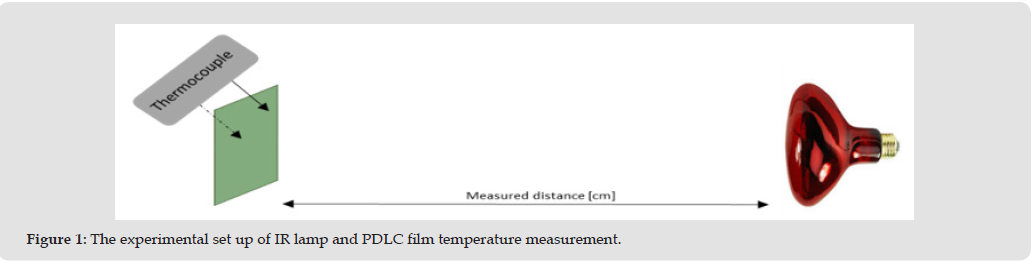
The heat-screening behavior of three PDLC film configurations: ITO-ITO, ITO-AgHT8 and AgHT8-AgHT8 under controlled infrared lamp exposure demonstrates clear distinctions in thermal response that correlate strongly with the optical properties of their respective metallized coatings. In Table 1 we tabulated the NIR transmissions and reflections at 800, 1100 and 1400 nm wavelengths in AgHT8- PDLC and ITO-PDLC films. The results clearly indicate the transmission and reflection differences between of double coated AgHT8-PDLC and ITO-PDLC films. Namely according to Table 1 & Figure 2 AgHT8- PDLC exhibits significantly higher NIR reflectance (69%) compared to ITO-PDLC (9%) at 1400 nm. Accordingly, the transmission and reflection differences between ITO-ITO PLC and AgH8-AgHT8 PDLC films, where the average values within the whole NIR range the transmissions are 79.3 (ITO-ITO) vs 13.5 (AgHT8-AgHT8) whereas the reflections are 20.5 (ITO-ITO) vs 57.3 (AgHT8-AgHT8). As we will see in below, these differences directly influence the measured ΔT values in the ITO-ITO and AgHT8-AgHT8 PDLC films. In order to have a better ΔT comparison, we also included hybrid ITO-AgHT8 PDLC film in these measurements. The results are presented in Table 2 & Figure 3 graphs and are described as follows:
• ITO-ITO: ΔT decreases slightly from 3.5°C to 1.3°C when the lamp distance is reduced, indicating that ITO allows most of the IR radiation to penetrate and heat the PDLC bulk.
• ITO-AgHT8: ΔT increases from 3.8˚C to 10.2˚C with a sharp increase at short distances (20–10 cm), showing that the AgHT8 layer begins to dominate heat management under high-radiance conditions.
• AgHT8-AgHT8: ΔT increases linearly from 5.9°C to 13.5°C, confirming that strong NIR reflection at both interfaces significantly reduces heat transmission through the film.
Figure 2
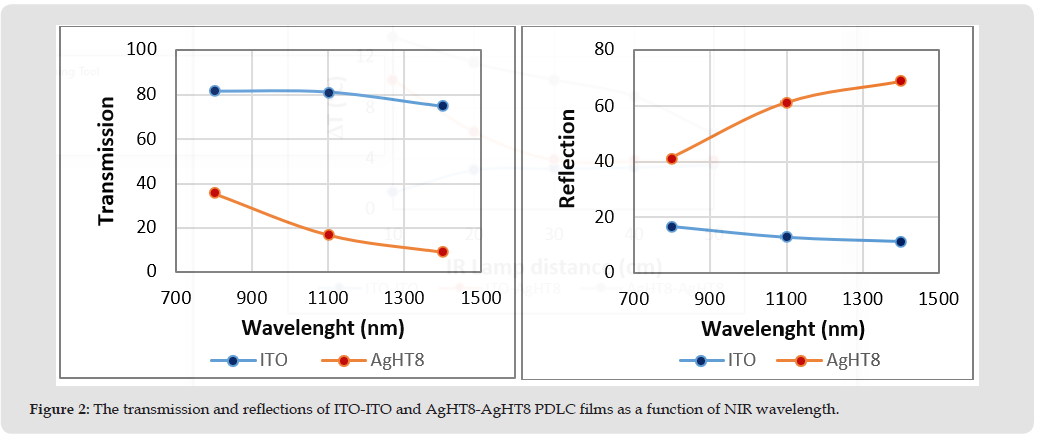
Figure 3
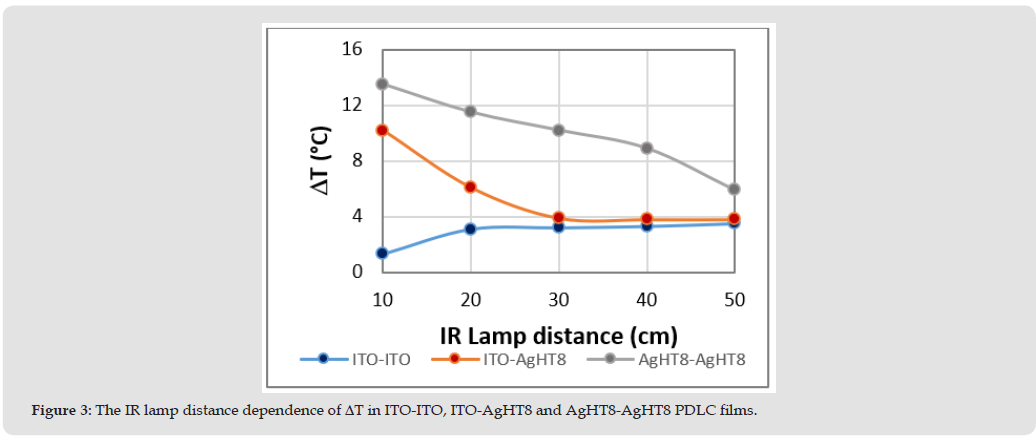
Table 1: The NIR transmissions and reflections of PDLC films with ITO and AgHT8 coatings.
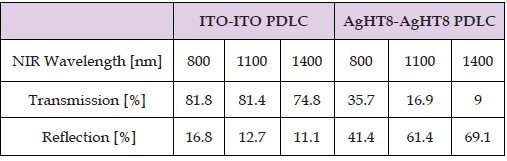
Table 2: ΔT values of PDLC films with three metallized coatings.
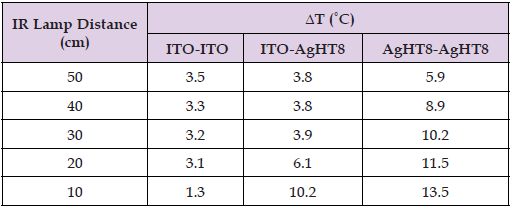
In the case of conventional ITO-ITO PDLC film, with low NIR reflectance permits deeper IR penetration. This increases internal absorption, raises back-surface temperature and causes the ΔT reduction. With regards to the hybrid ITO–AgHT8 PDLC film, ΔT at 50–30 cm range is nearly identical to ITO-ITO because the IR intensity is low and the front-surface reflectivity contributes minimally. However, at 20–10 cm range, ΔT rises dramatically, revealing that under stronger IR exposure the AgHT8 front surface plays a much more dominant role. This suggests a threshold effect where front-side reflectivity becomes important only when incident radiant flux exceeds a certain level. On the other hand, the nearly linear ΔT rise for AgHT8-AgHT8 PDLC with decreasing distance indicates minimal internal heat saturation, dominance of reflective rather than absorptive thermal processes and stable thermal behavior under increasing IR flux. The high ΔT in this case arises because much of the incident NIR energy is reflected at the PDLC film surface, indicating its distinct IR reflection potential and preventing thermal buildup inside the PDLC layer. This is in contrast to ITO-ITO PDLC film, where ΔT collapses at 10 cm distance due to thermal saturation of the PDLC interior.
Overall, the results demonstrate that silver‑based transparent conductor AgHT8 provides significant thermal improvements over conventional ITO conductor when integrated into PDLC switchable films, which reinforce several design advantages of AgHT8-PDLC films:
• The higher IR rejection efficiency reduces heat transfer to indoor spaces.
• Lower internal heating preserves PDLC optical stability. • Better performance under strong solar irradiance relevant for building glazing.
• Reduced cooling load in buildings due to improved solar heat management.
• Promising for energy-efficient smart windows where thermal shielding and optical switching coexist.
Compared to standard ITO-based PDLC films, the silver metallized AgHT8-PDLC films exhibit superior IR-reflective heat shielding. The measured ΔT values, reaching 13.5°C under close-range IR exposure, reflect the strong NIR reflection of AgHT8 layers. These findings position AgHT8-PDLC as a promising candidate for energy-efficient switchable smart PDLC windows requiring improved solar heat rejection. Future work will require thermal measurements, extended spectral characterization, and device optimization with other types of IR-reflective metallization for large-area architectural window applications. Opportunities for future investigations could include: multi-layer silver/dielectric stacks to broaden or tailor reflection spectra; Integration with broadband cholesteric liquid crystal reflectors for selective-band IR reflection; Radiative–conductive modeling for architectural-scale simulations and optimization of layer thickness and film symmetry to balance transparency, haze, and IR blocking.
This research received no external funding.
The authors declare no conflicts of interest.
This study has been internally funded by Gauzy Ltd, Tel Aviv, Israel, and has been carried out with R&D team at the company’s laboratories during 2015-2016 period as part of PDLC industrial research and development program.

International Association of Landscape Archaeology, Czech Glass Society, Czech Republic

Department of Chemistry, Semenov Institute of Chemical Physics, USSR Academy of Sciences, Moscow, Russia

Associate Professor at Department of Breast and Thyorid Surgey, Chongqing General Hospital, China

Professor of Nuclear Medicine, Faculty of Medicine and Surgery, University of Milan, Milan, Italy

Department of Pharmaceutical Sciences, South University School of Pharmacy, USA





 Abstract
 PDF
PDF



























