info@biomedres.us
+1 (502) 904-2126
One Westbrook Corporate Center, Suite 300, Westchester, IL 60154, USA
Site Map
 ISSN: 2574 -1241
ISSN: 2574 -1241
ISSN: 2574 -1241
Received: December 22, 2025; Published: January 07, 2026
*Corresponding author: Torres Hernández Rosa María, Clinical research Faculty of Medicine, Universidad Veracruzana, México
DOI: 10.26717/BJSTR.2026.64.010031
Ameloblastic carcinoma is a rare pathological entity, accounting for approximately 2% of head and neck tumors.
It behaves as a malignant neoplasm with locally invasive destructive capacity, including neural involvement,
lymphatic dissemination, and slow-growing distant metastases, leading to bone resorption and dental mobility
[1,2].
Clinical Case: We report the case of a 45-year-old male patient who presented with left mandibular swelling
since the age of 12. Facial computed tomography revealed a lobulated hypodense lesion measuring 5 × 6 cm
in the left mandible, associated with bone lysis. Excisional surgical removal under general anesthesia was performed,
including mandibular hemimandibulectomy and placement of a reconstruction plate. Histopathological
examination revealed a malignant odontogenic neoplasm composed of islands, cords, and sheets of ameloblastomatous
epithelium.
Conclusion: The transformation from ameloblastoma to ameloblastic carcinoma remains controversial. The
most relevant feature appears to be prolonged evolution over time. In this patient, the lesion began as a small
mandibular tumor at 12 years of age, remained untreated, and progressed to facial deformity, intraoral ulcerations,
dental mobility, and pain.
Keywords: Ameloblastic Carcinoma; Mandible; Case Report
Ameloblastic carcinoma is a malignant tumor derived from odontogenic epithelial remnants or the enamel organ. It is rare, representing approximately 1.6–2.2% of all odontogenic tumors. Despite exhibiting histological features that may resemble benign ameloblastoma in both primary and metastatic lesions, it behaves aggressively, with locally invasive destruction, neural involvement, lymphatic spread, and distant metastases [3,4]. This tumor predominantly affects the mandible and is more common in males between 40 and 60 years of age. Clinically, it is characterized by slow but invasive growth, with a high recurrence rate if not adequately excised. Histologically, it demonstrates cytological atypia. Several malignant odontogenic tumors are recognized, including primary intraosseous carcinoma, sclerosing odontogenic carcinoma, clear cell odontogenic carcinoma (CCOC), odontogenic carcinoma, odontogenic sarcomas, and odontogenic carcinosarcoma [5,6]. In 2012, the World Health Organization recognized two related entities: malignant ameloblastoma and ameloblastic carcinoma. The recommended treatment is surgical excision with tumor-free margins of 1–2 cm [1,7]. The clinical course of ameloblastic carcinoma includes aggressive local destruction and regional nodal or hematogenous metastasis, most commonly to the lungs [8,9]. Due to its rarity, there is no consensus regarding optimal treatment; therefore, wide local excision remains the treatment of choice. Local recurrence rates of less than 15% [7] have been reported following adequate surgical resection. Radiotherapy and chemotherapy remain under investigation.
Adjuvant radiotherapy (30–50 Gy) has been suggested in cases with positive or close surgical margins, perineural invasion, or soft tissue involvement; however, no significant improvement in 5-year survival has been demonstrated. Chemotherapy has been used in patients with systemic metastases to suppress tumor growth, but additional clinical studies are required to establish its role as adjuvant therapy [1].
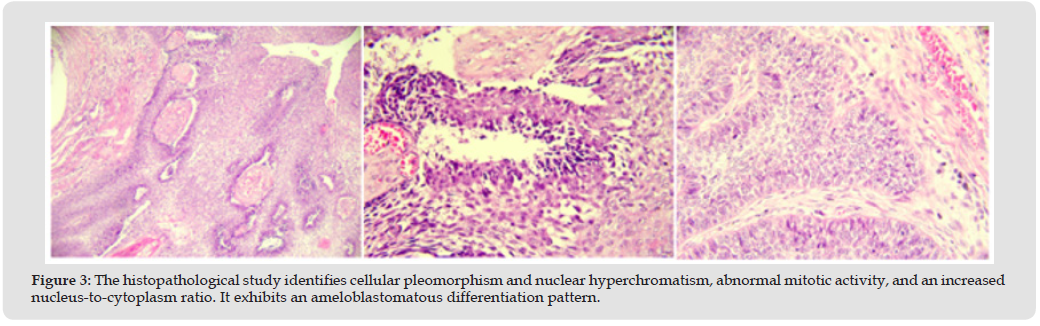
A 45-year-old male patient reported progressive swelling of the left mandible since the age of 12, associated with pain and limitation in mouth opening and closing. He had no significant past medical history. Physical examination revealed facial swelling in the left buccal and masseteric regions measuring approximately 3 × 4 cm. Intraoral examination demonstrated a mandibular mass with displacement of teeth and ulcerated mucosa (Figure 1). Magnetic resonance imaging and facial computed tomography (Figure 2) revealed a lobulated hypodense lesion measuring approximately 5 × 6 cm in the left mandible, associated with bone lysis. Surgical excision under general anesthesia was performed, including mandibular hemimandibulectomy and placement of a 2.4 reconstruction plate system. Histopathological examination revealed a malignant odontogenic neoplasm composed of islands, cords, and sheets of ameloblastomatous epithelium. The tumor showed a peripheral basal cell layer arranged in palisading with reversed nuclear polarity and a central stellate reticulum. Cellular pleomorphism, nuclear hyperchromatism, hypercellularity, abnormal mitotic activity, and an increased nuclear-to-cytoplasmic ratio were identified (Figure 3).
Figure 1

Figure 2
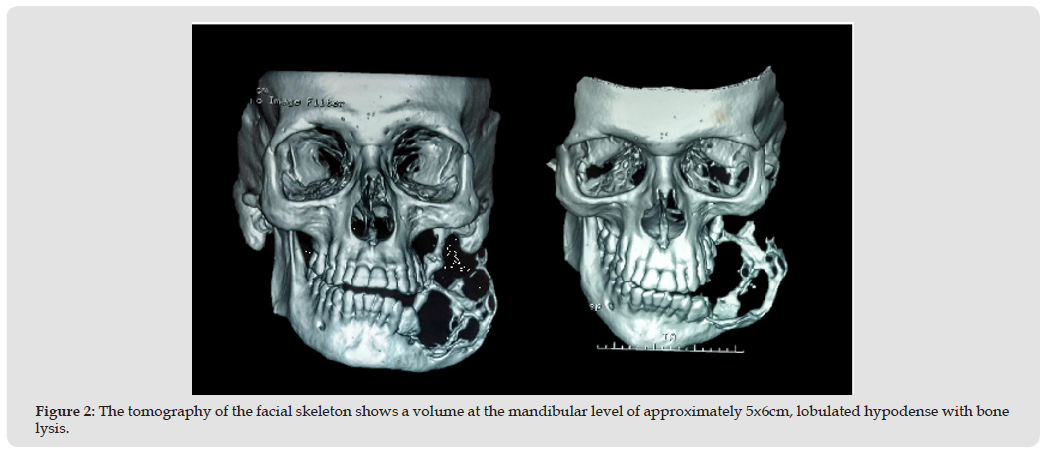
Figure 3
Ameloblastic carcinoma may initially present as a benign odontogenic tumor with slow-growing swelling causing bone resorption and dental mobility, or as an aggressive tumor with rapid growth leading to cortical perforation, soft tissue invasion, ulceration, trismus, dysphonia, and paresthesia [1,5,6]. The mandible is the most frequently affected site. Surgical resection with tumor-free margins of 1–2 cm remains the treatment of choice. Radiotherapy and chemotherapy are still under investigation as adjuvant therapies. Recurrence has been reported between 5 and 11 years after initial treatment, while distant metastases may occur from 4 months up to 12 years later. The lung is the most common metastatic site, followed by bone, liver, and brain. Ameloblastoma-derived carcinomas have been described using various terms, including malignant ameloblastoma, metastatic carcinoma, and intra-alveolar squamous carcinoma. According to the WHO classification, ameloblastic carcinoma is included among odontogenic carcinomas [10]. Radiographic findings include well-defined radiolucent lesions with focal radiopaque areas, cortical perforation, and bone resorption. Histological evaluation, particularly in the spindle- cell variant, requires careful assessment of cytological atypia, mitotic figures, and cellular morphology [9,10]. Based on the literature review and the clinical, radiological, and histopathological features observed, the diagnosis of ameloblastic carcinoma is appropriate in this case.
A key characteristic is the prolonged evolution of the lesion. In our patient, the tumor began as a small lesion at 12 years of age, remained untreated, and progressed to facial deformity, intraoral ulceration, dental mobility, and pain [11].
Ameloblastoma is a rare tumor, occurring in approximately 2.23% of cases. The standard treatment is en bloc surgical resection with tumor-free margins of 1–2 cm. Radiotherapy and chemotherapy require additional case reports and clinical studies to define their role in management. Both ameloblastoma and ameloblastic carcinoma are extremely rare entities [12-14]. A prolonged clinical course may lead to malignant transformation. Delayed diagnosis is associated with facial deformities and increased surgical complications, highlighting the importance of early detection and timely treatment.
The authors declare no conflict of interest.

International Association of Landscape Archaeology, Czech Glass Society, Czech Republic

Department of Chemistry, Semenov Institute of Chemical Physics, USSR Academy of Sciences, Moscow, Russia

Department of Educational Sciences, Research Centre Qualities of Teachers, School of Education – HAN, Nijmegen, Netherlands

Associate Professor at Department of Breast and Thyorid Surgey, Chongqing General Hospital, China

Neurology, LA BioMed Research Institute, USA





 Abstract
 PDF
PDF



























