info@biomedres.us
+1 (502) 904-2126
One Westbrook Corporate Center, Suite 300, Westchester, IL 60154, USA
Site Map
 ISSN: 2574 -1241
ISSN: 2574 -1241
ISSN: 2574 -1241
Received: December 18, 2025; Published: December 22, 2025
*Corresponding author: Marcelo Barros de Vasconcellos, Doctor from the Center for Health Sciences (UFRJ), Master in Public Health (UFF), and Specialist in Aquatic Activities (FAMATH), Associate Professor at State University of Rio de Janeiro (UERJ), CAp-UERJ, R. Barão de Itapagipe, 96 - Rio Comprido, Rio de Janeiro - RJ, 20261-005, Brazil
DOI: 10.26717/BJSTR.2025.64.010024
Drowning is a global public health problem that needs to be addressed through education. Learning to swim at a young age can reduce the number of children who drown, and therefore, preventative swimming is considered a life-saving skill for them. The objective of this text is to show how the second link in the chain (recognizing drowning) can be worked on in swimming lessons as a preventative/educational way to guide students on how to act in case of failure in the first link (prevention). Among the content that can be taught in safer swimming lessons is how to recognize drowning. Signs of drowning include: silence: the person may be silent, unconscious, or gasping for breath; mouth: the person may be coughing, foaming at the mouth, or making desperate sounds; eyes: the person’s eyes may be glazed, closed, or unable to focus, disoriented; head position: the person’s head may be tilted back or low in the water. Body position: the person may be upright in the water, not using their legs, body tense; movement: the person may appear to be climbing an invisible ladder, or trying to swim but without progressing or against the current; other signs: the person may have hair over their forehead or eyes, appear to be struggling, or gesticulating with their arms. Drowning prevention avoids premature mortality and has the potential to save far more lives than rescuing or treating drowning victims. In short, the first ring is always the best option. Prevention!
In Sweden, swimming is part of the primary school curriculum, as learning to swim at a young age can reduce the number of children who drown, and therefore, swimming is considered a life-saving skill for them [1].
In Brazil, increasingly, places have recognized that swimming lessons can help prevent drownings by developing the student’s aquatic skills, in classes, performing (Figure 1)
1. Swimming With Arms and Legs.
2. Changes of position.
3. Safe entry and exit from the water.
4. Underwater breathing.
5. Submersion and immersion.
6. Floating, and
7. Hand support [2]
Figure 1
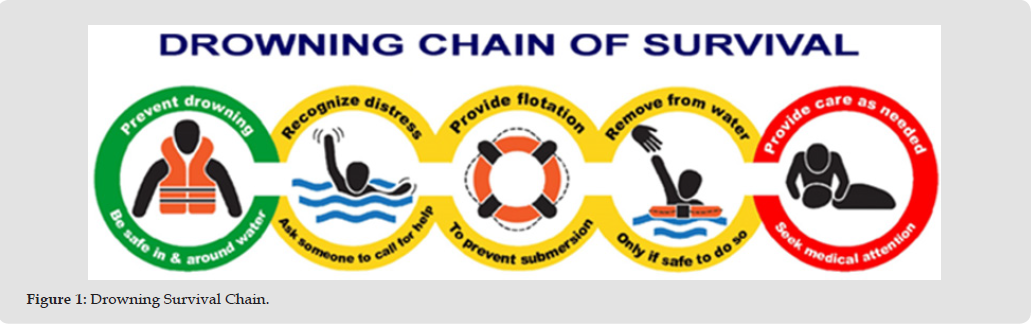
However, swimming lessons can also teach how to prevent another person from putting themselves at risk of drowning and, above all, how to recognize when a drowning is occurring. In 2014, a Drowning Survival Chain was created, composed of five links that guide the important steps to improve the chances of prevention, survival, and recovery from drowning. The steps in the chain are: preventing drowning, recognizing drowning, providing flotation, removing from the water, and providing care as needed [3]. This text aims to show how the 2nd link in the chain (recognizing drowning) can be worked on in swimming lessons as an educational way to guide students on how to act in case of failure in the 1st ring (prevention).
According to the Royal Life Saving Society Australia [4], a drowning victim is not what people normally see in movies with arms splashing water, a person screaming for help. In reality, drowning is much quieter and is often mistaken for play, as there are no screams. It is called the instinctive drowning response. The stereotype of “drowning” portrayed in movies or on TV is actually known as aquatic distress, which happens before a person begins to drown. Someone in distress may still be able to control their movements, reach out to grab a flotation device, and scream. When drowning begins, however, the person can no longer scream or control their body. They become vertical in the water, sometimes rocking up and down, with their hands partially or fully extended to the sides. Children may appear to be swimming like puppies or playing. But the silence, especially among children, is a warning that something may be fatally wrong.
Signs of drowning include:
• Silence: The person may be silent, unconscious, or gasping for air.
• Eyes: The person’s eyes may be glazed, closed, or unable to focus, disoriented.
• Mouth: The person may be coughing, foaming at the mouth, or making desperate sounds.
• Head Position: The person’s head may be tilted back or low in the water.
• Body Position: The person may be upright in the water, not using their legs, body tense.
• Movement: The person may appear to be climbing an invisible ladder, or trying to swim but not progressing or against the current.
• Other Signs: The person may have hair over their forehead or eyes, appear to be struggling, or gesticulating with their arms (Figure 2).
Figure 2
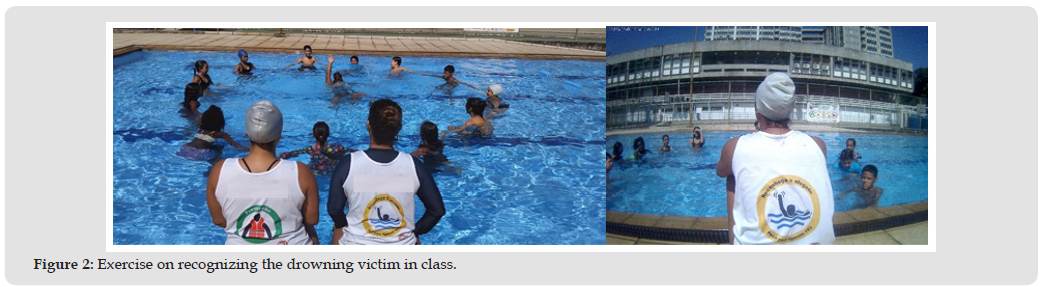
Recognizing a Drowning Victim
Among the topics that can be taught in safer swimming lessons is how to recognize a drowning. When recognizing a drowning victim, ask them to call 193 (Fire Department) or 192 (SAMU in Brazil) and report what is happening, where the incident is occurring, how many people are involved, and what you have already done or intend to do. If you do not have access to your country’s emergency number, always inform someone nearby of what you intend to do [5]. If possible, provide a flotation device to the victim (3rd link in the chain), without you having to expose yourself to attempting a rescue without training and skills. Above all, because Chinese researchers have shown that rescue efforts attempted by untrained bystanders often lead to the death of the primary drowning victim, the rescuer, or both [6]. Therefore, it is always best to execute the first link in the chain well (prevention). Prevention in this case means not putting yourself at risk, observing if the location has a “no swimming” sign, a red flag, a deep area, or a “no diving” sign; in these cases, do not enter the water. For researchers at the State University of Rio de Janeiro [7], swimming students need to learn more than just the procedural content included in the water acuity test. They need to learn
1. Attitudinal content, which involves actions focused on teaching the student to respect and/or coexist with (rules of use, teacher’s instructions, their limits, norms, postures, prevention habits, and attitudes);
2. Conceptual content, which involves actions focused on teaching the student to interpret and/or understand (signs, symbols, warnings, meanings, risks, danger, and concepts).
Drowning prevention avoids premature mortality and has the potential to save far more lives than rescuing or treating drowning individuals [8-10]. In short, the first ring is always the best option. Prevention! Help use swimming as an educational tool to prevent drowning, and never underestimate the aquatic environment.

International Association of Landscape Archaeology, Czech Glass Society, Czech Republic

Department of Chemistry, Semenov Institute of Chemical Physics, USSR Academy of Sciences, Moscow, Russia

Neurology, LA BioMed Research Institute, USA

Associate Professor at Department of Breast and Thyorid Surgey, Chongqing General Hospital, China

Professor of Nuclear Medicine, Faculty of Medicine and Surgery, University of Milan, Milan, Italy





 Abstract
 PDF
PDF



























