info@biomedres.us
+1 (502) 904-2126
One Westbrook Corporate Center, Suite 300, Westchester, IL 60154, USA
Site Map
 ISSN: 2574 -1241
ISSN: 2574 -1241
ISSN: 2574 -1241
Received: December 12, 2025; Published: December 22, 2025
*Corresponding author: Sory Kourouma, PHD Student at Ujkz (Leshco/Ladipa), Lecturer at The Higher Institute of Mory Kanté Arts in Dubréka (Isamk/D), Department of Cinema and Audiovisual, Republic of Guinea
DOI: 10.26717/BJSTR.2025.64.010020
Cinema is both an art and an industry. It is a way to explore man, his environment, his history and his culture. The
distribution of African cinema faces many obstacles, both on the continent and abroad.
In Africa, infrastructure is often insufficient: there is a lack of cinemas, structured distribution channels and
funding to promote works. Piracy, the high cost of the Internet, and the lack of state support aggravate the situation.
Internationally, African films are struggling to establish themselves because of low visibility, cultural prejudices
and limited access to major distribution platforms. Competition with Western film industries also makes
it difficult for African cinema to become visible. Finally, linguistic fragmentation and the lack of collaboration
between African countries hinder the circulation of works on the continent. To overcome these challenges, it is
necessary to strengthen cultural policies, increase the number of screening rooms, support African streaming
platforms, encourage co-productions and professionalize distribution networks.
Keywords: Film Production; Distribution; Exhibition; Public Policy; Technical Infrastructure; Communication; Development
Inspired by colonial models, most of our African countries had a film industry in the aftermath of independence. All the chains in the sector were operating normally despite the fact that the number of buildings has gradually decreased because there were more cinemas before independence than after independence and fewer and fewer than now. This problem is due to the lack of cultural policy. Some countries, like ours, after the first republic, relegated culture to the background. Before the end of the 1990s, the very notion of cultural diversity was not very much mobilized. It has been built over time and according to debates involving divergent interests. Thus, African cinema has experienced a remarkable artistic dynamism for several decades, marked by a diversity of productions, an emergence of young talents and a growing international recognition. However, the distribution of works remains one of the weakest links in the film value chain. Too few African films reach their local, regional or international audiences, due to a glaring lack of suitable infrastructure and a weakness in public policies in terms of support for distribution.
Faced with this observation, the strengthening of public policies and technical infrastructures is a strategic priority to allow a real visibility of African cinema, stimulate local cultural economies and strengthen the cultural sovereignty of African states. In this research, we support the idea that African states should play a leading role in helping to lay the foundations of a strong film industry and thus contribute to the production of content that enhances the diversity of cultural expressions. They must also help the sector to structure itself so that all the links in the chain work. Despite the policy of public subsidies created (unfortunately the funds allocated are very low), this is the case in Guinea of the Fund for the Development of Arts and Culture (FODAC), is a fund without funds that struggles to give satisfactory results. Indeed, this sector has been working poorly for many years and some professions are not formalized or tend to disappear. For example, since the liquidation of Sily Cinéma in Guinea in 1984 and the National Society of Burkinabe Cinema (Sonacib) in 2004, the film distribution sector has not been able to play its role. This leads directors, producers, cinema operators, to also act as distributors. Today, good public policy can form the basis of an enabling environment for the creation, dissemination and distribution of African cinematographic works.
Development, only development, is a qualitative, quantitative and sustainable improvement of an economy and its proper functioning. To achieve this, it requires a number of the most essential conditions. These conditions are based on factors that take into account the development of the human condition, that of art and culture. In a world of challenges and resilience, political will is needed to create and support artistic and cultural structures. Since the end of the 1960s, government action in the field of Art and Culture, cinema in particular, has always existed in Africa. This is the case in Guinea of Sily Cinema and the Guinean Cinema Office (ONACIG), now the Guinean Office of Cinema, Video and Photography, and FESPACO in Burkina Faso. Apart from the support of the Burkinabe State to this major festival, which has become the flagship event of African cinema through a set of measures, subsidies, sponsorship, the support of guest countries and other partnerships, support the sector. With these examples, we understand the importance of the sector, which must encourage our States to invest. Unfortunately, after creating these structures, they lost the sense that allowed them to provide significant support for the production and distribution of films in the countries. In short, a vacuum has been created in a poorly structured sector that is currently struggling to convince potential investors. Investment is not guaranteed by our States because it is not their priority. For them, this sector is not profitable like mining.
In this paper, we will try to present a set of possible public initiatives to support African cinema, but we have not sought to be exhaustive in the inventory and identification of funds or forms of state support. Our access aims to put the call on “Strengthening public policies and technical infrastructures for the distribution of African cinema”. Distribution is of importance that public action must support for the survival of the African film industry. Thus, even if the contribution of our States represents little money in the African film industry, public action could have a positive impact on the sector. In this context, support for the organization of the various branches, the professions of the sector, training, the adoption and application of appropriate regulatory texts, the establishment of a ticketing system are important levers for the cinema in its journey towards the establishment of solid foundations for its industrialization. Finally, if our States do not have enough resources to apply a good public policy for the development of this sector, they must sign agreements or partnerships at the same time to support the actors. This could help to have in their cultural policies, a fund to support cultural cinematographic production which will not take long to give significant results.
Since the 2000s, African cinema has been confronted with the closure of funding counters. This has had an impact on local film production. There were also the first uses of digital devices for production, which led to a significant reduction in production costs. This reality is common to all of French-speaking West Africa.
From 1990 to the present day, African countries, especially those south of the Sahara, especially French-speaking countries, have had difficulties related to the collection of cinema revenues and a prestigious investment in the construction of cinemas. At a certain time, when our states were in financial difficulty because of the establishment of democratic principles, culture was confined. As a result, there has been a decline in production or a trickle and cinematographic achievements classified as major works in Africa have become rare. For example, even Burkina Faso, which claims the title as the capital country of African cinema not only because it organizes the Fespaco biennial, but also because it played a major role for cinema in Africa in the 1980s and 1990s, has not remained on the sidelines. As proof, since Gaston Kaboré in 1997, no Burkinabe director has won the “Yennenga Golden Stallion”, the 1st prize of Fespaco except in 2025. Twenty-eight (28) years after Dani KOUYATÉ won with the film “KATANGA or THE DANCE OF THE SCORPIONS”. Also in our African countries, other aggravating situations are the poor management of public structures to support cinema and the poor collaboration of certain filmmakers who have benefited from public subsidies that they had to repay in part, these situations have contributed to undermining the subsidy mechanism put in place.
Also, the disappearance of cinemas after their nationalization, and in the cinema economy these infrastructures are at the first scale of returns. These spaces should exist and be numerous to compensate for the lack of funds for the promotion, production and extension of cinematographic activities. This shortage has significantly reduced the number of professionals in the distribution sector, who have been approved by the competent authorities since the early 2000s. On this subject, Armel Hien, Director General of Cinema and Audiovisual (DGCA), whom we interviewed, observes: “Distribution is a sector that is not yet well structured in Burkina Faso and that is not professional. This means that producers and cinema operators play the role of distributors because this link is not able to fully play its role. (Hien, interview of February 7, 2019). In addition, EVARISTE DAKOURE, in his article published online on 18 Feb, 2022, Public Action and Cultural Diversity, Public Policies to Support Burkinabe Cinema and National Film Production. “However, for a film industry to take place, the different segments of the sector must function properly. For example, distribution is important to ensure financial margins that can be reinvested in the production of other film projects. In addition to funds from the Burkinabe state, one of the country’s major sources of funding for cinema until the end of the 1990s came from the contribution of foreign ticket offices – French, Belgian, OIF funds, among others – which financially supported African film projects within the framework of cultural cooperation. ».
For this sector to function well in Africa, our States must equip themselves with structures in charge of the implementation of the film policy with substantial resources to carry out their missions. Without resources, the political will in terms of development in any field, especially cinema, will be doomed to failure and its results will be criticized, as is currently the case in Africa, especially French-speaking Africa. Finally, the subsidy obviously granted to the Arts and Culture sector is low despite the opportunity offered by digital technology, film production in Africa is in dribs and drabs. Therefore, the sector would benefit if it is better organised with specifications for the exercise of the various professions and these specifications must be accompanied by sanctions in the event of non-compliance with commitments.
Public policies are the foundation on which essential decisions are based for the proper functioning of national development sectors. They touch on various fields such as education, health, the economy, the environment and culture. Well designed, they improve the quality of life of citizens and ensure a certain socio-political equity. Within the framework of this communication, the objective is to achieve efficient and successful film production despite the difficulties encountered by technical and infrastructural industries for the distribution of African cinema either by their size or by the accelerated and profound evolution of digital technology.
From this objective stems our research question of the study, it is the following: How to achieve effective film production and solve the difficulties encountered by technical and infrastructural industries for the distribution of African cinema?
Any research hypothesis is intimately linked to the objective of the study. Thus, our hypothesis is formulated: Effective film production helps to combat the difficulties encountered by technical and infrastructural industries for the distribution of African cinema.
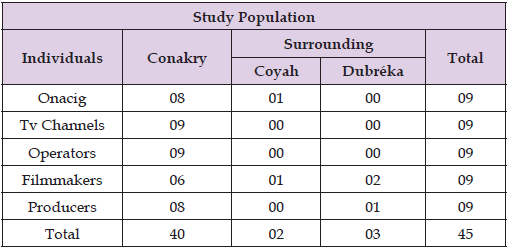
In this study, we used a qualitative methodology. This method is better suited for us, since it allows us to develop a convenient description and explanation of the technical phenomena and processes observed in the African context for the distribution of African cinema. A total of forty-five (45) semi-structured interviews with an average duration of one week were used in the context of the preparation of this communication. These interviews were conducted individually with a team of five (5) students, i.e. nine (9) individuals per interviewer, from September 8 to 14, 2025 inclusively, with officials of the General Directorate of ONACIG, television channels, cinema operators, directors and producers of the National Federation of Filmmakers of Guinea (FENACIG). The population surveyed resides in Greater Conakry, i.e. Conakry, Dubréka and Coyah Table 1. To ensure the validity of our conclusions, we proceeded, on the one hand, to an analysis of the presentations by institution on the public policies to support local cinema in particular and then to compare the realities experienced through our young experience in several African countries such as Côte d’Ivoire, Mali, Burkina Faso and Benin. From 2011 to the present day, we have crisscrossed these countries in the professional and training context. On the other hand, we have put these presentations in contraction with those of film professionals and researchers. The exploitation of field data consisted of extracting interviews and statements that could adequately support our results. Finally, this data was used to support some of what we said about the survey. The semi-structured interviews were supplemented by searches for activity reports and studies, regulatory texts, as well as documentary research on similar studies, among others.
Table 1: Study population.
Many African countries attach little importance to cultural policies. This is most often manifested in political discourses and orientations, often aligned with international discourses on cultural diversity or support for cultural and creative industries. However, this is not accompanied by political will and substantial financial support, while public action is considered by some actors as the main means of ensuring the diversity of cultural expressions. In this regard, Joëlle Farchy emphasizes that: “[...] Despite their differences, both the convention (Convention on the Diversity of Cultural Expressions) and the WTO agreement have one thing in common: they consider national public policies as the main means of ensuring diversity. However, these policies have many limitations, both in terms of their economic effectiveness and because of the ambiguities of the objective itself. (Farchy, et al. [1]) Thus, the notion of cultural policy refers to policies and measures relating to culture in terms of strengthening techniques, means and infrastructure at the local, national, regional and international levels. Such policies must focus on culture as such, or intended to have a direct effect on the cultural or artistic expressions of individuals, groups or societies. They also take into account the creation or production, dissemination and distribution of cultural activities, goods and services, as well as access to finance. However, it should be noted that it is public action in terms of support for film production that is of particular interest to us in this research.
Also, a revival of production has been observed in some African countries in recent years, due to the reduction in production costs with the use of digital technology in the creative chain. It should be noted that this production had already fallen drastically at the end of the 1990s in sub-Saharan Africa, especially French-speaking Africa. This can be explained by the scarcity of funding in the film sector of these African states, which are called upon to better structure and professionalize themselves in order to function as an industry capable of producing profitability through healthy distribution. To do this, they need the support of public action. Still concerning the effects of cultural policies on the production of cultural goods, Marie-Lise Alleman and her co-authors argue that over the past twenty years, the trade in cultural goods has been growing steadily. According to them, this trade accounts for 1 to 6% of the gross national product (GNP) of some countries. They indicate that the countries of the South that benefit from this growth are those that have implemented public policies for the development of their cultural industries: “ The case of the growth of the South African music and film industries shows that their development and economic impact depend directly on supportive public policies. At the level of sectors, the examples of Morocco, and to a lesser extent, Burkina Faso for cinema, and Côte d’Ivoire for publishing, attest to the direct effect of these measures on the level of development of the production of cultural goods.
(Alleman, et al. [2]) “ At the level of implementation, all individual collaborations are useful, but in order to be able to move on to a higher phase, the public authorities have a major role to play, on training of course, but above all in intervention against piracy, in the supervision of the informal economy, in the establishment and compliance with appropriate regulations, In the fight against corruption that makes any redistribution policy futile, even financial resources would be allocated upstream. (Forest, et al. [3]) To sum up, states must drive public action in terms of technical and strategic reinforcement for cinema: from production to distribution. If they lack resources, foreign partnerships are necessary because any public action can develop this sector [4-17].
The strengthening of public policies and technical infrastructures for the distribution of African cinema can also be seen through the prism of migration and diasporas. Many creators from diasporic communities are confronted with the question of their dual belonging. They have to juggle between their country of origin and the host country, seeking to translate this complexity of identity into terms of production and distribution. Nigeria, through its Nollywood, is a model of perfect success from production to distribution with the involvement of its diaspora for the proper functioning of the Nigerian film industry. Since it is a question of financing, our States do not have enough resources, they must count on the contribution of this diasporic community to find ways and means for the development of creation and distribution. Cinema is a way to express this cultural fusion or divide, by telling the stories of the experiences shared by migrant communities or the tensions between the two worlds to which they belong.
In Africa, financing, support for creativity, production, distribution and export are lacking due to a lack of technical infrastructure for cinema. We need measures to accompany and support film projects. These measures start with skills building training across the value chain. This measure focuses on building the capacities of actors in the sector with specialized training modules in all film and audiovisual professions. Also, another module in cultural entrepreneurship is necessary for the preservation, enhancement and maintenance of technical infrastructures. Movie theaters are disappearing overnight, even those of Canal Olympia that have served us in the last decade are closing since mid-August 2025. Without adequate infrastructure, the film industry is not better structured across the entire value chain. And this affects the search for funding and the circulation of filmmakers and their works. Also, South-South and North-South cooperation will have flaws depending on the needs identified in the value chain of the film sector (training, creation/scriptwriting, co-production, co-distribution, co-distribution, co-marketing). Thus, to encourage new national productions and the return of African cinema to the international scene, it is effective to revive and rebuild cinematographic infrastructures. This will provide new outlets and business opportunities for filmmakers on the continent. This will arouse the interest of young people in the film industry through academic and practical training provided to students, as well as opportunities for international support will be developed in their favor.
Finally, African cinema is adapting to new models of creation, production, broadcasting and marketing or distribution related to digital and ICT, the creation of a large number of paid VOD platforms will be in the product catalogues, African productions dubbed according to needs. Thanks to the construction of this new infrastructure dedicated to the image sector and the incentive measures, Africa can host many international film shoots.
With the rise of digital technologies and streaming platforms, creators have unprecedented access to production and distribution tools. This has helped to dismantle some geographical and economic barriers, facilitating the emergence of new voices. However, this phenomenon also generates tensions: openness to external influences and international formats can sometimes dilute local cultural specificities. As a result, cultural anchoring is once again a major challenge. Also, creators must put particular emphasis on the different phases of Marketing (Research Marketing, Strategic Marketing and Operational Marketing) because today the design of the product or service to be sold-Setting Prices-Choosing distribution channels-Developing a communication strategy are essential in the marketing of the film industry. How do you stay true to your heritage while enjoying the benefits of global visibility? To answer this question, young creators must know how to use the useful to the pleasant. That is to say, to highlight our cultural potential and reliable projects with internal funding, because funding is the eternal problem of the field. In addition, we have created our own communication strategy. This lack changes the nature of our projects and the content of creation. Or even the characteristics of the production: Space-Time-Characters, in short, the nature of the subject.
Of course, there is progress because things are moving forward in
some countries such as Togo and Côte d’Ivoire. These countries have
adopted a cinema code to encourage private and public investment
and to adopt the implementing decrees of a 2014 law regulating and
structuring the cinema sector. In addition, in many African countries,
public policies relating to cinema are focused on production (financing,
training, support for festivals), but very few are oriented towards
distribution. It is noteworthy: the absence of quotas for the broadcasting
of African films on television, little or no funds to support distribution
and weak regional coordination between States to promote
the circulation of African works. In terms of possible levers of action
by States to develop a policy to support distribution, several tools can
be mobilized. The avenues to create a favorable framework for more
investment in African cinema in order to be able to operate the entire
chain from production to distribution.
1. For the strengthening of public policy for the distribution of
African cinema, we envisage the following:
a. Creation of public funds dedicated to distribution and dissemination;
b. Subsidies to cinema operators or distributors showing African
films;
c. Legislation imposing a minimum percentage of African films
in the national media;
d. Regional partnerships promoting the cross-border circulation
of works.
2. Also, for the strategic importance of technical infrastructure
for the distribution of African cinema, we envisage the following:
3. The construction of modern cinemas (modern equipment:
digital projectors, sound, comfort, regular maintenance);
4. Control competition from television and informal platforms;
5. Digital technology: an opportunity to be seized (creation of
digital cinemas, good Internet connectivity, digital hosting infrastructures
(data centers, local servers);
6. Have distribution networks (a link to be structured, train
new distributors, encourage cooperatives or regional networks,
facilitate the logistics of circulating digital copies);
7. Coordination of common strategies;
8. The financing of regional dissemination projects;
9. The creation of a unified African market for cinema;
In short, a necessary synergy between public policy and technical
infrastructure for a good distribution of African cinema.
This sub-theme of communication that we have developed and analyzed has been approached on several axes. This double reinforcement will not only increase public access to African works, but also create a true cultural sovereignty, where Africans are at the same time creators, broadcasters and spectators of their own cinema. The strengthening of public policies and technical infrastructure for the distribution of African cinema is a fundamental challenge for the consolidation of a genuine film industry on the continent. It is not only a question of screening films, but of building a cultural, economic and technological ecosystem capable of sustainably supporting African creation and making it a lever for development, identity and influence. This means all the actions that allow the public to see African films, whether in theaters, on television, on the internet or via festivals. The main problem remains the low visibility of African productions on local and international markets. Because despite the growing production of African films, their visibility and accessibility remain limited on the continent itself and internationally. The private sector alone is not enough to structure the sector.

International Association of Landscape Archaeology, Czech Glass Society, Czech Republic

Department of Chemistry, Semenov Institute of Chemical Physics, USSR Academy of Sciences, Moscow, Russia

Neurology, LA BioMed Research Institute, USA

Associate Professor at Department of Breast and Thyorid Surgey, Chongqing General Hospital, China

Professor of Nuclear Medicine, Faculty of Medicine and Surgery, University of Milan, Milan, Italy





 Abstract
 PDF
PDF



























